Class 10 NCERT Science Notes
Cheatsheet Content
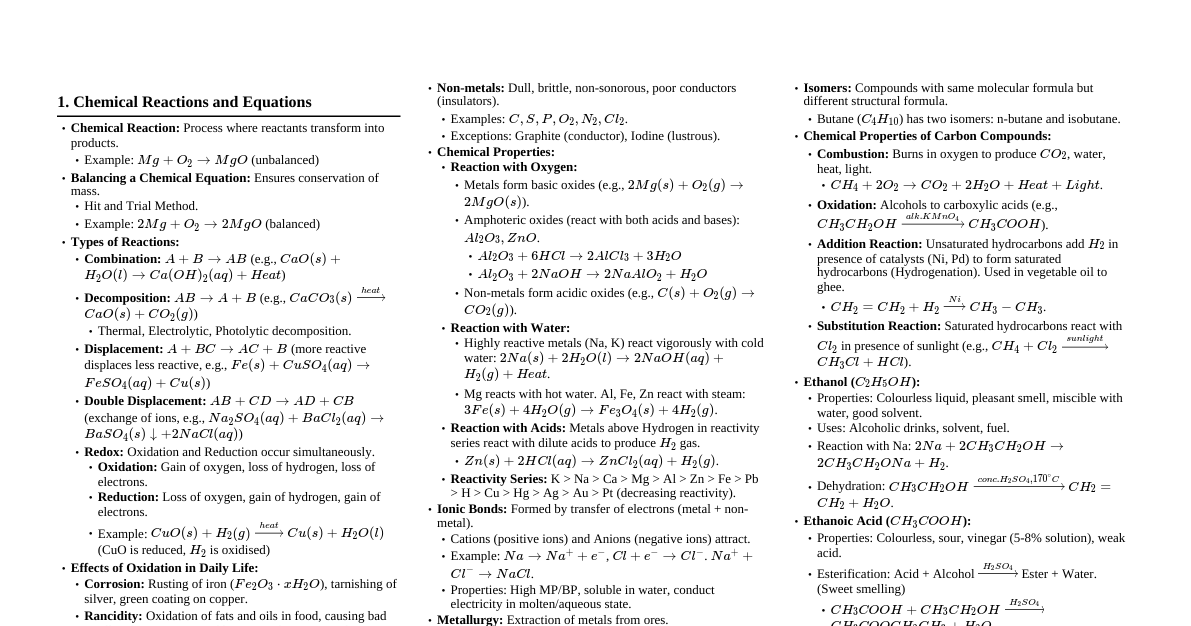
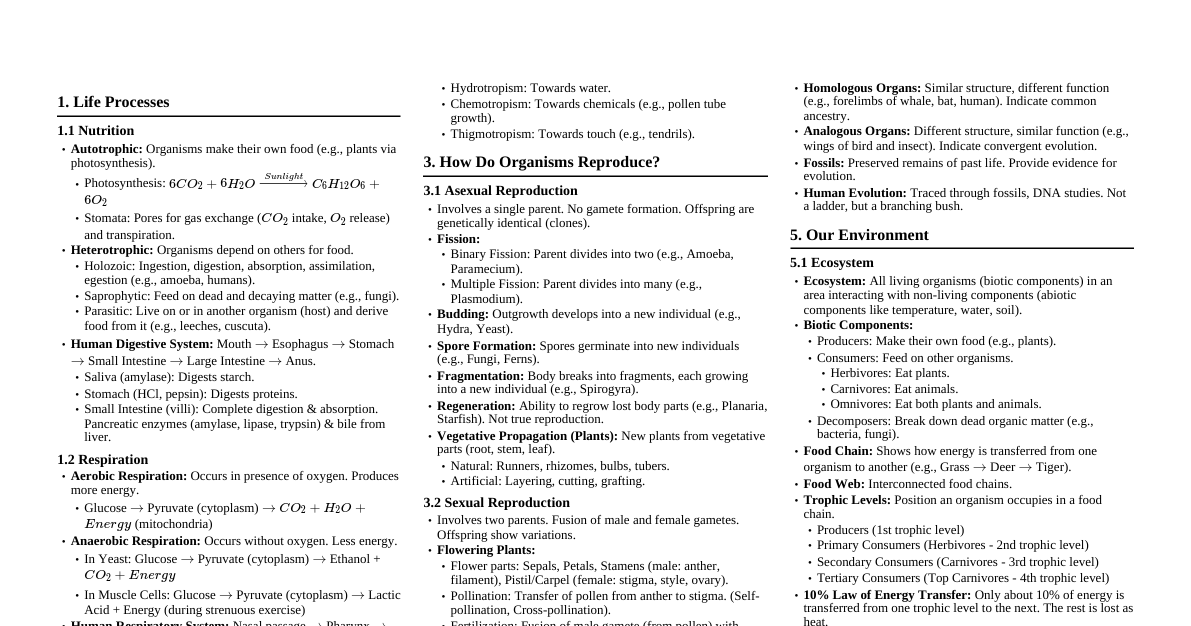
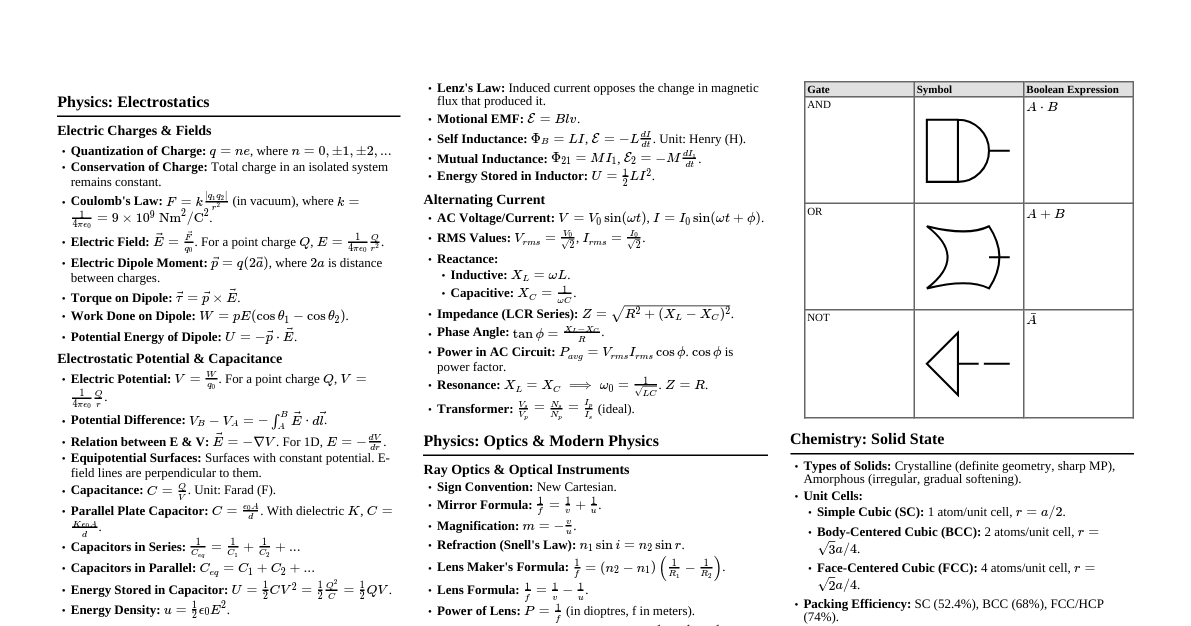
1. Chemical Reactions & Equations Chemical Reaction: Process where substances transform into new ones with different properties. Reactants: Substances that undergo chemical change. Products: Substances formed during a chemical reaction. Balancing Equations: Ensures conservation of mass. Number of atoms of each element must be equal on both sides. Types of Reactions: Combination Reaction: $A + B \rightarrow AB$ Decomposition Reaction: $AB \rightarrow A + B$ (e.g., thermal, electrolytic, photolytic) Displacement Reaction: $A + BC \rightarrow AC + B$ (more reactive displaces less reactive) Double Displacement Reaction: $AB + CD \rightarrow AD + CB$ (exchange of ions) Redox Reaction: Oxidation and Reduction occur simultaneously. Oxidation: Gain of oxygen, loss of hydrogen, loss of electrons. Reduction: Loss of oxygen, gain of hydrogen, gain of electrons. Exothermic Reaction: Releases heat (e.g., respiration). Endothermic Reaction: Absorbs heat (e.g., photosynthesis). Corrosion: Metals reacting with air/moisture (e.g., rusting of iron). Rancidity: Oxidation of fats/oils in food, causing bad smell/taste. 2. Acids, Bases & Salts Acids: Sour taste, turn blue litmus red, produce $H^+$ ions in water. pH $ Bases: Bitter taste, turn red litmus blue, produce $OH^-$ ions in water. pH $> 7$. Salts: Formed from reaction of acid and base (neutralization). Indicators: Substances showing different colors in acid/base (e.g., litmus, methyl orange, phenolphthalein). Olfactory Indicators: Change smell in acid/base (e.g., onion, vanilla). pH Scale: Measures $H^+$ ion concentration. $0-14$. Lower pH = more acidic. Higher pH = more basic. Important Compounds: Bleaching Powder ($CaOCl_2$): For bleaching, disinfectant. Baking Soda ($NaHCO_3$): Antacid, baking. Washing Soda ($Na_2CO_3 \cdot 10H_2O$): Cleaning, softening water. Plaster of Paris ($CaSO_4 \cdot \frac{1}{2}H_2O$): For casts, decorative purposes. 3. Metals & Non-metals Metals: Lustrous, malleable, ductile, good conductors of heat & electricity, sonorous. (e.g., Fe, Cu, Au) Non-metals: Dull, brittle, poor conductors (except graphite), non-sonorous. (e.g., C, O, S) Reactivity Series: Arranges metals in decreasing order of reactivity. More reactive displaces less reactive. Ionic Bonds: Formed by transfer of electrons (between metal and non-metal). Covalent Bonds: Formed by sharing of electrons (between non-metals). Extraction of Metals: High Reactivity: Electrolytic reduction (e.g., Na, K, Al). Medium Reactivity: Calcination (for carbonates), Roasting (for sulfides), then reduction (e.g., Zn, Fe, Pb). Low Reactivity: Heating alone (for sulfides), then reduction (e.g., Hg, Ag). Refining: Electrolytic refining is common for many metals. 4. Carbon & its Compounds Carbon: Non-metal, forms covalent bonds. Catenation: Self-linking property of carbon atoms to form long chains, branches, rings. Tetravalency: Carbon has 4 valence electrons, can form 4 bonds. Hydrocarbons: Compounds of carbon and hydrogen. Saturated: Alkanes (single bonds, e.g., $C_nH_{2n+2}$). Unsaturated: Alkenes (double bonds, e.g., $C_nH_{2n}$), Alkynes (triple bonds, e.g., $C_nH_{2n-2}$). Functional Groups: Atoms/groups that determine chemical properties. Alcohol (-OH), Aldehyde (-CHO), Ketone (C=O), Carboxylic acid (-COOH), Haloalkane (-X). Isomers: Compounds with same molecular formula but different structural formulas. Ethanol ($C_2H_5OH$): Alcohol, solvent, fuel. Ethanoic Acid ($CH_3COOH$): Carboxylic acid, vinegar. Soaps: Sodium or potassium salts of long-chain fatty acids. Form micelles. Detergents: Synthetic cleaning agents, work well with hard water. 5. Periodic Classification of Elements Dobereiner's Triads: Groups of 3 elements with similar properties, middle element's atomic mass was average of other two. Newlands' Law of Octaves: Properties repeat every 8th element when arranged by increasing atomic mass. Mendeleev's Periodic Table: Elements arranged by increasing atomic mass. Predicted properties of undiscovered elements. Modern Periodic Table (Moseley): Elements arranged by increasing atomic number. Periods: Horizontal rows (7 periods). Indicate number of shells. Groups: Vertical columns (18 groups). Indicate number of valence electrons (for main groups). Trends: Valency: Increases then decreases across a period. Constant down a group. Atomic Size: Decreases across a period, increases down a group. Metallic Character: Decreases across a period, increases down a group. Non-metallic Character: Increases across a period, decreases down a group. 6. Life Processes Nutrition: Process of obtaining food for energy, growth, repair. Autotrophic: Organisms make their own food (e.g., plants via photosynthesis). Heterotrophic: Organisms depend on others for food (e.g., animals). Photosynthesis: $6CO_2 + 6H_2O \xrightarrow{\text{Sunlight, Chlorophyll}} C_6H_{12}O_6 + 6O_2$ Respiration: Process of releasing energy from food. Aerobic: With oxygen ($C_6H_{12}O_6 \rightarrow CO_2 + H_2O + \text{Energy}$). Anaerobic: Without oxygen (e.g., in yeast: ethanol + $CO_2$; in muscle: lactic acid). Transportation: Plants: Xylem (water & minerals), Phloem (food). Humans: Heart, blood vessels (arteries, veins, capillaries), blood (RBC, WBC, platelets, plasma). Excretion: Removal of metabolic waste products. Humans: Kidneys (nephrons filter blood), ureters, bladder, urethra. Plants: Transpiration, shedding leaves, storing waste in vacuoles. 7. Control & Coordination Nervous System: Neurons: Structural and functional unit. Dendrite $\rightarrow$ Cell body $\rightarrow$ Axon $\rightarrow$ Nerve ending. Synapse: Gap between two neurons. Brain: Forebrain (cerebrum - thinking, memory), Midbrain, Hindbrain (cerebellum - posture, balance; medulla - involuntary actions). Spinal Cord: Reflex actions, connects brain to nerves. Reflex Arc: Sensory neuron $\rightarrow$ Spinal cord $\rightarrow$ Motor neuron. Endocrine System (Hormones): Pituitary: Growth hormone. Thyroid: Thyroxine (metabolism). Pancreas: Insulin (blood sugar regulation). Adrenal: Adrenaline (fight or flight). Testes: Testosterone (male secondary sexual characteristics). Ovaries: Estrogen, Progesterone (female secondary sexual characteristics, menstrual cycle). Coordination in Plants: Phytohormones: Auxins (growth), Gibberellins (stem growth), Cytokinins (cell division), Abscisic acid (growth inhibition), Ethylene (fruit ripening). Tropisms: Directional movements (e.g., phototropism, geotropism, hydrotropism, chemotropism). 8. How do Organisms Reproduce? Reproduction: Process by which organisms produce new individuals of their own kind. Asexual Reproduction: Single parent, no gamete fusion, genetically identical offspring. Fission: Binary (Amoeba), Multiple (Plasmodium). Fragmentation: Spirogyra. Regeneration: Planaria. Budding: Hydra, Yeast. Vegetative Propagation: Plants (roots, stems, leaves - e.g., layering, grafting). Spore Formation: Rhizopus. Sexual Reproduction: Two parents, gamete fusion, genetic variation. Flowering Plants: Flower (sepals, petals, stamens - male, pistil/carpel - female), Pollination, Fertilization, Seed/Fruit formation. Humans: Male: Testes (sperm, testosterone), vas deferens, urethra, penis. Female: Ovaries (egg, estrogen, progesterone), oviduct/fallopian tube, uterus, vagina. Fertilization: Fusion of sperm and egg, usually in fallopian tube. Menstrual Cycle: Monthly cycle of egg release and uterine lining preparation. Reproductive Health: STDs, contraception (condoms, pills, IUCDs, surgical methods). 9. Heredity & Evolution Heredity: Transmission of traits from parents to offspring. Variation: Differences among individuals of a species. Genes: Units of heredity, segments of DNA. Chromosomes: Thread-like structures in nucleus carrying genes. Mendel's Laws: Law of Dominance: One allele (dominant) expresses over another (recessive). Law of Segregation: Alleles separate during gamete formation. Law of Independent Assortment: Genes for different traits assort independently. Sex Determination: In humans, XX (female), XY (male). Father determines sex of child. Evolution: Gradual change in living organisms over generations. Acquired Traits: Developed during lifetime, not inherited (e.g., learning to read). Inherited Traits: Passed from parents to offspring. Natural Selection (Darwin): Favorable variations help survival and reproduction, leading to evolution. Speciation: Formation of new species due to reproductive isolation. Fossils: Preserved remains of ancient life, provide evidence for evolution. Homologous Organs: Similar structure, different function (e.g., bat wing, human arm). Indicate common ancestry. Analogous Organs: Different structure, similar function (e.g., bird wing, insect wing). Do not indicate common ancestry. 10. Light - Reflection & Refraction Light: Form of energy that enables us to see. Travels in straight lines. Reflection: Bouncing back of light. Laws: Angle of incidence = Angle of reflection. Incident ray, reflected ray, normal lie in same plane. Plane Mirror: Forms virtual, erect, same size image, laterally inverted, same distance behind mirror. Spherical Mirrors: Concave (converging), Convex (diverging). Mirror Formula: $\frac{1}{v} + \frac{1}{u} = \frac{1}{f}$ Magnification: $m = \frac{h'}{h} = -\frac{v}{u}$ Refraction: Bending of light as it passes from one medium to another. Laws: Incident ray, refracted ray, normal lie in same plane. Snell's Law: $\frac{\sin i}{\sin r} = \text{constant} = n$ (refractive index). Refractive Index ($n$): Ratio of speed of light in vacuum to speed of light in medium. $n = c/v$. Lenses: Convex (converging), Concave (diverging). Lens Formula: $\frac{1}{v} - \frac{1}{u} = \frac{1}{f}$ Magnification: $m = \frac{h'}{h} = \frac{v}{u}$ Power of Lens ($P$): $P = \frac{1}{f}$ (in dioptres, D). Sign Convention: New Cartesian Sign Convention. 11. Human Eye & Colourful World Human Eye: Cornea: Transparent front part, refracts light. Iris: Controls pupil size. Pupil: Regulates light entering. Lens: Focuses light on retina. Retina: Light-sensitive layer, contains rods (dim light) and cones (bright light, color). Optic Nerve: Transmits signals to brain. Power of Accommodation: Eye's ability to adjust focal length. Defects of Vision: Myopia (Nearsightedness): Distant objects unclear. Corrected by concave lens. Hypermetropia (Farsightedness): Near objects unclear. Corrected by convex lens. Presbyopia: Age-related, difficulty focusing near objects. Corrected by bifocal lenses. Dispersion of Light: Splitting of white light into constituent colors (VIBGYOR) by a prism. Atmospheric Refraction: Twinkling of stars, early sunrise, late sunset. Scattering of Light: Tyndall effect, blue sky, red sun at sunrise/sunset. 12. Electricity Electric Charge ($Q$): Property of matter, measured in Coulombs (C). $1 \text{ C} = 6 \times 10^{18}$ electrons. Electric Current ($I$): Rate of flow of charge. $I = Q/t$. Measured in Amperes (A). Electric Potential ($V$): Work done per unit charge. $V = W/Q$. Measured in Volts (V). Ohm's Law: $V = IR$. (At constant temp, $V \propto I$). Resistance ($R$): Opposition to current flow. Measured in Ohms ($\Omega$). $R = \rho \frac{L}{A}$ ($\rho$ = resistivity, $L$ = length, $A$ = area). Resistors in Series: $R_{eq} = R_1 + R_2 + R_3 + ...$ Resistors in Parallel: $\frac{1}{R_{eq}} = \frac{1}{R_1} + \frac{1}{R_2} + \frac{1}{R_3} + ...$ Heating Effect of Electric Current (Joule's Law): $H = I^2Rt = VIt = \frac{V^2}{R}t$. Electric Power ($P$): Rate at which energy is consumed. $P = VI = I^2R = \frac{V^2}{R}$. Measured in Watts (W). Commercial unit: kilowatt-hour (kWh). $1 \text{ kWh} = 3.6 \times 10^6 \text{ J}$. 13. Magnetic Effects of Electric Current Magnetic Field: Region around a magnet or current-carrying conductor where its magnetic influence can be felt. Magnetic Field Lines: Originate from N-pole, end at S-pole (outside magnet). Do not intersect. Closer lines = stronger field. Right-Hand Thumb Rule: For straight conductor, thumb points to current, fingers curl in direction of field lines. Magnetic Field due to Solenoid: Like a bar magnet. Field inside is uniform and strong. Force on Current-Carrying Conductor: $F = BIL\sin\theta$. Direction by Fleming's Left-Hand Rule. Electric Motor: Converts electrical energy to mechanical energy. Based on force on current-carrying conductor in magnetic field. Electromagnetic Induction: Production of induced current in a conductor by changing magnetic field. Fleming's Right-Hand Rule: For induced current. Thumb (motion), Forefinger (field), Middle finger (induced current). Electric Generator: Converts mechanical energy to electrical energy. Based on EMI. Domestic Electric Circuits: Live wire (red), Neutral wire (black), Earth wire (green). Short circuiting, overloading. 14. Sources of Energy Good Source of Energy: Easy to store, transport, economical, produces less pollution, high calorific value. Conventional Sources: Fossil Fuels: Coal, petroleum, natural gas. Non-renewable, cause pollution. Thermal Power Plants: Burn fossil fuels to produce electricity. Hydro Power Plants: Convert potential energy of falling water into electricity. Renewable, but environmental impact. Biomass: Organic matter (wood, animal dung). Renewable. Wind Energy: Renewable, requires large land area, variable. Non-conventional Sources: Solar Energy: Sun's energy. Solar cells, solar heaters. Renewable, clean. Ocean Energy: Tidal energy, wave energy, Ocean Thermal Energy Conversion (OTEC). Geothermal Energy: Heat from Earth's interior. Nuclear Energy: Fission of heavy nuclei (e.g., Uranium). High energy yield, but radioactive waste. 15. Our Environment Ecosystem: All living organisms (biotic) and non-living components (abiotic) in an area interacting. Components: Producers (autotrophs), Consumers (herbivores, carnivores, omnivores), Decomposers (bacteria, fungi). Food Chain: Flow of energy from producers to consumers. (e.g., Grass $\rightarrow$ Deer $\rightarrow$ Tiger). Food Web: Interconnected food chains. Trophic Levels: Different levels in a food chain. Energy decreases at each successive level (10% law). Environmental Problems: Ozone Layer Depletion: Ozone ($O_3$) protects from UV radiation. Depleted by CFCs. Waste Management: Biodegradable (decompose naturally) and non-biodegradable (do not decompose). Pollution: Air, water, soil. Methods of Waste Disposal: Landfills, composting, recycling, reuse. "Reduce, Reuse, Recycle": Three R's for sustainable waste management. 16. Management of Natural Resources Natural Resources: Resources obtained from nature. (e.g., forests, wildlife, water, coal, petroleum). Sustainable Management: Using resources wisely so they are available for future generations. Conservation: Protection and preservation of natural resources. Forests & Wildlife: Biodiversity hotspots. Importance: Timber, food, medicine, ecological balance. Conservation efforts: Reforestation, protected areas, community participation (e.g., Chipko Andolan). Water Resources: Rainwater harvesting, dams, irrigation. Issues: Water scarcity, pollution. Coal & Petroleum: Fossil fuels, non-renewable. Need for judicious use and alternative energy sources. Environmental impact: Air pollution, greenhouse gases.