JEE Physics
Cheatsheet Content
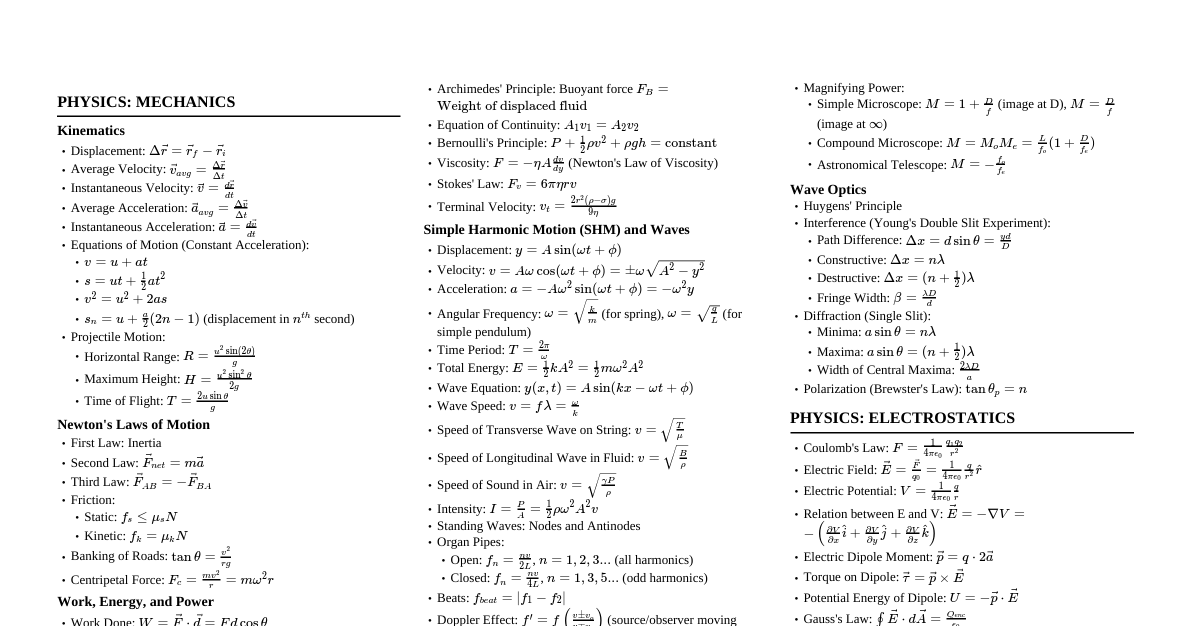
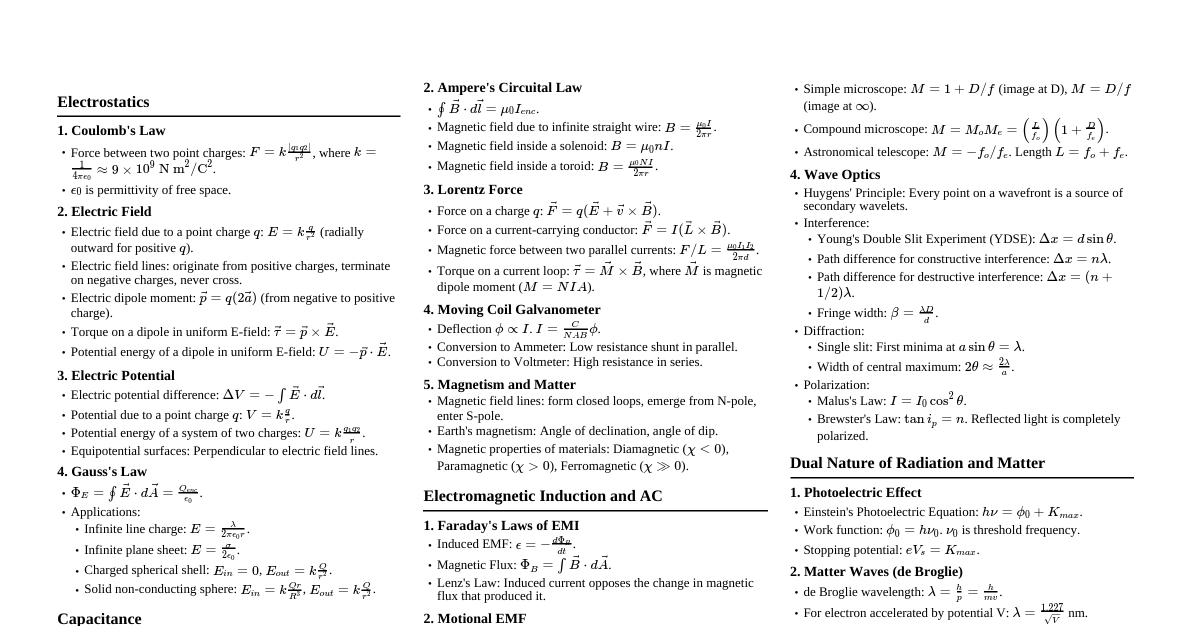
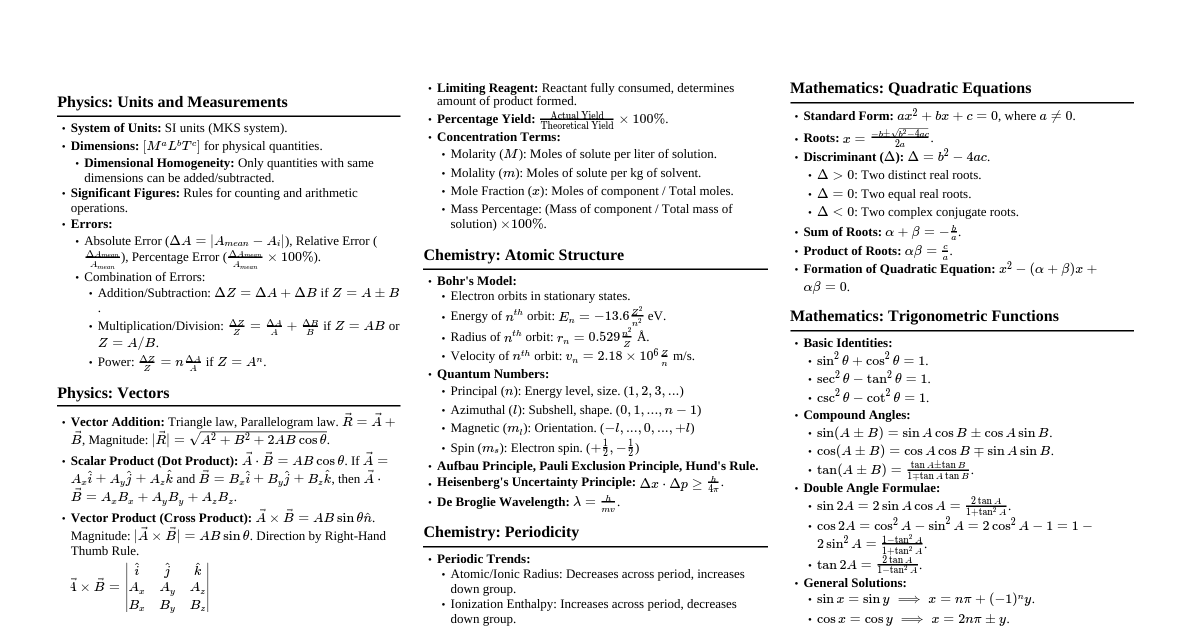
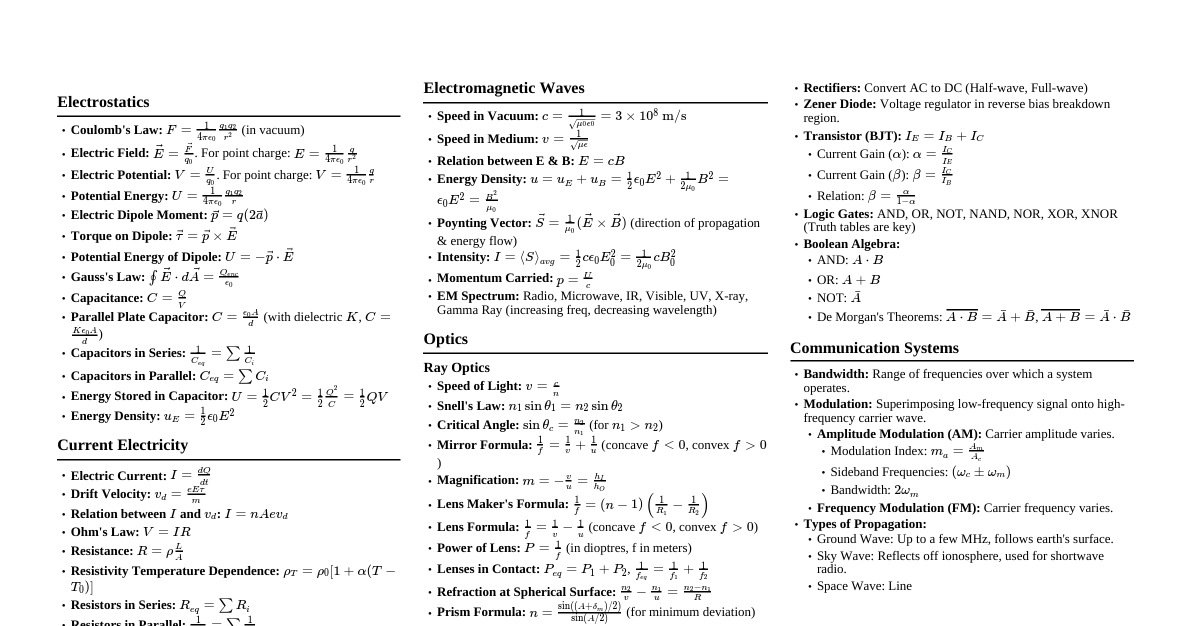
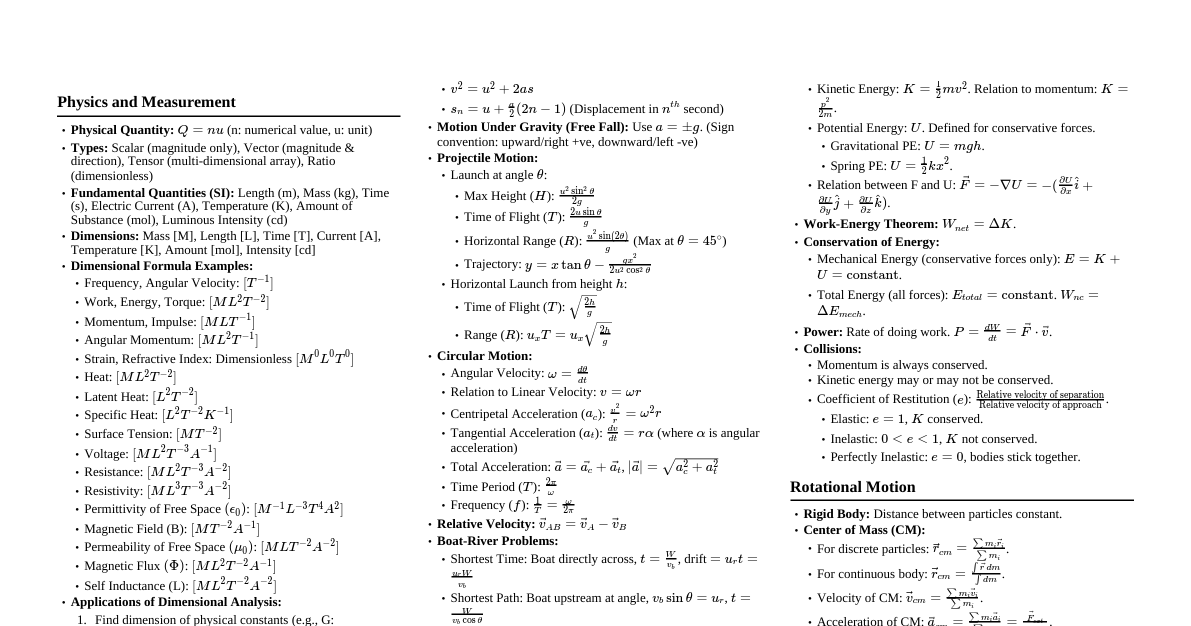
### Kinematics - **Displacement:** $\vec{s} = \vec{r}_f - \vec{r}_i$ - **Average Velocity:** $\vec{v}_{avg} = \frac{\Delta\vec{r}}{\Delta t}$ - **Instantaneous Velocity:** $\vec{v} = \frac{d\vec{r}}{dt}$ - **Average Acceleration:** $\vec{a}_{avg} = \frac{\Delta\vec{v}}{\Delta t}$ - **Instantaneous Acceleration:** $\vec{a} = \frac{d\vec{v}}{dt}$ #### Equations of Motion (Constant Acceleration) - $v = u + at$ - $s = ut + \frac{1}{2}at^2$ - $v^2 = u^2 + 2as$ - $s_n = u + \frac{a}{2}(2n-1)$ (Displacement in $n^{th}$ second) #### Projectile Motion - **Max Height:** $H = \frac{u^2\sin^2\theta}{2g}$ - **Time of Flight:** $T = \frac{2u\sin\theta}{g}$ - **Range:** $R = \frac{u^2\sin(2\theta)}{g}$ ### Newton's Laws of Motion - **First Law:** Inertia (object at rest stays at rest, object in motion stays in motion with constant velocity unless acted upon by a net external force). - **Second Law:** $\vec{F}_{net} = m\vec{a}$ (Impulse $J = \Delta p = F_{avg}\Delta t$) - **Third Law:** To every action, there is an equal and opposite reaction. #### Friction - **Static Friction:** $f_s \le \mu_s N$ - **Kinetic Friction:** $f_k = \mu_k N$ ### Work, Power, Energy - **Work Done:** $W = \vec{F} \cdot \vec{d} = Fd\cos\theta$ - **Kinetic Energy:** $K = \frac{1}{2}mv^2$ - **Potential Energy (Gravitational):** $U_g = mgh$ - **Potential Energy (Spring):** $U_s = \frac{1}{2}kx^2$ - **Work-Energy Theorem:** $W_{net} = \Delta K$ - **Power:** $P = \frac{dW}{dt} = \vec{F} \cdot \vec{v}$ - **Conservation of Mechanical Energy:** $K_i + U_i = K_f + U_f$ (for conservative forces) ### Rotational Motion - **Angular Displacement:** $\Delta\theta$ - **Angular Velocity:** $\omega = \frac{d\theta}{dt}$ - **Angular Acceleration:** $\alpha = \frac{d\omega}{dt}$ - **Relations:** $v = r\omega$, $a_t = r\alpha$, $a_c = r\omega^2 = \frac{v^2}{r}$ - **Torque:** $\vec{\tau} = \vec{r} \times \vec{F}$ - **Moment of Inertia:** $I = \sum m_i r_i^2$ (for discrete), $I = \int r^2 dm$ (for continuous) - **Parallel Axis Theorem:** $I = I_{cm} + Md^2$ - **Perpendicular Axis Theorem:** $I_z = I_x + I_y$ (for planar objects) - **Rotational Kinetic Energy:** $K_R = \frac{1}{2}I\omega^2$ - **Angular Momentum:** $\vec{L} = \vec{r} \times \vec{p} = I\vec{\omega}$ - **Newton's Second Law for Rotation:** $\vec{\tau}_{net} = I\vec{\alpha}$ - **Conservation of Angular Momentum:** If $\vec{\tau}_{net} = 0$, then $\vec{L} = \text{constant}$. ### Gravitation - **Newton's Law of Gravitation:** $F = \frac{Gm_1m_2}{r^2}$ - **Gravitational Field:** $E_g = \frac{GM}{r^2}$ - **Gravitational Potential Energy:** $U = -\frac{Gm_1m_2}{r}$ - **Gravitational Potential:** $V = -\frac{GM}{r}$ - **Escape Velocity:** $v_e = \sqrt{\frac{2GM}{R}}$ - **Orbital Velocity:** $v_o = \sqrt{\frac{GM}{r}}$ - **Kepler's Laws:** 1. Orbits are ellipses with Sun at one focus. 2. Equal areas in equal times ($\frac{dA}{dt} = \frac{L}{2m} =$ constant). 3. $T^2 \propto R^3$ (for circular orbits, $T^2 = \frac{4\pi^2}{GM}R^3$). ### Simple Harmonic Motion (SHM) & Waves #### SHM - **Displacement:** $x(t) = A\sin(\omega t + \phi)$ - **Velocity:** $v(t) = A\omega\cos(\omega t + \phi)$ - **Acceleration:** $a(t) = -A\omega^2\sin(\omega t + \phi) = -\omega^2 x(t)$ - **Angular Frequency:** $\omega = \sqrt{\frac{k}{m}}$ (spring-mass), $\omega = \sqrt{\frac{g}{L}}$ (simple pendulum) - **Period:** $T = \frac{2\pi}{\omega}$ - **Total Energy:** $E = \frac{1}{2}kA^2 = \frac{1}{2}m\omega^2 A^2$ #### Waves - **Wave Speed:** $v = f\lambda$ - **Transverse Wave Speed (string):** $v = \sqrt{\frac{T}{\mu}}$ - **Sound Wave Speed:** $v = \sqrt{\frac{B}{\rho}}$ (liquids/solids), $v = \sqrt{\frac{\gamma P}{\rho}}$ (gases) - **Intensity:** $I = \frac{P}{A} \propto A^2$ - **Doppler Effect:** $f' = f \left( \frac{v \pm v_o}{v \mp v_s} \right)$ (+$v_o$ for observer towards, -$v_s$ for source towards) - **Standing Waves (string fixed at both ends):** $L = \frac{n\lambda}{2}$, $f_n = \frac{nv}{2L}$ - **Standing Waves (pipe open at both ends):** $L = \frac{n\lambda}{2}$, $f_n = \frac{nv}{2L}$ - **Standing Waves (pipe closed at one end):** $L = \frac{(2n-1)\lambda}{4}$, $f_n = \frac{(2n-1)v}{4L}$ ### Fluid Mechanics - **Pressure:** $P = \frac{F}{A}$ - **Pressure in Fluid:** $P = P_0 + \rho gh$ - **Archimedes' Principle:** Buoyant Force $F_B = \rho_{fluid} V_{submerged} g$ - **Equation of Continuity:** $A_1v_1 = A_2v_2$ - **Bernoulli's Equation:** $P + \frac{1}{2}\rho v^2 + \rho gh = \text{constant}$ - **Viscosity (Poiseuille's Law):** $Q = \frac{\pi r^4 \Delta P}{8\eta L}$ - **Surface Tension:** $T = \frac{F}{L}$ (force per unit length), $W = T \Delta A$ (work done) - **Capillary Rise:** $h = \frac{2T\cos\theta}{\rho gr}$ ### Thermal Physics #### Heat Transfer - **Conduction:** $\frac{dQ}{dt} = -kA\frac{dT}{dx}$ - **Convection:** $\frac{dQ}{dt} = hA(T_s - T_f)$ - **Radiation (Stefan-Boltzmann Law):** $P = \epsilon \sigma A T^4$ - **Newton's Law of Cooling:** $\frac{dT}{dt} = -k(T - T_s)$ #### Thermodynamics - **First Law of Thermodynamics:** $\Delta U = Q - W$ - **Work Done by Gas:** $W = \int P dV$ - **Specific Heat:** $Q = mc\Delta T$, $C_P - C_V = R$ (for ideal gas) - **Adiabatic Process:** $PV^\gamma = \text{constant}$, $T V^{\gamma-1} = \text{constant}$, $T^\gamma P^{1-\gamma} = \text{constant}$ - **Isothermal Process:** $PV = \text{constant}$ - **Isobaric Process:** $P = \text{constant}$ - **Isochoric Process:** $V = \text{constant}$ - **Carnot Engine Efficiency:** $\eta = 1 - \frac{T_C}{T_H}$ - **Coefficient of Performance (Refrigerator):** $COP = \frac{Q_C}{W} = \frac{T_C}{T_H - T_C}$ ### Electrostatics - **Coulomb's Law:** $F = \frac{1}{4\pi\epsilon_0} \frac{q_1q_2}{r^2}$ - **Electric Field:** $\vec{E} = \frac{\vec{F}}{q_0} = \frac{1}{4\pi\epsilon_0} \frac{q}{r^2}\hat{r}$ - **Electric Potential:** $V = \frac{1}{4\pi\epsilon_0} \frac{q}{r}$, $\vec{E} = -\nabla V$ - **Potential Energy:** $U = \frac{1}{4\pi\epsilon_0} \frac{q_1q_2}{r}$ - **Gauss's Law:** $\oint \vec{E} \cdot d\vec{A} = \frac{q_{enc}}{\epsilon_0}$ - **Electric Dipole Moment:** $\vec{p} = q\vec{d}$ - **Torque on Dipole:** $\vec{\tau} = \vec{p} \times \vec{E}$ - **Potential Energy of Dipole:** $U = -\vec{p} \cdot \vec{E}$ ### Capacitance - **Capacitance:** $C = \frac{Q}{V}$ - **Parallel Plate Capacitor:** $C = \frac{\epsilon_0 A}{d}$ (with dielectric $C = \frac{K\epsilon_0 A}{d}$) - **Energy Stored:** $U = \frac{1}{2}CV^2 = \frac{1}{2}\frac{Q^2}{C} = \frac{1}{2}QV$ - **Energy Density:** $u_E = \frac{1}{2}\epsilon_0 E^2$ - **Series Combination:** $\frac{1}{C_{eq}} = \frac{1}{C_1} + \frac{1}{C_2} + ...$ - **Parallel Combination:** $C_{eq} = C_1 + C_2 + ...$ ### Current Electricity - **Current:** $I = \frac{dQ}{dt} = nev_dA$ - **Ohm's Law:** $V = IR$ - **Resistance:** $R = \rho\frac{L}{A}$ - **Resistivity Temperature Dependence:** $\rho = \rho_0(1 + \alpha(T-T_0))$ - **Power Dissipated:** $P = VI = I^2R = \frac{V^2}{R}$ - **Series Combination (Resistors):** $R_{eq} = R_1 + R_2 + ...$ - **Parallel Combination (Resistors):** $\frac{1}{R_{eq}} = \frac{1}{R_1} + \frac{1}{R_2} + ...$ - **Kirchhoff's Laws:** 1. **Junction Rule:** $\sum I_{in} = \sum I_{out}$ 2. **Loop Rule:** $\sum \Delta V = 0$ - **RC Circuit (Charging):** $Q(t) = Q_0(1 - e^{-t/\tau})$, $I(t) = I_0 e^{-t/\tau}$ where $\tau = RC$ - **RC Circuit (Discharging):** $Q(t) = Q_0 e^{-t/\tau}$, $I(t) = I_0 e^{-t/\tau}$ ### Magnetism - **Lorentz Force:** $\vec{F} = q(\vec{E} + \vec{v} \times \vec{B})$ - **Magnetic Force on Current Carrying Wire:** $\vec{F} = I(\vec{L} \times \vec{B})$ - **Biot-Savart Law:** $d\vec{B} = \frac{\mu_0}{4\pi} \frac{I d\vec{l} \times \hat{r}}{r^2}$ - **Magnetic Field (Long Straight Wire):** $B = \frac{\mu_0 I}{2\pi r}$ - **Magnetic Field (Circular Loop Center):** $B = \frac{\mu_0 I}{2R}$ - **Magnetic Field (Solenoid):** $B = \mu_0 nI$ - **Ampere's Law:** $\oint \vec{B} \cdot d\vec{l} = \mu_0 I_{enc}$ - **Torque on Current Loop:** $\vec{\tau} = \vec{M} \times \vec{B}$ where $\vec{M} = NI\vec{A}$ - **Magnetic Potential Energy:** $U = -\vec{M} \cdot \vec{B}$ ### Electromagnetic Induction (EMI) & Alternating Current (AC) #### EMI - **Magnetic Flux:** $\Phi_B = \int \vec{B} \cdot d\vec{A}$ - **Faraday's Law:** $\mathcal{E} = -\frac{d\Phi_B}{dt}$ - **Motional EMF:** $\mathcal{E} = (vBL)$ - **Self-Inductance:** $\Phi_B = LI$, $\mathcal{E} = -L\frac{dI}{dt}$ - **Mutual Inductance:** $\Phi_{21} = M_{21}I_1$, $\mathcal{E}_2 = -M_{21}\frac{dI_1}{dt}$ - **Energy Stored in Inductor:** $U_B = \frac{1}{2}LI^2$ - **Energy Density:** $u_B = \frac{B^2}{2\mu_0}$ #### AC Circuits - **Peak Voltage/Current:** $V = V_0\sin(\omega t)$, $I = I_0\sin(\omega t - \phi)$ - **RMS Values:** $V_{rms} = \frac{V_0}{\sqrt{2}}$, $I_{rms} = \frac{I_0}{\sqrt{2}}$ - **Reactance (Inductive):** $X_L = \omega L$ - **Reactance (Capacitive):** $X_C = \frac{1}{\omega C}$ - **Impedance (RLC Series):** $Z = \sqrt{R^2 + (X_L - X_C)^2}$ - **Phase Angle:** $\tan\phi = \frac{X_L - X_C}{R}$ - **Resonance Frequency:** $\omega_0 = \frac{1}{\sqrt{LC}}$ - **Power Factor:** $\cos\phi = \frac{R}{Z}$ - **Average Power:** $P_{avg} = V_{rms}I_{rms}\cos\phi$ - **Transformer:** $\frac{V_S}{V_P} = \frac{N_S}{N_P} = \frac{I_P}{I_S}$ ### Electromagnetic Waves - **Speed of EM Wave:** $c = \frac{1}{\sqrt{\mu_0\epsilon_0}}$ (in vacuum), $v = \frac{1}{\sqrt{\mu\epsilon}}$ (in medium) - **Relation between E and B:** $E = cB$ - **Poynting Vector:** $\vec{S} = \frac{1}{\mu_0}(\vec{E} \times \vec{B})$ (direction of propagation, intensity) - **Intensity:** $I = \frac{1}{2}c\epsilon_0 E_0^2 = \frac{1}{2}\frac{E_0 B_0}{\mu_0}$ - **Maxwell's Equations (integral form):** 1. $\oint \vec{E} \cdot d\vec{A} = \frac{q_{enc}}{\epsilon_0}$ (Gauss's Law for electric fields) 2. $\oint \vec{B} \cdot d\vec{A} = 0$ (Gauss's Law for magnetic fields) 3. $\oint \vec{E} \cdot d\vec{l} = -\frac{d\Phi_B}{dt}$ (Faraday's Law) 4. $\oint \vec{B} \cdot d\vec{l} = \mu_0 I_{enc} + \mu_0\epsilon_0\frac{d\Phi_E}{dt}$ (Ampere-Maxwell Law) ### Ray Optics - **Reflection:** Angle of incidence = Angle of reflection ($\angle i = \angle r$) - **Mirror Formula:** $\frac{1}{f} = \frac{1}{v} + \frac{1}{u}$ - **Magnification:** $m = -\frac{v}{u} = \frac{h_i}{h_o}$ - **Refraction (Snell's Law):** $n_1\sin\theta_1 = n_2\sin\theta_2$ - **Critical Angle:** $\sin\theta_c = \frac{n_2}{n_1}$ (for $n_1 > n_2$) - **Lens Formula:** $\frac{1}{f} = \frac{1}{v} - \frac{1}{u}$ - **Lens Maker's Formula:** $\frac{1}{f} = (n-1)\left(\frac{1}{R_1} - \frac{1}{R_2}\right)$ - **Power of Lens:** $P = \frac{1}{f}$ (in diopters if $f$ in meters) - **Combination of Lenses:** $\frac{1}{f_{eq}} = \frac{1}{f_1} + \frac{1}{f_2} - \frac{d}{f_1f_2}$ (for lenses separated by $d$) - **Prism:** $\delta = (n-1)A$ (for small angle prism) ### Wave Optics - **Young's Double Slit Experiment (YDSE):** - **Path Difference:** $\Delta x = d\sin\theta$ - **Bright Fringes (Constructive):** $\Delta x = n\lambda$, $y_n = \frac{n\lambda D}{d}$ - **Dark Fringes (Destructive):** $\Delta x = (n+\frac{1}{2})\lambda$, $y_n = \frac{(n+\frac{1}{2})\lambda D}{d}$ - **Fringe Width:** $\beta = \frac{\lambda D}{d}$ - **Diffraction (Single Slit):** - **Minima:** $a\sin\theta = n\lambda$ - **Central Max Width:** $2\theta = \frac{2\lambda}{a}$ - **Polarization (Brewster's Law):** $\tan\theta_p = n$ - **Malus's Law:** $I = I_0\cos^2\theta$ ### Modern Physics #### Dual Nature of Radiation and Matter - **Photon Energy:** $E = hf = \frac{hc}{\lambda}$ - **Momentum of Photon:** $p = \frac{E}{c} = \frac{h}{\lambda}$ - **Photoelectric Effect:** $K_{max} = hf - \phi_0$ (where $\phi_0$ is work function) - **De Broglie Wavelength:** $\lambda = \frac{h}{p} = \frac{h}{mv}$ - **Electron Wavelength (accelerated by V volts):** $\lambda = \frac{12.27}{\sqrt{V}} \text{ Å}$ #### Atomic & Nuclear Physics - **Bohr Model (Hydrogen-like atoms):** - **Radius:** $r_n = \frac{n^2 a_0}{Z}$ ($a_0 = 0.529 \text{ Å}$) - **Energy:** $E_n = -\frac{13.6 Z^2}{n^2} \text{ eV}$ - **Velocity:** $v_n = \frac{Z}{n} v_0$ ($v_0 = 2.18 \times 10^6 \text{ m/s}$) - **Rydberg Formula:** $\frac{1}{\lambda} = RZ^2\left(\frac{1}{n_1^2} - \frac{1}{n_2^2}\right)$ - **Mass Defect:** $\Delta m = (Zm_p + Nm_n) - M_{nucleus}$ - **Binding Energy:** $BE = \Delta m c^2$ - **Radioactive Decay Law:** $N(t) = N_0 e^{-\lambda t}$ - **Half-Life:** $T_{1/2} = \frac{\ln 2}{\lambda} = \frac{0.693}{\lambda}$ - **Mean Life:** $\tau = \frac{1}{\lambda}$ - **Activity:** $A = -\frac{dN}{dt} = \lambda N$ #### Semiconductors - **Diode Equation:** $I = I_0(e^{eV/k_BT} - 1)$ - **Transistor (Common Emitter):** $I_C = \beta I_B$, $I_E = I_B + I_C$, $V_{CE} = V_{CC} - I_C R_C$ - **Logic Gates:** AND, OR, NOT, NAND, NOR, XOR, XNOR (Truth tables and symbols)