JEE Main Physics Formulas
Cheatsheet Content
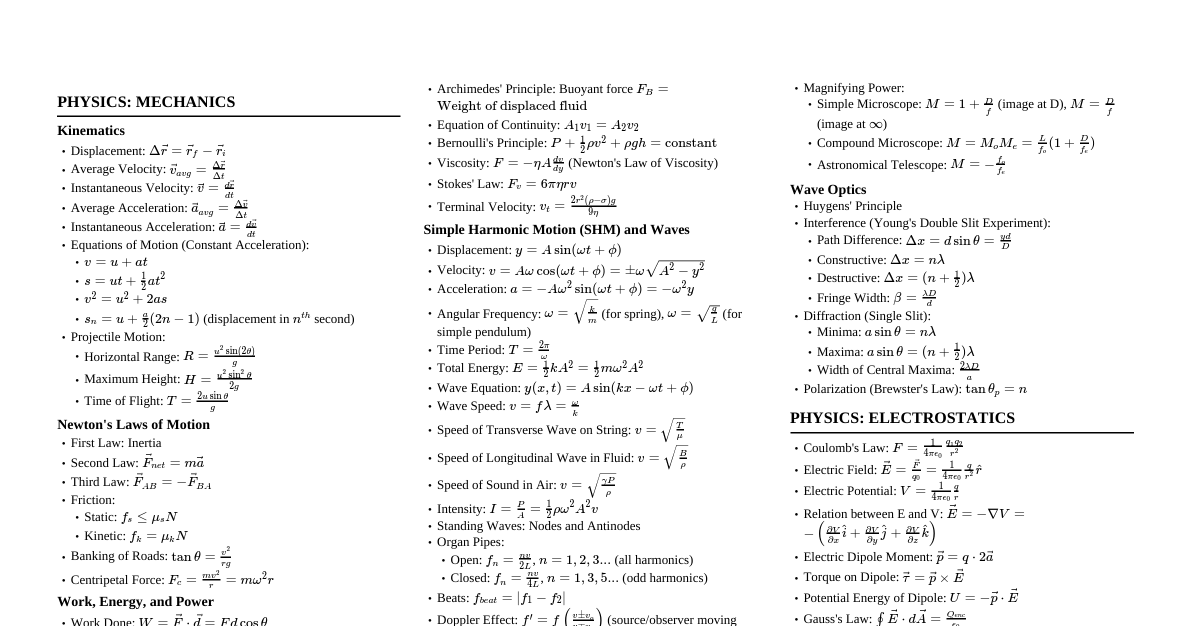
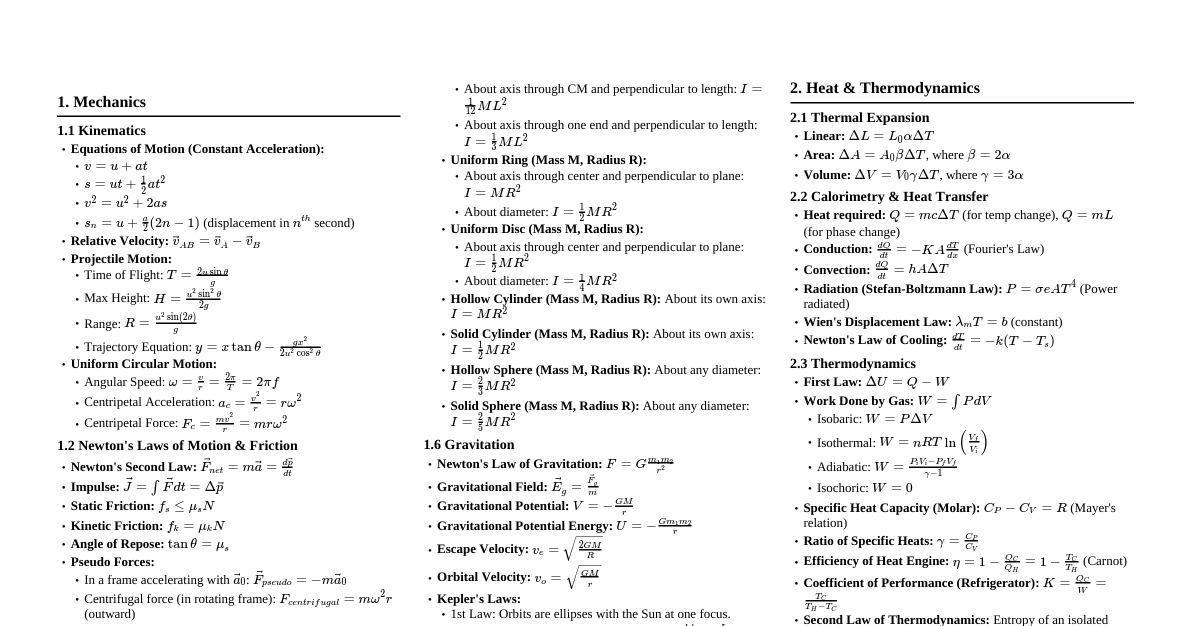
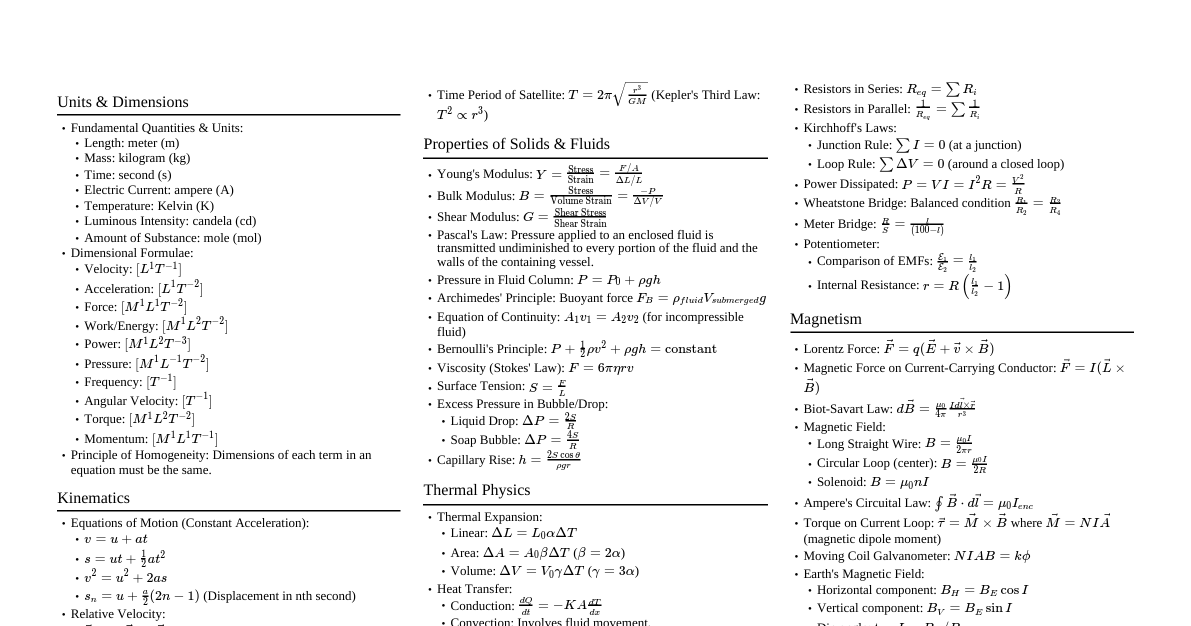
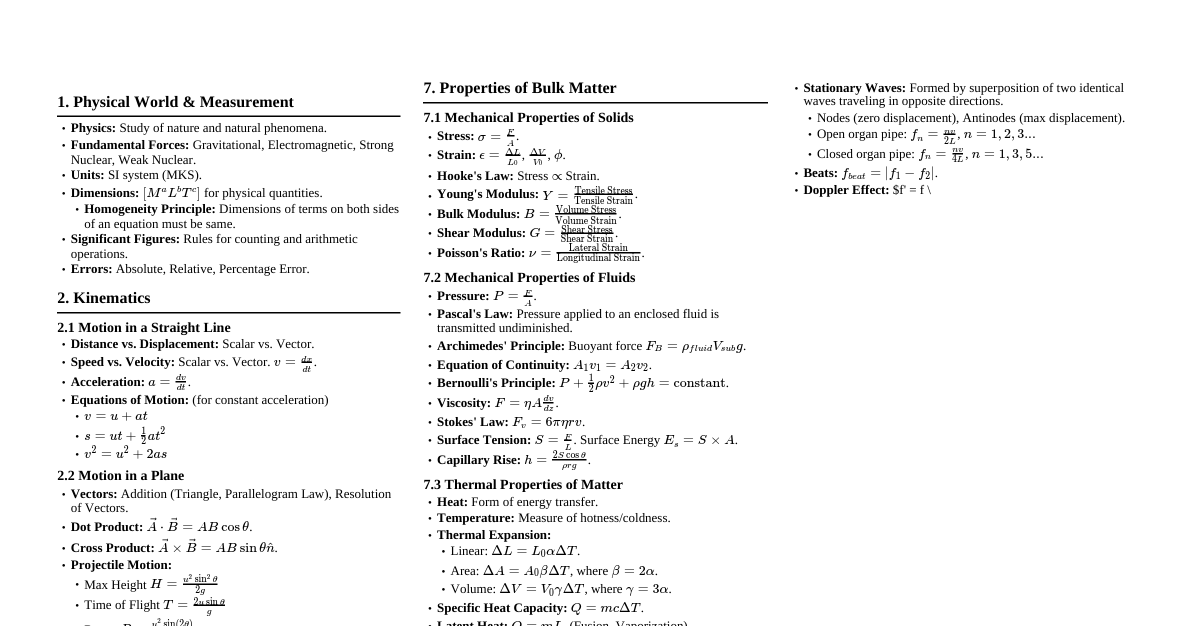
Physics and Measurement Physical Quantity: $Q = nu$ (n: numerical value, u: unit) Types: Scalar (magnitude only), Vector (magnitude & direction), Tensor (multi-dimensional array), Ratio (dimensionless) Fundamental Quantities (SI): Length (m), Mass (kg), Time (s), Electric Current (A), Temperature (K), Amount of Substance (mol), Luminous Intensity (cd) Dimensions: Mass [M], Length [L], Time [T], Current [A], Temperature [K], Amount [mol], Intensity [cd] Dimensional Formula Examples: Frequency, Angular Velocity: $[T^{-1}]$ Work, Energy, Torque: $[ML^2T^{-2}]$ Momentum, Impulse: $[MLT^{-1}]$ Angular Momentum: $[ML^2T^{-1}]$ Strain, Refractive Index: Dimensionless $[M^0L^0T^0]$ Heat: $[ML^2T^{-2}]$ Latent Heat: $[L^2T^{-2}]$ Specific Heat: $[L^2T^{-2}K^{-1}]$ Surface Tension: $[MT^{-2}]$ Voltage: $[ML^2T^{-3}A^{-1}]$ Resistance: $[ML^2T^{-3}A^{-2}]$ Resistivity: $[ML^3T^{-3}A^{-2}]$ Permittivity of Free Space $(\epsilon_0)$: $[M^{-1}L^{-3}T^4A^2]$ Magnetic Field (B): $[MT^{-2}A^{-1}]$ Permeability of Free Space $(\mu_0)$: $[MLT^{-2}A^{-2}]$ Magnetic Flux $(\Phi)$: $[ML^2T^{-2}A^{-1}]$ Self Inductance (L): $[ML^2T^{-2}A^{-2}]$ Applications of Dimensional Analysis: Find dimension of physical constants (e.g., G: $[M^{-1}L^3T^{-2}]$, h: $[ML^2T^{-1}]$) Convert units: $n_1u_1 = n_2u_2$ Check dimensional correctness (Principle of Homogeneity) Derive relations (e.g., $T \propto l^a m^b g^c$) Significant Figures: Non-zero digits are significant. Zeros between non-zero digits are significant. Leading zeros are not significant. Trailing zeros (with decimal) are significant. Exponential digits are not significant (e.g., $1.32 \times 10^{-2}$ has 3 sig figs). Rounding Off Rules: Digit to drop < 5: preceding digit unchanged. Digit to drop > 5: preceding digit raised by one. Digit to drop = 5 (followed by non-zero): preceding digit raised by one. Digit to drop = 5 (or 5 followed by zeros): preceding digit unchanged if even, raised by one if odd. Errors of Measurement: Absolute Error: $\Delta a_i = a_{mean} - a_i$ Mean Absolute Error: $\Delta a_{mean} = \frac{\sum |\Delta a_i|}{N}$ Relative Error: $\frac{\Delta a_{mean}}{a_{mean}}$ Percentage Error: $\frac{\Delta a_{mean}}{a_{mean}} \times 100\%$ Error in Sum/Difference ($x = a \pm b$): $\Delta x = \Delta a + \Delta b$ Error in Product/Division ($x = a \times b$ or $x = a/b$): $\frac{\Delta x}{x} = \frac{\Delta a}{a} + \frac{\Delta b}{b}$ Error in Power ($x = a^n b^m / c^p$): $\frac{\Delta x}{x} = n\frac{\Delta a}{a} + m\frac{\Delta b}{b} + p\frac{\Delta c}{c}$ Kinematics Rest and Motion: Relative concepts. Types of Motion: 1D (straight line), 2D (plane), 3D (space). Mathematical Tools: Differentiation: Slope of y-x graph, $\frac{dy}{dx}$ Integration: Area under y-x graph, $\int y \, dx$ Scalars and Vectors: Scalar: Magnitude only (Distance, Speed, Work). Vector: Magnitude and Direction (Displacement, Velocity, Force). Unit Vector: $\hat{A} = \frac{\vec{A}}{|\vec{A}|}$ (e.g., $\hat{i}, \hat{j}, \hat{k}$) Vector Addition (Triangle/Parallelogram Law): $|\vec{R}| = \sqrt{A^2+B^2+2AB\cos\theta}$ Dot Product: $\vec{A} \cdot \vec{B} = AB\cos\theta$ Cross Product: $|\vec{A} \times \vec{B}| = AB\sin\theta$ Distance and Displacement: Distance: Path length (scalar, always positive). Displacement: Shortest path (vector, can be $\pm$ or $0$). $|\text{Displacement}| \le \text{Distance}$. Speed and Velocity: Speed: $\frac{\text{Distance}}{\text{Time}}$ (scalar). Average Speed: $\frac{\text{Total Distance}}{\text{Total Time}}$. Instantaneous Speed: $\frac{ds}{dt}$. Velocity: $\frac{\text{Displacement}}{\text{Time}}$ (vector). Average Velocity: $\frac{\text{Total Displacement}}{\text{Total Time}}$. Instantaneous Velocity: $\frac{d\vec{r}}{dt}$. Acceleration: $\vec{a} = \frac{d\vec{v}}{dt}$ (vector). Uniform acceleration: constant change in velocity. Kinematics Equations (Constant Acceleration): $v = u + at$ $s = ut + \frac{1}{2}at^2$ $v^2 = u^2 + 2as$ $s_n = u + \frac{a}{2}(2n-1)$ (Displacement in $n^{th}$ second) Motion Under Gravity (Free Fall): Use $a = \pm g$. (Sign convention: upward/right +ve, downward/left -ve) Projectile Motion: Launch at angle $\theta$: Max Height ($H$): $\frac{u^2\sin^2\theta}{2g}$ Time of Flight ($T$): $\frac{2u\sin\theta}{g}$ Horizontal Range ($R$): $\frac{u^2\sin(2\theta)}{g}$ (Max at $\theta = 45^\circ$) Trajectory: $y = x\tan\theta - \frac{gx^2}{2u^2\cos^2\theta}$ Horizontal Launch from height $h$: Time of Flight ($T$): $\sqrt{\frac{2h}{g}}$ Range ($R$): $u_x T = u_x \sqrt{\frac{2h}{g}}$ Circular Motion: Angular Velocity: $\omega = \frac{d\theta}{dt}$ Relation to Linear Velocity: $v = \omega r$ Centripetal Acceleration ($a_c$): $\frac{v^2}{r} = \omega^2 r$ Tangential Acceleration ($a_t$): $\frac{dv}{dt} = r\alpha$ (where $\alpha$ is angular acceleration) Total Acceleration: $\vec{a} = \vec{a_c} + \vec{a_t}$, $|\vec{a}| = \sqrt{a_c^2 + a_t^2}$ Time Period ($T$): $\frac{2\pi}{\omega}$ Frequency ($f$): $\frac{1}{T} = \frac{\omega}{2\pi}$ Relative Velocity: $\vec{v}_{AB} = \vec{v}_A - \vec{v}_B$ Boat-River Problems: Shortest Time: Boat directly across, $t = \frac{W}{v_b}$, drift $= u_r t = \frac{u_r W}{v_b}$ Shortest Path: Boat upstream at angle, $v_b \sin\theta = u_r$, $t = \frac{W}{v_b\cos\theta}$ Rain-Man Problems: $\vec{v}_{rm} = \vec{v}_r - \vec{v}_m$ Laws of Motion Inertia: Property to resist change in state of motion. Types: Rest, Motion, Direction. Common Forces: Gravitational Force (Weight): $W = mg$ Normal Reaction: Perpendicular to surface. Tension: Pulling force along a string. Spring Force: $F_{sp} = -k\Delta x$. Series: $\frac{1}{k_{eq}} = \frac{1}{k_1} + \frac{1}{k_2}$. Parallel: $k_{eq} = k_1 + k_2$. Newton's Laws: 1st Law (Inertia): $\sum \vec{F} = 0 \implies \vec{a} = 0$. Valid in inertial frames. 2nd Law: $\vec{F}_{net} = \frac{d\vec{p}}{dt}$. If $m$ constant, $\vec{F}_{net} = m\vec{a}$. 3rd Law: Action-Reaction pairs are equal & opposite on different bodies. Linear Momentum: $\vec{p} = m\vec{v}$. Conservation if $\vec{F}_{ext} = 0$. Impulse: $\vec{J} = \int \vec{F} \, dt = \Delta \vec{p}$. Friction: Force opposing relative motion. Static Friction: $f_s \le \mu_s N$. Limiting Friction: $f_{s,max} = \mu_s N$. Kinetic Friction: $f_k = \mu_k N$. Usually $\mu_k \le \mu_s$. Angle of Repose ($\theta_r$): $\tan\theta_r = \mu_s$. Angle of Friction ($\phi$): $\tan\phi = \mu_s$. Motion on Inclined Plane: Smooth: $a = g\sin\theta$ (down incline). Rough: $a = g(\sin\theta - \mu_k\cos\theta)$ (down incline). Pulley Systems: Apply Newton's 2nd Law to each mass and solve simultaneous equations. Lift Problems: Apparent Weight $R$. Rest or constant velocity: $R = mg$. Accelerating up: $R = m(g+a)$. Accelerating down: $R = m(g-a)$. Free fall ($a=g$): $R = 0$ (weightlessness). Centripetal Force: $F_c = \frac{mv^2}{r} = m\omega^2 r$. Centrifugal Force: Fictitious force in rotating frame, $F_{cf} = \frac{mv^2}{r}$. Banking of Roads: Without friction: $\tan\theta = \frac{v^2}{rg}$. With friction: $v_{max} = \sqrt{rg \frac{\tan\theta+\mu_s}{1-\mu_s\tan\theta}}$. Vertical Circular Motion: Tension at any point: $T = \frac{mv^2}{r} + mg\cos\theta$. Min velocity at top to complete circle: $v_{top} = \sqrt{rg}$. Min velocity at bottom to complete circle: $v_{bottom} = \sqrt{5rg}$. Rocket Propulsion: Thrust $F_{th} = -v_{ex} \frac{dm}{dt}$. Acceleration $a = \frac{F_{th} - mg}{m}$. Work Energy and Power Work Done: $W = \vec{F} \cdot \vec{s} = Fs\cos\theta$. By variable force: $W = \int \vec{F} \cdot d\vec{s}$. Area under Force-Displacement graph. Conservative force: path-independent, $W_{closed} = 0$. (e.g., gravity, spring, electrostatic) Non-conservative force: path-dependent. (e.g., friction) Energy: Capacity to do work. Scalar. Kinetic Energy: $K = \frac{1}{2}mv^2$. Relation to momentum: $K = \frac{p^2}{2m}$. Potential Energy: $U$. Defined for conservative forces. Gravitational PE: $U = mgh$. Spring PE: $U = \frac{1}{2}kx^2$. Relation between F and U: $\vec{F} = -\nabla U = -(\frac{\partial U}{\partial x}\hat{i} + \frac{\partial U}{\partial y}\hat{j} + \frac{\partial U}{\partial z}\hat{k})$. Work-Energy Theorem: $W_{net} = \Delta K$. Conservation of Energy: Mechanical Energy (conservative forces only): $E = K+U = \text{constant}$. Total Energy (all forces): $E_{total} = \text{constant}$. $W_{nc} = \Delta E_{mech}$. Power: Rate of doing work. $P = \frac{dW}{dt} = \vec{F} \cdot \vec{v}$. Collisions: Momentum is always conserved. Kinetic energy may or may not be conserved. Coefficient of Restitution ($e$): $\frac{\text{Relative velocity of separation}}{\text{Relative velocity of approach}}$. Elastic: $e=1$, $K$ conserved. Inelastic: $0 Perfectly Inelastic: $e=0$, bodies stick together. Rotational Motion Rigid Body: Distance between particles constant. Center of Mass (CM): For discrete particles: $\vec{r}_{cm} = \frac{\sum m_i \vec{r}_i}{\sum m_i}$. For continuous body: $\vec{r}_{cm} = \frac{\int \vec{r} \, dm}{\int dm}$. Velocity of CM: $\vec{v}_{cm} = \frac{\sum m_i \vec{v}_i}{\sum m_i}$. Acceleration of CM: $\vec{a}_{cm} = \frac{\sum m_i \vec{a}_i}{\sum m_i} = \frac{\vec{F}_{ext}}{M_{total}}$. Rotational Kinematics (Constant Angular Acceleration $\alpha$): $\omega = \omega_0 + \alpha t$ $\theta = \omega_0 t + \frac{1}{2}\alpha t^2$ $\omega^2 = \omega_0^2 + 2\alpha\theta$ Torque ($\vec{\tau}$): $\vec{\tau} = \vec{r} \times \vec{F}$. Magnitude: $\tau = rF\sin\theta$. Moment of Inertia (I): Rotational analogue of mass. For discrete particles: $I = \sum m_i r_i^2$. For continuous body: $I = \int r^2 \, dm$. Parallel Axis Theorem: $I = I_{cm} + Md^2$. Perpendicular Axis Theorem (for planar bodies): $I_z = I_x + I_y$. Radius of Gyration (K): $I = MK^2$. Angular Momentum ($\vec{L}$): $\vec{L} = \vec{r} \times \vec{p} = I\vec{\omega}$. Newton's Second Law for Rotation: $\vec{\tau}_{net} = \frac{d\vec{L}}{dt}$. If $I$ constant, $\vec{\tau}_{net} = I\vec{\alpha}$. Conservation of Angular Momentum: If $\vec{\tau}_{ext} = 0$, then $\vec{L} = \text{constant}$. Rotational Kinetic Energy: $K_{rot} = \frac{1}{2}I\omega^2$. Work Done by Torque: $W = \int \tau \, d\theta$. Power in Rotational Motion: $P = \tau\omega$. Combined Rotation and Translation (Rolling): Total Kinetic Energy: $K_{total} = K_{trans} + K_{rot} = \frac{1}{2}Mv_{cm}^2 + \frac{1}{2}I_{cm}\omega^2$. For rolling without slipping: $v_{cm} = R\omega$. Total Kinetic Energy (rolling without slipping): $K_{total} = \frac{1}{2}I_P\omega^2$, where $I_P$ is MOI about point of contact. Gravitation Newton's Law of Gravitation: $F = \frac{Gm_1m_2}{r^2}$. (G: Gravitational Constant) Acceleration due to Gravity (g): $g = \frac{GM}{R^2}$. (M: mass of Earth, R: radius of Earth) Variation of g: Altitude (height h): $g_h = g(1 - \frac{2h}{R})$ for $h \ll R$. $g_h = \frac{GM}{(R+h)^2}$ (general). Depth (depth d): $g_d = g(1 - \frac{d}{R})$. At center ($d=R$): $g_{center} = 0$. Rotation of Earth (latitude $\lambda$): $g' = g - R\omega^2\cos^2\lambda$. Gravitational Field Intensity (I): Force per unit mass. $I = \frac{GM}{r^2}$. Gravitational Potential (V): Potential energy per unit mass. $V = -\frac{GM}{r}$. Gravitational Potential Energy (U): $U = -\frac{Gm_1m_2}{r}$. Escape Velocity ($v_e$): Minimum velocity to escape gravitational field. $v_e = \sqrt{\frac{2GM}{R}} = \sqrt{2gR}$. Orbital Velocity ($v_o$): Velocity for circular orbit. $v_o = \sqrt{\frac{GM}{r}}$. Relation: $v_e = \sqrt{2}v_o$. Time Period of Satellite: $T = 2\pi\sqrt{\frac{r^3}{GM}}$. Kepler's Laws: 1st Law (Orbits): Planets move in ellipses with Sun at one focus. 2nd Law (Areas): Line joining Sun to planet sweeps equal areas in equal times. (Conservation of Angular Momentum) 3rd Law (Periods): $T^2 \propto r^3$ (r: semi-major axis). Weightlessness: When apparent weight is zero (e.g., free fall, orbiting satellite). Mechanical Properties of Solids Elasticity: Property of material to regain original shape after deforming force removal. Stress ($\sigma$): Restoring force per unit area. $\sigma = \frac{F}{A}$. Unit: $N/m^2$ (Pascal). Longitudinal (Tensile/Compressive), Shearing (Tangential), Volumetric. Strain ($\epsilon$): Ratio of change in configuration to original configuration. Dimensionless. Longitudinal ($\frac{\Delta L}{L}$), Shearing ($\phi = \frac{\Delta x}{L}$), Volumetric ($\frac{\Delta V}{V}$). Hooke's Law: Stress $\propto$ Strain. $\sigma = E\epsilon$. (E: Modulus of Elasticity) Young's Modulus (Y): $\frac{\text{Longitudinal Stress}}{\text{Longitudinal Strain}}$. Shear Modulus (G): $\frac{\text{Shearing Stress}}{\text{Shearing Strain}}$. Bulk Modulus (B): $\frac{\text{Volumetric Stress}}{\text{Volumetric Strain}}$. Compressibility: $C = \frac{1}{B}$. Poisson's Ratio ($\nu$): $\frac{\text{Lateral Strain}}{\text{Longitudinal Strain}}$. Work Done in Stretching a Wire: $W = \frac{1}{2} \text{Stress} \times \text{Strain} \times \text{Volume} = \frac{1}{2} \frac{Y(\Delta L)^2}{L} A$. Mechanical Properties of Fluids Fluids: Substances that flow (liquids, gases). Pressure (P): Force per unit area. $P = \frac{F}{A}$. Unit: Pascal (Pa). Atmospheric Pressure: $P_{atm} \approx 1.01 \times 10^5 \text{ Pa}$. Hydrostatic Pressure: $P = P_0 + \rho gh$. (P increases with depth). Gauge Pressure: $P_{gauge} = P - P_{atm} = \rho gh$. Pascal's Law: Pressure applied to enclosed fluid is transmitted undiminished to every portion of fluid and walls. Archimedes' Principle (Buoyancy): $F_B = V_{displaced} \rho_{fluid} g$. Apparent Weight: $W_{app} = W_{actual} - F_B$. Floatation: If $\rho_{body} \rho_{fluid}$, object sinks. Types of Flow: Steady Flow: Velocity, pressure, density constant at a point over time. Streamline Flow: Particles follow same path as preceding particle. Laminar Flow: Fluid moves in parallel layers. Turbulent Flow: Irregular, disordered motion (above critical velocity). Equation of Continuity: $A_1v_1 = A_2v_2 = \text{constant}$ (for incompressible fluid). Bernoulli's Theorem: $P + \frac{1}{2}\rho v^2 + \rho gh = \text{constant}$. (Conservation of energy for fluids). Torricelli's Law (Efflux velocity): $v = \sqrt{2gh}$. Venturimeter: Measures flow rate. Viscosity: Fluid friction between layers. Viscous Force: $F = -\eta A \frac{dv}{dy}$. ($\eta$: coefficient of viscosity) Poiseuille's Formula (flow through capillary): $Q = \frac{\pi Pr^4}{8\eta L}$. Stokes' Law (force on sphere in fluid): $F_v = 6\pi\eta rv$. Terminal Velocity: $v_t = \frac{2r^2(\rho_p - \rho_f)g}{9\eta}$. Surface Tension (T): Force per unit length on liquid surface. $T = \frac{F}{L}$. Surface Energy: $E_s = T \Delta A$. Excess Pressure: $\Delta P = \frac{2T}{R}$ (droplet), $\frac{4T}{R}$ (bubble). Angle of Contact: Angle between tangent to liquid surface and solid surface. Capillary Rise: $h = \frac{2T\cos\theta}{\rho rg}$. Thermal Properties of Matter Temperature Scales: $\frac{C}{100} = \frac{F-32}{180} = \frac{K-273.15}{100}$. Thermal Expansion: Linear: $\Delta L = L_0 \alpha \Delta T$. Area: $\Delta A = A_0 \beta \Delta T \approx A_0 (2\alpha) \Delta T$. Volume: $\Delta V = V_0 \gamma \Delta T \approx V_0 (3\alpha) \Delta T$. Thermal Stress: $\text{Stress} = Y\alpha\Delta T$. Anomalous Expansion of Water: Contracts from $0^\circ C$ to $4^\circ C$, then expands. Max density at $4^\circ C$. Heat (Q): Form of energy transfer due to temperature difference. $Q = mc\Delta T$. (c: specific heat capacity) $Q = mL$. (L: latent heat, for phase change) Calorimetry Principle: Heat lost = Heat gained. Heat Transfer Modes: Conduction: Heat transfer through direct contact without mass transfer. Rate of heat flow: $\frac{dQ}{dt} = -KA\frac{dT}{dx}$. (K: thermal conductivity) Thermal Resistance: $R_{th} = \frac{L}{KA}$. Series: $R_{eq} = R_1 + R_2$. Parallel: $\frac{1}{R_{eq}} = \frac{1}{R_1} + \frac{1}{R_2}$. Convection: Heat transfer through mass movement (fluids). Radiation: Heat transfer via electromagnetic waves (no medium needed). Black Body Radiation: Kirchhoff's Law: Good absorbers are good emitters. $\frac{e}{a} = E_{blackbody}$. Wien's Displacement Law: $\lambda_{max} T = b$ (b: Wien's constant). Stefan-Boltzmann Law: $P = \epsilon \sigma A T^4$. ($\sigma$: Stefan-Boltzmann constant, $\epsilon$: emissivity). Net power radiated: $P_{net} = \epsilon \sigma A (T^4 - T_0^4)$. Newton's Law of Cooling: $\frac{dT}{dt} = -k(T - T_0)$ (for small $\Delta T$). Kinetic Theory of Gases Ideal Gas Assumptions: Point particles, no intermolecular forces, elastic collisions. Gas Laws: Boyle's Law: $PV = \text{constant}$ (constant T). Charles's Law: $V/T = \text{constant}$ (constant P). Gay-Lussac's Law: $P/T = \text{constant}$ (constant V). Avogadro's Law: $V \propto n$ (constant P, T). Dalton's Law of Partial Pressures: $P_{total} = \sum P_i$. Ideal Gas Equation: $PV = nRT = NkT$. (R: Universal gas constant, k: Boltzmann constant) Real Gas Equation (Van der Waals): $(P + \frac{an^2}{V^2})(V - nb) = nRT$. Pressure of Ideal Gas: $P = \frac{1}{3}\frac{Nmv_{rms}^2}{V}$. Speeds of Gas Molecules: RMS Speed: $v_{rms} = \sqrt{\frac{3RT}{M}} = \sqrt{\frac{3kT}{m}}$. Most Probable Speed: $v_{mp} = \sqrt{\frac{2RT}{M}}$. Average Speed: $v_{avg} = \sqrt{\frac{8RT}{\pi M}}$. Mean Free Path ($\lambda$): Average distance between collisions. $\lambda = \frac{1}{\sqrt{2}\pi d^2 n}$. Degrees of Freedom (f): Number of independent ways to store energy. Monoatomic: $f=3$ (translational). Diatomic: $f=5$ (3 trans + 2 rot) at room T, $f=7$ (3 trans + 2 rot + 2 vib) at high T. Law of Equipartition of Energy: Energy per degree of freedom = $\frac{1}{2}kT$. Internal Energy of Ideal Gas: $U = \frac{f}{2}nRT$. Specific Heats of Gas: $C_V = \frac{f}{2}R$. $C_P = C_V + R = (\frac{f}{2}+1)R$. (Mayer's Formula) Adiabatic Index ($\gamma$): $\gamma = \frac{C_P}{C_V} = 1 + \frac{2}{f}$. Thermodynamics Thermodynamic System: Open, Closed, Isolated. Thermodynamic Variables: P, V, T, U, n. Zeroth Law: If A and B are in thermal equilibrium, and B and C are in thermal equilibrium, then A and C are in thermal equilibrium. (Defines temperature) First Law of Thermodynamics: $\Delta Q = \Delta U + \Delta W$. (Conservation of Energy) $\Delta W = P\Delta V$ (for quasi-static process). Area under P-V curve. $\Delta U$ depends only on initial and final states (point function). Thermodynamic Processes: Isothermal (T constant): $\Delta U = 0 \implies \Delta Q = \Delta W$. $W = nRT\ln(\frac{V_f}{V_i})$. Adiabatic ($\Delta Q = 0$): $P V^\gamma = \text{constant}$, $T V^{\gamma-1} = \text{constant}$, $T^\gamma P^{1-\gamma} = \text{constant}$. $W = \frac{nR(T_i - T_f)}{\gamma-1}$. Isobaric (P constant): $W = P\Delta V$. $\Delta Q = nC_P\Delta T$. Isochoric (V constant): $\Delta W = 0 \implies \Delta Q = \Delta U$. $\Delta Q = nC_V\Delta T$. Cyclic: $\Delta U = 0 \implies \Delta Q = \Delta W$. Heat Engine: Converts heat to work. Efficiency $\eta = \frac{W}{Q_H} = 1 - \frac{Q_C}{Q_H}$. Carnot Engine (Ideal): $\eta = 1 - \frac{T_C}{T_H}$. Refrigerator/Heat Pump: Transfers heat from cold to hot. Coefficient of Performance (COP) $K = \frac{Q_C}{W} = \frac{Q_C}{Q_H - Q_C}$. Second Law of Thermodynamics: Clausius: Heat cannot spontaneously flow from cold to hot. Kelvin-Planck: No engine can have 100% efficiency. Entropy (S): Measure of disorder. $\Delta S = \int \frac{dQ_{rev}}{T}$. For isolated system, $\Delta S_{total} \ge 0$. Oscillations Periodic Motion: Repeats after regular time interval (T). $x(t) = x(t+T)$. Oscillatory Motion: To and fro motion about a fixed point. All SHM are oscillatory, but not vice-versa. Simple Harmonic Motion (SHM): Restoring force $\propto$ displacement from mean position. $F = -kx$. Differential Equation: $\frac{d^2x}{dt^2} + \omega^2 x = 0$. Displacement: $x(t) = A\cos(\omega t + \phi)$. Velocity: $v(t) = -A\omega\sin(\omega t + \phi) = \pm\omega\sqrt{A^2-x^2}$. Acceleration: $a(t) = -A\omega^2\cos(\omega t + \phi) = -\omega^2 x$. Angular Frequency: $\omega = \sqrt{\frac{k}{m}}$. Time Period: $T = \frac{2\pi}{\omega} = 2\pi\sqrt{\frac{m}{k}}$. Frequency: $f = \frac{1}{T}$. Energy in SHM: Potential Energy: $U = \frac{1}{2}kx^2 = \frac{1}{2}kA^2\cos^2(\omega t + \phi)$. Kinetic Energy: $K = \frac{1}{2}mv^2 = \frac{1}{2}kA^2\sin^2(\omega t + \phi)$. Total Energy: $E = U+K = \frac{1}{2}kA^2 = \text{constant}$. Spring-Mass System: $T = 2\pi\sqrt{\frac{m}{k}}$. Series: $\frac{1}{k_{eq}} = \frac{1}{k_1} + \frac{1}{k_2}$. Parallel: $k_{eq} = k_1 + k_2$. Simple Pendulum: $T = 2\pi\sqrt{\frac{L}{g}}$. (For small angles). Physical Pendulum: $T = 2\pi\sqrt{\frac{I}{mgd}}$. (I: MOI, d: distance from pivot to CM). Torsional Pendulum: $T = 2\pi\sqrt{\frac{I}{\kappa}}$. ($\kappa$: torsional constant). Damped Oscillations: Amplitude decreases exponentially due to resistive forces. Forced Oscillations & Resonance: Forced oscillation occurs when an external periodic force acts on an oscillator. Resonance occurs when driving frequency equals natural frequency, leading to maximum amplitude. Quality Factor (Q-factor): Measure of sharpness of resonance. $Q = \frac{\omega L}{R}$. Waves Wave Motion: Propagation of disturbance, transfers energy, not matter. Types of Waves: Mechanical (needs medium): Sound, water waves. Non-mechanical (EM waves, no medium): Light. Transverse (particle motion $\perp$ wave propagation): Light, waves on string. Longitudinal (particle motion $\parallel$ wave propagation): Sound. General Wave Equation: $y(x,t) = A\sin(kx \pm \omega t + \phi)$. Wave Speed: $v = f\lambda = \frac{\omega}{k}$. Angular Wave Number: $k = \frac{2\pi}{\lambda}$. Angular Frequency: $\omega = 2\pi f$. Speed of Transverse Wave on String: $v = \sqrt{\frac{T}{\mu}}$. (T: Tension, $\mu$: linear mass density). Power Transmitted by Wave: $P = \frac{1}{2}\mu\omega^2 A^2 v$. Intensity of Wave: $I = \frac{P}{Area} = \frac{1}{2}\rho\omega^2 A^2 v$. Superposition Principle: $y_{net} = \sum y_i$. Interference: Superposition of two or more waves. Path Difference ($\Delta x$), Phase Difference ($\Delta \phi$): $\Delta \phi = \frac{2\pi}{\lambda}\Delta x$. Resultant Intensity: $I_R = I_1 + I_2 + 2\sqrt{I_1I_2}\cos(\Delta \phi)$. Constructive: $\Delta x = n\lambda$, $\Delta \phi = 2n\pi$. $I_R = (\sqrt{I_1}+\sqrt{I_2})^2$. Destructive: $\Delta x = (n+\frac{1}{2})\lambda$, $\Delta \phi = (2n+1)\pi$. $I_R = (\sqrt{I_1}-\sqrt{I_2})^2$. Reflection of Waves: Fixed end: Phase change of $\pi$. Free end: No phase change. Standing Waves: Formed by superposition of two identical waves traveling in opposite directions. Nodes: Points of zero displacement. Antinodes: Points of maximum displacement. Distance between consecutive nodes/antinodes: $\frac{\lambda}{2}$. Distance between node and adjacent antinode: $\frac{\lambda}{4}$. Standing Waves in Strings (Fixed at both ends): $L = \frac{n\lambda}{2} \implies f_n = \frac{n v}{2L}$. ($n=1,2,3...$) (Harmonics). Standing Waves in Open Organ Pipe: $L = \frac{n\lambda}{2} \implies f_n = \frac{n v}{2L}$. ($n=1,2,3...$) Standing Waves in Closed Organ Pipe: $L = \frac{(2n-1)\lambda}{4} \implies f_n = \frac{(2n-1)v}{4L}$. ($n=1,2,3...$) (Odd Harmonics). Sound Waves: Longitudinal mechanical waves. Speed in gas: $v = \sqrt{\frac{\gamma P}{\rho}} = \sqrt{\frac{\gamma RT}{M}}$. (Newton-Laplace formula). Intensity of Sound: $I = \frac{P_{avg}}{Area}$. Loudness: $L = 10\log_{10}(\frac{I}{I_0})$. Beats: Interference of two sound waves of slightly different frequencies. Beat frequency: $f_{beat} = |f_1 - f_2|$. Doppler Effect: Apparent change in frequency due to relative motion between source and observer. $f' = f \frac{v \pm v_o}{v \mp v_s}$. (Choose signs based on whether distance is decreasing (+ in numerator, - in denominator) or increasing (- in numerator, + in denominator)). Electric Charges and Fields Electric Charge: Scalar. Unit: Coulomb (C). Quantized: $q = \pm ne$. Conserved. Coulomb's Law: Force between two point charges. $F = \frac{k|q_1q_2|}{r^2}$. ($k = \frac{1}{4\pi\epsilon_0}$). Electric Field ($\vec{E}$): Force per unit test charge. $\vec{E} = \frac{\vec{F}}{q_0}$. Unit: N/C or V/m. Due to point charge: $E = \frac{kq}{r^2}$. Superposition Principle: $\vec{E}_{net} = \sum \vec{E}_i$. Electric Field Lines: Originate from +ve, terminate on -ve. Never cross. Tangent gives E direction. Electric Dipole: Two equal and opposite charges $\pm q$ separated by $2a$. Dipole Moment: $\vec{p} = q(2\vec{a})$. Direction from -q to +q. Field on Axial Line: $E_{axial} = \frac{2kp}{r^3}$ (for $r \gg a$). Field on Equatorial Line: $E_{eq} = \frac{kp}{r^3}$ (for $r \gg a$). Torque in uniform E-field: $\vec{\tau} = \vec{p} \times \vec{E}$. Potential Energy in uniform E-field: $U = -\vec{p} \cdot \vec{E}$. Electric Flux ($\Phi_E$): $\Phi_E = \int \vec{E} \cdot d\vec{A}$. Gauss's Law: $\Phi_E = \oint \vec{E} \cdot d\vec{A} = \frac{Q_{enc}}{\epsilon_0}$. Infinite line charge: $E = \frac{\lambda}{2\pi\epsilon_0 r}$. Infinite plane sheet: $E = \frac{\sigma}{2\epsilon_0}$. Conducting sphere (outside): $E = \frac{kQ}{r^2}$. (inside): $E=0$. Non-conducting sphere (outside): $E = \frac{kQ}{r^2}$. (inside): $E = \frac{kQr}{R^3}$. Electrostatic Potential and Capacitance Electric Potential (V): Work done per unit test charge to bring it from infinity to a point. $V = \frac{U}{q_0}$. Scalar. Unit: Volt (V). Due to point charge: $V = \frac{kq}{r}$. Superposition: $V_{net} = \sum V_i$. Relation between E and V: $\vec{E} = -\nabla V$. For uniform field, $E = -\frac{dV}{dr}$. Equipotential Surface: Surface where potential is constant. E-field lines are perpendicular to equipotential surfaces. Electric Potential Energy (U): $U = \frac{kq_1q_2}{r}$ (for two point charges). Capacitor: Device to store electric charge and energy. Capacitance (C): $C = \frac{Q}{V}$. Unit: Farad (F). Parallel Plate Capacitor: $C = \frac{\epsilon_0 A}{d}$. With dielectric: $C = \frac{K\epsilon_0 A}{d}$. Energy Stored: $U = \frac{1}{2}CV^2 = \frac{1}{2}QV = \frac{Q^2}{2C}$. Energy Density: $u = \frac{1}{2}\epsilon_0 E^2$. Combination of Capacitors: Series: $\frac{1}{C_{eq}} = \frac{1}{C_1} + \frac{1}{C_2} + \dots$. (Charge same, voltage divides). Parallel: $C_{eq} = C_1 + C_2 + \dots$. (Voltage same, charge divides). Dielectrics: Insulating materials. Polar and Non-polar. Reduce E-field inside. Current Electricity Electric Current (I): Rate of flow of charge. $I = \frac{dQ}{dt}$. Unit: Ampere (A). Conventional current: Direction of positive charge flow. Current Density ($\vec{J}$): Current per unit area. $\vec{J} = \frac{I}{A}\hat{n}$. Vector. Unit: $A/m^2$. Drift Velocity ($v_d$): Average velocity of charge carriers in E-field. $v_d = \frac{eE\tau}{m}$. Relation between I and $v_d$: $I = nAev_d$. Ohm's Law: $V = IR$. Microscopic form: $\vec{J} = \sigma \vec{E}$. ($\sigma$: conductivity). Resistance (R): Opposition to current flow. $R = \rho \frac{L}{A}$. Unit: Ohm ($\Omega$). Resistivity ($\rho$): Intrinsic property. $\rho = \frac{1}{\sigma}$. Temperature dependence: $R_T = R_0(1+\alpha(T-T_0))$. Power Dissipation in Resistor: $P = I^2R = \frac{V^2}{R} = VI$. Combination of Resistors: Series: $R_{eq} = R_1 + R_2 + \dots$. (Current same, voltage divides). Parallel: $\frac{1}{R_{eq}} = \frac{1}{R_1} + \frac{1}{R_2} + \dots$. (Voltage same, current divides). Cells and EMF: EMF ($\mathcal{E}$): Potential difference across terminals when no current drawn. Internal Resistance (r): Resistance offered by electrolyte. Terminal Voltage: $V = \mathcal{E} - Ir$. Current from cell: $I = \frac{\mathcal{E}}{R+r}$. Max power transfer: $R=r$, $P_{max} = \frac{\mathcal{E}^2}{4r}$. Kirchhoff's Laws: 1st Law (Junction Rule): $\sum I_{in} = \sum I_{out}$. (Conservation of Charge). 2nd Law (Loop Rule): $\sum \Delta V = 0$ in a closed loop. (Conservation of Energy). Measuring Instruments: Galvanometer: Detects current. Ammeter: Measures current. Low resistance, connected in series. (G + shunt in parallel). Voltmeter: Measures potential difference. High resistance, connected in parallel. (G + high R in series). Wheatstone Bridge: $R_1/R_2 = R_3/R_4$ for balanced condition. Meter Bridge: Application of Wheatstone bridge to find unknown resistance. Potentiometer: Measures EMF/PD without drawing current. $V \propto L$. Moving Charges and Magnetism Biot-Savart Law: $d\vec{B} = \frac{\mu_0}{4\pi} \frac{I d\vec{l} \times \vec{r}}{r^3}$. Magnetic Field (B): Unit: Tesla (T). Due to straight wire: $B = \frac{\mu_0 I}{2\pi r}$. Due to circular loop at center: $B = \frac{\mu_0 I}{2R}$. On axis: $B = \frac{\mu_0 I R^2}{2(R^2+x^2)^{3/2}}$. Ampere's Circuital Law: $\oint \vec{B} \cdot d\vec{l} = \mu_0 I_{enc}$. Solenoid: $B = \mu_0 n I$ (inside). Toroid: $B = \frac{\mu_0 N I}{2\pi r}$ (inside). Lorentz Force: Force on a moving charge in E & B fields. $\vec{F} = q(\vec{E} + \vec{v} \times \vec{B})$. Magnetic Force on Current-Carrying Conductor: $\vec{F} = I(\vec{l} \times \vec{B})$. Force between Two Parallel Wires: $F/L = \frac{\mu_0 I_1 I_2}{2\pi d}$. (Attractive if currents parallel, repulsive if anti-parallel). Torque on Current Loop in B-field: $\vec{\tau} = \vec{M} \times \vec{B}$. ($\vec{M} = NI\vec{A}$: magnetic dipole moment). Motion of Charged Particle in B-field: If $\vec{v} \perp \vec{B}$: Circular path. Radius $r = \frac{mv}{qB}$. Period $T = \frac{2\pi m}{qB}$. If $\vec{v}$ not $\perp \vec{B}$: Helical path. Cyclotron: Accelerates charged particles. Cyclotron frequency: $f_c = \frac{qB}{2\pi m}$. Galvanometer: Measures current. Current sensitivity: $\frac{\theta}{I}$. Voltage sensitivity: $\frac{\theta}{V}$. Magnetism and Matter Magnetic Field Lines: Form closed loops. Originate N, terminate S (outside). Never cross. Bar Magnet: Equivalent to a solenoid. Magnetic Dipole Moment: $\vec{M} = m(2\vec{l})$. Direction from S to N. Field on Axial Line: $B_{axial} = \frac{\mu_0}{4\pi}\frac{2M}{r^3}$ (for short magnet). Field on Equatorial Line: $B_{eq} = \frac{\mu_0}{4\pi}\frac{M}{r^3}$ (for short magnet). Gauss's Law for Magnetism: $\oint \vec{B} \cdot d\vec{A} = 0$. (Magnetic monopoles do not exist). Earth's Magnetism: Magnetic Declination ($\theta$): Angle between geographic and magnetic meridian. Angle of Dip ($\delta$): Angle between Earth's total B-field and horizontal. $B_H = B_E\cos\delta$, $B_V = B_E\sin\delta$. Magnetization (M): Magnetic dipole moment per unit volume. Magnetic Intensity (H): $H = \frac{B}{\mu_0} - M$. Magnetic Susceptibility ($\chi_m$): $M = \chi_m H$. Magnetic Permeability ($\mu$): $\mu = \mu_0(1+\chi_m) = \mu_r \mu_0$. Classification of Materials: Diamagnetic: $\chi_m Paramagnetic: $\chi_m > 0$ (small), $\mu_r > 1$ (small). Weakly attracted. Curie's Law: $\chi_m \propto 1/T$. Ferromagnetic: $\chi_m \gg 0$, $\mu_r \gg 1$. Strongly attracted. Hysteresis. Electromagnetic Induction Magnetic Flux ($\Phi_B$): $\Phi_B = \int \vec{B} \cdot d\vec{A}$. Unit: Weber (Wb). Faraday's Law of Induction: $\mathcal{E} = -\frac{d\Phi_B}{dt}$. (Induced EMF). Lenz's Law: Direction of induced current opposes the change in magnetic flux that produced it. (Conservation of Energy). Motional EMF: $\mathcal{E} = (vBL)\sin\theta$. For a conductor moving perpendicular to B-field: $\mathcal{E} = vBL$. Induced Electric Field: $\oint \vec{E} \cdot d\vec{l} = -\frac{d\Phi_B}{dt}$. Eddy Currents: Induced circulating currents in bulk conductors due to changing magnetic flux. Self-Inductance (L): $\Phi_B = LI$. Induced EMF: $\mathcal{E} = -L\frac{dI}{dt}$. Unit: Henry (H). Solenoid: $L = \mu_0 n^2 A l$. Energy Stored: $U = \frac{1}{2}LI^2$. Mutual Inductance (M): $\Phi_{B2} = M I_1$. Induced EMF: $\mathcal{E}_2 = -M\frac{dI_1}{dt}$. $M = k\sqrt{L_1L_2}$. AC Generator: Converts mechanical energy to electrical energy. $\mathcal{E} = NAB\omega\sin(\omega t)$. Alternating Currents AC Voltage/Current: $V = V_m\sin(\omega t)$, $I = I_m\sin(\omega t)$. RMS Value: $V_{rms} = \frac{V_m}{\sqrt{2}}$, $I_{rms} = \frac{I_m}{\sqrt{2}}$. Average Value (half cycle): $V_{avg} = \frac{2V_m}{\pi}$, $I_{avg} = \frac{2I_m}{\pi}$. (Full cycle is 0). AC Circuits: Resistor only (R): $V = IR$. Current in phase with voltage. Inductor only (L): $V = IX_L$. $X_L = \omega L$. Current lags voltage by $\pi/2$. Capacitor only (C): $V = IX_C$. $X_C = \frac{1}{\omega C}$. Current leads voltage by $\pi/2$. Series LCR Circuit: Impedance (Z): $Z = \sqrt{R^2 + (X_L - X_C)^2}$. Phase Angle ($\phi$): $\tan\phi = \frac{X_L - X_C}{R}$. Current: $I = V/Z$. Resonance (Series LCR): $X_L = X_C \implies \omega_0 = \frac{1}{\sqrt{LC}}$. $Z = R$ (minimum). Current maximum. Power in AC Circuit: $P_{avg} = V_{rms} I_{rms} \cos\phi$. ($\cos\phi$: Power Factor). LC Oscillations: Energy oscillates between inductor and capacitor. $\omega = \frac{1}{\sqrt{LC}}$. Transformers: Changes AC voltage/current. $\frac{V_s}{V_p} = \frac{N_s}{N_p} = \frac{I_p}{I_s}$. Efficiency: $\eta = \frac{P_{out}}{P_{in}}$. Electromagnetic Waves Displacement Current ($I_d$): $I_d = \epsilon_0 \frac{d\Phi_E}{dt}$. Ampere-Maxwell Law: $\oint \vec{B} \cdot d\vec{l} = \mu_0 (I_c + I_d) = \mu_0 I_c + \mu_0 \epsilon_0 \frac{d\Phi_E}{dt}$. Nature of EM Waves: Perpendicular E and B fields, perpendicular to propagation direction. Speed in vacuum: $c = \frac{1}{\sqrt{\mu_0\epsilon_0}}$. Speed in medium: $v = \frac{1}{\sqrt{\mu\epsilon}}$. Relation: $E_0 = cB_0$. Energy Density: $u = u_E + u_B = \frac{1}{2}\epsilon_0 E^2 + \frac{1}{2\mu_0} B^2 = \epsilon_0 E^2 = \frac{B^2}{\mu_0}$. Intensity: $I = \text{Average Power} / \text{Area} = c u_{avg}$. Momentum: $p = E/c$. Radiation Pressure: $P_{rad} = I/c$ (absorbing), $2I/c$ (reflecting). Electromagnetic Spectrum: Radio, Micro, Infrared, Visible, UV, X-ray, Gamma ray (increasing freq, decreasing wavelength). Ray Optics and Optical Instruments Laws of Reflection: $\angle i = \angle r$. Incident ray, reflected ray, normal are coplanar. Plane Mirror: Image is virtual, erect, laterally inverted, same size, same distance behind. Spherical Mirrors: Mirror Formula: $\frac{1}{f} = \frac{1}{v} + \frac{1}{u}$. ($f = R/2$). Magnification: $m = \frac{h_i}{h_o} = -\frac{v}{u}$. Concave: $f$ is -ve. Convex: $f$ is +ve. Refraction: Bending of light due to change in speed. Frequency constant. Snell's Law: $n_1\sin\theta_1 = n_2\sin\theta_2$. Real and Apparent Depth: $n = \frac{\text{Real Depth}}{\text{Apparent Depth}}$. Total Internal Reflection (TIR): Occurs when light goes from denser to rarer medium and $\angle i > \angle C$. $\sin C = \frac{n_r}{n_d}$. Refraction through Glass Slab: Lateral shift. No deviation. Refraction through Prism: $A = r_1 + r_2$. $\delta = i + e - A$. Min. Deviation: $i=e$, $r_1=r_2=A/2$. $n = \frac{\sin((A+\delta_m)/2)}{\sin(A/2)}$. Dispersion: Splitting of white light into colors. Angular dispersion: $\theta = \delta_v - \delta_r$. Dispersive Power: $\omega = \frac{\delta_v - \delta_r}{\delta_{mean}}$. Refraction at Spherical Surface: $\frac{n_2}{v} - \frac{n_1}{u} = \frac{n_2 - n_1}{R}$. Lenses: Lens Maker's Formula: $\frac{1}{f} = (n-1)(\frac{1}{R_1} - \frac{1}{R_2})$. Lens Formula: $\frac{1}{f} = \frac{1}{v} - \frac{1}{u}$. Magnification: $m = \frac{h_i}{h_o} = \frac{v}{u}$. Power: $P = \frac{1}{f}$ (in diopters if f in meters). Combination of Lenses: $P_{eq} = P_1 + P_2$. $\frac{1}{f_{eq}} = \frac{1}{f_1} + \frac{1}{f_2}$. Optical Instruments: Simple Microscope: $M = 1 + \frac{D}{f}$ (image at D). $M = \frac{D}{f}$ (image at infinity). Compound Microscope: $M = M_o M_e = \frac{v_o}{u_o}(1+\frac{D}{f_e})$. Length $L = v_o + u_e$. Astronomical Telescope: $M = -\frac{f_o}{f_e}$. Length $L = f_o + f_e$ (normal adjustment). Wave Optics Huygens' Principle: Every point on a wavefront is a source of secondary wavelets. Interference (Young's Double Slit Experiment YDSE): Fringe Width: $\beta = \frac{\lambda D}{d}$. Position of Bright Fringes: $x_n = \frac{n\lambda D}{d}$. Position of Dark Fringes: $x_n = \frac{(n+\frac{1}{2})\lambda D}{d}$. Intensity: $I = 4I_0 \cos^2(\frac{\phi}{2})$. Optical Path: $n \times \text{geometrical path}$. Shift: $\Delta x = \frac{(\mu-1)t D}{d}$. Thin Film Interference: Conditions for constructive/destructive interference depend on phase change upon reflection. Diffraction (Single Slit): Bending of light around obstacles. Minima: $b\sin\theta = n\lambda$. Maxima: $b\sin\theta = (n+\frac{1}{2})\lambda$. Angular width of central maxima: $\frac{2\lambda}{b}$. Resolving Power: Ability to distinguish closely spaced objects. Telescope: $RP = \frac{D}{1.22\lambda}$. Microscope: $RP = \frac{2n\sin\theta}{1.22\lambda}$. Polarization: Restriction of light oscillations to a single plane. Brewster's Law: $\tan i_p = n$. (Reflected light fully polarized). Malus' Law: $I = I_0 \cos^2\theta$. Dual Nature of Matter and Radiation Electron Emission: Work Function ($\Phi_0$): Minimum energy to eject electron. Photoelectric, Thermionic, Field, Secondary emission. Photon Theory of Light: Light consists of photons (quanta of energy). Energy of photon: $E = hf = \frac{hc}{\lambda}$. Momentum of photon: $p = \frac{h}{\lambda} = \frac{E}{c}$. Rest mass of photon = 0. Photoelectric Effect: Emission of electrons when light falls on metal. Einstein's Photoelectric Equation: $K_{max} = hf - \Phi_0 = hf - hf_0$. Stopping Potential ($V_0$): $K_{max} = eV_0$. Threshold Frequency ($f_0$): Minimum frequency for emission. Threshold Wavelength ($\lambda_0$): Maximum wavelength for emission. Radiation Pressure: Force exerted by photons on a surface. Matter Waves (De Broglie): Particles also exhibit wave-like properties. De Broglie Wavelength: $\lambda = \frac{h}{p} = \frac{h}{mv}$. For accelerated electron: $\lambda = \frac{h}{\sqrt{2me V}}$. Davisson-Germer Experiment: Experimentally verified wave nature of electrons. Atoms Rutherford's Atomic Model: Nucleus at center, electrons orbit. Most of atom is empty space. Drawbacks: Instability of atom (electron radiates energy, spirals into nucleus), couldn't explain line spectra. Bohr's Atomic Model (for H-atom): Electrons orbit in stable, discrete orbits without radiating energy. Angular momentum is quantized: $L = n\frac{h}{2\pi}$. Energy emitted/absorbed during transition: $\Delta E = E_f - E_i = hf$. Radius of orbit: $r_n = \frac{n^2 h^2 \epsilon_0}{\pi m e^2 Z}$. For H-atom ($Z=1$): $r_n = n^2 a_0$. ($a_0$: Bohr radius). Energy of orbit: $E_n = -\frac{me^4 Z^2}{8\epsilon_0^2 h^2 n^2} = -\frac{13.6 Z^2}{n^2} \text{ eV}$. Line Spectra of Hydrogen Atom: Wavenumber: $\frac{1}{\lambda} = RZ^2 (\frac{1}{n_1^2} - \frac{1}{n_2^2})$. (R: Rydberg constant). Series: Lyman ($n_1=1$, UV), Balmer ($n_1=2$, Visible), Paschen ($n_1=3$, IR), Brackett ($n_1=4$, IR), Pfund ($n_1=5$, IR). De Broglie's Explanation of Bohr's Second Postulate: Electron orbits are standing waves. $2\pi r = n\lambda$. X-rays: High energy EM waves. Continuous X-rays: Produced by accelerating/decelerating electrons. Min wavelength: $\lambda_{min} = \frac{hc}{eV}$. Characteristic X-rays: Produced when electrons transition between inner shells. Moseley's Law: $\sqrt{f} = a(Z-b)$. Absorption of X-rays: $I = I_0 e^{-\mu x}$. Nuclei Nucleus: Protons (Z) and Neutrons (N). Mass Number $A = Z+N$. Nuclear Radius: $R = R_0 A^{1/3}$. ($R_0 \approx 1.2 \text{ fm}$). Nuclear Density: Approximately constant for all nuclei. Mass-Energy Equivalence: $E = mc^2$. (1 amu = 931.5 MeV). Mass Defect ($\Delta m$): Difference between sum of constituent masses and actual nuclear mass. $\Delta m = (Zm_p + Nm_n) - M_{nucleus}$. Binding Energy (BE): Energy released when nucleus formed from nucleons. $BE = \Delta m c^2$. Binding Energy per Nucleon (BEN): $BEN = BE/A$. (Peak around $A=56$ for stability). Nuclear Forces: Strongest fundamental force, short-range, charge-independent, saturates. Radioactive Decay: Spontaneous disintegration of unstable nuclei. Alpha ($\alpha$) decay: $(Z, A) \to (Z-2, A-4) + \text{He nucleus}$. Beta-minus ($\beta^-$) decay: $(Z, A) \to (Z+1, A) + e^- + \bar{\nu}$. Beta-plus ($\beta^+$) decay: $(Z, A) \to (Z-1, A) + e^+ + \nu$. Gamma ($\gamma$) decay: Emission of photons from excited nucleus. Law of Radioactive Decay: $\frac{dN}{dt} = -\lambda N$. $N(t) = N_0 e^{-\lambda t}$. Activity ($A$): $A = \lambda N$. $A(t) = A_0 e^{-\lambda t}$. Unit: Becquerel (Bq), Curie (Ci). Half-life ($T_{1/2}$): Time for half nuclei to decay. $T_{1/2} = \frac{\ln 2}{\lambda} = \frac{0.693}{\lambda}$. Mean Life ($\tau$): $\tau = \frac{1}{\lambda}$. $T_{1/2} = 0.693 \tau$. Nuclear Fission: Heavy nucleus splits into lighter nuclei (energy released). Nuclear Fusion: Lighter nuclei combine to form heavier nucleus (energy released). Requires high temperature and pressure. Electronic Devices Band Theory of Solids: Conductors: Valence Band (VB) and Conduction Band (CB) overlap. Insulators: Large Forbidden Gap ($>3 \text{ eV}$) between VB and CB. Semiconductors: Small Forbidden Gap ($ Semiconductors: Intrinsic: Pure (Si, Ge). $n_e = n_h = n_i$. Conductivity low. Extrinsic: Doped. N-type: Doped with pentavalent impurity (e.g., P). Electrons are majority carriers ($n_e \gg n_h$). P-type: Doped with trivalent impurity (e.g., B). Holes are majority carriers ($n_h \gg n_e$). Mass Action Law: $n_e n_h = n_i^2$. Conductivity: $\sigma = e(n_e\mu_e + n_h\mu_h)$. P-N Junction Diode: Depletion Region: Region near junction depleted of free charge carriers. Barrier Potential: Potential difference across depletion region. Forward Bias: P-side to +ve, N-side to -ve. Depletion region narrows, current flows. Reverse Bias: P-side to -ve, N-side to +ve. Depletion region widens, very small current flows (leakage current). Breakdown Voltage: Reverse voltage at which current increases sharply (Zener, Avalanche). Rectifiers: Convert AC to DC. Half-wave: Rectifies one half of AC cycle. Full-wave: Rectifies both halves of AC cycle. Filter (Capacitor): Smoothes pulsating DC output. Zener Diode: Heavily doped p-n junction, designed to operate in reverse breakdown. Used as voltage regulator. Special Purpose Diodes: Photodiode: Detects optical signals (reverse bias). LED: Emits light (forward bias). Solar Cell: Converts solar energy to electrical energy. Bipolar Junction Transistor (BJT): NPN or PNP. Three terminals: Emitter, Base, Collector. Operation Modes: Cutoff (OFF switch), Saturation (ON switch), Active (Amplifier). Common Emitter (CE) Configuration: Most common for amplification. Logic Gates: Basic building blocks of digital circuits. NOT: Output is inverse of input. $Y = \bar{A}$. AND: Output 1 only if all inputs are 1. $Y = A \cdot B$. OR: Output 1 if any input is 1. $Y = A + B$. NAND: NOT AND. $Y = \overline{A \cdot B}$. (Universal Gate). NOR: NOT OR. $Y = \overline{A + B}$. (Universal Gate). De Morgan's Theorems: $\overline{A \cdot B} = \bar{A} + \bar{B}$, $\overline{A + B} = \bar{A} \cdot \bar{B}$. Communication Systems Basic Elements: Information Source $\to$ Transmitter $\to$ Channel $\to$ Receiver $\to$ User. Transmitter: Converts message signal to suitable form for transmission. Receiver: Extracts message signal from received signal. Noise: Unwanted signals. Attenuation: Loss of signal strength. Amplification: Increases signal strength. Bandwidth: Range of frequencies occupied by a signal or allowed by a channel. Modulation: Superimposing low-frequency message signal onto high-frequency carrier wave. (Necessary for efficient radiation, power, and avoiding signal mixing). Demodulation: Extraction of message signal from modulated wave. Propagation of EM Waves: Ground Wave: Low frequency, propagates along Earth's surface. Sky Wave: Reflects off ionosphere (3-30 MHz). Space Wave: Line-of-sight (LoS) propagation, used for high frequencies. Range: $d_T = \sqrt{2Rh_T}$. Amplitude Modulation (AM): Amplitude of carrier varies with message signal. Modulation Index ($m_a$): $\frac{A_m}{A_c}$. Modulated Wave: $V_{AM} = A_c(1 + m_a\sin(\omega_m t))\sin(\omega_c t)$. Frequencies: Carrier ($\omega_c$), Upper Sideband ($\omega_c + \omega_m$), Lower Sideband ($\omega_c - \omega_m$). Power in AM wave: $P_t = P_c(1 + \frac{m_a^2}{2})$. Detection of AM Wave: Uses a rectifier and envelope detector. Experimental Skills Vernier Callipers: Measures length. Least Count (LC): 1 MSD - 1 VSD. Reading = MSR + VSR. Zero Error: Positive or Negative. Corrected by subtracting. Screw Gauge: Measures small lengths (thickness, diameter). Least Count (LC): Pitch / Number of divisions on circular scale. Reading = LSR + CSR.