Class 12 Integrals & Applications
Cheatsheet Content
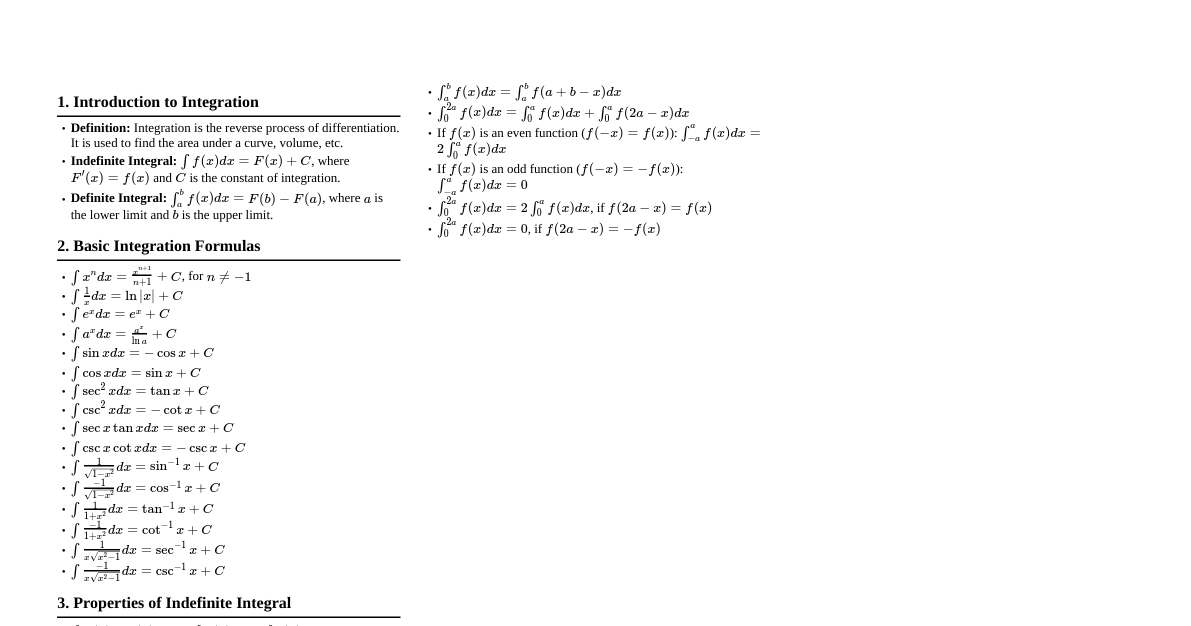
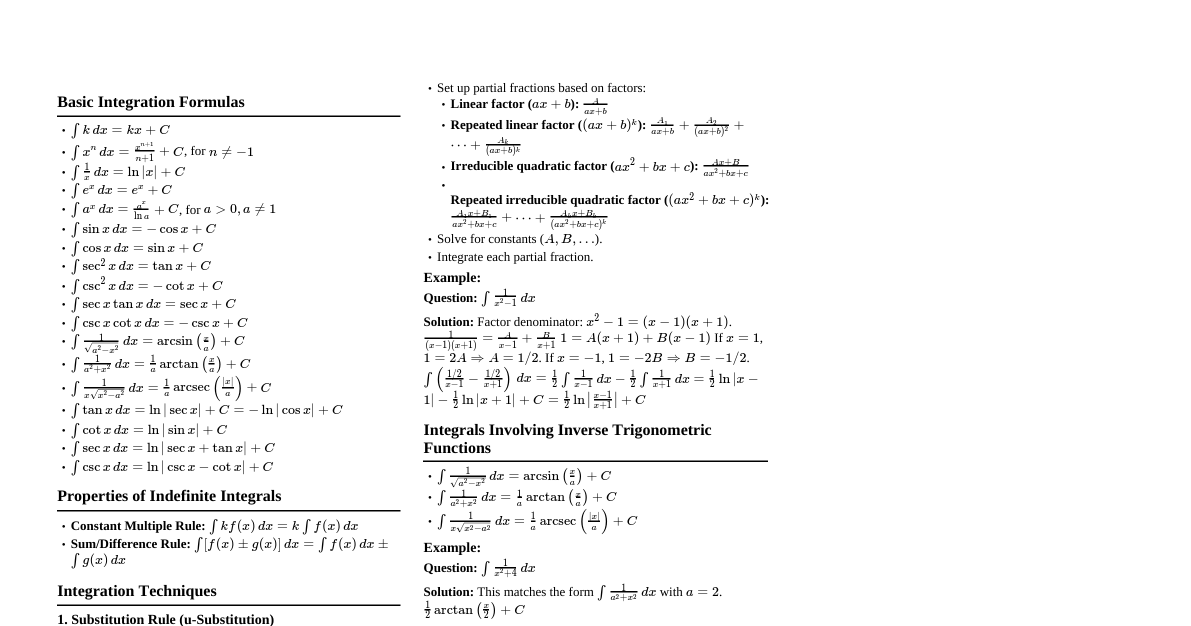
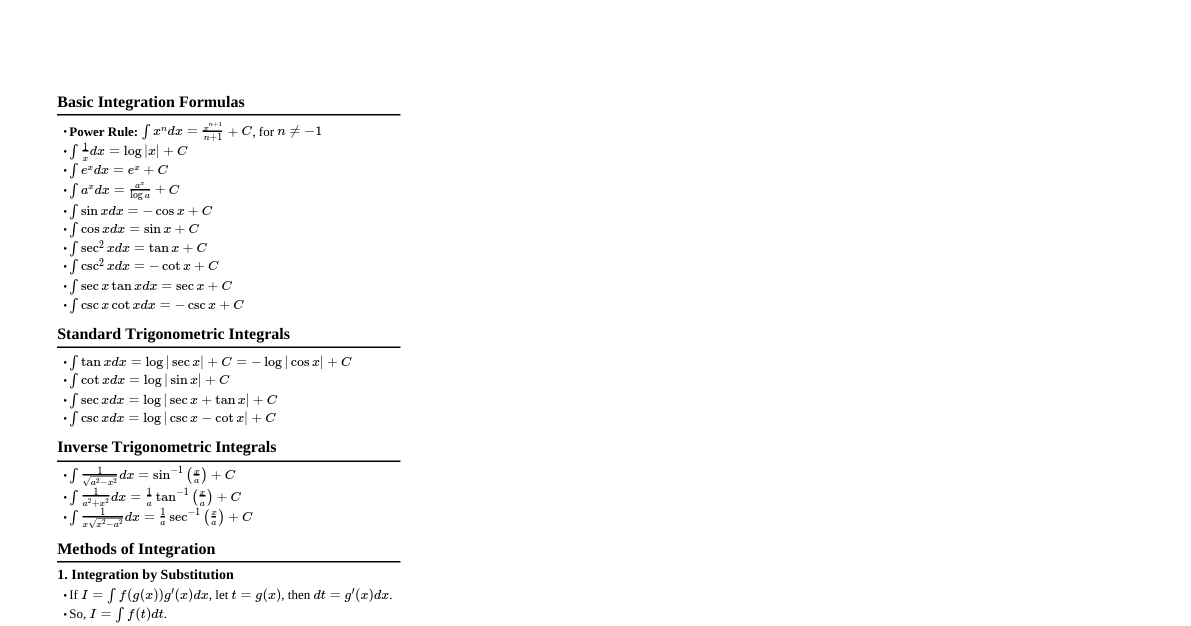
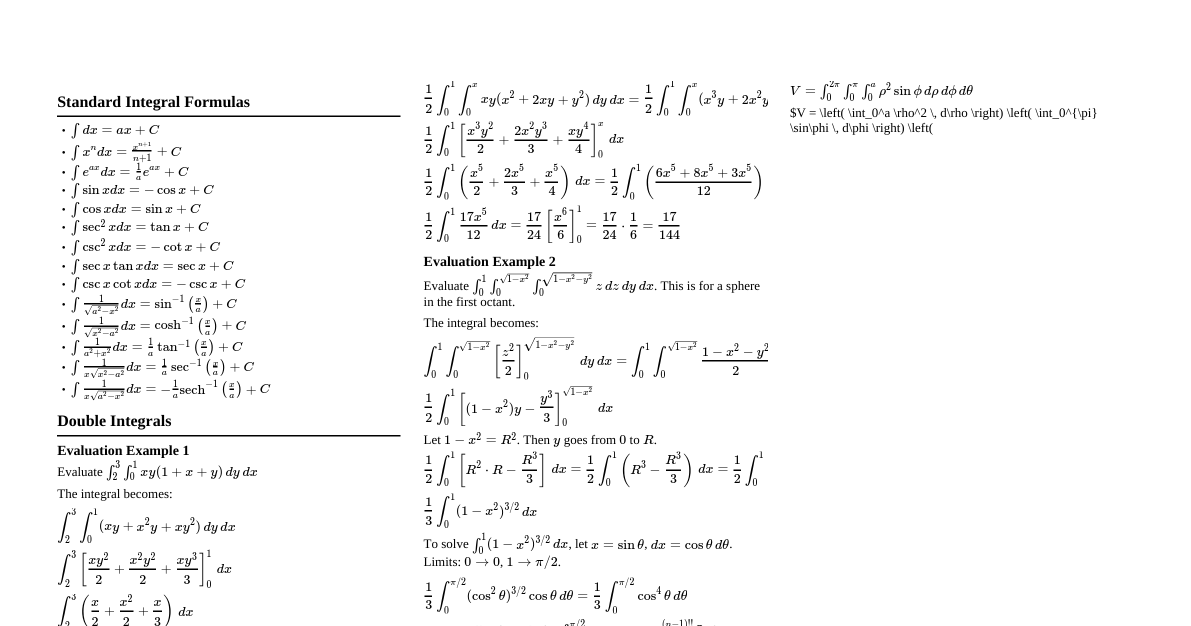
1. Indefinite Integrals Integration is the inverse process of differentiation. If $F'(x) = f(x)$, then $\int f(x) dx = F(x) + C$, where $C$ is the constant of integration. 1.1 Standard Formulas $\int x^n dx = \frac{x^{n+1}}{n+1} + C$, for $n \neq -1$ $\int \frac{1}{x} dx = \log|x| + C$ $\int e^x dx = e^x + C$ $\int a^x dx = \frac{a^x}{\log a} + C$ $\int \sin x dx = -\cos x + C$ $\int \cos x dx = \sin x + C$ $\int \sec^2 x dx = \tan x + C$ $\int \csc^2 x dx = -\cot x + C$ $\int \sec x \tan x dx = \sec x + C$ $\int \csc x \cot x dx = -\csc x + C$ $\int \frac{1}{\sqrt{a^2 - x^2}} dx = \sin^{-1}\left(\frac{x}{a}\right) + C$ $\int \frac{1}{a^2 + x^2} dx = \frac{1}{a} \tan^{-1}\left(\frac{x}{a}\right) + C$ $\int \frac{1}{x\sqrt{x^2 - a^2}} dx = \frac{1}{a} \sec^{-1}\left(\frac{x}{a}\right) + C$ 1.2 Properties of Indefinite Integrals $\int [f(x) \pm g(x)] dx = \int f(x) dx \pm \int g(x) dx$ $\int k f(x) dx = k \int f(x) dx$, where $k$ is a constant 2. Methods of Integration 2.1 Integration by Substitution If $\int f(x) dx$ needs to be evaluated, and we substitute $x = g(t)$, then $dx = g'(t) dt$. The integral becomes $\int f(g(t)) g'(t) dt$. Alternatively, if we substitute $u = g(x)$, then $du = g'(x) dx$. 2.2 Integration by Parts Formula: $\int u v' dx = uv - \int u'v dx$ or $\int u dv = uv - \int v du$ Choice of $u$ and $v'$ (or $u$ and $dv$) using ILATE rule (Inverse, Logarithmic, Algebraic, Trigonometric, Exponential). 2.3 Integration of Rational Functions (Partial Fractions) A rational function $\frac{P(x)}{Q(x)}$ can be decomposed into simpler fractions if the degree of $P(x)$ is less than the degree of $Q(x)$. Form of Rational Function Form of Partial Fraction $\frac{px+q}{(x-a)(x-b)}$ $\frac{A}{x-a} + \frac{B}{x-b}$ $\frac{px+q}{(x-a)^2}$ $\frac{A}{x-a} + \frac{B}{(x-a)^2}$ $\frac{px^2+qx+r}{(x-a)(x-b)(x-c)}$ $\frac{A}{x-a} + \frac{B}{x-b} + \frac{C}{x-c}$ $\frac{px^2+qx+r}{(x-a)^2(x-b)}$ $\frac{A}{x-a} + \frac{B}{(x-a)^2} + \frac{C}{x-b}$ $\frac{px^2+qx+r}{(x-a)(x^2+bx+c)}$ $\frac{A}{x-a} + \frac{Bx+C}{x^2+bx+c}$ (where $x^2+bx+c$ is irreducible) 2.4 Some Special Integrals $\int \frac{dx}{x^2 - a^2} = \frac{1}{2a} \log\left|\frac{x-a}{x+a}\right| + C$ $\int \frac{dx}{a^2 - x^2} = \frac{1}{2a} \log\left|\frac{a+x}{a-x}\right| + C$ $\int \frac{dx}{\sqrt{x^2 - a^2}} = \log|x + \sqrt{x^2 - a^2}| + C$ $\int \frac{dx}{\sqrt{x^2 + a^2}} = \log|x + \sqrt{x^2 + a^2}| + C$ $\int \sqrt{a^2 - x^2} dx = \frac{x}{2}\sqrt{a^2 - x^2} + \frac{a^2}{2}\sin^{-1}\left(\frac{x}{a}\right) + C$ $\int \sqrt{x^2 - a^2} dx = \frac{x}{2}\sqrt{x^2 - a^2} - \frac{a^2}{2}\log|x + \sqrt{x^2 - a^2}| + C$ $\int \sqrt{x^2 + a^2} dx = \frac{x}{2}\sqrt{x^2 + a^2} + \frac{a^2}{2}\log|x + \sqrt{x^2 + a^2}| + C$ 3. Definite Integrals If $F(x)$ is an antiderivative of $f(x)$, then $\int_a^b f(x) dx = [F(x)]_a^b = F(b) - F(a)$. 3.1 Properties of Definite Integrals $\int_a^b f(x) dx = -\int_b^a f(x) dx$ $\int_a^a f(x) dx = 0$ $\int_a^b f(x) dx = \int_a^c f(x) dx + \int_c^b f(x) dx$ (where $a $\int_a^b f(x) dx = \int_a^b f(t) dt$ (change of variable name) $\int_a^b f(x) dx = \int_a^b f(a+b-x) dx$ $\int_0^a f(x) dx = \int_0^a f(a-x) dx$ (a special case of the above) $\int_0^{2a} f(x) dx = \int_0^a f(x) dx + \int_0^a f(2a-x) dx$ $\int_0^{2a} f(x) dx = 2\int_0^a f(x) dx$ if $f(2a-x) = f(x)$ $\int_0^{2a} f(x) dx = 0$ if $f(2a-x) = -f(x)$ $\int_{-a}^a f(x) dx = 2\int_0^a f(x) dx$ if $f(x)$ is an even function ($f(-x)=f(x)$) $\int_{-a}^a f(x) dx = 0$ if $f(x)$ is an odd function ($f(-x)=-f(x)$) 4. Application of Integrals (Area Under Curves) The area of the region bounded by the curve $y = f(x)$, the x-axis, and the lines $x=a$ and $x=b$ (where $f(x) \ge 0$ on $[a,b]$) is given by: $$ A = \int_a^b y \, dx = \int_a^b f(x) \, dx $$ 4.1 Area Bounded by Curve and Y-axis The area bounded by the curve $x = g(y)$, the y-axis, and the lines $y=c$ and $y=d$ (where $g(y) \ge 0$ on $[c,d]$) is given by: $$ A = \int_c^d x \, dy = \int_c^d g(y) \, dy $$ 4.2 Area Between Two Curves If two curves $y = f(x)$ and $y = g(x)$ intersect at $x=a$ and $x=b$, and $f(x) \ge g(x)$ on $[a,b]$, the area between them is: $$ A = \int_a^b [f(x) - g(x)] \, dx $$ Similarly, for curves $x = f(y)$ and $x = g(y)$ intersecting at $y=c$ and $y=d$, and $f(y) \ge g(y)$ on $[c,d]$: $$ A = \int_c^d [f(y) - g(y)] \, dy $$ 4.3 Important Considerations If the curve lies below the x-axis, the integral value will be negative. Area is always positive, so take the absolute value: $A = \left| \int_a^b f(x) dx \right|$. If the curve crosses the x-axis, divide the region into parts where $f(x)$ is positive and negative, and sum the absolute values of the integrals for each part. For area between curves, correctly identify which function is upper and which is lower (or right and left). Break down the integral if the upper/lower curve changes. 5. Common Geometric Shapes & Their Area Formulas (for verification) Circle: Area of a circle with radius $r$ is $\pi r^2$. Can be found by integrating $y = \sqrt{r^2 - x^2}$ from $-r$ to $r$ and multiplying by 2 (for both halves). Ellipse: Area of an ellipse $\frac{x^2}{a^2} + \frac{y^2}{b^2} = 1$ is $\pi ab$. Can be found by integrating $y = b\sqrt{1 - \frac{x^2}{a^2}}$ from $-a$ to $a$ and multiplying by 2.