Math & Stats Part II Essentials
Cheatsheet Content
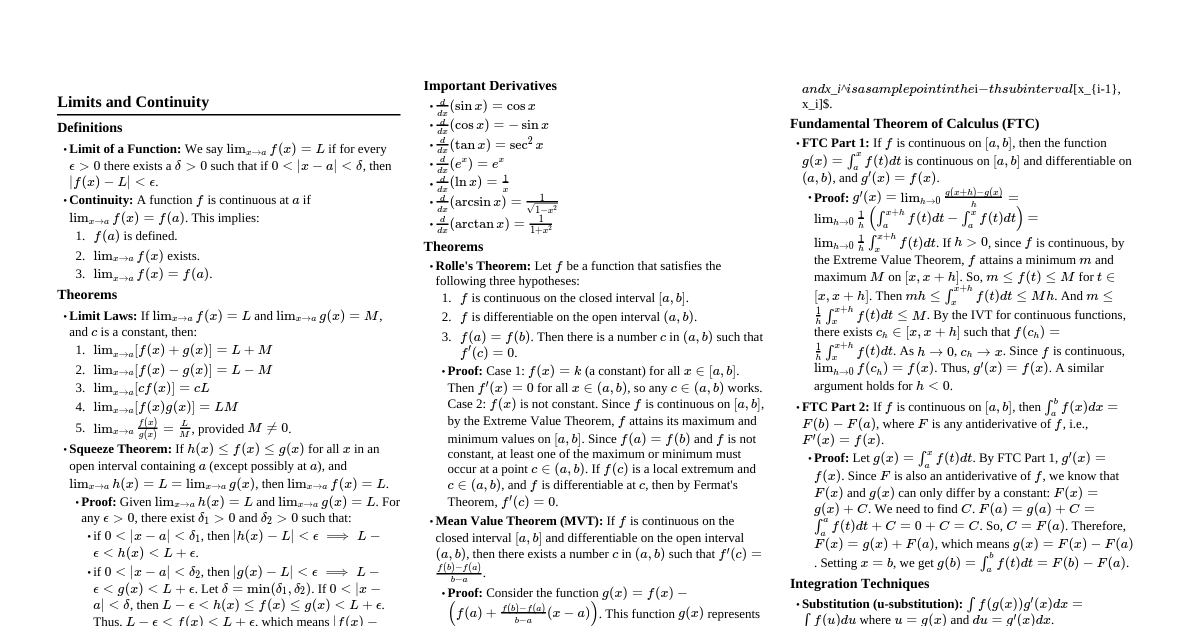
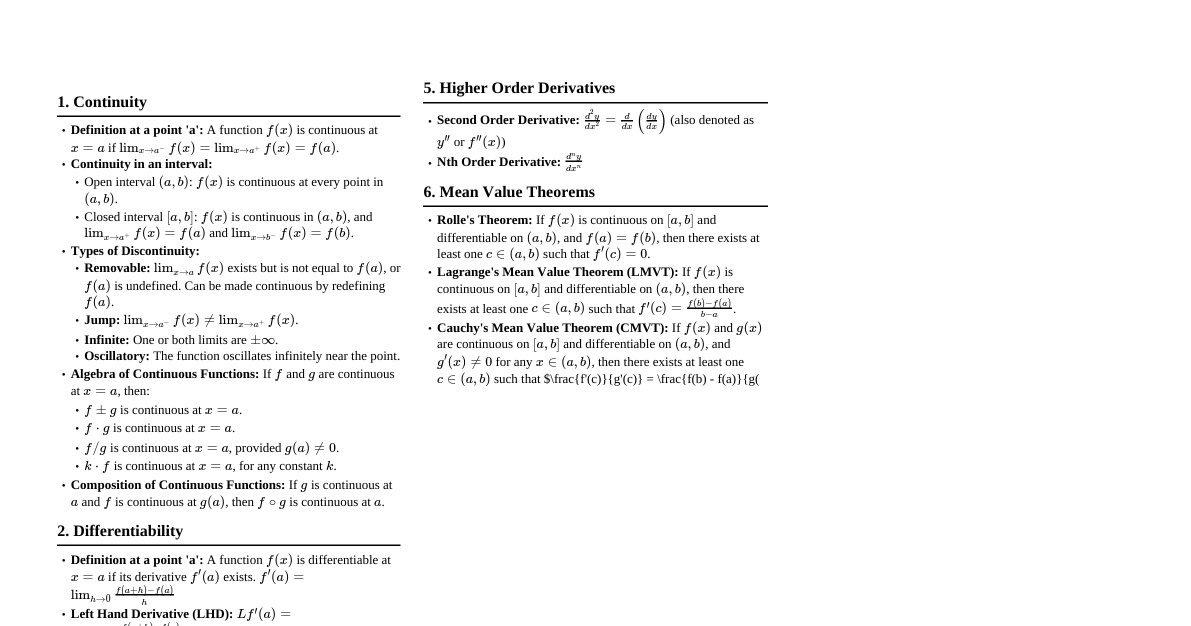
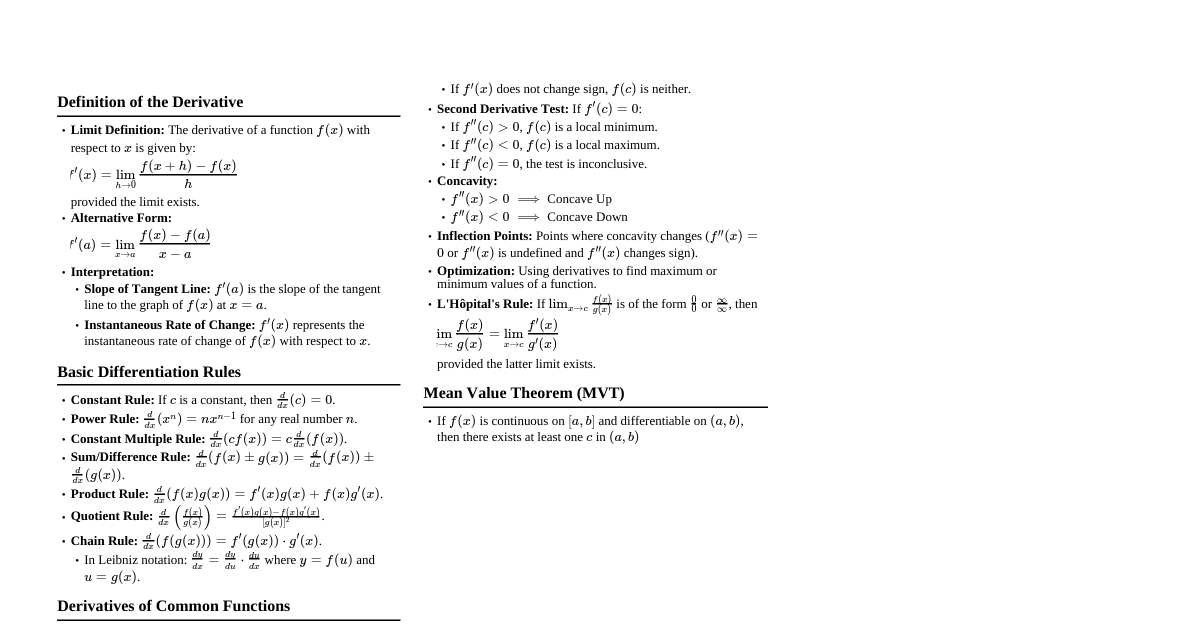
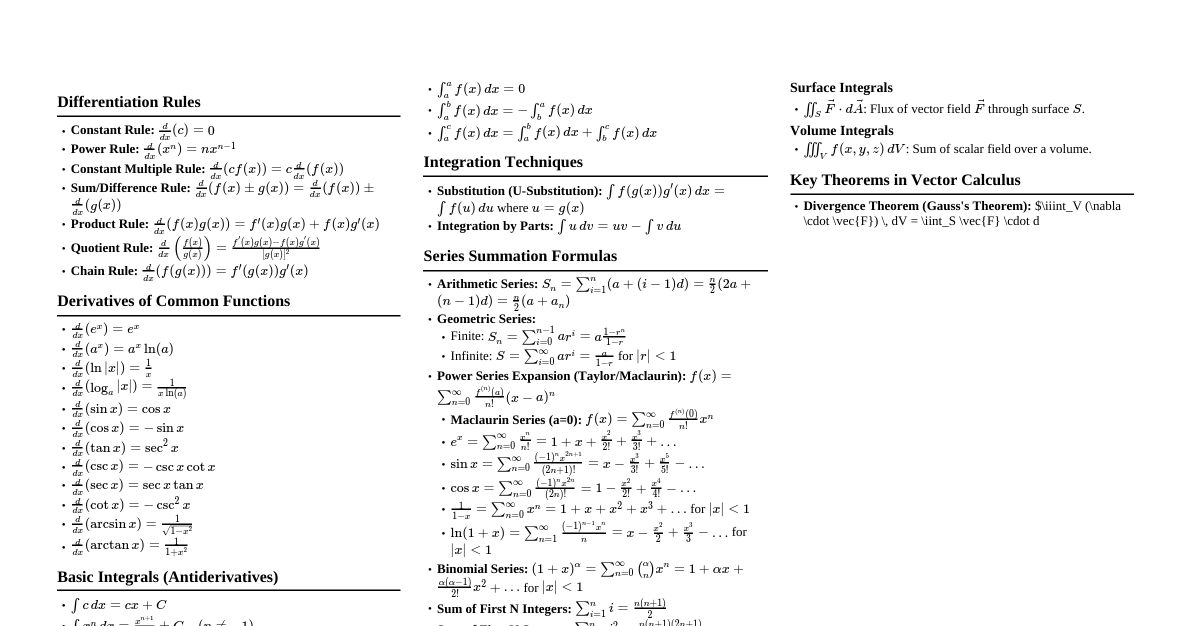
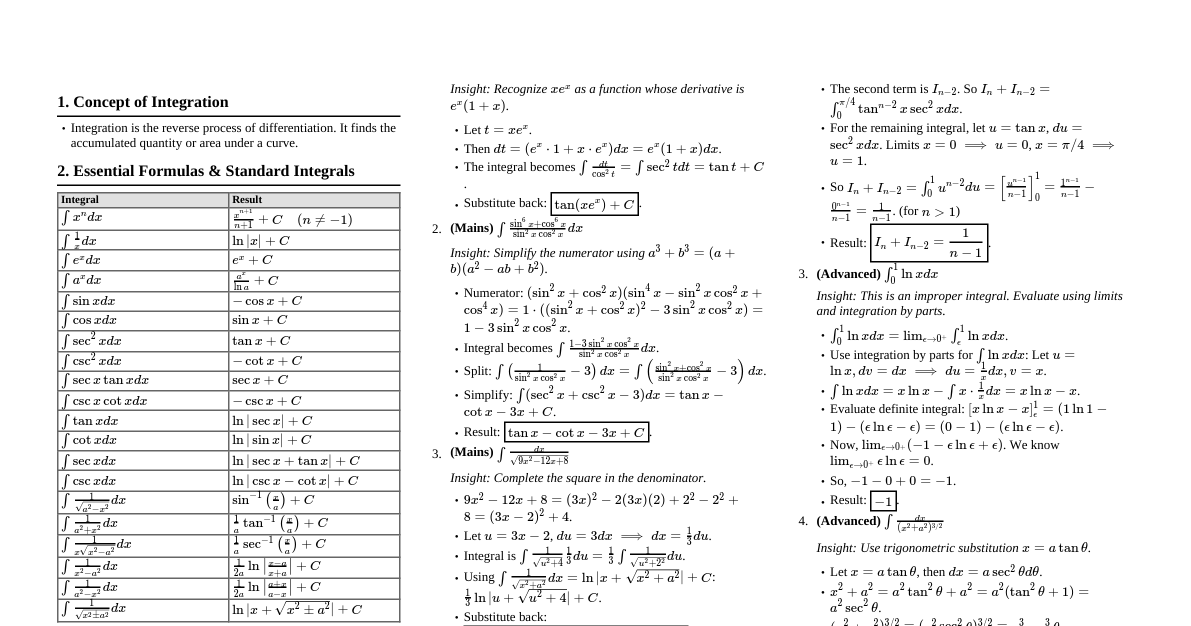
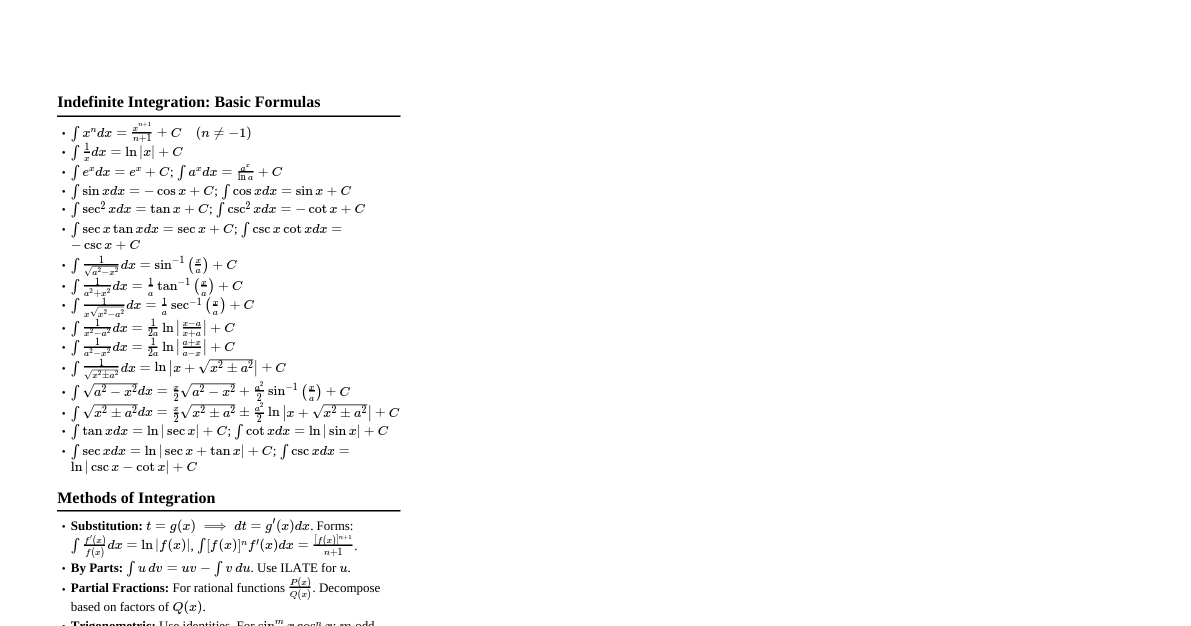
Chapter 1: Differentiation Chain Rule: If $y = f(u)$ and $u = g(x)$, then $\frac{dy}{dx} = \frac{dy}{du} \cdot \frac{du}{dx}$. Inverse Function Theorem: If $y = f(x)$ and $x = f^{-1}(y)$ exists, then $\frac{dx}{dy} = \frac{1}{dy/dx}$, where $\frac{dy}{dx} \neq 0$. Derivatives of Inverse Trigonometric Functions: $\frac{d}{dx}(\sin^{-1} x) = \frac{1}{\sqrt{1 - x^2}}$, $|x| $\frac{d}{dx}(\cos^{-1} x) = -\frac{1}{\sqrt{1 - x^2}}$, $|x| $\frac{d}{dx}(\tan^{-1} x) = \frac{1}{1 + x^2}$ $\frac{d}{dx}(\cot^{-1} x) = -\frac{1}{1 + x^2}$ $\frac{d}{dx}(\sec^{-1} x) = \frac{1}{|x|\sqrt{x^2 - 1}}$, $|x| > 1$ $\frac{d}{dx}(\csc^{-1} x) = -\frac{1}{|x|\sqrt{x^2 - 1}}$, $|x| > 1$ Logarithmic Differentiation: Used for functions $y = [f(x)]^{g(x)}$ or complex products/quotients. Take $\ln$ on both sides: $\ln y = g(x) \ln[f(x)]$. Implicit Differentiation: Differentiate both sides of the equation w.r.t. $x$, treating $y$ as a function of $x$. Group $\frac{dy}{dx}$ terms and solve. Parametric Differentiation: If $x = f(t)$ and $y = g(t)$, then $\frac{dy}{dx} = \frac{dy/dt}{dx/dt}$, where $\frac{dx}{dt} \neq 0$. Higher Order Derivatives: $\frac{d^2y}{dx^2} = \frac{d}{dx}\left(\frac{dy}{dx}\right)$, $\frac{d^3y}{dx^3} = \frac{d}{dx}\left(\frac{d^2y}{dx^2}\right)$, etc. Chapter 2: Applications of Derivatives Tangent and Normal: Slope of tangent at $(x_1, y_1)$: $m = \left(\frac{dy}{dx}\right)_{(x_1, y_1)}$. Equation of tangent: $y - y_1 = m(x - x_1)$. Slope of normal: $m' = -\frac{1}{m}$ (if $m \neq 0$). Equation of normal: $y - y_1 = m'(x - x_1)$. Rate Measure: If $y = f(x)$, $\frac{dy}{dx}$ represents the instantaneous rate of change of $y$ w.r.t. $x$. Approximations: $f(a + h) \approx f(a) + h f'(a)$ for small $h$. Rolle's Theorem: If $f$ is continuous on $[a, b]$, differentiable on $(a, b)$, and $f(a) = f(b)$, then there exists $c \in (a, b)$ such that $f'(c) = 0$. Lagrange's Mean Value Theorem (LMVT): If $f$ is continuous on $[a, b]$ and differentiable on $(a, b)$, then there exists $c \in (a, b)$ such that $f'(c) = \frac{f(b) - f(a)}{b - a}$. Increasing/Decreasing Functions: $f(x)$ is strictly increasing if $f'(x) > 0$. $f(x)$ is strictly decreasing if $f'(x) Maxima and Minima (First Derivative Test): Local Maxima at $x=c$: $f'(c)=0$, $f'(c-h)>0$, $f'(c+h) Local Minima at $x=c$: $f'(c)=0$, $f'(c-h) 0$. Maxima and Minima (Second Derivative Test): Local Maxima at $x=c$: $f'(c)=0$ and $f''(c) Local Minima at $x=c$: $f'(c)=0$ and $f''(c)>0$. Chapter 3: Indefinite Integration Basic Formulas: $\int x^n dx = \frac{x^{n+1}}{n+1} + C$, $n \neq -1$ $\int \frac{1}{x} dx = \ln|x| + C$ $\int e^x dx = e^x + C$ $\int a^x dx = \frac{a^x}{\ln a} + C$ $\int \sin x dx = -\cos x + C$ $\int \cos x dx = \sin x + C$ $\int \sec^2 x dx = \tan x + C$ $\int \csc^2 x dx = -\cot x + C$ $\int \sec x \tan x dx = \sec x + C$ $\int \csc x \cot x dx = -\csc x + C$ $\int \tan x dx = \ln|\sec x| + C$ $\int \cot x dx = \ln|\sin x| + C$ $\int \sec x dx = \ln|\sec x + \tan x| + C$ $\int \csc x dx = \ln|\csc x - \cot x| + C$ Methods of Integration: Substitution: $\int f(g(x))g'(x) dx = \int f(u) du$ by letting $u = g(x)$. Integration by Parts: $\int u dv = uv - \int v du$. (Choose $u$ using LIATE rule). Partial Fractions: For rational functions $\frac{P(x)}{Q(x)}$ where $\text{deg}(P) Special Integrals: $\int \frac{1}{x^2 + a^2} dx = \frac{1}{a} \tan^{-1}\left(\frac{x}{a}\right) + C$ $\int \frac{1}{x^2 - a^2} dx = \frac{1}{2a} \ln\left|\frac{x - a}{x + a}\right| + C$ $\int \frac{1}{a^2 - x^2} dx = \frac{1}{2a} \ln\left|\frac{a + x}{a - x}\right| + C$ $\int \frac{1}{\sqrt{a^2 - x^2}} dx = \sin^{-1}\left(\frac{x}{a}\right) + C$ $\int \frac{1}{\sqrt{x^2 - a^2}} dx = \ln\left|x + \sqrt{x^2 - a^2}\right| + C$ $\int \frac{1}{\sqrt{x^2 + a^2}} dx = \ln\left|x + \sqrt{x^2 + a^2}\right| + C$ $\int \sqrt{a^2 - x^2} dx = \frac{x}{2}\sqrt{a^2 - x^2} + \frac{a^2}{2}\sin^{-1}\left(\frac{x}{a}\right) + C$ $\int \sqrt{x^2 - a^2} dx = \frac{x}{2}\sqrt{x^2 - a^2} - \frac{a^2}{2}\ln\left|x + \sqrt{x^2 - a^2}\right| + C$ $\int \sqrt{x^2 + a^2} dx = \frac{x}{2}\sqrt{x^2 + a^2} + \frac{a^2}{2}\ln\left|x + \sqrt{x^2 + a^2}\right| + C$ Integral of the form $\int e^x [f(x) + f'(x)] dx = e^x f(x) + C$ Chapter 4: Definite Integration As Limit of Sum: $\int_a^b f(x) dx = \lim_{n \to \infty} \sum_{r=1}^n h f(a + rh)$, where $h = \frac{b-a}{n}$. Fundamental Theorem of Integral Calculus: If $\int f(x) dx = g(x) + C$, then $\int_a^b f(x) dx = g(b) - g(a)$. Properties of Definite Integrals: $\int_a^a f(x) dx = 0$ $\int_a^b f(x) dx = -\int_b^a f(x) dx$ $\int_a^b f(x) dx = \int_a^b f(t) dt$ $\int_a^b f(x) dx = \int_a^c f(x) dx + \int_c^b f(x) dx$, where $a $\int_a^b f(x) dx = \int_a^b f(a + b - x) dx$ $\int_0^a f(x) dx = \int_0^a f(a - x) dx$ $\int_0^{2a} f(x) dx = \int_0^a f(x) dx + \int_0^a f(2a - x) dx$ $\int_{-a}^a f(x) dx = \begin{cases} 2\int_0^a f(x) dx & \text{if } f(x) \text{ is even} \\ 0 & \text{if } f(x) \text{ is odd} \end{cases}$ Chapter 5: Application of Definite Integration Area Under a Curve: Area bounded by $y = f(x)$, X-axis, $x=a$, $x=b$: $A = \left|\int_a^b y dx\right|$. Area bounded by $x = g(y)$, Y-axis, $y=c$, $y=d$: $A = \left|\int_c^d x dy\right|$. Area Between Two Curves: Area bounded by $y = f(x)$ and $y = g(x)$ from $x=a$ to $x=b$: $A = \left|\int_a^b (f(x) - g(x)) dx\right|$. (Ensure $f(x) \ge g(x)$ for the interval, or take absolute value). Chapter 6: Differential Equations Definition: An equation involving an independent variable, a dependent variable, and the derivatives of the dependent variable with respect to the independent variable. Order: The order of the highest derivative in the equation. Degree: The power of the highest order derivative, after the equation has been freed from radicals and fractions w.r.t. derivatives. Formation of Differential Equations: Eliminate arbitrary constants by differentiating the given relation multiple times (equal to the number of arbitrary constants). Solution of Differential Equations: Variable Separable Method: If $\frac{dy}{dx} = f(x)g(y)$, rewrite as $\frac{dy}{g(y)} = f(x) dx$ and integrate both sides. Homogeneous Differential Equation: If $\frac{dy}{dx} = F\left(\frac{y}{x}\right)$, substitute $y = vx$ (so $\frac{dy}{dx} = v + x\frac{dv}{dx}$) to make it variable separable. Linear Differential Equation: Form $\frac{dy}{dx} + Py = Q$ (where $P, Q$ are functions of $x$). Integrating Factor (I.F.) $= e^{\int P dx}$. General Solution: $y \cdot (\text{I.F.}) = \int Q \cdot (\text{I.F.}) dx + C$. Linear Differential Equation: Form $\frac{dx}{dy} + Px = Q$ (where $P, Q$ are functions of $y$). Integrating Factor (I.F.) $= e^{\int P dy}$. General Solution: $x \cdot (\text{I.F.}) = \int Q \cdot (\text{I.F.}) dy + C$. Applications: Population Growth/Decay: $\frac{dP}{dt} = kP \implies P(t) = P_0 e^{kt}$. (Growth if $k>0$, Decay if $k Newton's Law of Cooling: $\frac{dT}{dt} = -k(T - T_s) \implies T(t) = T_s + (T_0 - T_s)e^{-kt}$. ($T_s$ is surrounding temperature). Trigonometric Formulas Basic Identities $\sin^2 \theta + \cos^2 \theta = 1$ $1 + \tan^2 \theta = \sec^2 \theta$ $1 + \cot^2 \theta = \csc^2 \theta$ Sum and Difference Formulas $\sin(A \pm B) = \sin A \cos B \pm \cos A \sin B$ $\cos(A \pm B) = \cos A \cos B \mp \sin A \sin B$ $\tan(A \pm B) = \frac{\tan A \pm \tan B}{1 \mp \tan A \tan B}$ Double Angle Formulas $\sin(2A) = 2 \sin A \cos A$ $\cos(2A) = \cos^2 A - \sin^2 A = 2 \cos^2 A - 1 = 1 - 2 \sin^2 A$ $\tan(2A) = \frac{2 \tan A}{1 - \tan^2 A}$ Half Angle Formulas $\sin^2 A = \frac{1 - \cos(2A)}{2}$ $\cos^2 A = \frac{1 + \cos(2A)}{2}$ $\tan^2 A = \frac{1 - \cos(2A)}{1 + \cos(2A)}$ Product-to-Sum Formulas $2 \sin A \cos B = \sin(A + B) + \sin(A - B)$ $2 \cos A \sin B = \sin(A + B) - \sin(A - B)$ $2 \cos A \cos B = \cos(A + B) + \cos(A - B)$ $2 \sin A \sin B = \cos(A - B) - \cos(A + B)$ Sum-to-Product Formulas $\sin C + \sin D = 2 \sin\left(\frac{C + D}{2}\right) \cos\left(\frac{C - D}{2}\right)$ $\sin C - \sin D = 2 \cos\left(\frac{C + D}{2}\right) \sin\left(\frac{C - D}{2}\right)$ $\cos C + \cos D = 2 \cos\left(\frac{C + D}{2}\right) \cos\left(\frac{C - D}{2}\right)$ $\cos C - \cos D = -2 \sin\left(\frac{C + D}{2}\right) \sin\left(\frac{C - D}{2}\right)$