Class 10 History: Print Culture
Cheatsheet Content
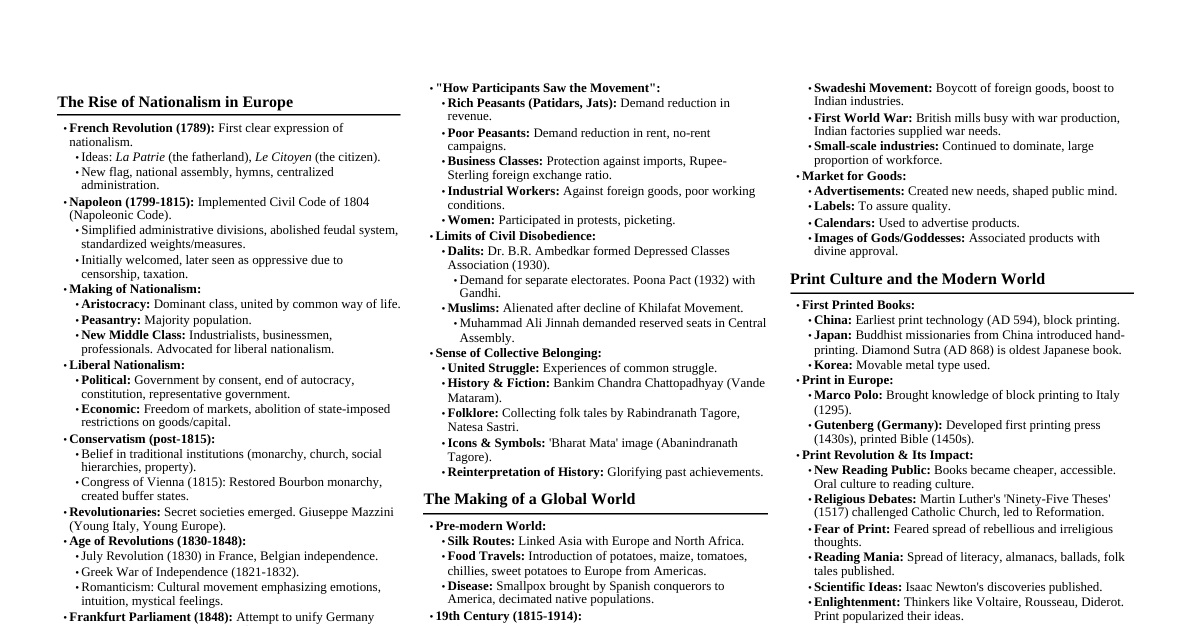
1. The First Printed Books China: Cradle of Print: The earliest form of print culture originated in China. Books were primarily produced by hand-printing. Woodblock Printing: This technique involved rubbing paper against the inked surface of carved wooden blocks. As both sides of the thin, porous paper could not be printed, traditional Chinese 'accordion books' were folded and stitched at the side. Skilled Calligraphers: Master calligraphers meticulously copied manuscripts, ensuring accuracy and aesthetic appeal, before the blocks were carved. Buddhist Missionaries and Japan: Buddhist missionaries from China introduced hand-printing technology to Japan around AD 768-770. The oldest Japanese book, the Buddhist Diamond Sutra , printed in AD 868, is a prime example, featuring six sheets of text and intricate woodcut illustrations. Korea and Movable Metal Type: While China developed woodblock printing, Korea made significant advancements with movable metal type earlier than Europe, though it didn't lead to a widespread print revolution there. Marco Polo and Europe: The Italian explorer Marco Polo, after years of exploration in China, brought knowledge of woodblock printing back to Italy in 1295, introducing it to Europe. 2. Print Comes to Europe Manuscript Culture: Before the advent of print, Europe relied on manuscript production. Books were extremely expensive, laborious to produce, and often commissioned by wealthy patrons. Scribes, skilled in calligraphy, worked in monastic scriptoriums to copy texts by hand. Growing Demand: The expansion of trade, the rise of universities, and the increasing literacy among merchants and students created a burgeoning demand for books that manuscript production could not meet. Early European Woodblocks: Woodblock printing, introduced from China, was initially used for printing textiles, playing cards, and simple religious pictures with short texts. Johannes Gutenberg and the Printing Press: Born in Strasbourg, Germany, Gutenberg developed the first true printing press in the 1430s. His innovation was not a single invention but a synthesis of existing technologies: the olive press for pressure, the wine press screw mechanism, and techniques for casting metal type. He perfected the process of casting uniform metal type molds for letters of the alphabet, which could be arranged and rearranged (movable type). The Gutenberg Bible: Printed between 1450 and 1455, approximately 180 copies of the Bible were produced. It marked the beginning of the printing revolution. Impact: The shift from hand-copying to mechanical printing dramatically increased the speed and volume of book production, making books more accessible and affordable. 3. The Print Revolution and Its Impact A New Reading Public: Print reduced the cost of books and the time required to produce them. This meant books could reach a wider audience, including the common people, leading to a surge in literacy rates across Europe. Shift from Oral to Reading Culture: Before print, knowledge was largely transmitted orally, through listening to sacred texts, ballads, and folk tales. Print allowed for individual, silent reading, fostering a new culture of reading and reflection. Religious Debates and the Fear of Print: Spread of Ideas: Print allowed for the rapid and wide circulation of ideas, including dissenting ones. Martin Luther: In 1517, the German priest Martin Luther wrote his "Ninety-Five Theses," criticizing the corrupt practices of the Roman Catholic Church. Printed copies were widely distributed, leading to intense debates and eventually the Protestant Reformation. Church's Reaction: The Roman Catholic Church, initially wary of the new technology, became deeply troubled by the spread of heterodox ideas. It feared that print could undermine its authority and spread irreligious or rebellious thoughts. Censorship: To control the flow of information, the Church imposed strict censorship on publishers and booksellers from 1558, maintaining an "Index of Prohibited Books." 4. Reading Mania and New Forms of Print 18th Century Boom: By the 18th century, literacy rates soared across most parts of Europe. Books were no longer just for the elites. Periodicals: Newspapers and journals emerged, carrying news, current affairs, articles, and entertainment, catering to a new, curious public. Almanacs and Calendars: These popular publications provided astronomical data, practical information, and often folk tales and humor, becoming staples in many households. Chapbooks and "Bibliothèque Bleue": In England, cheap "penny chapbooks" were carried by peddlers (chapmen) and sold to the masses. In France, "Bibliothèque Bleue" were low-priced books printed on poor-quality paper and bound in cheap blue covers, containing popular romances, folk tales, and histories. Novels and Leisure Reading: The emergence of the novel as a distinct literary form allowed for immersive, sustained reading experiences, often for pleasure and entertainment. Reading for Women and Children: Publishers increasingly targeted women and children. Books for women often offered guidance on household management and proper conduct, while children's literature focused on moral instruction and education. 5. Print and the French Revolution Enlightenment and Reason: Print played a crucial role in disseminating the ideas of Enlightenment thinkers like Voltaire and Rousseau , who championed reason, rationality, and criticized tradition, superstition, and despotism. Public Sphere: Print created a new public sphere where ideas about social reform, governance, and individual rights could be openly debated. People could read, discuss, and form opinions collectively. Critique of Monarchy: Through printed pamphlets, newspapers, and even satirical caricatures, the monarchy and its moral failings were openly criticized and ridiculed, eroding public trust in the ancien régime. Historians' Debate: While some historians argue that print directly ignited the French Revolution by spreading revolutionary propaganda, others contend that print merely provided the context for new ideas. They suggest that people interpreted these ideas in their own ways, leading to diverse responses rather than a uniform revolutionary impulse. 6. India and the World of Print Manuscript Tradition: India had a rich and ancient tradition of handwritten manuscripts in various languages like Sanskrit, Arabic, Persian, and regional vernaculars. These were often beautifully illustrated and preserved in temples, monasteries, and royal courts. Arrival of the Printing Press: Portuguese Missionaries: The first printing press arrived in Goa with Portuguese missionaries in the mid-16th century. They printed religious texts in Konkani and other local languages. First Tamil Book: Jesuit priests printed the first Tamil book in 1579 at Cochin. First Malayalam Book: Dutch Protestant missionaries printed the first Malayalam book in 1713. English Printing: The English East India Company established its own presses in the late 18th century, primarily for administrative and commercial purposes. Early Newspapers and Journals: James Augustus Hicky: In 1780, Hicky started the "Bengal Gazette," India's first weekly English newspaper. He was critical of Company officials, leading to his eventual persecution and the paper's demise. Indian Initiatives: Soon, Indians began publishing their own newspapers and journals, often in vernacular languages, to voice their concerns and disseminate information. 7. Religious Reform and Public Debates Early 19th Century: The print medium became a powerful tool for intense debates on religious, social, and political issues in India. Hinduism: Rammohun Roy: A prominent social reformer, published "Sambad Kaumudi" in 1821 to propagate his reformist ideas, especially against Sati. Hindu Orthodoxy: Conservative Hindu groups countered Roy's views by publishing newspapers like "Samachar Chandrika." These debates were crucial in shaping public opinion and modern Indian identity. Islam: The Ulama (Muslim scholars) used print to publish Persian and Urdu translations of scriptures and religious newspapers. They aimed to educate Muslims about their faith, counter colonial influences, and defend Islam against missionary attacks. The Darul Uloom Deoband seminary published fatwas (religious decrees) on various aspects of life, printed in vast numbers. New Forms of Writing: The proliferation of print led to the development of new literary forms such as novels, essays, short stories, and poetry, often addressing social reform, national identity, and cultural revival. 8. Women and Print Resistance to Female Education: Initially, conservative sections of society, both Hindu and Muslim, feared that education and reading would corrupt women, make them disobedient, or even lead them to widowhood. Liberal Initiatives: However, liberal families began educating their women at home or sending them to newly established girls' schools. Women Writers: Rashsundari Debi: A young Bengali housewife, secretly learned to read and wrote her autobiography, "Amar Jiban" (My Life), published in 1876, offering insights into women's lives in the 19th century. Other women like Kailashbashini Debi wrote extensively about the plight of women, advocating for their rights and education. Tarabai Shinde and Pandita Ramabai: Pioneering feminists in Maharashtra, they wrote passionately about the miserable lives of upper-caste Hindu women, particularly widows, challenging patriarchal norms. Print for Women: From the early 20th century, journals and magazines, like the "Indian Ladies' Magazine," specifically catered to women, offering entertainment, fashion advice, and discussions on women's issues. 9. Print and the Poor Accessibility: The availability of cheap, small books and public libraries made reading accessible to the poor. Public Libraries: From the late 19th century, public libraries were established, often funded by philanthropists or local governments, providing a vital resource for working-class people. Caste Discrimination: Jyotiba Phule: The Marathi pioneer of the anti-caste movement, wrote "Gulamgiri" (Slavery) in 1871, exposing the injustices of the caste system and the exploitation of lower castes. B.R. Ambedkar: The architect of the Indian Constitution, wrote extensively on caste oppression and advocated for the rights of Dalits. E.V. Ramaswamy Naicker (Periyar): A leader of the Self-Respect Movement in Tamil Nadu, he used print to propagate his anti-caste and anti-religious reformist ideas. Popular Literature: Local prose narratives, folk tales, and political tracts were often printed in cheap editions, widely circulated among workers in factories and fields, fostering social awareness. 10. Print and Censorship Initial Laissez-faire: For most of the 18th century, the colonial state in India did not impose strict censorship. Early controls were primarily aimed at Englishmen who criticized the East India Company's administration. Growing Control: By the 1820s, the Calcutta Supreme Court passed regulations to control press freedom, especially concerning content that could incite rebellion. Governor-General William Bentinck (1835): Liberalized press laws, leading to a period of greater freedom. Vernacular Press Act (1878): Enacted by Lord Lytton in response to rising nationalist sentiment expressed in vernacular newspapers. This act allowed the government to confiscate the printing presses and assets of any vernacular newspaper that published "seditious" material (content critical of British rule). It was a direct attempt to control and suppress nationalist voices. Nationalist Resistance: The Act provoked widespread protests and demands for press freedom. Nationalist newspapers, despite the risks, continued to publish critical reports and editorials, fostering anti-colonial sentiment. Bal Gangadhar Tilak: His Marathi newspaper "Kesari" was particularly outspoken. He was imprisoned in 1908 on charges of sedition for his writings, leading to widespread protests across India.