Organic Reactions - Class 12
Cheatsheet Content
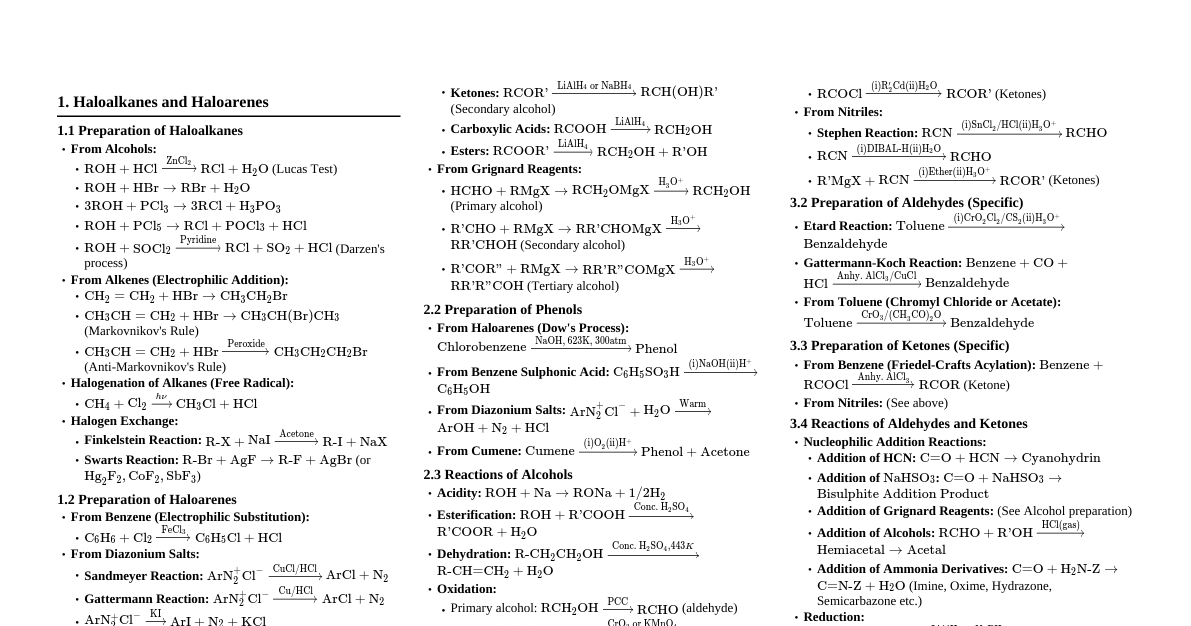
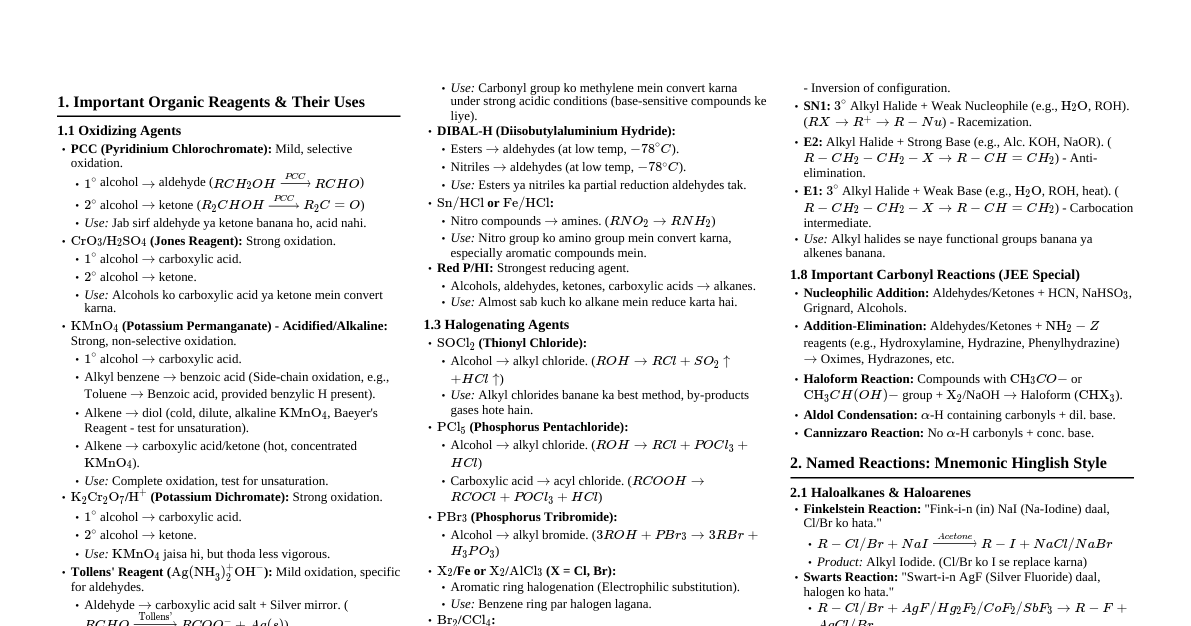
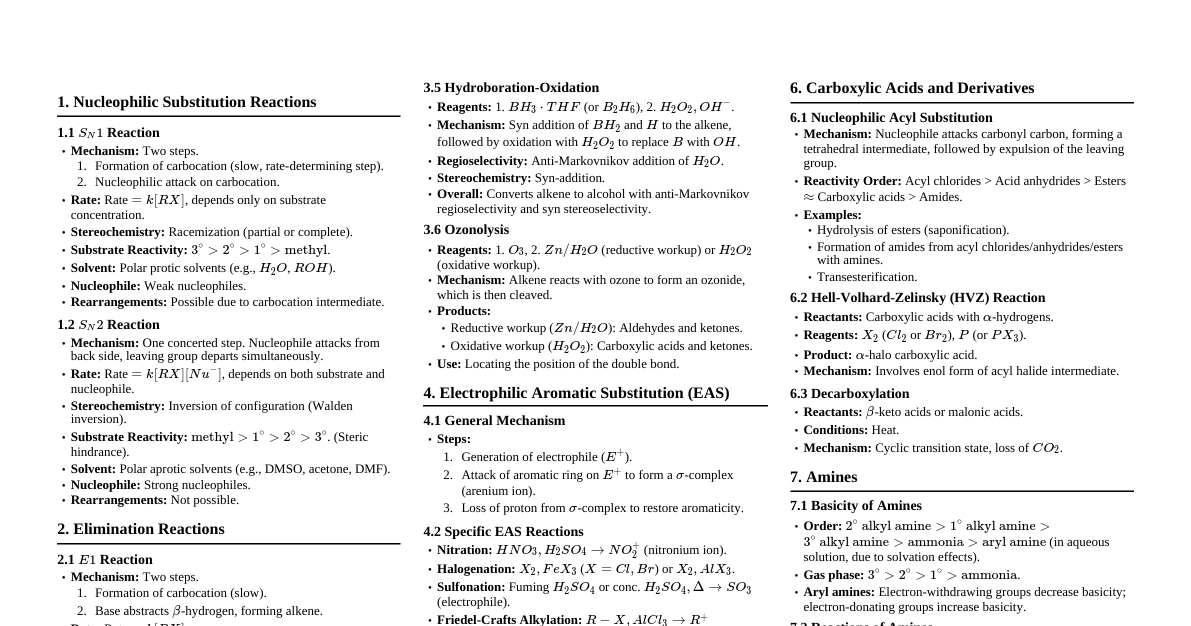
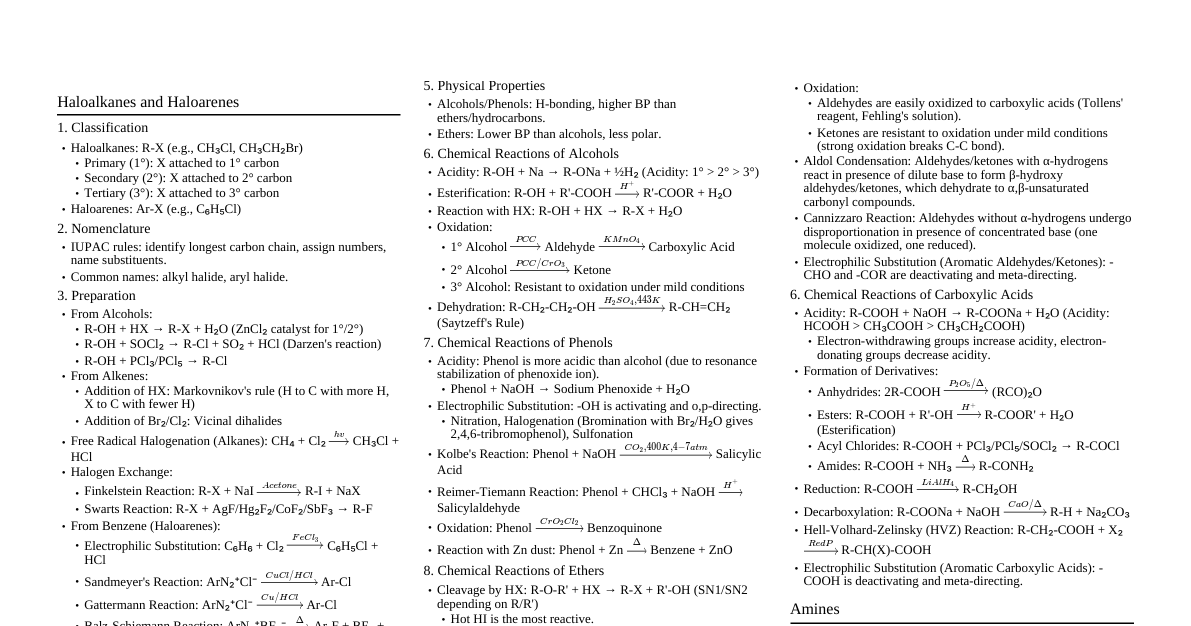
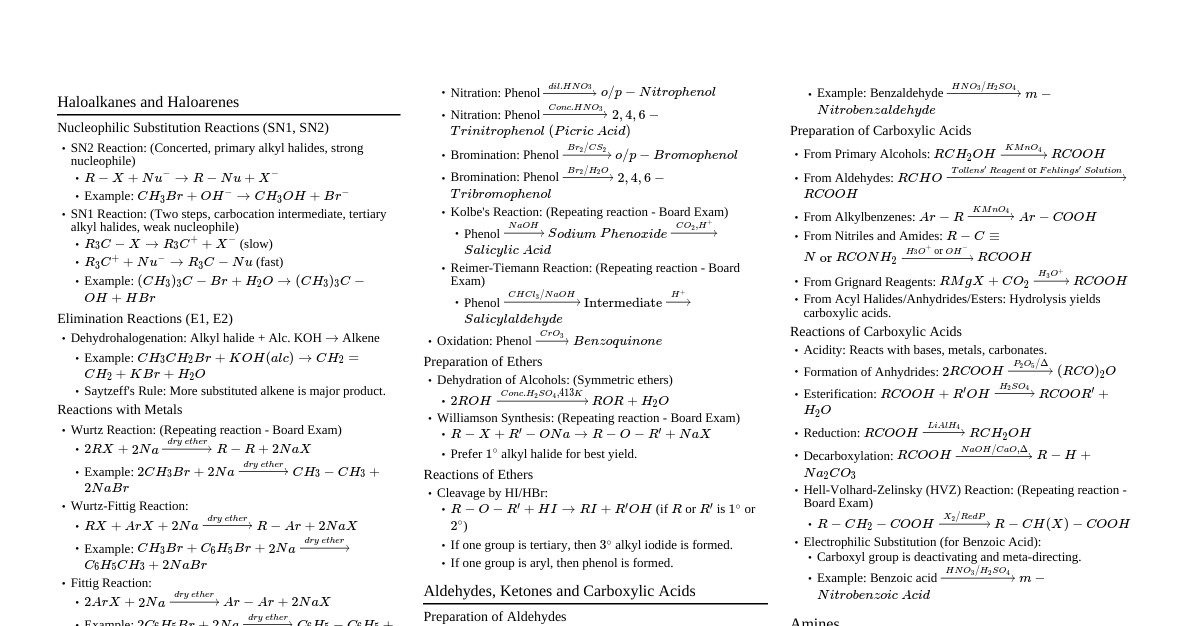
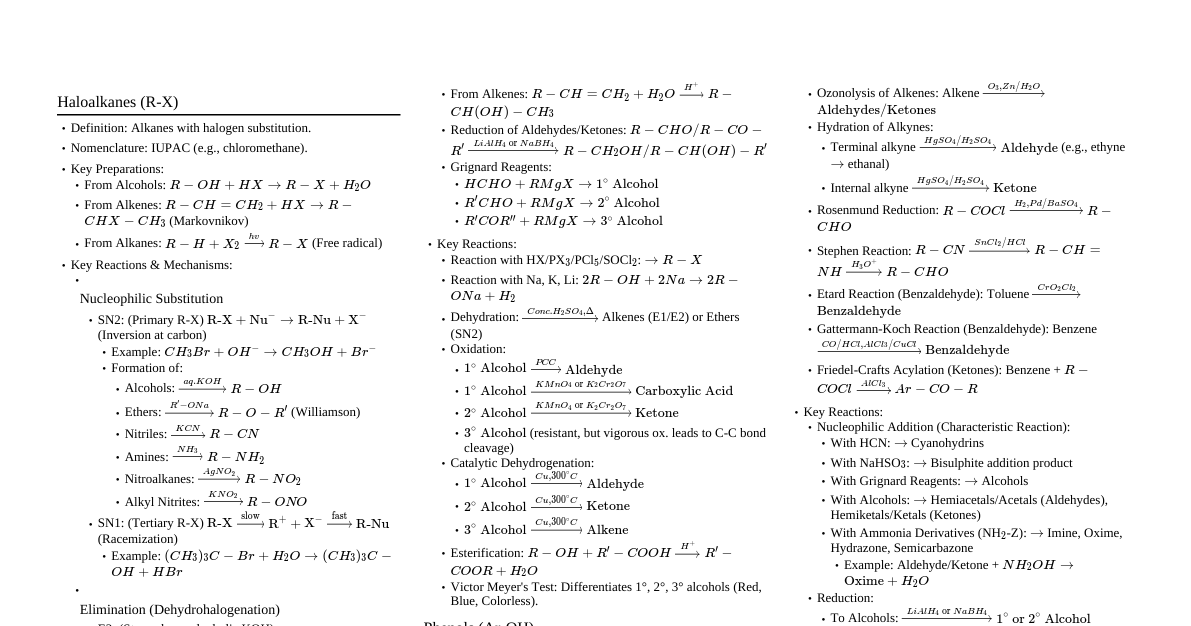
### Haloalkanes & Haloarenes - **Nucleophilic Substitution (S$_N$1 & S$_N$2)** - **S$_N$2:** Concerted, 1-step, inversion of configuration. Reactivity: $CH_3X > 1^\circ > 2^\circ$. Favored by strong nucleophiles, aprotic solvents. - **S$_N$1:** 2-step, carbocation intermediate, racemization. Reactivity: $3^\circ > 2^\circ > 1^\circ$. Favored by weak nucleophiles, protic solvents. - **Elimination Reactions (E1 & E2)** - **Dehydrohalogenation:** $R-CH_2-CH_2-X \xrightarrow{alc. KOH, \Delta} R-CH=CH_2 + KX + H_2O$. Follows Saytzeff's rule (more substituted alkene is major product). - **Reaction with Metals** - **Wurtz Reaction:** $2RX + 2Na \xrightarrow{dry \ ether} R-R + 2NaX$. For alkanes. - **Wurtz-Fittig Reaction:** $RX + ArX + 2Na \xrightarrow{dry \ ether} R-Ar + 2NaX$. For alkylarenes. - **Fittig Reaction:** $2ArX + 2Na \xrightarrow{dry \ ether} Ar-Ar + 2NaX$. For diaryls. - **Grignard Reagent:** $RX + Mg \xrightarrow{dry \ ether} R-MgX$ (alkyl magnesium halide). Reacts with compounds containing active hydrogen. ### Alcohols, Phenols & Ethers - **Alcohols** - **Oxidation:** - $1^\circ$ Alcohol $\xrightarrow{PCC}$ Aldehyde - $1^\circ$ Alcohol $\xrightarrow{K_2Cr_2O_7/H^+, \text{or } KMnO_4/H^+}$ Carboxylic Acid - $2^\circ$ Alcohol $\xrightarrow{PCC \text{ or } K_2Cr_2O_7/H^+}$ Ketone - $3^\circ$ Alcohol: No oxidation under mild conditions. - **Dehydration:** Alcohol $\xrightarrow{Conc. H_2SO_4, \Delta}$ Alkene (E1 mechanism for $2^\circ, 3^\circ$, E2 for $1^\circ$). - **Esterification:** $R-OH + R'-COOH \xrightarrow{H^+} R'-COOR + H_2O$. - **Phenols** - **Electrophilic Aromatic Substitution:** -OH is activating and o,p-directing. - **Nitration:** Phenol $\xrightarrow{dil. HNO_3}$ o-nitrophenol + p-nitrophenol - Phenol $\xrightarrow{conc. HNO_3}$ 2,4,6-Trinitrophenol (Picric Acid) - **Halogenation:** Phenol $\xrightarrow{Br_2/CS_2}$ o-bromophenol + p-bromophenol - Phenol $\xrightarrow{Br_2(aq)}$ 2,4,6-Tribromophenol (white ppt) - **Reimer-Tiemann Reaction:** Phenol $\xrightarrow{CHCl_3/NaOH \text{ then } H^+} $ Salicylaldehyde. - **Kolbe's Reaction (Kolbe-Schmidt):** Phenol $\xrightarrow{1. NaOH, 2. CO_2, \Delta, 3. H^+} $ Salicylic Acid. - **Oxidation:** Phenol $\xrightarrow{Na_2Cr_2O_7/H_2SO_4}$ Benzoquinone. - **Ethers** - **Cleavage by HI/HBr:** $R-O-R' \xrightarrow{HI \text{ or } HBr}$ $R-I + R'-OH$ (if $R$ is $1^\circ$ or $2^\circ$). If one is $3^\circ$, $3^\circ$ halide is formed. - **Electrophilic Substitution:** -OR is activating and o,p-directing. ### Aldehydes, Ketones & Carboxylic Acids - **Aldehydes & Ketones** - **Nucleophilic Addition Reactions:** - **Addition of HCN:** $R-CHO \text{ or } R_2CO \xrightarrow{HCN}$ Cyanohydrin. - **Addition of NaHSO$_3$:** Bisulphite addition product. - **Addition of Grignard Reagent:** $R-MgX \xrightarrow{1. Carbonyl, 2. H_2O}$ Alcohol. - Formaldehyde $\rightarrow 1^\circ$ Alcohol - Other Aldehydes $\rightarrow 2^\circ$ Alcohol - Ketones $\rightarrow 3^\circ$ Alcohol - **Addition of Alcohols (Acetal/Ketal formation):** $R-CHO \xrightarrow{R'OH/H^+}$ Acetal. - **Addition of Ammonia Derivatives:** Forms imines, oximes, hydrazones, etc. ($C=O + H_2N-Z \rightarrow C=N-Z + H_2O$). - **Reduction:** - **To Alcohols:** $R-CHO \text{ or } R_2CO \xrightarrow{LiAlH_4 \text{ or } NaBH_4}$ Alcohol. - **Clemmensen Reduction:** $R-CHO \text{ or } R_2CO \xrightarrow{Zn-Hg/Conc. HCl}$ Alkane. - **Wolff-Kishner Reduction:** $R-CHO \text{ or } R_2CO \xrightarrow{NH_2NH_2/KOH, \text{ethylene glycol, }\Delta}$ Alkane. - **Oxidation:** - **Aldehydes:** $R-CHO \xrightarrow{mild \text{ oxidizing agents (Tollens', Fehling's)}} R-COOH$. - **Ketones:** Require strong oxidizing agents and high temperature, C-C bond cleavage. - **Aldol Condensation:** Carbonyl compounds with $\alpha$-hydrogen. Forms $\beta$-hydroxy aldehyde/ketone, then $\alpha,\beta$-unsaturated carbonyl. - **Cannizzaro Reaction:** Aldehydes without $\alpha$-hydrogen. Disproportionation. $2R-CHO \xrightarrow{Conc. NaOH} R-CH_2OH + R-COONa$. - **Electrophilic Substitution (Aromatic Aldehydes/Ketones):** -CHO and -COR are deactivating and meta-directing. - **Carboxylic Acids** - **Acidity:** $RCOOH \leftrightarrow RCOO^- + H^+$. Electron-withdrawing groups increase acidity. - **Esterification:** $R-COOH + R'-OH \xrightarrow{H^+} R-COOR' + H_2O$. - **Reduction:** $R-COOH \xrightarrow{LiAlH_4 \text{ then } H_2O} R-CH_2OH$. (Aldehyde not formed). - **Decarboxylation:** $R-COOH \xrightarrow{NaOH/CaO, \Delta} R-H + Na_2CO_3$. - **Hell-Volhard-Zelinsky (HVZ) Reaction:** $R-CH_2-COOH \xrightarrow{X_2/Red P} R-CH(X)-COOH$. $\alpha$-halogenation. ### Amines - **Basicity:** $R-NH_2 > NH_3$. Alkyl groups increase basicity (electron-donating effect). Aromatic amines are less basic due to resonance. - **Acylation:** $R-NH_2 + CH_3COCl \rightarrow R-NHCOCH_3 + HCl$. - **Carbylamine Reaction (Isocyanide Test):** $1^\circ$ Amine $\xrightarrow{CHCl_3/KOH, \Delta}$ Alkyl Isocyanide (foul smell). - **Reaction with Nitrous Acid ($HNO_2$):** - $1^\circ$ Aliphatic amine $\xrightarrow{NaNO_2/HCl, 0-5^\circ C}$ Alcohol + $N_2$. - $1^\circ$ Aromatic amine $\xrightarrow{NaNO_2/HCl, 0-5^\circ C}$ Arenediazonium salt ($Ar-N_2^+Cl^-$). - $2^\circ$ Amine $\rightarrow$ N-nitrosoamine (yellow oily liquid). - $3^\circ$ Amine $\rightarrow$ Salt. - **Hinsberg's Test:** Differentiates $1^\circ, 2^\circ, 3^\circ$ amines using benzenesulphonyl chloride. - $1^\circ$ Amine: Forms sulphonamide, soluble in KOH. - $2^\circ$ Amine: Forms sulphonamide, insoluble in KOH. - $3^\circ$ Amine: No reaction. - **Electrophilic Substitution (Aromatic Amines):** -NH$_2$ is strongly activating and o,p-directing. - **Bromination:** Aniline $\xrightarrow{Br_2(aq)}$ 2,4,6-Tribromoaniline (white ppt). To get monosubstituted product, protect -NH$_2$ by acetylation. - **Nitration:** Direct nitration gives tarry products. Protect -NH$_2$ first. ### Diazonium Salts - **Sandmeyer Reaction:** $Ar-N_2^+Cl^- \xrightarrow{Cu_2Cl_2/HCl \text{ or } Cu_2Br_2/HBr} Ar-Cl \text{ or } Ar-Br$. - **Gattermann Reaction:** $Ar-N_2^+Cl^- \xrightarrow{Cu/HCl \text{ or } Cu/HBr} Ar-Cl \text{ or } Ar-Br$. - **Balz-Schiemann Reaction:** $Ar-N_2^+Cl^- \xrightarrow{HBF_4, \Delta} Ar-F$. - **Replacement by I:** $Ar-N_2^+Cl^- \xrightarrow{KI} Ar-I$. - **Replacement by H:** $Ar-N_2^+Cl^- \xrightarrow{H_3PO_2 \text{ or } CH_3CH_2OH} Ar-H$. - **Replacement by OH:** $Ar-N_2^+Cl^- \xrightarrow{H_2O, \Delta} Ar-OH$. - **Coupling Reactions:** Forms azo dyes (e.g., with phenol or aniline). ### Biomolecules - **Carbohydrates** - **Glucose:** Aldohexose. - **Reaction with HI:** Glucose $\xrightarrow{HI, \Delta}$ n-Hexane. (Confirms straight chain). - **Reaction with Hydroxylamine:** Forms oxime. - **Reaction with HCN:** Forms cyanohydrin. (Confirms carbonyl group). - **Oxidation:** - $\xrightarrow{Br_2(aq)}$ Gluconic Acid (mild oxidizing agent, oxidizes aldehyde to acid). - $\xrightarrow{HNO_3, \Delta}$ Saccharic Acid (strong oxidizing agent, oxidizes both aldehyde and primary alcohol). - **Reduction:** $\xrightarrow{NaBH_4 \text{ or } LiAlH_4}$ Sorbitol. - **Fructose:** Ketohexose. Reduces Tollens' and Fehling's due to isomerization to glucose in alkaline medium. - **Disaccharides:** Sucrose (glucose + fructose), Lactose (glucose + galactose), Maltose (glucose + glucose). - **Polysaccharides:** Starch, Cellulose, Glycogen. - **Proteins** - **Amino Acids:** Building blocks of proteins. Contain both -NH$_2$ and -COOH groups. - **Peptide Bond:** Formed by condensation of -COOH of one amino acid with -NH$_2$ of another. - **Denaturation:** Loss of biological activity due to change in 3D structure (e.g., heating, pH change). - **Vitamins:** Organic compounds required in small amounts for normal growth and metabolism. - **Nucleic Acids (DNA & RNA)** - **Components:** Pentose sugar (deoxyribose in DNA, ribose in RNA), Nitrogenous bases (A, T, C, G in DNA; A, U, C, G in RNA), Phosphate group. - **DNA Double Helix:** Complementary base pairing (A-T, G-C). ### Polymers - **Classification:** - **Natural:** Starch, Cellulose, Proteins, Natural Rubber. - **Synthetic:** Polyethene, PVC, Nylon, Bakelite. - **Types of Polymerization:** - **Addition Polymerization:** Monomers add to one another without elimination of small molecules. (e.g., Polyethene from ethene). - **Condensation Polymerization:** Monomers combine with elimination of small molecules (e.g., H$_2$O, HCl). (e.g., Nylon 6,6, Terylene). - **Important Polymers & Monomers:** - **Polyethene:** Ethene - **PVC:** Vinyl Chloride - **Teflon:** Tetrafluoroethene - **Natural Rubber:** Isoprene - **Nylon 6,6:** Hexamethylenediamine + Adipic Acid - **Nylon 6:** Caprolactam - **Terylene (Dacron):** Ethylene Glycol + Terephthalic Acid - **Bakelite:** Phenol + Formaldehyde ### Chemistry in Everyday Life - **Drugs** - **Analgesics:** Pain relievers (e.g., Aspirin, Paracetamol). - **Tranquilizers:** Reduce stress and anxiety (e.g., Equanil). - **Antiseptics:** Applied to living tissues (e.g., Dettol, Savlon). - **Disinfectants:** Applied to inanimate objects (e.g., Chlorine, Phenol). - **Antibiotics:** Treat bacterial infections (e.g., Penicillin, Chloramphenicol). - **Antacids:** Neutralize excess acid in stomach (e.g., Mg(OH)$_2$, Al(OH)$_3$). - **Antihistamines:** Counteract histamine effects (e.g., Seldane, Terfenadine). - **Food Preservatives:** Prevent spoilage (e.g., Sodium Benzoate). - **Artificial Sweeteners:** Sucralose, Aspartame, Saccharin. - **Soaps & Detergents:** - **Soaps:** Sodium/Potassium salts of long-chain fatty acids. - **Detergents:** Synthetic cleaning agents, work well in hard water.