Organic Chemistry Class 12 NEB
Cheatsheet Content
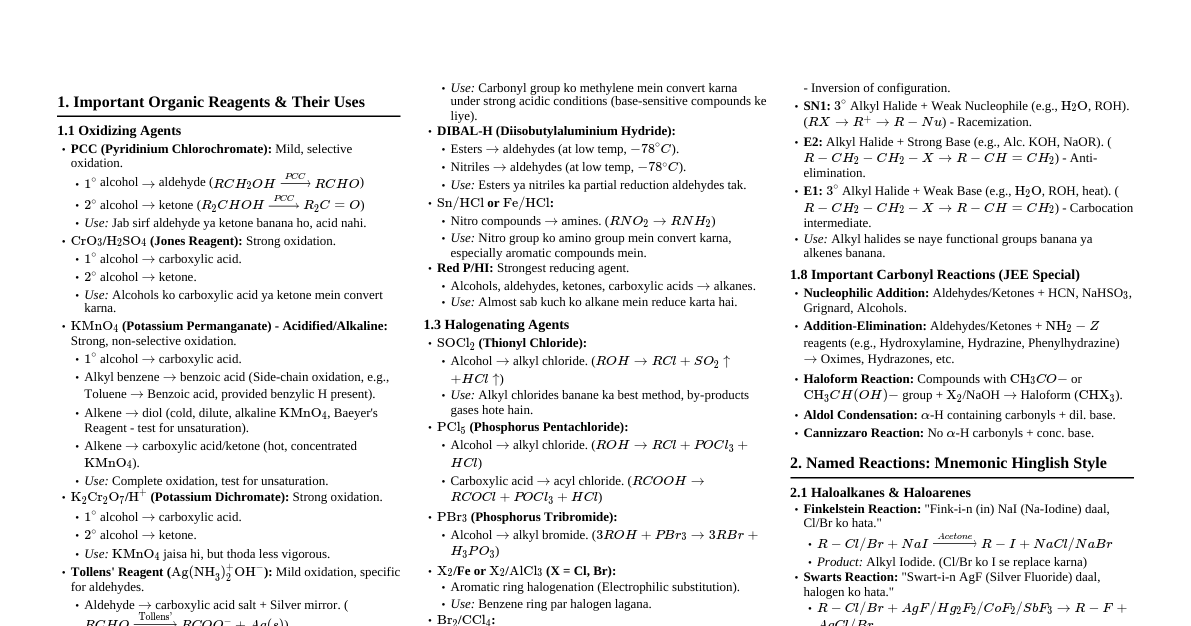
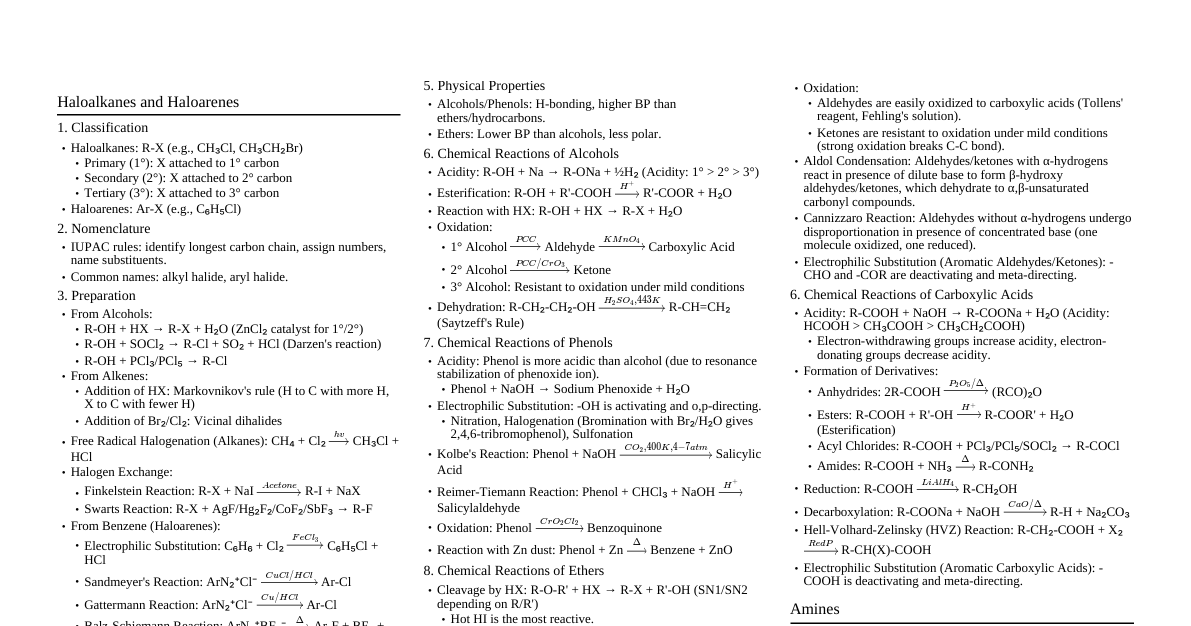
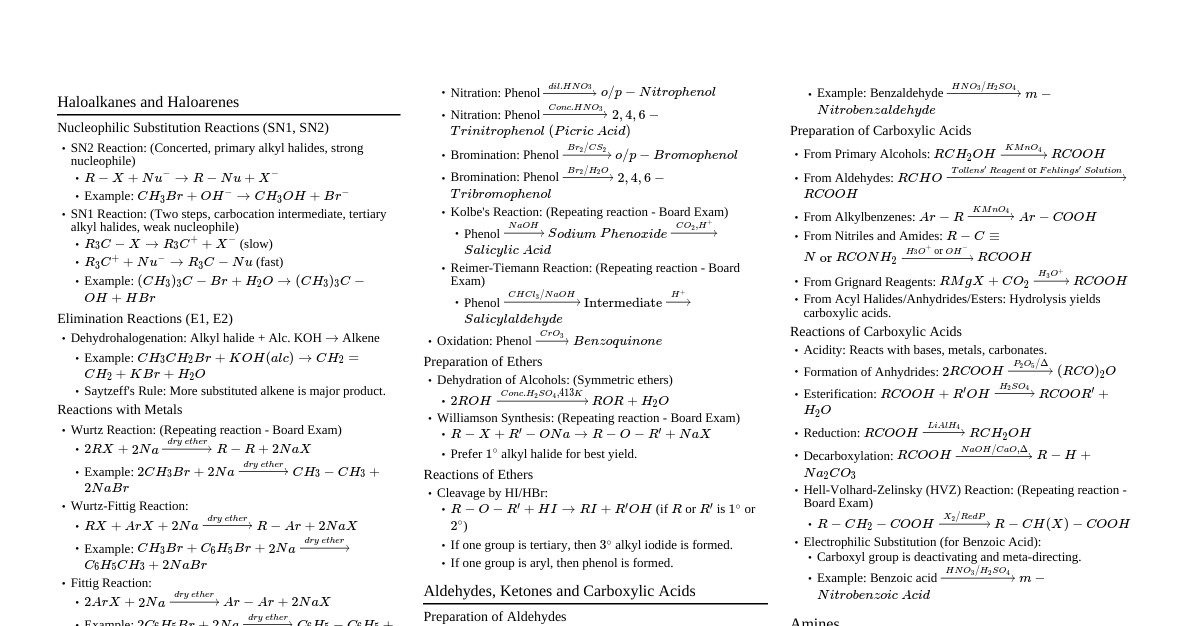
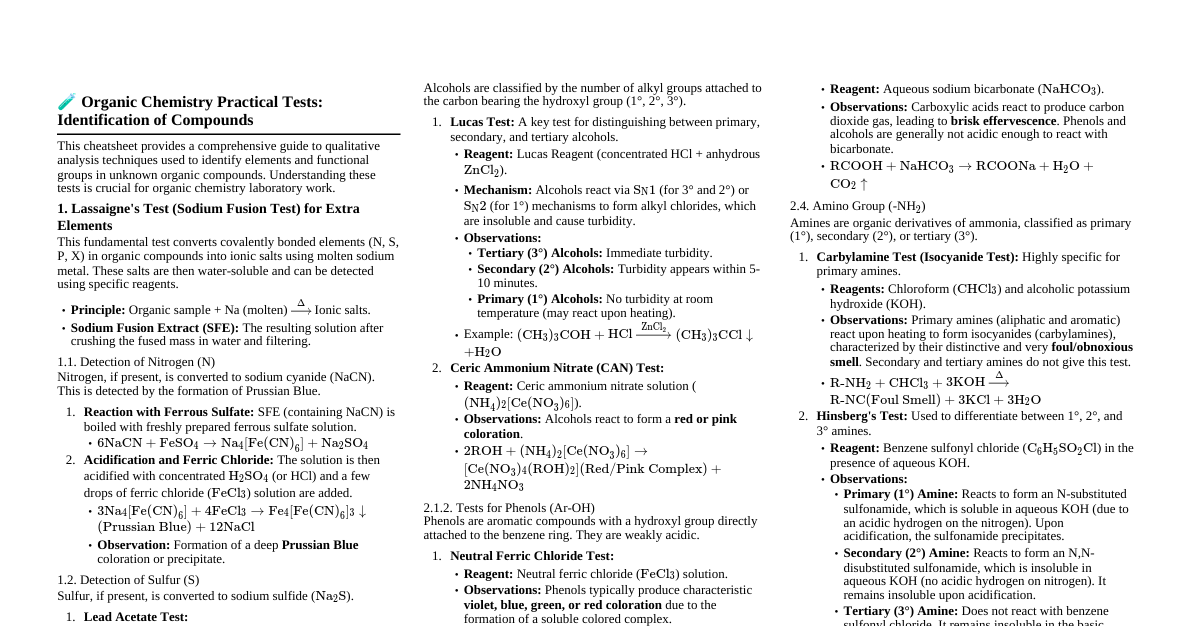
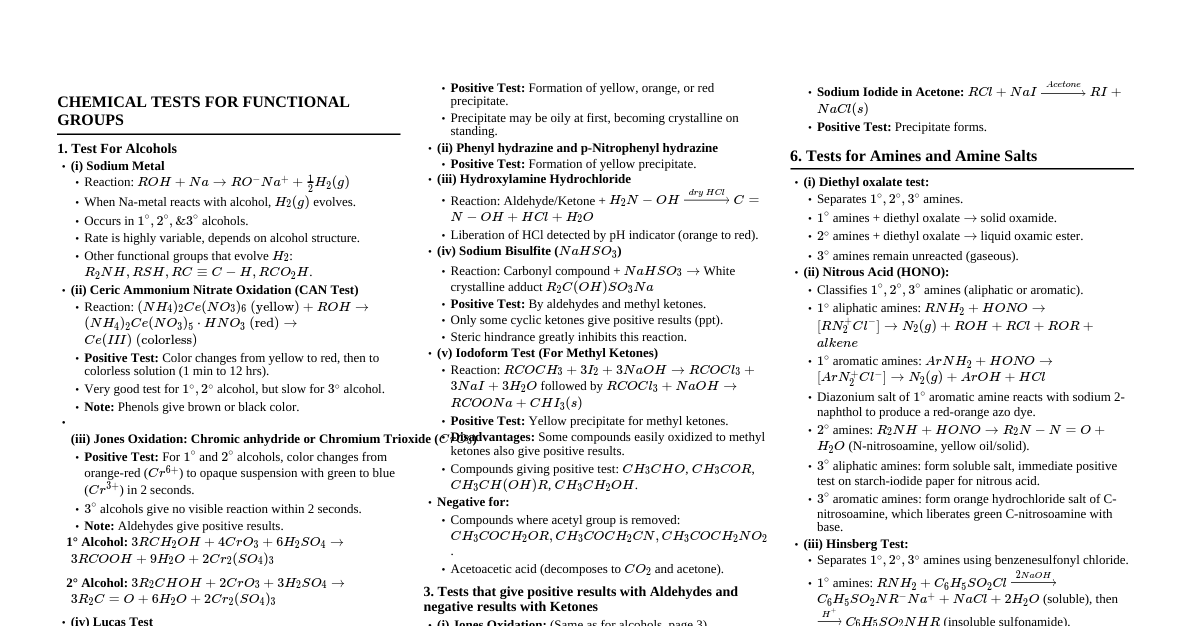
### Haloalkanes (R-X) - **Definition:** Alkanes with halogen substitution. - **Nomenclature:** IUPAC (e.g., chloromethane). - **Key Preparations:** - **From Alcohols:** $R-OH + HX \rightarrow R-X + H_2O$ - **From Alkenes:** $R-CH=CH_2 + HX \rightarrow R-CHX-CH_3$ (Markovnikov) - **From Alkanes:** $R-H + X_2 \xrightarrow{hv} R-X$ (Free radical) - **Key Reactions & Mechanisms:** - #### Nucleophilic Substitution - **SN2:** (Primary R-X) $\text{R-X} + \text{Nu}^- \rightarrow \text{R-Nu} + \text{X}^-$ (Inversion at carbon) - *Example:* $CH_3Br + OH^- \rightarrow CH_3OH + Br^-$ - **Formation of:** - **Alcohols:** $\xrightarrow{aq. KOH} R-OH$ - **Ethers:** $\xrightarrow{R'-ONa} R-O-R'$ (Williamson) - **Nitriles:** $\xrightarrow{KCN} R-CN$ - **Amines:** $\xrightarrow{NH_3} R-NH_2$ - **Nitroalkanes:** $\xrightarrow{AgNO_2} R-NO_2$ - **Alkyl Nitrites:** $\xrightarrow{KNO_2} R-ONO$ - **SN1:** (Tertiary R-X) $\text{R-X} \xrightarrow{\text{slow}} \text{R}^+ + \text{X}^- \xrightarrow{\text{fast}} \text{R-Nu}$ (Racemization) - *Example:* $(CH_3)_3C-Br + H_2O \rightarrow (CH_3)_3C-OH + HBr$ - #### Elimination (Dehydrohalogenation) - **E2:** (Strong base, alcoholic KOH) $\text{R-CH}_2\text{-CH}_2\text{-X} \xrightarrow{\text{Alc. KOH, } \Delta} \text{R-CH=CH}_2 + \text{HX}$ (Saytzeff's Rule) - **Wurtz Reaction:** $2R-X + 2Na \xrightarrow{dry \ ether} R-R + 2NaX$ - **Reduction:** $R-X \xrightarrow{LiAlH_4 \text{ or } Zn/HCl} R-H$ - **Trichloromethane (Chloroform, CHCl$_3$):** - **Preparation:** From Ethanol/Propanone (Haloform reaction). - **Reactions:** - Oxidation: $CHCl_3 + O_2 \xrightarrow{light} COCl_2 \text{ (Phosgene)} + HCl$ - Reduction: $CHCl_3 \xrightarrow{Zn/HCl} CH_2Cl_2$ - With Ag powder: $2CHCl_3 + 6Ag \xrightarrow{\Delta} C_2H_2 + 6AgCl$ - With Conc. HNO$_3$: $CHCl_3 + HNO_3 \rightarrow CCl_3NO_2 \text{ (Chloropicrin)} + H_2O$ - With Propanone: $CHCl_3 + (CH_3)_2CO \xrightarrow{KOH} (CH_3)_2C(OH)CCl_3 \text{ (Chloritone)}$ - With Aqueous Alkali: $CHCl_3 + 4KOH \rightarrow HCOOK + 3KCl + 2H_2O$ ### Haloarenes (Ar-X) - **Definition:** Halogen directly bonded to an aromatic ring. - **Nomenclature:** (e.g., chlorobenzene). - **Key Preparations:** - **Halogenation of Benzene:** Benzene + $X_2 \xrightarrow{FeX_3} \text{Ar-X} + HX$ - **Sandmeyer Reaction:** $Ar-N_2^+Cl^- \xrightarrow{CuX/HX} Ar-X + N_2$ (for chlorobenzene from benzene diazonium chloride) - **Key Properties & Reactions:** - **Low Reactivity to SN Reactions:** Due to resonance stabilization, $sp^2$ carbon of C-X bond, and repulsion from electron-rich arene. - **Electrophilic Aromatic Substitution (EAS):** Halogens are deactivating but ortho/para directing. - **Nitration:** $\xrightarrow{Conc. HNO_3/H_2SO_4}$ Nitrohaloarenes (o/p) - **Sulfonation:** $\xrightarrow{Conc. H_2SO_4}$ Halobenzenesulfonic acids (o/p) - **Halogenation:** $\xrightarrow{X_2/FeX_3}$ Dihalobenzenes (o/p) - **Reduction of Chlorobenzene:** $\xrightarrow{Ni/H_2 \text{ or } LiAlH_4} \text{Benzene}$ - **Wurtz-Fittig Reaction:** $Ar-X + R-X + 2Na \xrightarrow{dry \ ether} Ar-R + 2NaX$ - **Fittig Reaction:** $2Ar-X + 2Na \xrightarrow{dry \ ether} Ar-Ar + 2NaX$ - **Action with Chloral:** Chlorobenzene $\xrightarrow{Chloral/Conc. H_2SO_4} DDT$ ### Alcohols (R-OH) - **Definition:** -OH group on aliphatic carbon. - **Classification:** 1°, 2°, 3°. - **Nomenclature:** "-ol" suffix. - **Key Preparations:** - **From Haloalkanes:** $R-X \xrightarrow{aq. KOH} R-OH$ - **From Alkenes:** $R-CH=CH_2 + H_2O \xrightarrow{H^+} R-CH(OH)-CH_3$ - **Reduction of Aldehydes/Ketones:** $R-CHO/R-CO-R' \xrightarrow{LiAlH_4 \text{ or } NaBH_4} R-CH_2OH/R-CH(OH)-R'$ - **Grignard Reagents:** - $HCHO + RMgX \rightarrow 1^\circ \text{ Alcohol}$ - $R'CHO + RMgX \rightarrow 2^\circ \text{ Alcohol}$ - $R'COR'' + RMgX \rightarrow 3^\circ \text{ Alcohol}$ - **Key Reactions:** - **Reaction with HX/PX$_3$/PCl$_5$/SOCl$_2$:** $\rightarrow R-X$ - **Reaction with Na, K, Li:** $2R-OH + 2Na \rightarrow 2R-ONa + H_2$ - **Dehydration:** $\xrightarrow{Conc. H_2SO_4, \Delta}$ Alkenes (E1/E2) or Ethers (SN2) - **Oxidation:** - $1^\circ \text{ Alcohol} \xrightarrow{PCC} \text{Aldehyde}$ - $1^\circ \text{ Alcohol} \xrightarrow{KMnO_4 \text{ or } K_2Cr_2O_7} \text{Carboxylic Acid}$ - $2^\circ \text{ Alcohol} \xrightarrow{KMnO_4 \text{ or } K_2Cr_2O_7} \text{Ketone}$ - $3^\circ \text{ Alcohol}$ (resistant, but vigorous ox. leads to C-C bond cleavage) - **Catalytic Dehydrogenation:** - $1^\circ \text{ Alcohol} \xrightarrow{Cu, 300^\circ C} \text{Aldehyde}$ - $2^\circ \text{ Alcohol} \xrightarrow{Cu, 300^\circ C} \text{Ketone}$ - $3^\circ \text{ Alcohol} \xrightarrow{Cu, 300^\circ C} \text{Alkene}$ - **Esterification:** $R-OH + R'-COOH \xrightarrow{H^+} R'-COOR + H_2O$ - **Victor Meyer's Test:** Differentiates 1°, 2°, 3° alcohols (Red, Blue, Colorless). ### Phenols (Ar-OH) - **Definition:** -OH group directly on benzene ring. - **Acidity:** More acidic than alcohols due to resonance stabilization of phenoxide ion. - **Key Preparations:** - **From Chlorobenzene:** $C_6H_5Cl + NaOH \xrightarrow{300^\circ C} C_6H_5ONa \xrightarrow{H^+} C_6H_5OH$ - **From Diazonium Salt:** $Ar-N_2^+Cl^- \xrightarrow{H_2O, \Delta} Ar-OH + N_2 + HCl$ - **From Benzene Sulfonic Acid:** $C_6H_5SO_3H \xrightarrow{NaOH, \Delta} C_6H_5ONa \xrightarrow{H^+} C_6H_5OH$ - **Key Reactions:** - **Acidic Nature:** Reacts with NaOH. - **Reaction with Zn dust:** $Ar-OH \xrightarrow{Zn} \text{Benzene} + ZnO$ - **Electrophilic Aromatic Substitution (EAS):** -OH is strongly activating and ortho/para directing. - **Bromination:** $\xrightarrow{Br_2/H_2O} \text{2,4,6-Tribromophenol}$ - **Nitration:** $\xrightarrow{Dil. HNO_3} \text{o-/p-Nitrophenol}$ ; $\xrightarrow{Conc. HNO_3} \text{Picric Acid (2,4,6-Trinitrophenol)}$ - **Sulfonation:** $\xrightarrow{Conc. H_2SO_4}$ Phenolsulfonic acids (o/p) - **Friedel-Crafts Alkylation/Acylation:** (Not directly, requires protection or specific conditions) - **Reimer-Tiemann Reaction:** Phenol $\xrightarrow{CHCl_3/NaOH} \text{Salicylaldehyde}$ - **Kolbe's Reaction:** Phenol $\xrightarrow{CO_2/NaOH} \text{Salicylic Acid}$ - **Oxidation:** $\xrightarrow{K_2Cr_2O_7/H_2SO_4}$ Quinones - **FeCl$_3$ Test:** Gives characteristic color (violet). ### Ethers (R-O-R') - **Definition:** Oxygen atom bonded to two alkyl/aryl groups. - **Nomenclature:** Alkoxyalkane (e.g., methoxyethane). - **Key Preparations:** - **Williamson Synthesis:** $R-ONa + R'-X \rightarrow R-O-R' + NaX$ (Best for 1° R'-X) - **Dehydration of Alcohols:** $2R-OH \xrightarrow{Conc. H_2SO_4, 140^\circ C} R-O-R + H_2O$ (Symmetric ethers) - **Key Reactions:** - **Cleavage by Hot HI/HBr:** $R-O-R' + HI \xrightarrow{\Delta} R-I + R'-OH$ (or $R-I + R'-I$ if excess HI) - If one group is aryl: $Ar-O-R + HI \rightarrow Ar-OH + R-I$ - **Peroxide Formation:** $R-O-R \xrightarrow{O_2 \text{ (air)}} \text{R-O-O-R}$ (explosive) - **Electrophilic Substitution (for Aromatic Ethers):** -OR is activating and ortho/para directing. ### Aldehydes (RCHO) & Ketones (RCOR') - **Definition:** Carbonyl group ($C=O$). Aldehydes have H on carbonyl, Ketones have two C groups. - **Nomenclature:** Aldehydes "-al", Ketones "-one". - **Key Preparations:** - **Oxidation of Alcohols:** $1^\circ \text{ alcohol} \xrightarrow{PCC} \text{Aldehyde}$; $2^\circ \text{ alcohol} \xrightarrow{Oxidizing \ agent} \text{Ketone}$ - **Ozonolysis of Alkenes:** Alkene $\xrightarrow{O_3, Zn/H_2O} \text{Aldehydes/Ketones}$ - **Hydration of Alkynes:** - Terminal alkyne $\xrightarrow{HgSO_4/H_2SO_4} \text{Aldehyde}$ (e.g., ethyne $\rightarrow$ ethanal) - Internal alkyne $\xrightarrow{HgSO_4/H_2SO_4} \text{Ketone}$ - **Rosenmund Reduction:** $R-COCl \xrightarrow{H_2, Pd/BaSO_4} R-CHO$ - **Stephen Reaction:** $R-CN \xrightarrow{SnCl_2/HCl} R-CH=NH \xrightarrow{H_3O^+} R-CHO$ - **Etard Reaction (Benzaldehyde):** Toluene $\xrightarrow{CrO_2Cl_2} \text{Benzaldehyde}$ - **Gattermann-Koch Reaction (Benzaldehyde):** Benzene $\xrightarrow{CO/HCl, AlCl_3/CuCl} \text{Benzaldehyde}$ - **Friedel-Crafts Acylation (Ketones):** Benzene + $R-COCl \xrightarrow{AlCl_3} Ar-CO-R$ - **Key Reactions:** - **Nucleophilic Addition (Characteristic Reaction):** - **With HCN:** $\rightarrow$ Cyanohydrins - **With NaHSO$_3$:** $\rightarrow$ Bisulphite addition product - **With Grignard Reagents:** $\rightarrow$ Alcohols - **With Alcohols:** $\rightarrow$ Hemiacetals/Acetals (Aldehydes), Hemiketals/Ketals (Ketones) - **With Ammonia Derivatives (NH$_2$-Z):** $\rightarrow$ Imine, Oxime, Hydrazone, Semicarbazone - *Example:* Aldehyde/Ketone + $NH_2OH \rightarrow \text{Oxime} + H_2O$ - **Reduction:** - **To Alcohols:** $\xrightarrow{LiAlH_4 \text{ or } NaBH_4} 1^\circ \text{ or } 2^\circ \text{ Alcohol}$ - **Clemmensen Reduction:** $\xrightarrow{Zn-Hg/HCl} \text{Alkanes}$ - **Wolff-Kishner Reduction:** $\xrightarrow{N_2H_4/KOH, \Delta} \text{Alkanes}$ - **Oxidation:** - **Aldehydes:** $\xrightarrow{Tollens' \ Reagent} \text{Silver Mirror}$ (R-COOH); $\xrightarrow{Fehling's \ Solution} \text{Red ppt}$ (R-COOH) - **Ketones:** Generally resistant, require vigorous conditions (C-C bond cleavage). - **Aldol Condensation:** Aldehydes/Ketones with $\alpha$-hydrogens $\xrightarrow{Dil. NaOH} \beta\text{-Hydroxycarbonyl} \xrightarrow{\Delta} \alpha,\beta\text{-Unsaturated Carbonyl}$ - **Cannizzaro Reaction:** Aldehydes without $\alpha$-hydrogens $\xrightarrow{Conc. NaOH} \text{Alcohol} + \text{Carboxylate Salt}$ - **Haloform Reaction:** Methyl ketones, ethanol, secondary alcohols with methyl group $\xrightarrow{X_2/NaOH} \text{Haloform (CHX}_3\text{)}$ - **Perkin Condensation (Benzaldehyde):** Benzaldehyde + Acetic Anhydride $\xrightarrow{CH_3COONa} \text{Cinnamic acid}$ - **Benzoin Condensation (Benzaldehyde):** $2C_6H_5CHO \xrightarrow{KCN} C_6H_5CH(OH)COC_6H_5$ ### Carboxylic Acids (R-COOH) - **Definition:** Contains carboxyl group (-COOH). - **Nomenclature:** "-oic acid". - **Acidity:** More acidic than phenols > alcohols. - **Key Preparations:** - **Oxidation of $1^\circ$ Alcohols/Aldehydes:** $R-CH_2OH/R-CHO \xrightarrow{KMnO_4 \text{ or } K_2Cr_2O_7} R-COOH$ - **Hydrolysis of Nitriles:** $R-CN \xrightarrow{H_2O/H^+} R-COOH$ - **Grignard with CO$_2$:** $R-MgX + CO_2 \rightarrow R-COOMgX \xrightarrow{H_3O^+} R-COOH$ - **Oxidation of Alkylbenzenes:** Toluene $\xrightarrow{KMnO_4} \text{Benzoic Acid}$ - **Key Reactions:** - **Acidic Character:** Reacts with bases, Na, NaHCO$_3$. - **Esterification:** $R-COOH + R'-OH \xrightarrow{H^+} R-COOR' + H_2O$ - **Formation of Acid Chlorides:** $R-COOH \xrightarrow{SOCl_2 \text{ or } PCl_5 \text{ or } PCl_3} R-COCl$ - **Formation of Amides:** $R-COOH + NH_3 \rightarrow R-COONH_4 \xrightarrow{\Delta} R-CONH_2$ - **Reduction:** $\xrightarrow{LiAlH_4} 1^\circ \text{ Alcohol}$ - **Hell-Volhard-Zelinsky (HVZ) Reaction:** $R-CH_2-COOH \xrightarrow{Br_2/Red \ P} R-CH(Br)-COOH$ - **Decarboxylation:** $R-COOH \xrightarrow{NaOH/CaO, \Delta} R-H$ - **Effect of Substituents on Acidity:** Electron-withdrawing groups increase acidity; electron-donating groups decrease acidity. - **Derivatives of Carboxylic Acids:** (Acid halides, Anhydrides, Esters, Amides) - **Reactivity Order (towards Nucleophiles):** Acid Chloride > Anhydride > Ester > Amide - **Hydrolysis:** All derivatives hydrolyze to carboxylic acids. - **Ammonolysis:** Acid derivatives + $NH_3 \rightarrow$ Amides - **Alcoholysis:** Acid derivatives + $R-OH \rightarrow$ Esters - **Reduction:** Esters/Amides $\xrightarrow{LiAlH_4} \text{Alcohols/Amines}$ - **Hofmann Bromamide Degradation (Amides):** $R-CONH_2 \xrightarrow{Br_2/KOH} R-NH_2$ (one C less) ### Nitro Compounds (R-NO$_2$) - **Definition:** Organic compounds with -NO$_2$ group. - **Nomenclature:** Nitroalkane (e.g., nitromethane), Nitrobenzene. - **Key Preparations:** - **Nitroalkanes:** - **From Haloalkanes:** $R-X + AgNO_2 \rightarrow R-NO_2 + AgX$ - **From Alkanes:** $R-H + HNO_3 \xrightarrow{\Delta} R-NO_2$ (Vapor phase nitration) - **Nitrobenzene:** - **From Benzene:** Benzene $\xrightarrow{Conc. HNO_3/Conc. H_2SO_4} \text{Nitrobenzene}$ - **Key Reactions:** - **Reduction:** - **Nitroalkanes:** $R-NO_2 \xrightarrow{Sn/HCl \text{ or } LiAlH_4} R-NH_2$ (Primary Amine) - **Nitrobenzene:** - $\xrightarrow{Sn/HCl \text{ or } Fe/HCl} \text{Aniline}$ - $\xrightarrow{Zn/NH_4Cl} \text{Phenylhydroxylamine}$ - $\xrightarrow{Zn/NaOH} \text{Hydrazobenzene}$ - $\xrightarrow{Electrolytic \ reduction} \text{p-aminophenol}$ - **Electrophilic Aromatic Substitution (Nitrobenzene):** -NO$_2$ is strongly deactivating and meta-directing. - **Nitration:** $\xrightarrow{Conc. HNO_3/H_2SO_4} \text{m-Dinitrobenzene}$ - **Halogenation:** $\xrightarrow{X_2/FeX_3} \text{m-Halonitrobenzene}$ - **Sulfonation:** $\xrightarrow{Conc. H_2SO_4} \text{m-Nitrobenzenesulfonic acid}$ ### Amines (R-NH$_2$, R$_2$NH, R$_3$N) - **Definition:** Derivatives of ammonia. - **Classification:** Primary (1°), Secondary (2°), Tertiary (3°). - **Nomenclature:** Alkylamine (e.g., methylamine), or amino- prefix. - **Basicity:** Basic due to lone pair on N. Aliphatic amines > Ammonia > Aromatic amines. - **Key Preparations:** - **Reduction of Nitro Compounds:** $R-NO_2 \xrightarrow{Sn/HCl} R-NH_2$; Nitrobenzene $\rightarrow$ Aniline - **Ammonolysis of Haloalkanes:** $R-X + NH_3 \rightarrow R-NH_2$ (can lead to 2°, 3° amines) - **Gabriel Phthalimide Synthesis:** For pure $1^\circ$ amines. - **Hofmann Bromamide Degradation:** $R-CONH_2 \xrightarrow{Br_2/KOH} R-NH_2$ (one C less) - **Reduction of Nitriles:** $R-CN \xrightarrow{LiAlH_4 \text{ or } H_2/Ni} R-CH_2NH_2$ - **Reduction of Amides:** $R-CONH_2 \xrightarrow{LiAlH_4} R-CH_2NH_2$ - **Key Reactions:** - **Basicity:** Reacts with acids to form salts. - **Alkylation:** $R-NH_2 + R'-X \rightarrow R-NHR' \rightarrow R_2NR' \rightarrow R_3NR' \rightarrow R_4N^+X^-$ (Quaternary salt) - **Acylation:** $R-NH_2 + R'-COCl \rightarrow R-NHCOR' + HCl$ (Amide formation) - **Carbylamine Reaction (Isocyanide Test):** $1^\circ \text{ Amine} + CHCl_3 + 3KOH \xrightarrow{\Delta} R-NC + 3KCl + 3H_2O$ (Foul smell) - **Reaction with Nitrous Acid (NaNO$_2$/HCl):** - $1^\circ \text{ Aliphatic Amine}: R-NH_2 \xrightarrow{HNO_2} R-OH + N_2 + H_2O$ - $1^\circ \text{ Aromatic Amine}: Ar-NH_2 \xrightarrow{HNO_2, 0-5^\circ C} Ar-N_2^+Cl^-$ (Diazonium Salt) - $2^\circ \text{ Amine}: R_2NH \xrightarrow{HNO_2} R_2N-N=O$ (N-Nitrosamine, yellow oil) - $3^\circ \text{ Amine}: R_3N + HNO_2 \rightarrow \text{Salt}$ - **Hinsberg Test:** Differentiates $1^\circ$, $2^\circ$, $3^\circ$ amines using Benzenesulfonyl chloride. - **Electrophilic Aromatic Substitution (Aniline):** -NH$_2$ is strongly activating and ortho/para directing. - **Bromination:** $\xrightarrow{Br_2/H_2O} \text{2,4,6-Tribromoaniline}$ (To get monosubstituted, protect -NH$_2$ group by acetylation first). - **Nitration:** Direct nitration leads to oxidation and meta product. Acetylate first. - **Sulfonation:** $\xrightarrow{Conc. H_2SO_4} \text{Sulfanilic acid}$ - **Diazotization Reactions (from Aniline):** - Sandmeyer: $Ar-N_2^+Cl^- \xrightarrow{CuCl/HCl} Ar-Cl$; $\xrightarrow{CuBr/HBr} Ar-Br$; $\xrightarrow{CuCN/KCN} Ar-CN$ - Gattermann: Similar to Sandmeyer, but with Cu powder. - Coupling Reaction: $Ar-N_2^+Cl^- + \text{Phenol/Aniline} \rightarrow \text{Azo Dye}$