Exam Cheatsheet
Cheatsheet Content
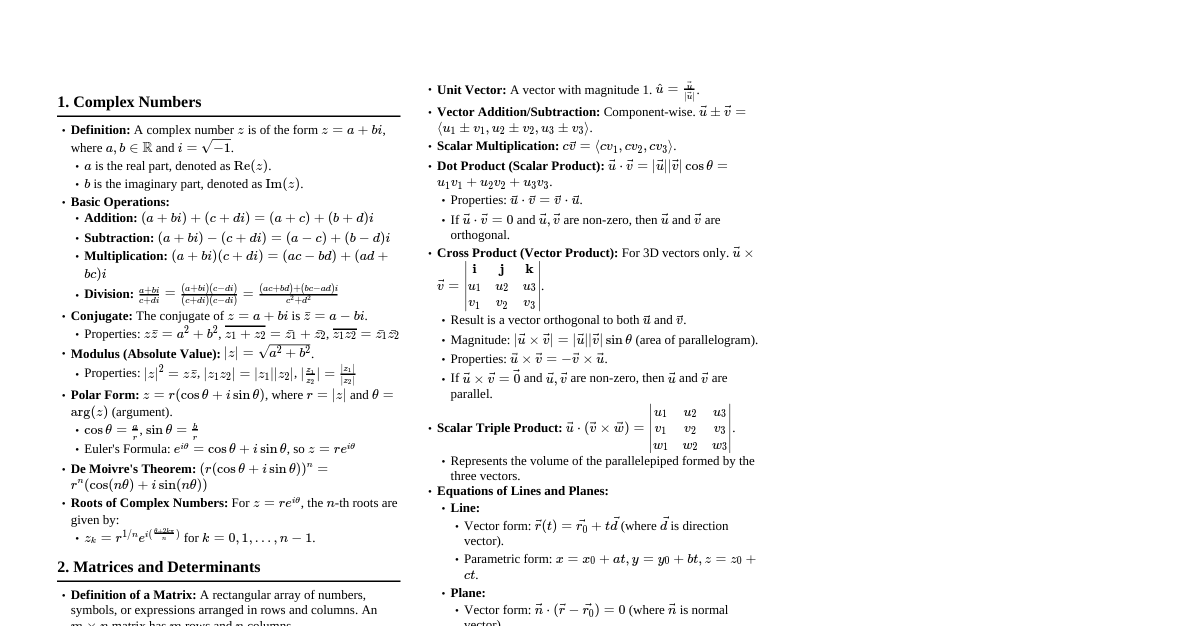
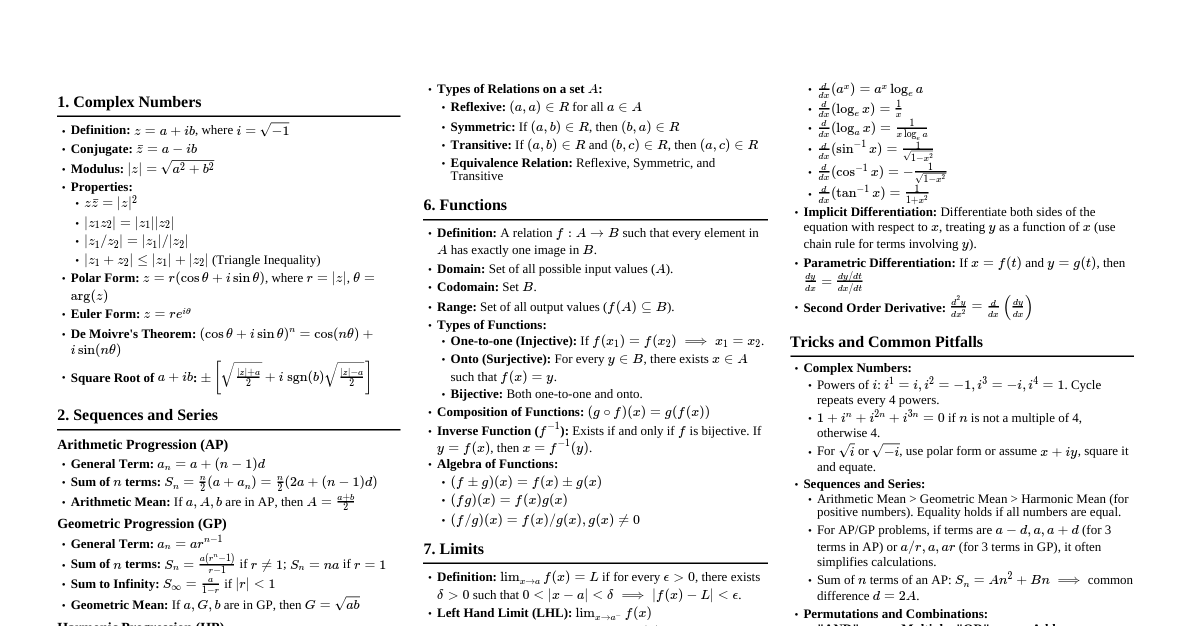
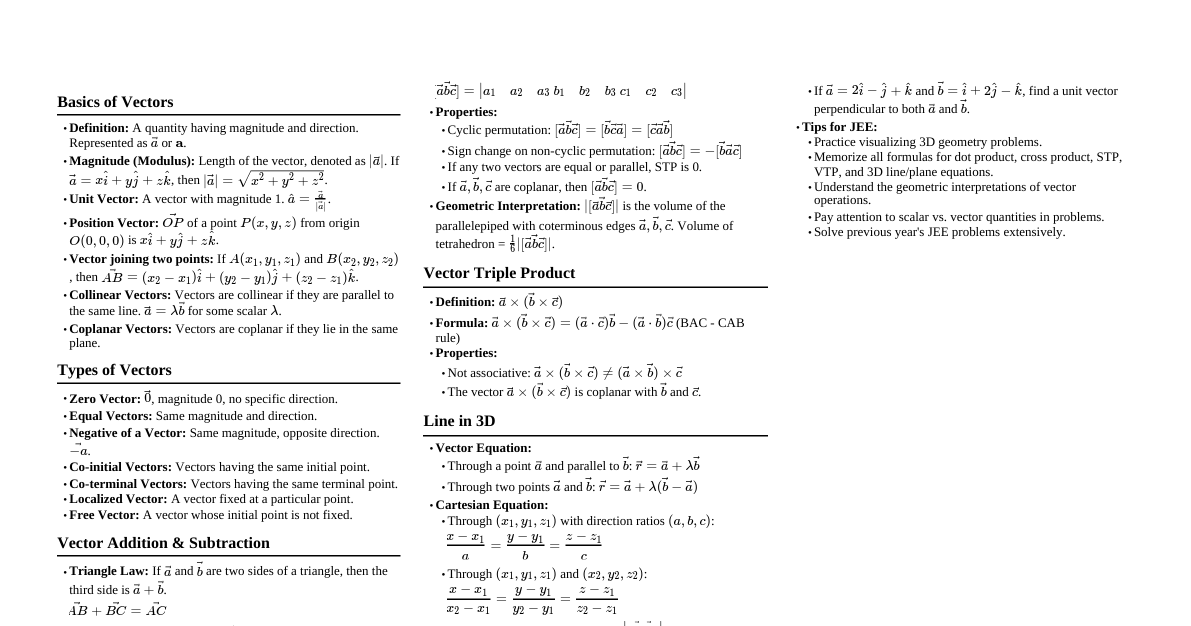
1. Complex Numbers Definition: A complex number $z$ is of the form $z = a + bi$, where $a, b \in \mathbb{R}$ and $i = \sqrt{-1}$. $a$ is the real part, denoted as $\text{Re}(z)$. $b$ is the imaginary part, denoted as $\text{Im}(z)$. Basic Operations: Addition: $(a+bi) + (c+di) = (a+c) + (b+d)i$ Subtraction: $(a+bi) - (c+di) = (a-c) + (b-d)i$ Multiplication: $(a+bi)(c+di) = (ac-bd) + (ad+bc)i$ Division: $\frac{a+bi}{c+di} = \frac{(a+bi)(c-di)}{(c+di)(c-di)} = \frac{(ac+bd) + (bc-ad)i}{c^2+d^2}$ Conjugate: The conjugate of $z = a+bi$ is $\bar{z} = a-bi$. Properties: $z\bar{z} = a^2+b^2$, $\overline{z_1+z_2} = \bar{z_1}+\bar{z_2}$, $\overline{z_1z_2} = \bar{z_1}\bar{z_2}$ Modulus (Absolute Value): $|z| = \sqrt{a^2+b^2}$. Properties: $|z|^2 = z\bar{z}$, $|z_1z_2| = |z_1||z_2|$, $|\frac{z_1}{z_2}| = \frac{|z_1|}{|z_2|}$ Polar Form: $z = r(\cos\theta + i\sin\theta)$, where $r = |z|$ and $\theta = \arg(z)$ (argument). $\cos\theta = \frac{a}{r}$, $\sin\theta = \frac{b}{r}$ Euler's Formula: $e^{i\theta} = \cos\theta + i\sin\theta$, so $z = re^{i\theta}$ De Moivre's Theorem: $(r(\cos\theta + i\sin\theta))^n = r^n(\cos(n\theta) + i\sin(n\theta))$ Roots of Complex Numbers: For $z = re^{i\theta}$, the $n$-th roots are given by: $z_k = r^{1/n} e^{i(\frac{\theta + 2k\pi}{n})}$ for $k=0, 1, \ldots, n-1$. 2. Matrices and Determinants Definition of a Matrix: A rectangular array of numbers, symbols, or expressions arranged in rows and columns. An $m \times n$ matrix has $m$ rows and $n$ columns. $A = [a_{ij}]$ where $a_{ij}$ is the element in the $i$-th row and $j$-th column. Types of Matrices: Square Matrix: $m=n$. Identity Matrix ($I$): Square matrix with $1$s on the main diagonal and $0$s elsewhere. Zero Matrix ($0$): All elements are $0$. Diagonal Matrix: Square matrix where all non-diagonal elements are $0$. Scalar Matrix: Diagonal matrix where all diagonal elements are equal. Symmetric Matrix: $A^T = A$. Skew-Symmetric Matrix: $A^T = -A$. Matrix Operations: Addition/Subtraction: Element-wise for matrices of the same dimensions. $A \pm B = [a_{ij} \pm b_{ij}]$ Scalar Multiplication: $cA = [ca_{ij}]$ Matrix Multiplication: If $A$ is $m \times n$ and $B$ is $n \times p$, then $C=AB$ is $m \times p$. $c_{ij} = \sum_{k=1}^n a_{ik}b_{kj}$. (Number of columns in $A$ must equal number of rows in $B$). Transpose ($A^T$): Rows become columns and columns become rows. $(A^T)_{ij} = A_{ji}$. Determinant of a Matrix ($\det(A)$ or $|A|$): A scalar value associated with a square matrix. $2 \times 2$ Matrix: For $A = \begin{pmatrix} a & b \\ c & d \end{pmatrix}$, $\det(A) = ad-bc$. $3 \times 3$ Matrix: $A = \begin{pmatrix} a & b & c \\ d & e & f \\ g & h & i \end{pmatrix}$ $\det(A) = a(ei-fh) - b(di-fg) + c(dh-eg)$ (Cofactor expansion). Properties: $\det(A^T) = \det(A)$ $\det(AB) = \det(A)\det(B)$ $\det(cA) = c^n \det(A)$ for an $n \times n$ matrix $A$. If two rows/columns are identical or multiples, $\det(A)=0$. If a row/column is all zeros, $\det(A)=0$. Swapping two rows/columns changes the sign of the determinant. Inverse of a Matrix ($A^{-1}$): For a square matrix $A$, $A^{-1}$ exists if $\det(A) \neq 0$. $AA^{-1} = A^{-1}A = I$. For a $2 \times 2$ matrix $A = \begin{pmatrix} a & b \\ c & d \end{pmatrix}$, $A^{-1} = \frac{1}{ad-bc} \begin{pmatrix} d & -b \\ -c & a \end{pmatrix}$. For larger matrices, $A^{-1} = \frac{1}{\det(A)} \text{adj}(A)$, where $\text{adj}(A)$ is the adjugate matrix (transpose of the cofactor matrix). Cramer's Rule: For a system of linear equations $AX=B$, if $\det(A) \neq 0$, then $x_j = \frac{\det(A_j)}{\det(A)}$, where $A_j$ is the matrix $A$ with the $j$-th column replaced by $B$. 3. Vectors Definition: A quantity having both magnitude and direction. Represented geometrically by an arrow. Components: $\vec{v} = \langle v_1, v_2, v_3 \rangle$ in 3D (or $(v_1, v_2)$ in 2D). Position Vector: $\vec{r} = x\mathbf{i} + y\mathbf{j} + z\mathbf{k}$. Magnitude (Length): $|\vec{v}| = \sqrt{v_1^2 + v_2^2 + v_3^2}$. Unit Vector: A vector with magnitude 1. $\hat{u} = \frac{\vec{u}}{|\vec{u}|}$. Vector Addition/Subtraction: Component-wise. $\vec{u} \pm \vec{v} = \langle u_1 \pm v_1, u_2 \pm v_2, u_3 \pm v_3 \rangle$. Scalar Multiplication: $c\vec{v} = \langle cv_1, cv_2, cv_3 \rangle$. Dot Product (Scalar Product): $\vec{u} \cdot \vec{v} = |\vec{u}||\vec{v}|\cos\theta = u_1v_1 + u_2v_2 + u_3v_3$. Properties: $\vec{u} \cdot \vec{v} = \vec{v} \cdot \vec{u}$. If $\vec{u} \cdot \vec{v} = 0$ and $\vec{u}, \vec{v}$ are non-zero, then $\vec{u}$ and $\vec{v}$ are orthogonal. Cross Product (Vector Product): For 3D vectors only. $\vec{u} \times \vec{v} = \begin{vmatrix} \mathbf{i} & \mathbf{j} & \mathbf{k} \\ u_1 & u_2 & u_3 \\ v_1 & v_2 & v_3 \end{vmatrix}$. Result is a vector orthogonal to both $\vec{u}$ and $\vec{v}$. Magnitude: $|\vec{u} \times \vec{v}| = |\vec{u}||\vec{v}|\sin\theta$ (area of parallelogram). Properties: $\vec{u} \times \vec{v} = -\vec{v} \times \vec{u}$. If $\vec{u} \times \vec{v} = \vec{0}$ and $\vec{u}, \vec{v}$ are non-zero, then $\vec{u}$ and $\vec{v}$ are parallel. Scalar Triple Product: $\vec{u} \cdot (\vec{v} \times \vec{w}) = \begin{vmatrix} u_1 & u_2 & u_3 \\ v_1 & v_2 & v_3 \\ w_1 & w_2 & w_3 \end{vmatrix}$. Represents the volume of the parallelepiped formed by the three vectors. Equations of Lines and Planes: Line: Vector form: $\vec{r}(t) = \vec{r_0} + t\vec{d}$ (where $\vec{d}$ is direction vector). Parametric form: $x = x_0+at, y = y_0+bt, z = z_0+ct$. Plane: Vector form: $\vec{n} \cdot (\vec{r} - \vec{r_0}) = 0$ (where $\vec{n}$ is normal vector). Scalar form: $a(x-x_0) + b(y-y_0) + c(z-z_0) = 0$. General form: $ax+by+cz=d$. 4. Sequences and Series Sequence: An ordered list of numbers. $\{a_n\}_{n=1}^\infty$. Arithmetic Sequence: $a_n = a_1 + (n-1)d$. (Common difference $d$) Geometric Sequence: $a_n = a_1 r^{n-1}$. (Common ratio $r$) Series: The sum of the terms of a sequence. $\sum_{n=1}^\infty a_n$. Arithmetic Series: $S_n = \frac{n}{2}(a_1 + a_n) = \frac{n}{2}(2a_1 + (n-1)d)$. Geometric Series: $S_n = a_1 \frac{1-r^n}{1-r}$ (for $r \neq 1$). Infinite Geometric Series: $S = \frac{a_1}{1-r}$ if $|r| Convergence Tests for Infinite Series $\sum a_n$: Divergence Test: If $\lim_{n \to \infty} a_n \neq 0$, then $\sum a_n$ diverges. (If $\lim_{n \to \infty} a_n = 0$, test is inconclusive). Integral Test: If $f(x)$ is positive, continuous, and decreasing for $x \ge 1$ and $a_n = f(n)$, then $\sum a_n$ and $\int_1^\infty f(x) dx$ either both converge or both diverge. P-Series Test: $\sum_{n=1}^\infty \frac{1}{n^p}$ converges if $p > 1$, diverges if $p \le 1$. Comparison Test: For positive terms $a_n, b_n$. If $a_n \le b_n$ and $\sum b_n$ converges, then $\sum a_n$ converges. If $a_n \ge b_n$ and $\sum b_n$ diverges, then $\sum a_n$ diverges. Limit Comparison Test: For positive terms $a_n, b_n$. If $\lim_{n \to \infty} \frac{a_n}{b_n} = L$ where $0 Ratio Test: Let $L = \lim_{n \to \infty} \left|\frac{a_{n+1}}{a_n}\right|$. If $L If $L > 1$, the series diverges. If $L = 1$, the test is inconclusive. Root Test: Let $L = \lim_{n \to \infty} \sqrt[n]{|a_n|}$. If $L If $L > 1$, the series diverges. If $L = 1$, the test is inconclusive. Alternating Series Test: For $\sum (-1)^n b_n$ ($b_n > 0$). If $b_n$ is decreasing and $\lim_{n \to \infty} b_n = 0$, then the series converges. Absolute vs. Conditional Convergence: A series $\sum a_n$ converges absolutely if $\sum |a_n|$ converges. A series $\sum a_n$ converges conditionally if $\sum a_n$ converges but $\sum |a_n|$ diverges. Absolute convergence implies convergence. Power Series: $\sum_{n=0}^\infty c_n (x-a)^n$. Radius of Convergence ($R$): The interval $(a-R, a+R)$ where the series converges. Find using Ratio Test. Interval of Convergence: Includes endpoints, which must be checked separately. Taylor and Maclaurin Series: Taylor Series: $f(x) = \sum_{n=0}^\infty \frac{f^{(n)}(a)}{n!}(x-a)^n$. Maclaurin Series: Taylor series with $a=0$. $f(x) = \sum_{n=0}^\infty \frac{f^{(n)}(0)}{n!}x^n$. Common Maclaurin Series: $e^x = \sum_{n=0}^\infty \frac{x^n}{n!} = 1 + x + \frac{x^2}{2!} + \frac{x^3}{3!} + \dots$ $\sin x = \sum_{n=0}^\infty (-1)^n \frac{x^{2n+1}}{(2n+1)!} = x - \frac{x^3}{3!} + \frac{x^5}{5!} - \dots$ $\cos x = \sum_{n=0}^\infty (-1)^n \frac{x^{2n}}{(2n)!} = 1 - \frac{x^2}{2!} + \frac{x^4}{4!} - \dots$ $\frac{1}{1-x} = \sum_{n=0}^\infty x^n = 1 + x + x^2 + x^3 + \dots$ (for $|x|