NCERT Class 11 Maths Formulas
Cheatsheet Content
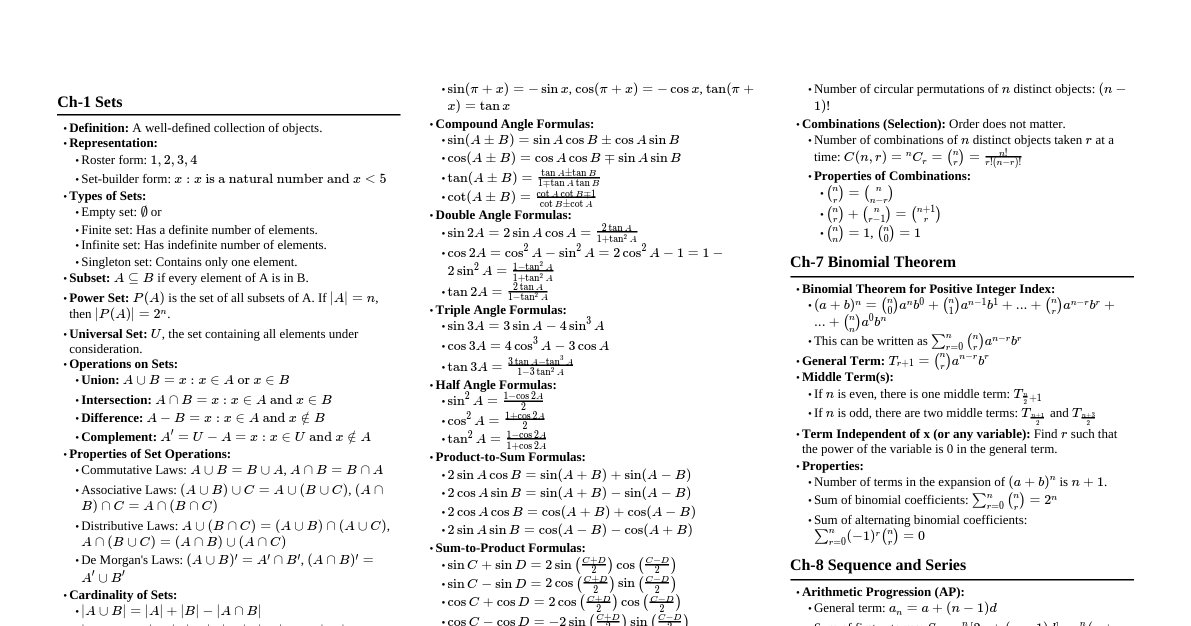
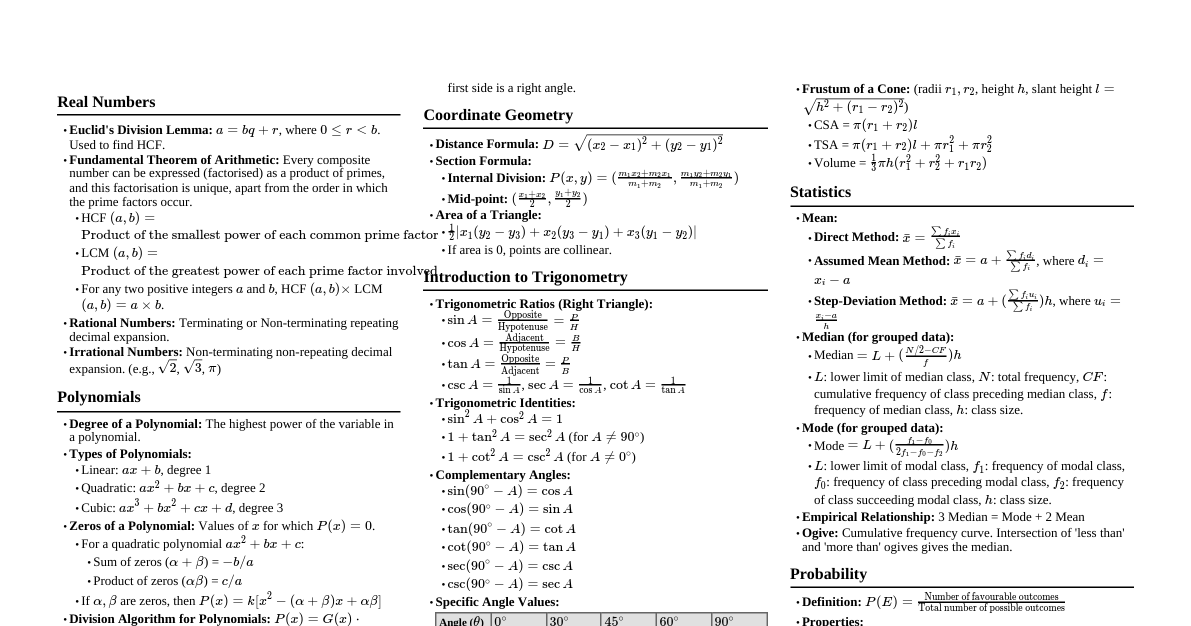
Chapter 3: Trigonometric Functions Basic Identities $\sin^2 x + \cos^2 x = 1$ $1 + \tan^2 x = \sec^2 x$ $1 + \cot^2 x = \csc^2 x$ Compound Angle Formulas $\sin(A+B) = \sin A \cos B + \cos A \sin B$ $\sin(A-B) = \sin A \cos B - \cos A \sin B$ $\cos(A+B) = \cos A \cos B - \sin A \sin B$ $\cos(A-B) = \cos A \cos B + \sin A \sin B$ $\tan(A+B) = \frac{\tan A + \tan B}{1 - \tan A \tan B}$ $\tan(A-B) = \frac{\tan A - \tan B}{1 + \tan A \tan B}$ Double Angle Formulas $\sin 2A = 2 \sin A \cos A = \frac{2 \tan A}{1 + \tan^2 A}$ $\cos 2A = \cos^2 A - \sin^2 A = 2 \cos^2 A - 1 = 1 - 2 \sin^2 A = \frac{1 - \tan^2 A}{1 + \tan^2 A}$ $\tan 2A = \frac{2 \tan A}{1 - \tan^2 A}$ Triple Angle Formulas $\sin 3A = 3 \sin A - 4 \sin^3 A$ $\cos 3A = 4 \cos^3 A - 3 \cos A$ $\tan 3A = \frac{3 \tan A - \tan^3 A}{1 - 3 \tan^2 A}$ Sum and Difference to Product Formulas $\sin X + \sin Y = 2 \sin \left(\frac{X+Y}{2}\right) \cos \left(\frac{X-Y}{2}\right)$ $\sin X - \sin Y = 2 \cos \left(\frac{X+Y}{2}\right) \sin \left(\frac{X-Y}{2}\right)$ $\cos X + \cos Y = 2 \cos \left(\frac{X+Y}{2}\right) \cos \left(\frac{X-Y}{2}\right)$ $\cos X - \cos Y = -2 \sin \left(\frac{X+Y}{2}\right) \sin \left(\frac{X-Y}{2}\right)$ Product to Sum and Difference Formulas $2 \sin A \cos B = \sin(A+B) + \sin(A-B)$ $2 \cos A \sin B = \sin(A+B) - \sin(A-B)$ $2 \cos A \cos B = \cos(A+B) + \cos(A-B)$ $2 \sin A \sin B = \cos(A-B) - \cos(A+B)$ General Solutions of Trigonometric Equations $\sin x = \sin y \implies x = n\pi + (-1)^n y$, where $n \in \mathbb{Z}$ $\cos x = \cos y \implies x = 2n\pi \pm y$, where $n \in \mathbb{Z}$ $\tan x = \tan y \implies x = n\pi + y$, where $n \in \mathbb{Z}$ $\sin^2 x = \sin^2 y \implies x = n\pi \pm y$, where $n \in \mathbb{Z}$ $\cos^2 x = \cos^2 y \implies x = n\pi \pm y$, where $n \in \mathbb{Z}$ $\tan^2 x = \tan^2 y \implies x = n\pi \pm y$, where $n \in \mathbb{Z}$ Chapter 6: Linear Inequalities Solving inequalities involves operations similar to equations, with one key difference: Multiplying or dividing by a negative number reverses the inequality sign. Representation on number line and Cartesian plane. Chapter 7: Permutations and Combinations Fundamental Principle of Counting If an event can occur in $m$ different ways and another event can occur in $n$ different ways, then the total number of occurrences of the events in the given order is $m \times n$. Factorial Notation $n! = n \times (n-1) \times \dots \times 2 \times 1$ $0! = 1$ Permutations The number of permutations of $n$ different things taken $r$ at a time, $P(n, r) = \frac{n!}{(n-r)!}$, where $0 \le r \le n$. The number of permutations of $n$ things where $p_1$ things are of one kind, $p_2$ things are of second kind, ..., $p_k$ things are of $k^{th}$ kind is $\frac{n!}{p_1! p_2! \dots p_k!}$. Combinations The number of combinations of $n$ different things taken $r$ at a time, $C(n, r) = \binom{n}{r} = \frac{n!}{r!(n-r)!}$, where $0 \le r \le n$. Properties: $\binom{n}{r} = \binom{n}{n-r}$ $\binom{n}{r} + \binom{n}{r-1} = \binom{n+1}{r}$ $\binom{n}{n} = 1$, $\binom{n}{0} = 1$ Chapter 8: Binomial Theorem Binomial Theorem for Positive Integer Index $(a+b)^n = \binom{n}{0}a^n + \binom{n}{1}a^{n-1}b + \binom{n}{2}a^{n-2}b^2 + \dots + \binom{n}{n}b^n$ General term (or $(r+1)^{th}$ term): $T_{r+1} = \binom{n}{r}a^{n-r}b^r$ Properties Number of terms in the expansion of $(a+b)^n$ is $n+1$. Sum of indices of $a$ and $b$ in each term is $n$. Middle term: If $n$ is even, middle term is $(\frac{n}{2} + 1)^{th}$ term. If $n$ is odd, middle terms are $(\frac{n+1}{2})^{th}$ and $(\frac{n+3}{2})^{th}$ terms. Chapter 9: Sequences and Series Arithmetic Progression (A.P.) General term: $a_n = a + (n-1)d$ Sum of first $n$ terms: $S_n = \frac{n}{2}[2a + (n-1)d] = \frac{n}{2}(a + l)$, where $l = a_n$. Arithmetic Mean (A.M.) between $a$ and $b$: $A = \frac{a+b}{2}$ Geometric Progression (G.P.) General term: $a_n = ar^{n-1}$ Sum of first $n$ terms: $S_n = \frac{a(r^n - 1)}{r-1}$ if $r \ne 1$ $S_n = na$ if $r = 1$ Sum of infinite G.P. (when $|r| Geometric Mean (G.M.) between $a$ and $b$: $G = \sqrt{ab}$ Relation between A.M. and G.M. For two positive numbers $a$ and $b$, A.M. $\ge$ G.M., i.e., $\frac{a+b}{2} \ge \sqrt{ab}$. Special Series Sum of first $n$ natural numbers: $\sum_{k=1}^{n} k = \frac{n(n+1)}{2}$ Sum of squares of first $n$ natural numbers: $\sum_{k=1}^{n} k^2 = \frac{n(n+1)(2n+1)}{6}$ Sum of cubes of first $n$ natural numbers: $\sum_{k=1}^{n} k^3 = \left(\frac{n(n+1)}{2}\right)^2$ Chapter 10: Straight Lines Distance Formula Distance between $(x_1, y_1)$ and $(x_2, y_2)$: $D = \sqrt{(x_2-x_1)^2 + (y_2-y_1)^2}$ Section Formula Internal division: $P(x,y) = \left(\frac{mx_2+nx_1}{m+n}, \frac{my_2+ny_1}{m+n}\right)$ Mid-point formula: $M(x,y) = \left(\frac{x_1+x_2}{2}, \frac{y_1+y_2}{2}\right)$ Area of a Triangle Area of triangle with vertices $(x_1, y_1), (x_2, y_2), (x_3, y_3)$: $A = \frac{1}{2} |x_1(y_2-y_3) + x_2(y_3-y_1) + x_3(y_1-y_2)|$ Slope of a Line Slope $m = \tan \theta = \frac{y_2-y_1}{x_2-x_1}$ Slope of parallel lines: $m_1 = m_2$ Slope of perpendicular lines: $m_1 m_2 = -1$ Equation of a Line in Various Forms Horizontal line: $y=k$ Vertical line: $x=c$ Point-slope form: $y - y_1 = m(x - x_1)$ Two-point form: $y - y_1 = \frac{y_2-y_1}{x_2-x_1}(x - x_1)$ Slope-intercept form: $y = mx + c$ Intercept form: $\frac{x}{a} + \frac{y}{b} = 1$ Normal form: $x \cos \alpha + y \sin \alpha = p$ General equation: $Ax + By + C = 0$ Distance of a Point from a Line Distance from $(x_1, y_1)$ to $Ax+By+C=0$: $d = \frac{|Ax_1+By_1+C|}{\sqrt{A^2+B^2}}$ Distance between Parallel Lines Distance between $Ax+By+C_1=0$ and $Ax+By+C_2=0$: $d = \frac{|C_1-C_2|}{\sqrt{A^2+B^2}}$ Chapter 11: Conic Sections Circle Equation of a circle with center $(h,k)$ and radius $r$: $(x-h)^2 + (y-k)^2 = r^2$ Equation of a circle with center $(0,0)$ and radius $r$: $x^2 + y^2 = r^2$ Parabola Standard equations: $y^2 = 4ax$ (focus $(a,0)$, directrix $x=-a$) $y^2 = -4ax$ (focus $(-a,0)$, directrix $x=a$) $x^2 = 4ay$ (focus $(0,a)$, directrix $y=-a$) $x^2 = -4ay$ (focus $(0,-a)$, directrix $y=a$) Latus Rectum length: $4a$ Ellipse Standard equations: $\frac{x^2}{a^2} + \frac{y^2}{b^2} = 1$, $a > b$ (foci $(\pm c, 0)$, $c^2 = a^2 - b^2$) $\frac{x^2}{b^2} + \frac{y^2}{a^2} = 1$, $a > b$ (foci $(0, \pm c)$, $c^2 = a^2 - b^2$) Eccentricity $e = \frac{c}{a}$, $0 Length of major axis: $2a$ Length of minor axis: $2b$ Latus Rectum length: $\frac{2b^2}{a}$ Hyperbola Standard equations: $\frac{x^2}{a^2} - \frac{y^2}{b^2} = 1$ (foci $(\pm c, 0)$, $c^2 = a^2 + b^2$) $\frac{y^2}{a^2} - \frac{x^2}{b^2} = 1$ (foci $(0, \pm c)$, $c^2 = a^2 + b^2$) Eccentricity $e = \frac{c}{a}$, $e > 1$ Length of transverse axis: $2a$ Length of conjugate axis: $2b$ Latus Rectum length: $\frac{2b^2}{a}$ Chapter 12: Introduction to Three Dimensional Geometry Distance Formula Distance between $P(x_1, y_1, z_1)$ and $Q(x_2, y_2, z_2)$: $PQ = \sqrt{(x_2-x_1)^2 + (y_2-y_1)^2 + (z_2-z_1)^2}$ Section Formula Internal division of $PQ$ in ratio $m:n$: $R = \left(\frac{mx_2+nx_1}{m+n}, \frac{my_2+ny_1}{m+n}, \frac{mz_2+nz_1}{m+n}\right)$ Mid-point formula: $M = \left(\frac{x_1+x_2}{2}, \frac{y_1+y_2}{2}, \frac{z_1+z_2}{2}\right)$ Centroid of a Triangle Vertices $(x_1, y_1, z_1)$, $(x_2, y_2, z_2)$, $(x_3, y_3, z_3)$: $G = \left(\frac{x_1+x_2+x_3}{3}, \frac{y_1+y_2+y_3}{3}, \frac{z_1+z_2+z_3}{3}\right)$