Acids, Bases & Salts - Ultimat
Cheatsheet Content
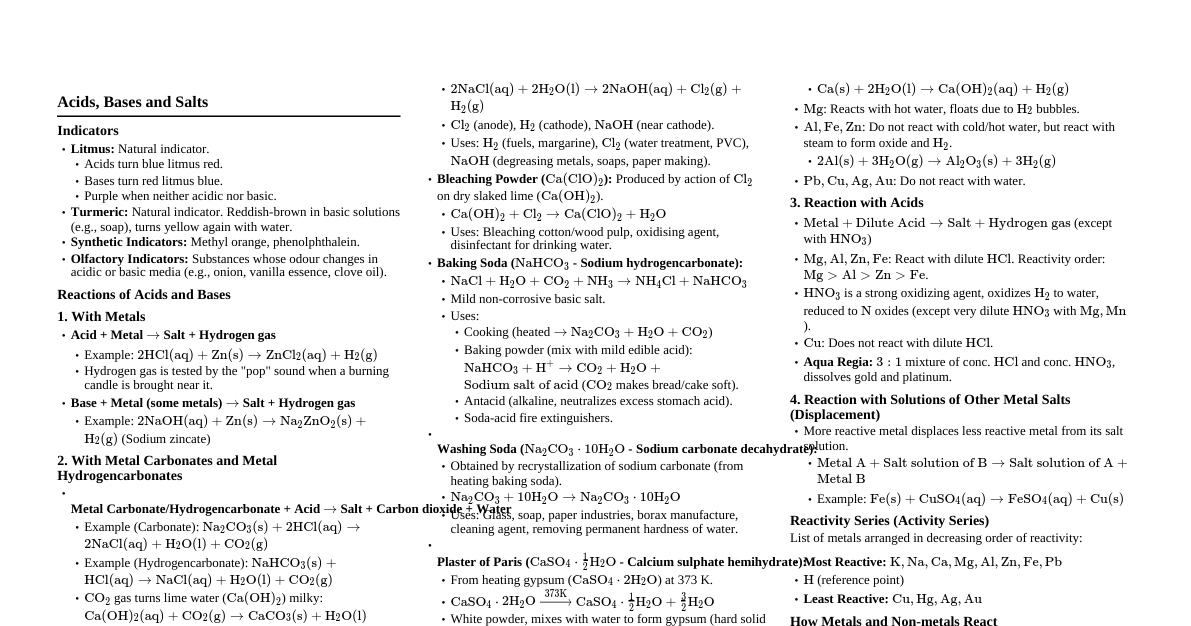
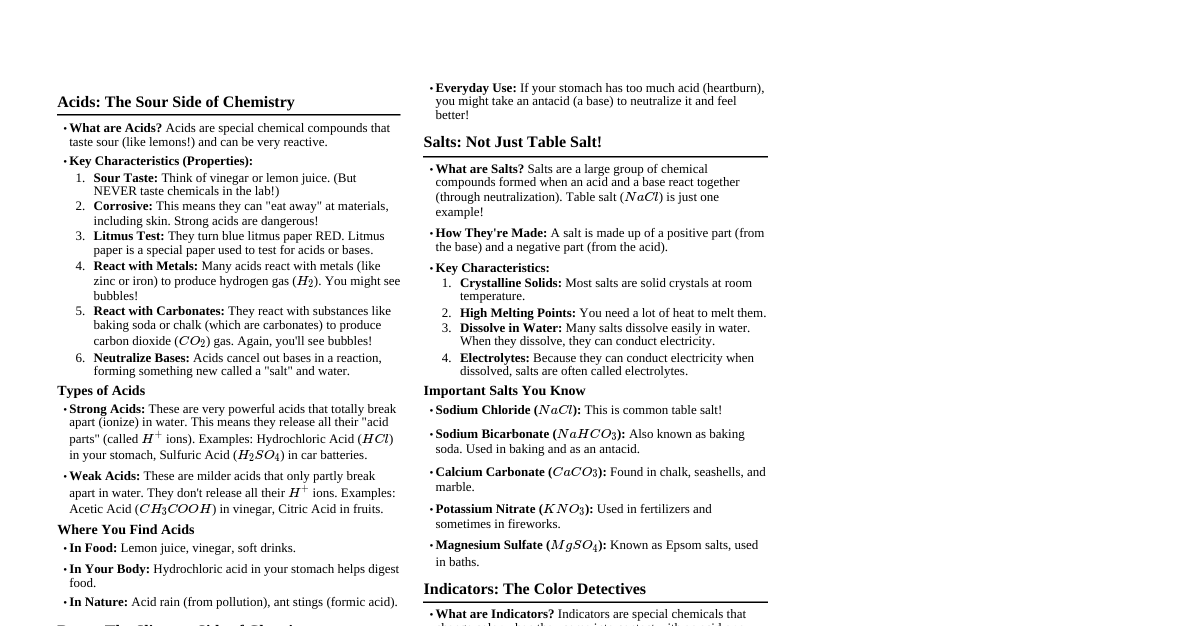
### 🧪 Introduction & Indicators: The pH Preview #### 🔬 What are Acids, Bases & Salts? - **Acids**: - **Taste** : Sour (e.g., lemon). - **Litmus** : Turn blue litmus paper red . - **Ions** : Produce H⁺ (or H₃O⁺) ions in aqueous solutions. - **pH** : Less than 7. - **Examples**: HCl (Hydrochloric acid), CH₃COOH (Acetic acid). - **Bases**: - **Taste** : Bitter, soapy touch (e.g., soap). - **Litmus** : Turn red litmus paper blue . - **Ions** : Produce OH⁻ ions in aqueous solutions. - **pH** : Greater than 7. - **Examples**: NaOH (Sodium hydroxide), Ca(OH)₂ (Calcium hydroxide). - **Salts**: - **Definition**: Ionic compounds formed by the neutralization reaction between an acid and a base. - **Structure**: Composed of cations (positive ions) and anions (negative ions). - **Bonding**: Held together by ionic bonds. - **Examples**: NaCl (Sodium chloride), Na₂SO₄ (Sodium sulphate). #### 🌈 Indicators: Your Chemical Colour-Changers Substances that show a change (color or smell) when mixed with an acid or a base. | Indicator Type | Indicator | In Acid | In Base | In Neutral | | :------------------- | :------------- | :------------- | :------------- | :------------- | | **Natural** | Litmus | Red | Blue | Purple | | | Turmeric | Yellow | Reddish-brown | Yellow | | | Red Cabbage | Red | Green | Purple | | | Hydrangea | Blue | Pink | - | | **Synthetic** | Phenolphthalein| Colourless | Pink | Colourless | | | Methyl Orange | Red | Yellow | Orange | | **Olfactory (Smell)**| Onion Extract | Smell Retained | Smell Vanishes | Smell Retained | | | Vanilla Extract| Smell Retained | Smell Vanishes | Smell Retained | | | Clove Oil | Smell Retained | Smell Vanishes | Smell Retained | Q1: How would you test for the presence of an acid using an olfactory indicator? **A1**: Take a few drops of an olfactory indicator like vanilla extract in two separate test tubes. Add the given solution (acid) to one and a base to the other. If the characteristic smell of vanilla is retained in one and vanishes in the other, the solution where the smell is retained is the acid. ### 🔥 Chemical Properties of Acids: The Reactivity Zone #### 1. Reaction with Metals - **General Reaction**: Metal + Dilute Acid → Salt + Hydrogen Gas ($\text{H}_2$) - **Example**: Zinc reacts with hydrochloric acid. $\text{Zn (s)} + \text{2HCl (aq)} \rightarrow \text{ZnCl}_2 \text{ (aq)} + \text{H}_2 \text{ (g)}$ - **Test for $\text{H}_2$ Gas**: Bring a burning splinter near the gas. It extinguishes with a 'pop' sound . - **Exception**: Nitric acid ($\text{HNO}_3$) is a strong oxidizing agent and usually produces water and oxides of nitrogen instead of $\text{H}_2$. However, very dilute $\text{HNO}_3$ reacts with Magnesium ($\text{Mg}$) and Manganese ($\text{Mn}$) to produce $\text{H}_2$. #### 2. Reaction with Metal Carbonates & Bicarbonates - **General Reaction**: Metal Carbonate/Bicarbonate + Acid → Salt + Carbon Dioxide ($\text{CO}_2$) + Water ($\text{H}_2\text{O}$) - **Example 1 (Carbonate)**: Sodium carbonate reacts with hydrochloric acid. $\text{Na}_2\text{CO}_3 \text{ (s)} + \text{2HCl (aq)} \rightarrow \text{2NaCl (aq)} + \text{CO}_2 \text{ (g)} + \text{H}_2\text{O (l)}$ - **Example 2 (Bicarbonate)**: Sodium bicarbonate reacts with hydrochloric acid. $\text{NaHCO}_3 \text{ (s)} + \text{HCl (aq)} \rightarrow \text{NaCl (aq)} + \text{CO}_2 \text{ (g)} + \text{H}_2\text{O (l)}$ - **Test for $\text{CO}_2$ Gas**: Pass the gas through lime water (Calcium hydroxide, $\text{Ca(OH)}_2$) . - **Observation**: Lime water turns milky due to the formation of insoluble Calcium Carbonate ($\text{CaCO}_3$). $\text{Ca(OH)}_2 \text{ (aq)} + \text{CO}_2 \text{ (g)} \rightarrow \text{CaCO}_3 \text{ (s)} \downarrow + \text{H}_2\text{O (l)}$ - **Excess $\text{CO}_2$**: If excess $\text{CO}_2$ is passed, the milkiness disappears due to the formation of soluble Calcium Bicarbonate ($\text{Ca(HCO}_3)_2$). $\text{CaCO}_3 \text{ (s)} + \text{CO}_2 \text{ (g)} + \text{H}_2\text{O (l)} \rightarrow \text{Ca(HCO}_3)_2 \text{ (aq)}$ #### 3. Reaction with Metallic Oxides - **General Reaction**: Metallic Oxide + Acid → Salt + Water ($\text{H}_2\text{O}$) - **Nature**: Metallic oxides are basic in nature . This reaction is a type of neutralization. - **Example**: Copper oxide reacts with hydrochloric acid. $\text{CuO (s)} + \text{2HCl (aq)} \rightarrow \text{CuCl}_2 \text{ (aq)} + \text{H}_2\text{O (l)}$ - **Observation**: The black copper oxide dissolves, and the solution turns blue-green due to the formation of copper(II) chloride. #### 4. Reaction with Bases (Neutralization) - **General Reaction**: Acid + Base → Salt + Water ($\text{H}_2\text{O}$) - **Definition**: A reaction where an acid and a base react quantitatively to form a salt and water. - **Example**: Hydrochloric acid reacts with sodium hydroxide. $\text{HCl (aq)} + \text{NaOH (aq)} \rightarrow \text{NaCl (aq)} + \text{H}_2\text{O (l)}$ - **Ionic Equation**: $\text{H}^+ \text{ (aq)} + \text{OH}^- \text{ (aq)} \rightarrow \text{H}_2\text{O (l)}$ Q2: Why should curd and other sour food substances not be kept in brass and copper vessels? **A2**: Curd and sour food substances contain acids (e.g., lactic acid). When these acids react with the metals (copper/brass, which is an alloy of copper and zinc) of the vessels, they form toxic metal salts. These salts are harmful for consumption and can cause food poisoning. ### 💦 Chemical Properties of Bases: The Alkaline Side #### 1. Reaction with Metals - **General Reaction**: Metal + Base → Salt + Hydrogen Gas ($\text{H}_2$) - **Note**: Only certain reactive metals like Zinc ($\text{Zn}$), Aluminium ($\text{Al}$) react with strong bases. - **Example**: Zinc reacts with sodium hydroxide. $\text{Zn (s)} + \text{2NaOH (aq)} \rightarrow \text{Na}_2\text{ZnO}_2 \text{ (aq)} + \text{H}_2 \text{ (g)}$ (Sodium Zincate) #### 2. Reaction with Non-Metallic Oxides - **General Reaction**: Non-Metallic Oxide + Base → Salt + Water ($\text{H}_2\text{O}$) - **Nature**: Non-metallic oxides are acidic in nature . This is also a type of neutralization. - **Example**: Carbon dioxide reacts with calcium hydroxide (lime water). $\text{CO}_2 \text{ (g)} + \text{Ca(OH)}_2 \text{ (aq)} \rightarrow \text{CaCO}_3 \text{ (s)} + \text{H}_2\text{O (l)}$ - **Observation**: This reaction is responsible for lime water turning milky when $\text{CO}_2$ is passed through it. #### 3. Reaction with Acids (Neutralization) - **General Reaction**: Base + Acid → Salt + Water ($\text{H}_2\text{O}$) - **Example**: Sodium hydroxide reacts with hydrochloric acid. $\text{NaOH (aq)} + \text{HCl (aq)} \rightarrow \text{NaCl (aq)} + \text{H}_2\text{O (l)}$ Q3: Why are non-metallic oxides called acidic oxides? **A3**: Non-metallic oxides react with bases to form salt and water, similar to how acids react with bases. For example, carbon dioxide (a non-metallic oxide) reacts with calcium hydroxide (a base) to form calcium carbonate (salt) and water. This acidic behavior leads them to be called acidic oxides. ### 💧 Acids & Bases in Water: The Ionization Story #### What do all Acids & Bases have in common? - Both conduct electricity in aqueous solutions because they produce ions. - **Acids**: Produce H⁺ ions (which immediately combine with water to form Hydronium ions, H₃O⁺ ). $\text{HCl (aq)} + \text{H}_2\text{O (l)} \rightarrow \text{H}_3\text{O}^+ \text{ (aq)} + \text{Cl}^- \text{ (aq)}$ - **Bases**: Produce OH⁻ ions in water. $\text{NaOH (s)} \xrightarrow{\text{Water}} \text{Na}^+ \text{ (aq)} + \text{OH}^- \text{ (aq)}$ - **Alkali**: Water-soluble bases are called alkalis (e.g., NaOH, KOH, Ca(OH)₂). All alkalis are bases, but not all bases are alkalis. #### Dilution of Acids & Bases - **Exothermic Process**: The dissolution of an acid or a base in water is a highly exothermic process. - **Safety Precaution**: Always add acid to water slowly with constant stirring, not water to acid. This is because adding water to concentrated acid can generate a large amount of heat, causing the mixture to splash out and cause burns. - **Effect of Dilution**: Decreases the concentration of H₃O⁺ or OH⁻ ions per unit volume, thus decreasing the strength of the acid or base. Q4: Why does dry HCl gas not change the colour of dry blue litmus paper? **A4**: Dry HCl gas does not produce H⁺ ions in the absence of water. The acidic property (like changing litmus paper color) is due to the presence of H⁺ ions. Only when HCl dissolves in water does it ionize to produce H⁺ ions (forming H₃O⁺), which are responsible for the acidic behavior. Q5: Why does distilled water not conduct electricity, whereas rainwater does? **A5**: Distilled water is pure water and contains very few ions, making it a poor conductor of electricity. Rainwater, however, dissolves acidic gases like $\text{CO}_2$, $\text{SO}_2$, $\text{NO}_2$ from the atmosphere to form carbonic acid, sulfuric acid, and nitric acid. These acids ionize in water to produce H⁺ ions, making rainwater a good conductor of electricity. ### 📊 The pH Scale: Measuring Acidity & Basicity - **Definition**: pH (Potential of Hydrogen) is a measure of the concentration of H⁺ ions in a solution. - Mathematically: $\text{pH} = -\text{log}[\text{H}^+]$ - **Range**: From 0 (most acidic) to 14 (most basic). - **Neutral Point**: pH = 7 (e.g., pure water). - **Acidic Solutions**: pH 7 (Lower H⁺ concentration, higher OH⁻ concentration). - **Strength**: - A change of 1 unit in pH represents a ten-fold change in H⁺ ion concentration. - pH 1 is 10 times more acidic than pH 2, and 100 times more acidic than pH 3. #### Universal Indicator & pH Paper - A mixture of several indicators that shows different colors at different pH values. - **Color Chart**: | pH Value | Nature | Color | | :------- | :------------ | :------------- | | 0-2 | Strong Acid | Dark Red | | 3-6 | Weak Acid | Orange/Yellow | | 7 | Neutral | Green | | 8-10 | Weak Base | Blue | | 11-14 | Strong Base | Violet | Q6: Fresh milk has a pH of 6. How do you think the pH will change as it turns into curd? Explain your answer. **A6**: When milk turns into curd, lactic acid is formed due to the action of bacteria. The formation of lactic acid increases the H⁺ ion concentration in the milk, making it more acidic. Therefore, the pH of the milk will decrease (become less than 6) as it turns into curd. Q7: Which has a higher concentration of H⁺ ions: a 1 M HCl solution or a 1 M CH₃COOH solution? **A7**: A 1 M HCl solution has a higher concentration of H⁺ ions. HCl is a strong acid and ionizes completely in water, producing a high concentration of H⁺ ions. CH₃COOH (acetic acid) is a weak acid and ionizes only partially, producing a lower concentration of H⁺ ions even at the same molarity. ### 🌍 pH in Daily Life: It's Everywhere! #### 1. Digestion in our Stomach - **Stomach pH**: Our stomach produces hydrochloric acid (HCl) , maintaining a pH of 1-3. This acidic environment is crucial for activating digestive enzymes like pepsin. - **Indigestion**: Excess acid production causes pain and irritation. - **Antacids**: Mild bases (e.g., Milk of Magnesia, Mg(OH)₂ , baking soda) are used to neutralize excess stomach acid and provide relief. #### 2. pH of Soil - **Plant Growth**: Most plants grow best in a specific pH range (usually 6.5 - 7.5). - **Acidic Soil**: If soil is too acidic, it's treated with bases like quicklime (CaO) , slaked lime (Ca(OH)₂) , or chalk ($\text{CaCO}_3$). - **Basic Soil**: If soil is too basic, it's treated with acidic substances like organic matter (which releases acids on decomposition) or gypsum ($\text{CaSO}_4$). #### 3. Tooth Decay - **Cause**: Bacteria present in our mouth produce acids by degrading sugar and food particles after eating. - **Enamel Damage**: Tooth enamel (made of calcium phosphate , the hardest substance in the body) starts to corrode when the pH in the mouth falls below 5.5 . - **Prevention**: Using basic toothpastes neutralizes the excess acid and prevents tooth decay. #### 4. Self-Defense by Animals and Plants - **Bee Sting**: A bee sting injects an acidic liquid (formic acid) causing pain and irritation. It can be relieved by rubbing baking soda (a mild base). - **Wasp Sting**: A wasp sting injects an alkaline liquid . It can be relieved by rubbing a mild acid like vinegar (acetic acid). - **Nettle Leaf Sting**: The stinging hair of nettle leaves injects methanoic acid , causing a burning pain. Rubbing the affected area with a dock plant leaf (which contains a base) provides relief. #### 5. pH in Aquatic Life - **Acid Rain**: When the pH of rainwater is below 5.6, it's called acid rain. - **Impact**: Acid rain flows into rivers and lakes, lowering their pH. This acidic environment makes it difficult for aquatic life (fish, etc.) to survive. Q8: A milkman adds a very small amount of baking soda to fresh milk. (a) Why does he shift the pH of the fresh milk from 6 to slightly alkaline? (b) Why does this milk take a longer time to set as curd? **A8**: (a) The milkman adds baking soda (sodium hydrogen carbonate) because it is a mild base. This makes the milk slightly alkaline and prevents it from turning sour quickly due to lactic acid formation by bacteria. (b) For milk to set into curd, lactic acid needs to be produced. Since the milk is made alkaline by the addition of baking soda, the bacteria need more time to produce enough lactic acid to neutralize the base and then lower the pH to the acidic range required for curd formation. ### 🧂 Salts & Their Families: Beyond NaCl #### Types of Salts based on pH of aqueous solution - **Neutral Salts (pH ≈ 7)**: Formed from Strong Acid + Strong Base. - **Examples**: NaCl, KCl, Na₂SO₄. - **Acidic Salts (pH 7)**: Formed from Weak Acid + Strong Base. - **Examples**: Na₂CO₃ (Sodium carbonate), CH₃COONa (Sodium acetate). #### Important Salts & Their Production ##### 1. Common Salt (NaCl) - Sodium Chloride - **Source**: Sea water, rock salt deposits. - **Formation**: Obtained from the neutralization of HCl and NaOH. - **Uses**: - Essential component of our food. - Preservative for pickles and meat. - Raw material for many important chemicals like NaOH, Na₂CO₃, NaHCO₃. ##### 2. Sodium Hydroxide (NaOH) - Caustic Soda - **Production**: Chlor-alkali process – Electrolysis of an aqueous solution of sodium chloride (brine). $\text{2NaCl (aq)} + \text{2H}_2\text{O (l)} \xrightarrow{\text{Electrolysis}} \text{2NaOH (aq)} + \text{Cl}_2 \text{ (g)} + \text{H}_2 \text{ (g)}$ - **At Anode (+)**: Chlorine gas ($\text{Cl}_2$) is produced. - **At Cathode (–)**: Hydrogen gas ($\text{H}_2$) is produced. - **Near Cathode**: Sodium hydroxide (NaOH) solution is formed. - **Products & Uses**: - **NaOH**: Soaps and detergents, paper making, artificial fibres, degreasing metals. - **$\text{Cl}_2$**: Water treatment, PVC manufacturing, disinfectants, bleaches, pesticides. - **$\text{H}_2$**: Fuels, margarine, ammonia for fertilizers. Competency Alert! The chlor-alkali process is very important. Remember the products formed at each electrode and their wide range of uses. ##### 3. Bleaching Powder (CaOCl₂) - Calcium Oxychloride - **Production**: Chlorine gas is passed over dry slaked lime ($\text{Ca(OH)}_2$). $\text{Ca(OH)}_2 \text{ (s)} + \text{Cl}_2 \text{ (g)} \rightarrow \text{CaOCl}_2 \text{ (s)} + \text{H}_2\text{O (l)}$ - **Uses**: - **Bleaching**: Cotton and linen in the textile industry, wood pulp in paper factories. - **Disinfectant**: Oxidizing agent for purifying drinking water (kills germs). - **Oxidizing agent** in many chemical industries. ##### 4. Baking Soda (NaHCO₃) - Sodium Hydrogen Carbonate / Sodium Bicarbonate - **Production (Solvay Process)**: NaCl + H₂O + CO₂ + NH₃ → NH₄Cl + NaHCO₃ - **Properties**: Mild, non-corrosive basic salt. - **Uses**: - **Antacid**: Neutralizes excess stomach acid. - **Baking Powder**: A mixture of baking soda and a mild edible acid (e.g., tartaric acid). When heated or mixed with water, it releases $\text{CO}_2$ gas, which makes cakes and bread fluffy and soft. $\text{NaHCO}_3 + \text{H}^+ \text{ (from acid)} \rightarrow \text{CO}_2 \text{ (g)} + \text{H}_2\text{O (l)} + \text{Sodium salt of acid}$ - **Fire Extinguishers**: Used in soda-acid fire extinguishers to produce $\text{CO}_2$. ##### 5. Washing Soda (Na₂CO₃·10H₂O) - Sodium Carbonate Decahydrate - **Production**: 1. Heating baking soda: $\text{2NaHCO}_3 \text{ (s)} \xrightarrow{\text{Heat}} \text{Na}_2\text{CO}_3 \text{ (s)} + \text{H}_2\text{O (l)} + \text{CO}_2 \text{ (g)}$ 2. Recrystallization of anhydrous sodium carbonate: $\text{Na}_2\text{CO}_3 \text{ (s)} + \text{10H}_2\text{O (l)} \rightarrow \text{Na}_2\text{CO}_3 \cdot \text{10H}_2\text{O (s)}$ - **Properties**: Basic salt. - **Uses**: - Cleaning agent for domestic purposes. - Softening hard water (removes permanent hardness). - Manufacturing of glass, soap, and paper. - Manufacture of borax. Q9: Why does baking powder, not baking soda, make cakes fluffy? **A9**: Baking soda (sodium hydrogen carbonate) alone is basic and, when heated, produces carbon dioxide but also leaves behind sodium carbonate, which makes the cake bitter. Baking powder is a mixture of baking soda and a mild edible acid (like tartaric acid). The acid neutralizes the sodium carbonate formed, preventing bitterness, while the $\text{CO}_2$ gas released makes the cake rise and become fluffy. ### 💎 Water of Crystallization: Hidden Water in Crystals - **Definition**: The fixed number of water molecules chemically attached to each formula unit of a salt in its crystalline form. - **Importance**: Gives salts their characteristic shape and color. #### Examples - **Copper Sulphate (CuSO₄·5H₂O) - Blue Vitriol**: - **Hydrated**: Blue crystals (contains 5 molecules of water). - **Heating**: Loses water, turns white and anhydrous. $\text{CuSO}_4 \cdot \text{5H}_2\text{O (s, Blue)} \xrightarrow{\text{Heat}} \text{CuSO}_4 \text{ (s, White)} + \text{5H}_2\text{O (g)}$ - **Rehydration**: Adding water to anhydrous copper sulphate restores its blue color. - **Gypsum (CaSO₄·2H₂O)**: Contains 2 molecules of water. - **Washing Soda (Na₂CO₃·10H₂O)**: Contains 10 molecules of water. - **Ferrous Sulphate (FeSO₄·7H₂O)**: Green crystals. Q10: What is observed when a few drops of water are added to anhydrous copper sulphate? **A10**: When a few drops of water are added to anhydrous copper sulphate (which is white), it turns blue. This is because the anhydrous copper sulphate absorbs the water molecules to form hydrated copper sulphate ($\text{CuSO}_4 \cdot \text{5H}_2\text{O}$), which is blue in color. This reaction is also exothermic. ### 🛠️ Plaster of Paris (POP) - CaSO₄·½H₂O - **Chemical Name**: Calcium Sulphate Hemihydrate. - **Production**: Obtained by heating gypsum ($\text{CaSO}_4 \cdot \text{2H}_2\text{O}$) at 373 K (100°C) . $\text{CaSO}_4 \cdot \text{2H}_2\text{O (s, Gypsum)} \xrightarrow{\text{373K}} \text{CaSO}_4 \cdot \frac{1}{2}\text{H}_2\text{O (s, POP)} + 1\frac{1}{2}\text{H}_2\text{O (g)}$ - **Setting Property**: POP is a white powder that, when mixed with water, rapidly sets into a hard solid mass (gypsum). This is due to rehydration. $\text{CaSO}_4 \cdot \frac{1}{2}\text{H}_2\text{O (s)} + 1\frac{1}{2}\text{H}_2\text{O (l)} \rightarrow \text{CaSO}_4 \cdot \text{2H}_2\text{O (s, Gypsum)}$ - **Storage**: Must be stored in a moisture-proof container to prevent it from absorbing water and setting into a hard mass. - **Dead Burnt Plaster**: If gypsum is heated above 373 K, it loses all its water of crystallization and forms anhydrous calcium sulphate ($\text{CaSO}_4$). This is called dead burnt plaster and loses its setting property. - **Uses**: - For supporting fractured bones in the correct position. - Making casts for statues, toys, and decorative materials. - Used in dentistry for dental impressions. - For making surfaces smooth (e.g., plastering walls). - As a fireproofing material. Q11: Why is Plaster of Paris stored in a moisture-proof container? **A11**: Plaster of Paris (CaSO₄·½H₂O) is stored in a moisture-proof container because it has a strong tendency to absorb moisture (water) from the atmosphere. Upon absorbing water, it undergoes a chemical reaction to form a hard solid mass of gypsum (CaSO₄·2H₂O), losing its useful property of setting when needed for specific applications. Q12: A compound X of sodium is used in glass and soap industry. It is prepared from brine. Write the chemical formula of X and how is it obtained from brine? **A12**: The compound X is Sodium Carbonate (Washing Soda), $\text{Na}_2\text{CO}_3 \cdot \text{10H}_2\text{O}$. It is obtained from brine ($\text{NaCl}$ solution) through the Solvay process: 1. Brine reacts with ammonia and carbon dioxide to form sodium hydrogen carbonate: $\text{NaCl (aq)} + \text{H}_2\text{O (l)} + \text{CO}_2 \text{ (g)} + \text{NH}_3 \text{ (g)} \rightarrow \text{NH}_4\text{Cl (aq)} + \text{NaHCO}_3 \text{ (s)}$ 2. Sodium hydrogen carbonate is then heated to produce anhydrous sodium carbonate: $\text{2NaHCO}_3 \text{ (s)} \xrightarrow{\text{Heat}} \text{Na}_2\text{CO}_3 \text{ (s)} + \text{H}_2\text{O (l)} + \text{CO}_2 \text{ (g)}$ 3. Finally, anhydrous sodium carbonate is recrystallized from water to get washing soda: $\text{Na}_2\text{CO}_3 \text{ (s)} + \text{10H}_2\text{O (l)} \rightarrow \text{Na}_2\text{CO}_3 \cdot \text{10H}_2\text{O (s)}$