Mole Concept (JEE Edition)
Cheatsheet Content
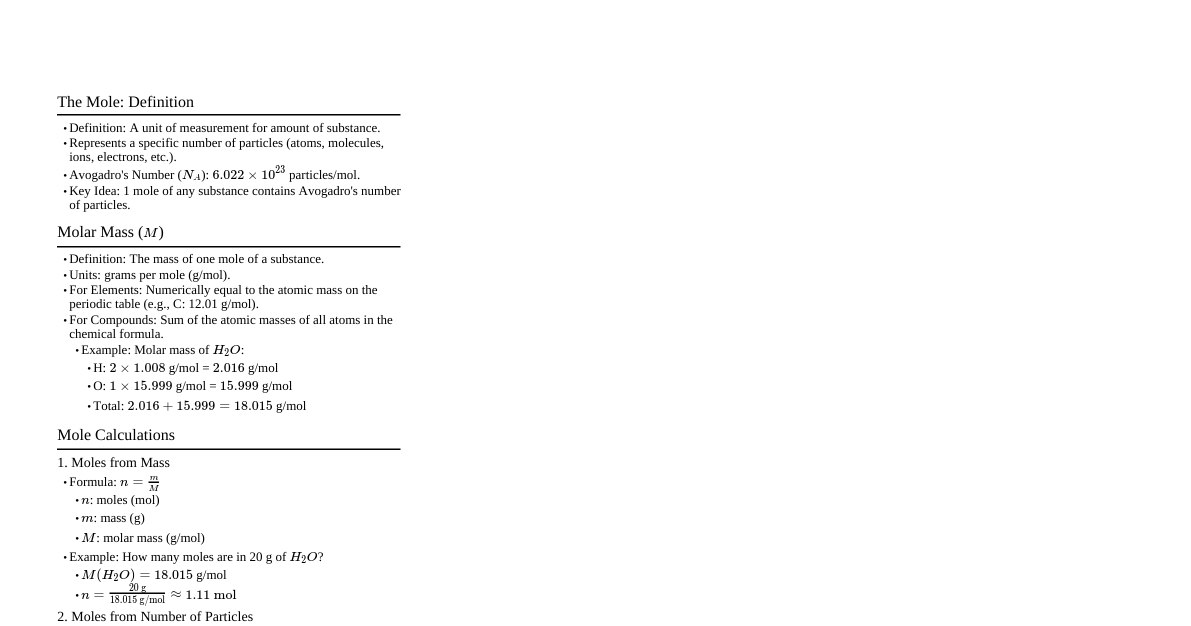
### Introduction to Mole Concept - **Mole (n):** The SI unit for amount of substance. It's defined as the amount of substance that contains as many elementary entities (atoms, molecules, ions, electrons, etc.) as there are atoms in 12 grams of carbon-12 isotope. - **Avogadro's Number ($N_A$):** The number of entities in one mole. - $N_A = 6.022 \times 10^{23} \text{ entities/mol}$ - **Molar Mass (M):** The mass of one mole of a substance (g/mol). Numerically equal to atomic or molecular mass in amu. ### Interconversion: Mass, Moles, & Number of Particles - **Moles from Mass:** $n = \frac{\text{Mass (g)}}{\text{Molar Mass (g/mol)}}$ - **Mass from Moles:** $\text{Mass (g)} = n \times \text{Molar Mass (g/mol)}$ - **Number of Particles from Moles:** $\text{Number of Particles} = n \times N_A$ - **Moles from Number of Particles:** $n = \frac{\text{Number of Particles}}{N_A}$ #### Example - How many moles are in 36 g of water ($H_2O$)? - Molar mass of $H_2O = 2(1) + 16 = 18 \text{ g/mol}$ - $n = \frac{36 \text{ g}}{18 \text{ g/mol}} = 2 \text{ mol}$ - How many water molecules are in 36 g of water? - $\text{Number of molecules} = 2 \text{ mol} \times 6.022 \times 10^{23} \text{ molecules/mol} = 1.2044 \times 10^{24} \text{ molecules}$ ### Mole Concept for Gases (at STP) - **STP (Standard Temperature and Pressure):** - Temperature = $0^\circ C$ (273.15 K) - Pressure = 1 atm - **Molar Volume at STP:** 1 mole of any ideal gas occupies 22.4 Litres at STP. - $n = \frac{\text{Volume of Gas (L)}}{\text{22.4 L/mol}}$ (only at STP) - **Avogadro's Law:** At constant temperature and pressure, equal volumes of all gases contain equal number of moles/molecules. #### Note for JEE: - Sometimes NTP (Normal Temperature and Pressure: $20^\circ C$, 1 atm) is used, but STP is more common for volume calculations. - For non-ideal gases or other conditions, use the Ideal Gas Equation ($PV=nRT$). ### Stoichiometry & Limiting Reagent - **Stoichiometry:** The quantitative relationship between reactants and products in a balanced chemical equation. - **Mole Ratio:** Ratios of moles of reactants and products derived from balanced equation coefficients. - **Limiting Reagent:** The reactant that is completely consumed in a chemical reaction, thereby limiting the amount of product formed. - **Excess Reagent:** The reactant present in an amount greater than required to react with the limiting reagent. #### Steps to find Limiting Reagent: 1. Balance the chemical equation. 2. Convert given masses/volumes of reactants to moles. 3. Divide actual moles of each reactant by its stoichiometric coefficient from the balanced equation. 4. The reactant with the smallest value from step 3 is the limiting reagent. #### Example $$N_2(g) + 3H_2(g) \rightarrow 2NH_3(g)$$ If 10 moles of $N_2$ reacts with 24 moles of $H_2$: - For $N_2$: $\frac{10}{1} = 10$ - For $H_2$: $\frac{24}{3} = 8$ - Since $8 < 10$, $H_2$ is the limiting reagent. ### Solution Stoichiometry: Concentration Terms - **Molarity (M):** Moles of solute per litre of solution. - $M = \frac{\text{Moles of solute}}{\text{Volume of solution (L)}}$ - **Molality (m):** Moles of solute per kg of solvent. - $m = \frac{\text{Moles of solute}}{\text{Mass of solvent (kg)}}$ - **Mole Fraction ($X$):** Ratio of moles of one component to total moles in solution. - $X_A = \frac{n_A}{n_A + n_B}$ - **Mass Percentage (% w/w):** $\frac{\text{Mass of solute}}{\text{Mass of solution}} \times 100$ - **Volume Percentage (% v/v):** $\frac{\text{Volume of solute}}{\text{Volume of solution}} \times 100$ - **Mass/Volume Percentage (% w/v):** $\frac{\text{Mass of solute (g)}}{\text{Volume of solution (mL)}} \times 100$ - **Parts Per Million (ppm):** $\frac{\text{Mass of solute}}{\text{Mass of solution}} \times 10^6$ (for very dilute solutions) ### Eudiometry (Gas Analysis) - **Principle:** Based on Avogadro's law - the volume ratio of gaseous reactants and products (at identical T & P) is the same as their mole ratio. - Used to determine the molecular formula of gaseous hydrocarbons or the composition of gaseous mixtures. - **Key Reactions:** - Combustion of Hydrocarbon: $C_xH_y + (x + \frac{y}{4})O_2 \rightarrow xCO_2 + \frac{y}{2}H_2O(l)$ - Note: $H_2O$ condenses to liquid, so its volume is considered negligible. - Reaction with KOH: $CO_2$ is absorbed by KOH solution. - Reaction with alkaline pyrogallol: $O_2$ is absorbed. - Reaction with ammoniacal $Cu_2Cl_2$: CO is absorbed. #### Example (Stone Question type) 10 mL of a gaseous hydrocarbon was exploded with 50 mL of $O_2$. The volume after explosion was 30 mL. On treatment with KOH, the volume decreased to 10 mL. Find the molecular formula of the hydrocarbon. (All volumes measured at same T & P). 1. **Volume absorbed by KOH = Volume of $CO_2$ formed:** $V_{CO_2} = 30 \text{ mL} - 10 \text{ mL} = 20 \text{ mL}$ 2. **Balanced Combustion Equation:** $$C_xH_y + (x + \frac{y}{4})O_2 \rightarrow xCO_2 + \frac{y}{2}H_2O(l)$$ 3. **Using volume ratios (Avogadro's Law):** - 1 volume of $C_xH_y$ gives $x$ volumes of $CO_2$. - 10 mL $C_xH_y$ gives 20 mL $CO_2$. - So, $x = \frac{20}{10} = 2$. 4. **Calculating $O_2$ required and excess $O_2$:** - Initial $O_2$ taken = 50 mL - Volume after explosion = Total volume of gases remaining ($CO_2$ + unreacted $O_2$) = 30 mL - Unreacted $O_2 = \text{Volume after KOH treatment} - \text{Remaining } H_2 (\text{if any}) = 10 \text{ mL}$ (since only $CO_2$ and $O_2$ remain in gas phase after explosion, and KOH removes $CO_2$, the remaining 10 mL is unreacted $O_2$). - $O_2$ consumed = Initial $O_2$ - Unreacted $O_2 = 50 - 10 = 40 \text{ mL}$ 5. **Using $O_2$ consumed in equation:** - 1 volume of $C_xH_y$ consumes $(x + \frac{y}{4})$ volumes of $O_2$. - 10 mL $C_xH_y$ consumes 40 mL $O_2$. - So, $(x + \frac{y}{4}) = \frac{40}{10} = 4$. 6. **Substitute $x=2$:** - $2 + \frac{y}{4} = 4$ - $\frac{y}{4} = 2$ - $y = 8$ 7. **Molecular Formula:** $C_2H_8$, which is incorrect for a hydrocarbon. - **Correction:** A common mistake in Eudiometry questions is assuming the remaining gas is only unreacted $O_2$. The 10 mL remaining after KOH treatment is the unreacted oxygen. - My example solution had a flaw. Let's re-evaluate the calculation for a valid hydrocarbon formula. **Revised Example (Stone Question type - corrected)** A gaseous hydrocarbon $(C_xH_y)$ was mixed with excess $O_2$ and exploded. On cooling, the volume contracted by 1.5 times the volume of hydrocarbon reacted. If the volume of $CO_2$ formed was twice the volume of hydrocarbon reacted, determine the formula of the hydrocarbon. (All volumes measured at same T & P). 1. **Let initial volume of hydrocarbon ($C_xH_y$) be $V$ mL.** 2. **From the problem:** Volume of $CO_2$ formed $= 2V$ mL. - From general equation $C_xH_y + (x + \frac{y}{4})O_2 \rightarrow xCO_2 + \frac{y}{2}H_2O(l)$ - Ratio $V_{C_xH_y} : V_{CO_2} = 1 : x$ - So, $V : 2V = 1 : x \Rightarrow x = 2$. 3. **Contraction in volume $(\Delta V)$:** - $\Delta V = (\text{Volume of reactants}) - (\text{Volume of gaseous products})$ - Reactants (gases): $V_{C_xH_y} + V_{O_2 \text{ consumed}}$ - Gaseous products: $V_{CO_2}$ (since $H_2O$ condenses) - $\Delta V = (V + V_{O_2 \text{ consumed}}) - V_{CO_2}$ - We are given: Contraction $= 1.5 \times V = 1.5V$. 4. **From balanced equation:** - $V_{O_2 \text{ consumed}}$ for $V$ mL of $C_xH_y = (x + \frac{y}{4})V$ - Substitute $x=2$: $V_{O_2 \text{ consumed}} = (2 + \frac{y}{4})V$ 5. **Substitute into $\Delta V$ equation:** - $1.5V = (V + (2 + \frac{y}{4})V) - 2V$ - $1.5V = V + 2V + \frac{y}{4}V - 2V$ - $1.5V = V + \frac{y}{4}V$ - Divide by $V$ (assuming $V \ne 0$): $1.5 = 1 + \frac{y}{4}$ - $0.5 = \frac{y}{4}$ - $y = 0.5 \times 4 = 2$ 6. **Molecular Formula:** $C_2H_2$ (Ethyne/Acetylene). This is a valid hydrocarbon. ### Percentage Composition & Empirical/Molecular Formula - **Percentage Composition:** Mass percentage of each element in a compound. - $\% \text{Element} = \frac{\text{Mass of element in compound}}{\text{Molar mass of compound}} \times 100$ - **Empirical Formula:** Simplest whole number ratio of atoms in a compound. - **Molecular Formula:** Actual number of atoms of each element in a molecule. - Molecular Formula = $( \text{Empirical Formula} )_n$, where $n = \frac{\text{Molecular Mass}}{\text{Empirical Formula Mass}}$ #### Steps to determine Empirical Formula: 1. Convert percentage composition of each element to grams (assume 100g sample). 2. Convert grams to moles for each element. 3. Divide moles of each element by the smallest number of moles to get simple ratio. 4. If ratios are not whole numbers, multiply by a suitable integer to get whole numbers. #### Example A compound contains 2.22% hydrogen, 26.66% carbon, and 71.12% oxygen. Its molecular mass is 90 g/mol. Find its empirical and molecular formula. (Atomic masses: H=1, C=12, O=16) 1. **Convert % to mass (out of 100g):** - H: 2.22 g - C: 26.66 g - O: 71.12 g 2. **Convert mass to moles:** - H: $\frac{2.22}{1} = 2.22 \text{ mol}$ - C: $\frac{26.66}{12} = 2.22 \text{ mol}$ - O: $\frac{71.12}{16} = 4.445 \text{ mol}$ 3. **Divide by smallest number of moles (2.22):** - H: $\frac{2.22}{2.22} = 1$ - C: $\frac{2.22}{2.22} = 1$ - O: $\frac{4.445}{2.22} \approx 2$ 4. **Empirical Formula:** $CH_1O_2 \Rightarrow CHO_2$ (It's written as $HCO_2$ in some contexts, but $CHO_2$ follows order of finding) - Empirical Formula Mass $= 12(1) + 1(1) + 16(2) = 12 + 1 + 32 = 45 \text{ g/mol}$ 5. **Determine 'n' for Molecular Formula:** - $n = \frac{\text{Molecular Mass}}{\text{Empirical Formula Mass}} = \frac{90}{45} = 2$ 6. **Molecular Formula:** $(CHO_2)_2 = C_2H_2O_4$ (Oxalic Acid) ### Important Constants & Formulas - **Avogadro's Number ($N_A$):** $6.022 \times 10^{23} \text{ mol}^{-1}$ - **Molar Volume of Gas at STP:** 22.4 L/mol - **Ideal Gas Equation:** $PV = nRT$ - R (Gas Constant): 0.0821 L atm mol$^{-1}$ K$^{-1}$ or 8.314 J mol$^{-1}$ K$^{-1}$ - **Density ($d$):** $\frac{\text{Mass}}{\text{Volume}}$ - **Vapour Density (VD):** $\frac{\text{Molar Mass of Gas}}{28.96 \text{ (Molar Mass of Air)}}$ OR $\frac{\text{Molar Mass of Gas}}{2 \times \text{Molar Mass of } H_2 \text{ gas}}$ (if relative to $H_2$) - For $H_2$: $VD = \frac{M}{2}$ $\Rightarrow M = 2 \times VD$ (This is a very common shortcut for gases)