Mole Concept for NEET
Cheatsheet Content
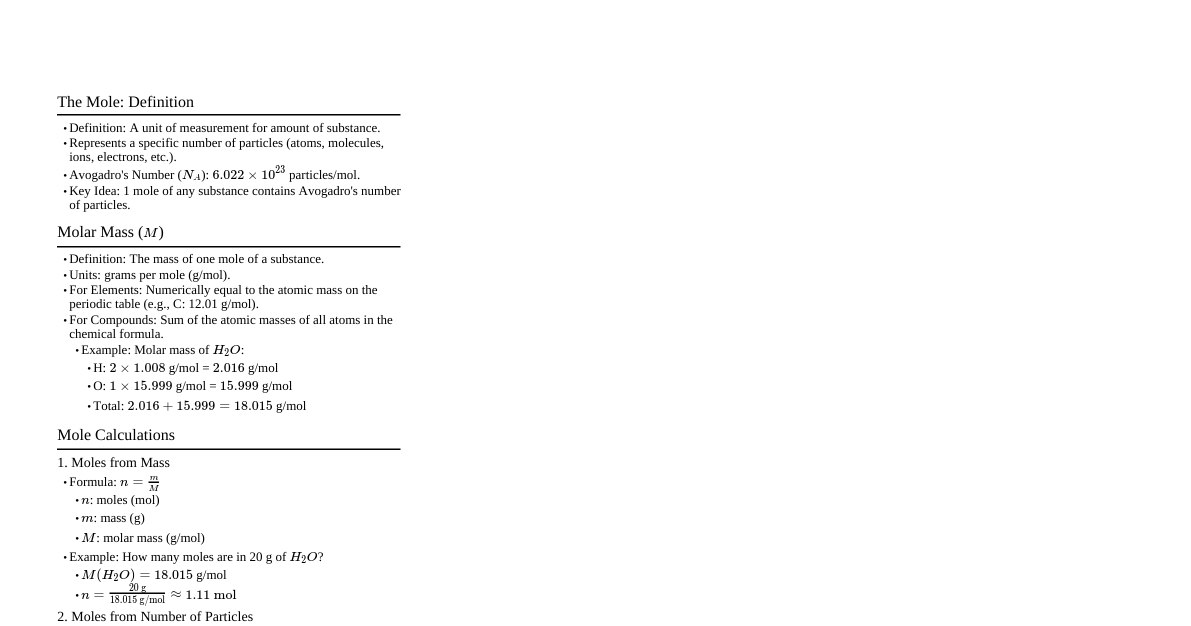
### Introduction to Chemistry and Matter Chemistry is the study of atoms and molecules. #### Matter: Definition and Classification **Matter** is anything that has both volume (or shape) and mass. ##### Physical Classification of Matter Matter can be classified into **Solid**, **Liquid**, and **Gas**. State is determined by: * **Intermolecular Force (IMF)**: Attraction between molecules. * **Thermal Energy (TE)**: Energy of particle motion. | State | IMF vs TE | Characteristics | | :----- | :---------------------------------- | :------------------------------------------------ | | **Gas** | $TE \gg IMF$ | Particles far apart, constant random motion. | | **Solid** | $IMF \gg TE$ | Tightly packed, fixed positions, vibrate only. | | **Liquid** | $IMF \approx TE$ (intermediate) | Particles move past each other, remain in contact. | ##### Chemical Classification of Matter * **Pure Substances**: Fixed ratio of components. * **Elements**: One type of atom (e.g., Fe, O$_2$). * **Compounds**: Two+ different atoms chemically combined (e.g., H$_2$O, CO$_2$). * **Mixtures**: Two+ substances physically combined, non-fixed ratio. * **Homogeneous**: Uniform composition (e.g., salt in water). * **Heterogeneous**: Non-uniform, distinct phases (e.g., sand and water). ### Atoms and Molecules #### Definitions * **Atom**: Smallest indivisible unit retaining element properties (e.g., O, N, Fe, H). * **Molecule**: Formed when two or more atoms combine. * **Homoatomic Molecules**: Same type of atoms (elements) (e.g., O$_2$, S$_8$). * **Heteroatomic Molecules**: Different types of atoms (compounds) (e.g., CO$_2$, H$_2$O). #### Atomicity **Atomicity** = total number of atoms in a molecule. * O$_2$: Atomicity = 2. * S$_8$: Atomicity = 8. * C$_{12}$H$_{22}$O$_{11}$: Total atomicity = $12+22+11 = 45$. **Conversion**: * Molecules $\rightarrow$ Atoms: Multiply by atomicity. * Atoms $\rightarrow$ Molecules: Divide by atomicity. ### Atomic Structure and Subatomic Particles #### Representation of an Atom $^A_Z X$ * $X$: Element symbol. * $Z$: **Atomic Number** (protons). * $A$: **Mass Number** (protons + neutrons). #### Subatomic Particles | Particle | Symbol | Relative Charge | Relative Mass (amu) | | :-------- | :----- | :-------------- | :------------------ | | Electron | e$^-$ | $-1$ | $\approx 0$ | | Proton | p$^+$ | $+1$ | $1$ | | Neutron | n | $0$ | $1$ | * **Mass Order**: $m_{\text{neutron}} > m_{\text{proton}} > m_{\text{electron}}$. * **Atomic Mass**: Primarily from protons and neutrons. Mass of atom $\approx A \times 1\,\text{amu}$. #### Calculating Subatomic Particles * **Protons ($p$)** = Atomic Number ($Z$). * **Neutrons ($n$)** = Mass Number ($A$) - Atomic Number ($Z$). * **Electrons ($e$)**: * Neutral atom: $e = p$. * Cation (+ charge): $e = p - \text{charge}$. * Anion (- charge): $e = p + \text{charge}$. * All are whole numbers. #### Atomic Mass Unit (amu or u) $1\,\text{amu} = \frac{1}{12} \times \text{mass of one atom of Carbon-12} \approx \text{mass of one proton}$. #### Iso-species * **Isotopes**: Same element, same $Z$, different $A$ (different neutrons). * Ex: $^1_1 H, ^2_1 H, ^3_1 H$. Same chemical, different physical properties. * **Average Atomic Mass**: $\frac{\sum (\text{Isotopic Mass} \times \text{Percentage Abundance})}{100}$ (can be fractional). * **Isobars**: Different elements, same $A$, different $Z$. * **Isotones**: Same number of neutrons. * **Isoelectronic Species**: Same number of electrons. * **Isosteres**: Same number of electrons AND same atomicity. * **Isodiaphers**: Same difference between neutrons and protons ($N-P$). ### Mole Concept and Molar Quantities #### The Mole * A unit of quantity: $1\,\text{mole} = 6.022 \times 10^{23}$ particles (**Avogadro's Number, $N_A$**). * When "gram" or "g" is used as a prefix (e.g., "2 gram atom"), it signifies moles (e.g., 2 moles of atoms). #### Mass of Atoms and Moles * **Mass of 1 Atom**: In amu (e.g., 1 atom of Oxygen = $16\,\text{amu}$). * **Mass of 1 Mole of Atoms (Gram Atomic Mass)**: In grams (e.g., 1 mole of Oxygen atoms = $16\,\text{g}$). Numerically equal to atomic mass in amu. * **Relative Atomic Mass**: Ratio of mass of one atom to $1/12$ mass of Carbon-12 atom. Numerically equal to mass number. #### Calculating Number of Moles ($n$) * **From mass**: $n = \frac{\text{Given Mass}}{\text{Molar Mass}}$ * **From particles**: $n = \frac{\text{Given Number of Particles}}{N_A}$ * **For gases (from volume)**: $n = \frac{\text{Given Volume}}{\text{Molar Volume}}$ #### Molar Volume ($V_m$) Volume of one mole of any gas at specific T & P. * Independent of gas nature/atomicity. * Depends on T & P. | Condition | T | P | $V_m$ | | :-------- | :-------------- | :-------------- | :----------------- | | Old STP | $273\,\text{K}$ | $1\,\text{atm}$ | $22.4\,\text{L}$ | | New STP | $273\,\text{K}$ | $1\,\text{bar}$ | $22.7\,\text{L}$ | | SATP | $298\,\text{K}$ | $1\,\text{bar}$ | $24.8\,\text{L}$ | #### Ideal Gas Equation and Gas Laws **Ideal Gas Equation**: $PV = nRT$ * $P$: Pressure, $V$: Volume, $n$: Moles, $T$: Temperature (K), $R$: Universal Gas Constant. * **Alternative**: $PM = dRT$ ($d$ = density). **Universal Gas Constant (R) values**: * $8.314\,\text{J/mol·K}$ * $2\,\text{cal/mol·K}$ * $0.0821\,\text{L·atm/mol·K}$ ##### Gas Laws * **Boyle's Law**: $P \propto 1/V$ (constant $T, n$) $\Rightarrow P_1V_1 = P_2V_2$. * **Charles's Law**: $V \propto T$ (constant $P, n$) $\Rightarrow V_1/T_1 = V_2/T_2$. * **Gay-Lussac's Law**: $P \propto T$ (constant $V, n$) $\Rightarrow P_1/T_1 = P_2/T_2$. * **Avogadro's Law**: $V \propto n$ (constant $T, P$). Equal volumes of gases at same T, P have equal moles. * **Combined Gas Eq.**: $P_1V_1/T_1 = P_2V_2/T_2$ (constant $n$). ##### Density and Vapor Density of Gases * **Density of Gas ($d$)**: $d = PM/RT$. ($d \propto P$, $d \propto 1/T$). * **Vapor Density (VD)**: Ratio of gas density to H$_2$ density at same T, P. * $VD = \text{Molar Mass of Gas} / 2$. #### Mole Calculation "Y-Map" (Interconversions) * **Mass $\overset{\div \text{Molar Mass}}{\underset{\times \text{Molar Mass}}{\rightleftharpoons}}$ Moles $\overset{\div N_A}{\underset{\times N_A}{\rightleftharpoons}}$ Number of Particles** * **Moles $\overset{\div \text{Molar Volume}}{\underset{\times \text{Molar Volume}}{\rightleftharpoons}}$ Volume (for gases)** ### Laws of Chemical Combination * **Law of Conservation of Mass (Lavoisier)**: Mass is conserved in chemical reactions. * **Law of Constant (or Definite) Proportions (Proust)**: A compound always has elements in fixed mass ratio (e.g., H$_2$O always 1:8 H:O by mass). * **Law of Multiple Proportions (Dalton)**: If two elements form multiple compounds, masses of one element combining with fixed mass of other are in small whole number ratios (e.g., CO, CO$_2$ for fixed C, O masses are 1:2). * **Gay-Lussac's Law of Gaseous Volumes**: Gases react in simple whole-number volume ratios (at constant T, P). ### Empirical and Molecular Formula * **Molecular Formula (MF)**: Exact number of atoms of each element. * **Empirical Formula (EF)**: Simplest whole-number ratio of atoms. **Relationship**: $MF = n \times EF$, where $n = \frac{\text{Molecular Formula Mass}}{\text{Empirical Formula Mass}}$. **Method to Calculate EF**: 1. List elements. 2. Note % or mass. 3. Divide by atomic mass $\rightarrow$ atomic ratio. 4. Divide all by smallest atomic ratio $\rightarrow$ simplest whole number ratio (EF). #### Minimum Molecular Mass $\text{Minimum Molecular Mass} = \frac{\text{Atomic Mass of Element} \times 100}{\text{Percentage of Element}}$ (Adjust atomic mass if >1 atom of element is in EF). ### Percentage Composition Describes proportion of a component. * **Mass by Mass (% w/w)**: $$ \frac{\text{Mass of Solute}}{\text{Total Mass of Solution}} \times 100 $$ (e.g., 20% w/w NaOH $\Rightarrow 20\,\text{g}$ NaOH in $100\,\text{g}$ solution). * **Volume by Volume (% v/v)**: $$ \frac{\text{Volume of Solute}}{\text{Total Volume of Solution}} \times 100 $$ (e.g., 20% v/v NaOH $\Rightarrow 20\,\text{mL}$ NaOH in $100\,\text{mL}$ solution). * **Mass by Volume (% w/v)**: $$ \frac{\text{Mass of Solute}}{\text{Total Volume of Solution}} \times 100 $$ (e.g., 20% w/v NaOH $\Rightarrow 20\,\text{g}$ NaOH in $100\,\text{mL}$ solution). ### Stoichiometry Calculation of reactant/product quantities in balanced reactions. #### Reading a Balanced Chemical Equation Ex: $N_2 (g) + 3H_2 (g) \rightarrow 2NH_3 (g)$ * **Moles**: 1 mole $N_2$ + 3 moles $H_2$ $\rightarrow$ 2 moles $NH_3$. * **Molecules**: 1 molecule $N_2$ + 3 molecules $H_2$ $\rightarrow$ 2 molecules $NH_3$. * **Mass**: $28\,\text{g}$ $N_2$ + $6\,\text{g}$ $H_2$ $\rightarrow$ $34\,\text{g}$ $NH_3$. * **Volume (gases, const T, P)**: $1 V_{N_2}$ + $3 V_{H_2}$ $\rightarrow$ $2 V_{NH_3}$. #### Stoichiometric Calculations (Cris-Cross Method) $$ \text{Unknown Quantity} = \frac{\text{Given Quantity of Known Substance}}{\text{Standard Quantity of Known Substance}} \times \text{Standard Quantity of Unknown Substance} $$ #### Purity Concept (Reactants) * Only pure mass of reactant participates. * **Percentage Purity**: $$ \frac{\text{Mass of Pure Reactant}}{\text{Given Mass of Reactant Sample}} \times 100 $$ #### Yield Concept (Products) * **Actual Yield**: Experimentally obtained product. * **Theoretical Yield**: Maximum product from stoichiometry. * **Percentage Yield**: $$ \frac{\text{Actual Yield}}{\text{Theoretical Yield}} \times 100 $$ #### Limiting Reagent (LR) and Excess Reactant (ER) * **LR**: Reactant consumed first; determines max product. * **ER**: Reactant left over. **Identify LR**: 1. For each reactant, calculate $\frac{\text{moles}}{\text{stoichiometric coefficient}}$. 2. Reactant with lowest ratio is LR. ### Concentration Terms Amount of solute in solvent/solution. #### Fraction Terms (0 to 1) * **Mass Fraction of A**: $\frac{\text{Mass of A}}{\text{Total Mass of Solution}}$. * **Volume Fraction of A**: $\frac{\text{Volume of A}}{\text{Total Volume of Solution}}$. * **Mole Fraction ($\chi$) of A**: $\frac{\text{Moles of A}}{\text{Total Moles of Solution}}$. * $\sum \chi = 1$. #### Molality ($m$) * **Definition**: Moles of solute per kg of solvent. * **Formula**: $m = \frac{\text{Moles of Solute}}{\text{Mass of Solvent (kg)}}$. * **Unit**: mol/kg or molal. * **Temperature Independent**. * **Relation with Mole Fraction**: $m = \frac{\chi_{\text{solute}}}{\chi_{\text{solvent}}} \times \frac{1000}{\text{Molar Mass of Solvent}}$. #### Strength ($S$) * **Definition**: Mass of solute (g) per liter of solution. * **Formula**: $S = \frac{\text{Mass of Solute (g)}}{\text{Volume of Solution (L)}}$. * **Unit**: g/L. #### Molarity ($M$) * **Definition**: Moles of solute per liter of solution. * **Formula**: $M = \frac{\text{Moles of Solute}}{\text{Volume of Solution (L)}}$. * **Unit**: mol/L or Molar. * **Numerical Formula**: $M = \frac{\text{Given Mass of Solute}}{\text{Molar Mass of Solute}} \times \frac{1000}{\text{Volume of Solution (mL)}}$. * **Temperature Dependent** (volume changes with T). * **Relations**: * Strength = Molarity $\times$ Molar Mass of Solute. * $M = \frac{10 \times \text{Percentage w/w of Solute} \times \text{Density of Solution}}{\text{Molar Mass of Solute}}$. * **Molality ($m$) and Molarity ($M$)**: $$ m = \frac{1000 \times M}{1000 \times \text{Density of Solution} - M \times \text{Molar Mass of Solute}} $$ #### Dilution and Mixing * **Dilution/Concentration**: Moles of solute constant. $M_1V_1 = M_2V_2$. * **Mixing Solutions**: $M_{\text{mixture}} = \frac{M_1V_1 + M_2V_2}{V_1 + V_2}$.