Chemical Equilibrium (JEE Advanced)
Cheatsheet Content
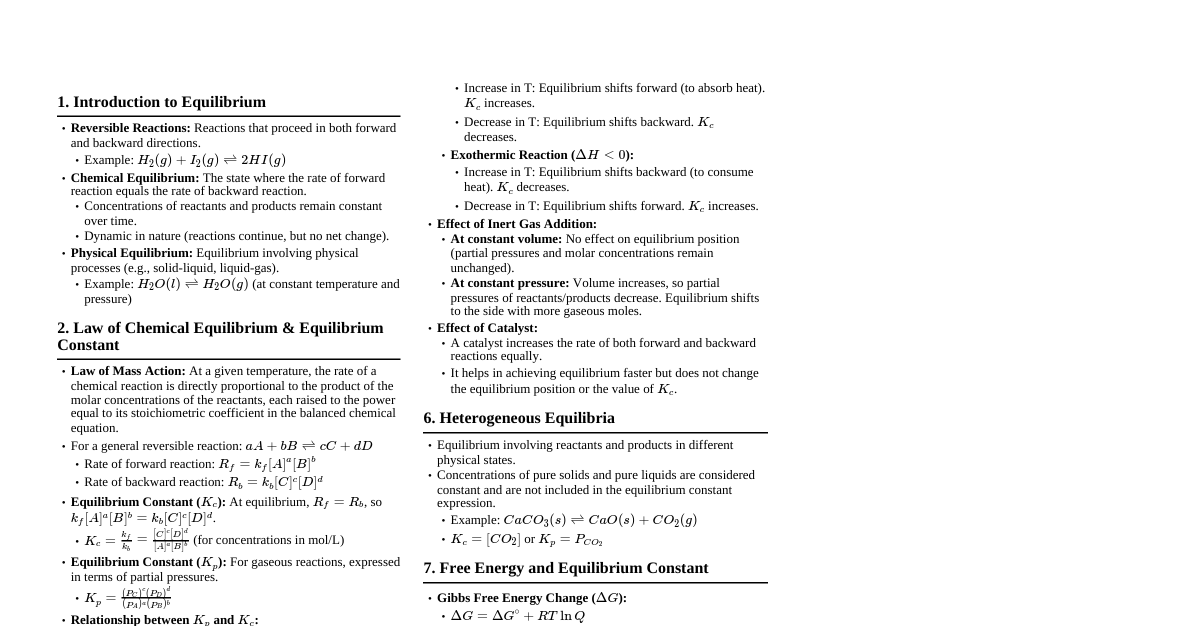
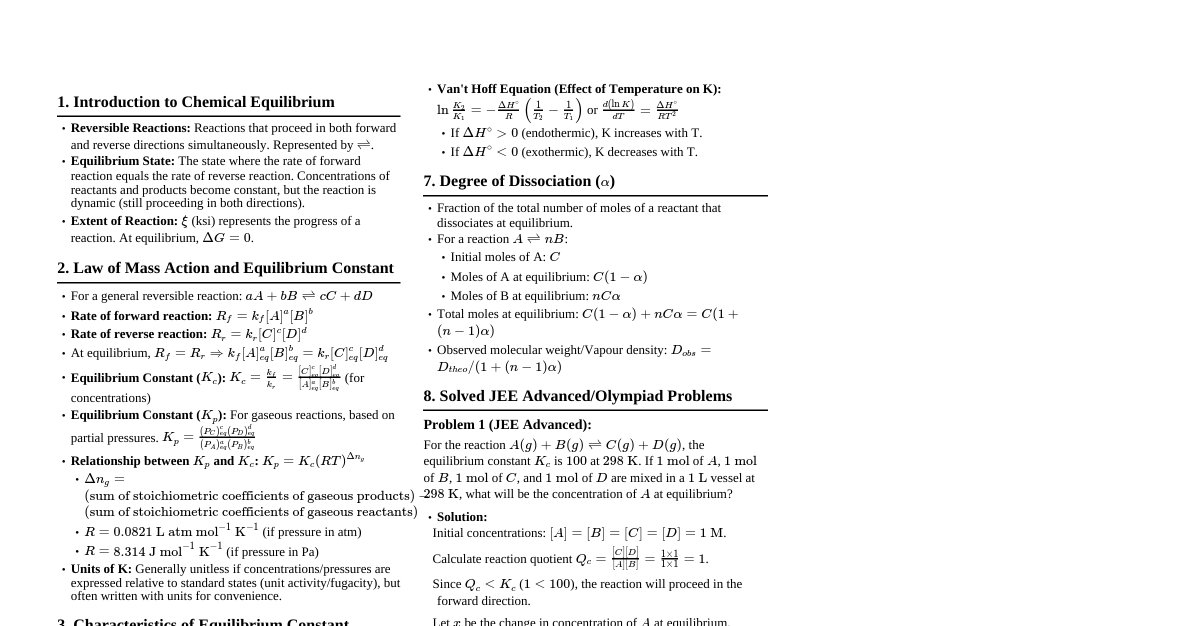
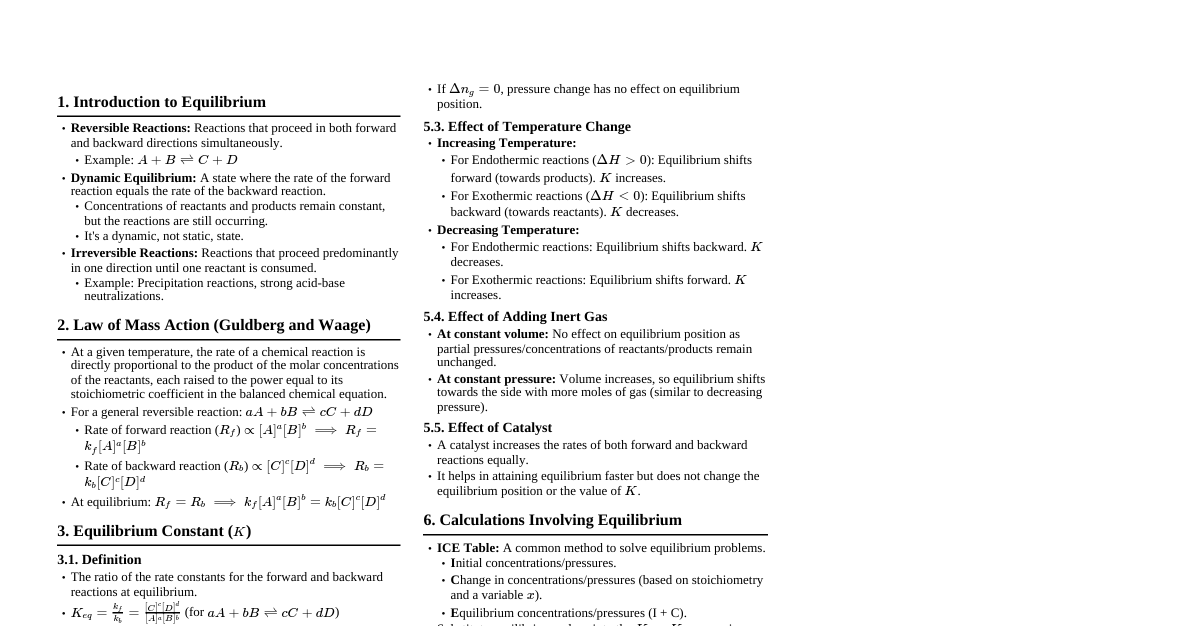
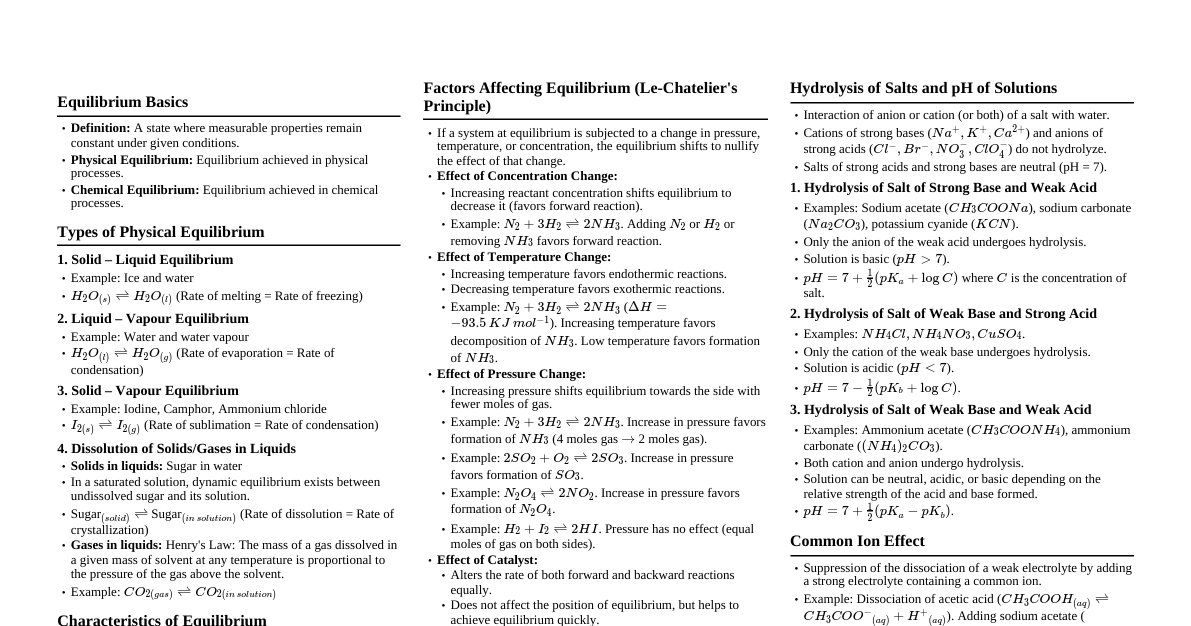
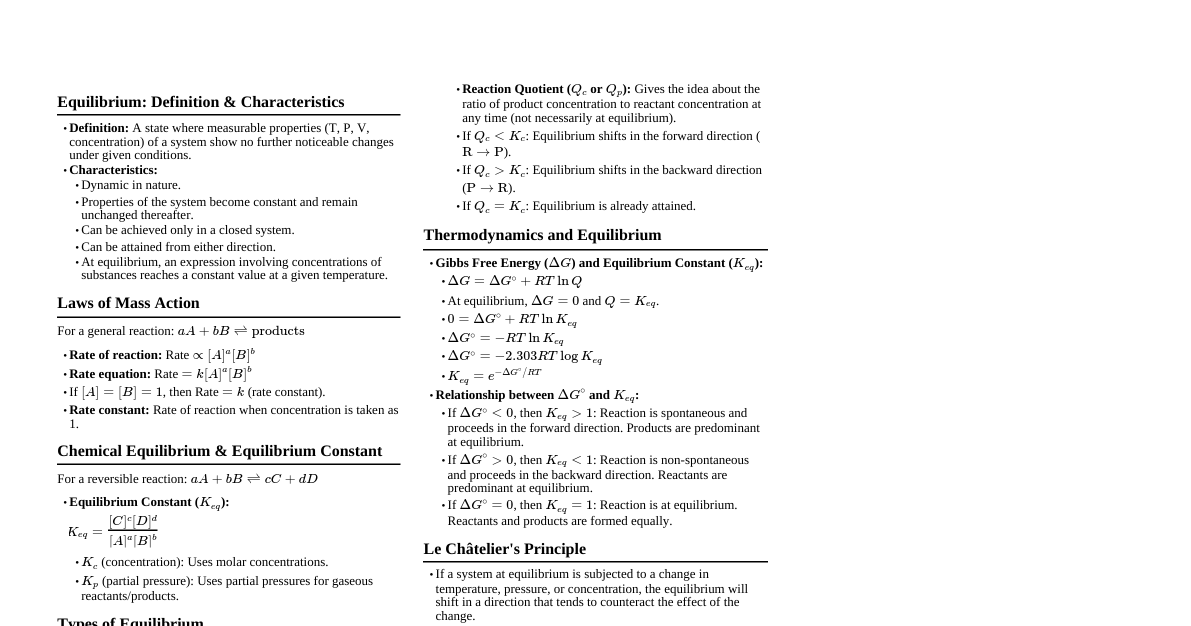
1. Introduction to Equilibrium Reversible Reactions: Reactions that proceed in both forward and reverse directions. Represented by $\rightleftharpoons$. Equilibrium State: The state where the rate of forward reaction equals the rate of reverse reaction. Concentrations of reactants and products become constant. Dynamic in nature (reactions still occur). Achievable from either direction. Closed system required. 2. Law of Mass Action & Equilibrium Constant For a general reversible reaction: $aA + bB \rightleftharpoons cC + dD$ Rate of forward reaction ($R_f$): $R_f = k_f[A]^a[B]^b$ Rate of reverse reaction ($R_r$): $R_r = k_r[C]^c[D]^d$ At equilibrium: $R_f = R_r \implies k_f[A]^a[B]^b = k_r[C]^c[D]^d$ Equilibrium Constant ($K_c$): $K_c = \frac{k_f}{k_r} = \frac{[C]^c[D]^d}{[A]^a[B]^b}$ (for concentrations) Equilibrium Constant ($K_p$): For gaseous reactions, $K_p = \frac{(P_C)^c(P_D)^d}{(P_A)^a(P_B)^b}$ (for partial pressures) Relationship between $K_p$ and $K_c$: $K_p = K_c(RT)^{\Delta n_g}$ $\Delta n_g = (\text{sum of stoichiometric coefficients of gaseous products}) - (\text{sum of stoichiometric coefficients of gaseous reactants})$ $R = 0.0821 \text{ L atm mol}^{-1} \text{ K}^{-1}$ or $8.314 \text{ J mol}^{-1} \text{ K}^{-1}$ $T$ is temperature in Kelvin. Units of K: Generally unitless if using activities/fugacities, but can have units of $(\text{mol/L})^{\Delta n}$ or $(\text{atm})^{\Delta n_g}$. 3. Types of Equilibrium Homogeneous Equilibrium: All reactants and products are in the same phase (e.g., all gaseous or all liquid solutions). Example: $N_2(g) + 3H_2(g) \rightleftharpoons 2NH_3(g)$ Heterogeneous Equilibrium: Reactants and products are in different phases. Concentrations of pure solids and pure liquids are considered constant and are not included in the equilibrium expression. Example: $CaCO_3(s) \rightleftharpoons CaO(s) + CO_2(g)$ $K_c = [CO_2]$; $K_p = P_{CO_2}$ 4. Characteristics of Equilibrium Constant Value depends only on temperature and the stoichiometry of the balanced reaction. Does not depend on initial concentrations, presence of catalyst, or direction from which equilibrium is approached. Manipulating K: If reaction is reversed: $K'_{eq} = 1/K_{eq}$ If reaction is multiplied by 'n': $K'_{eq} = (K_{eq})^n$ If reactions are added: $K'_{eq} = K_1 \times K_2$ Magnitude of K: $K \gg 10^3$: Products highly favored (reaction goes almost to completion). $K \ll 10^{-3}$: Reactants highly favored (reaction barely proceeds). $10^{-3} 5. Reaction Quotient (Q) Calculated like K, but using non-equilibrium concentrations/pressures. $Q_c = \frac{[C]^c[D]^d}{[A]^a[B]^b}$ (at any point in time) Predicting Reaction Direction: If $Q If $Q > K$: Net reaction proceeds in the reverse direction to reach equilibrium. If $Q = K$: System is at equilibrium. 6. Le Chatelier's Principle "If a system at equilibrium is subjected to a change in conditions, the system will shift in a direction that counteracts the change." Effect of Concentration: Adding reactant: Shift right (forward direction). Removing reactant: Shift left (reverse direction). Adding product: Shift left. Removing product: Shift right. Effect of Pressure (for gaseous reactions): Increasing pressure (decreasing volume): Shift towards side with fewer moles of gas. Decreasing pressure (increasing volume): Shift towards side with more moles of gas. If $\Delta n_g = 0$: No effect of pressure change. Adding inert gas at constant volume: No effect on equilibrium position (partial pressures remain unchanged). Adding inert gas at constant total pressure: Increases volume, shifts towards side with more moles of gas. Effect of Temperature: Endothermic reaction ($\Delta H > 0$): Treat heat as a reactant. Increase T: Shift right (K increases). Decrease T: Shift left (K decreases). Exothermic reaction ($\Delta H Treat heat as a product. Increase T: Shift left (K decreases). Decrease T: Shift right (K increases). Effect of Catalyst: Increases rate of both forward and reverse reactions equally. Helps attain equilibrium faster, but does NOT change the equilibrium position or the value of K. 7. Calculation of Equilibrium Concentrations Often involves setting up an "ICE" table (Initial, Change, Equilibrium). Steps: Write balanced chemical equation. Write K expression. List initial concentrations/pressures. Define 'x' as the change in concentration/pressure for one species. Express equilibrium concentrations/pressures in terms of 'x'. Substitute into K expression and solve for 'x'. Calculate final equilibrium concentrations/pressures. Approximation: If K is very small ($ 8. Thermodynamics and Equilibrium Gibbs Free Energy Change ($\Delta G$): $\Delta G = \Delta G^\circ + RT \ln Q$ At equilibrium, $\Delta G = 0$ and $Q = K$. So, $0 = \Delta G^\circ + RT \ln K \implies \Delta G^\circ = -RT \ln K$ Relationship between K and $\Delta G^\circ$: If $\Delta G^\circ 1$ (products favored). If $\Delta G^\circ > 0$: $K If $\Delta G^\circ = 0$: $K = 1$ (neither favored). Van't Hoff Equation: Relates K to temperature and enthalpy change. $$ \ln \frac{K_2}{K_1} = -\frac{\Delta H^\circ}{R} \left( \frac{1}{T_2} - \frac{1}{T_1} \right) $$ Can be used to predict how K changes with temperature. For endothermic reactions ($\Delta H^\circ > 0$), $K$ increases with $T$. For exothermic reactions ($\Delta H^\circ 9. Multiple Equilibria If an overall reaction can be expressed as the sum of two or more elementary reactions, the overall equilibrium constant is the product of the individual equilibrium constants. Reaction 1: $A \rightleftharpoons B$, $K_1$ Reaction 2: $B \rightleftharpoons C$, $K_2$ Overall Reaction: $A \rightleftharpoons C$, $K_{overall} = K_1 \times K_2$