Aptitude Concept Builder
Cheatsheet Content
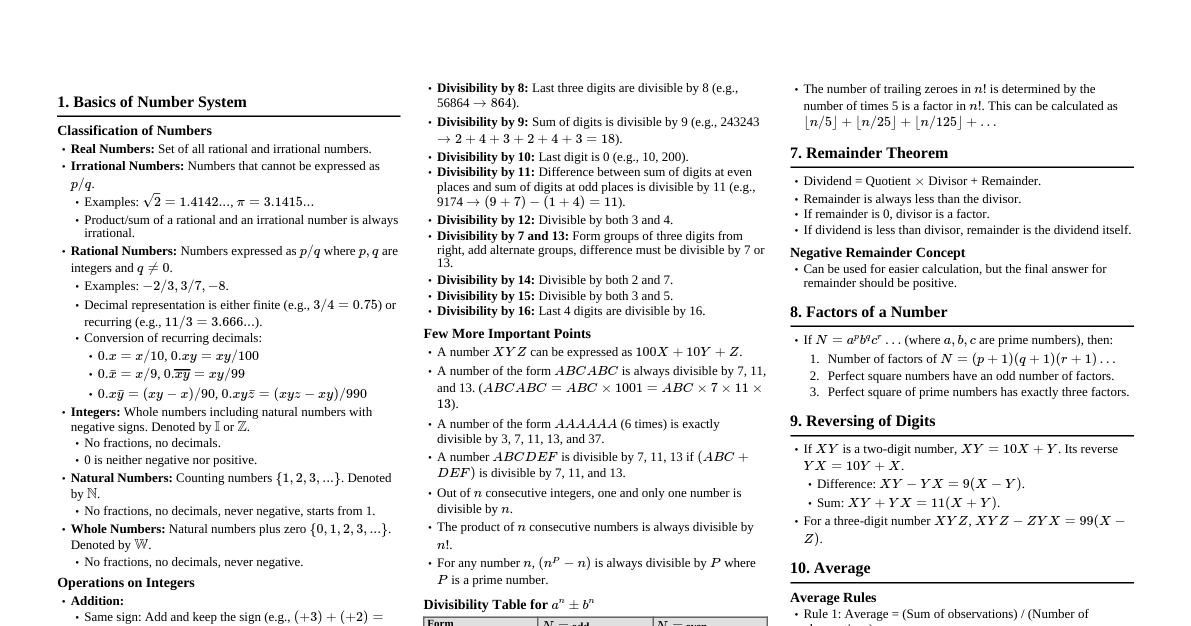
Unit 1: Number System Classification of Numbers Real Numbers: Can be positive or negative, lies on the number line. Natural Numbers: $1, 2, 3, \dots$ (Counting numbers). Lowest is $1$. Whole Numbers: $0, 1, 2, 3, \dots$ (Natural numbers + zero). Integers: $\dots, -2, -1, 0, 1, 2, \dots$ (Positive, negative whole numbers and zero). Rational Numbers: Can be written as $p/q$ where $q \ne 0$. Irrational Numbers: Cannot be written as $p/q$. Prime Numbers Numbers with exactly two factors: $1$ and itself. Example: $2, 3, 5, 7, 11, \dots$ There are $25$ prime numbers between $1$ and $100$. The only even prime number is $2$. $1$ is neither prime nor composite. To check if $N$ is prime: Find $\sqrt{N}$. Check divisibility by primes less than $\sqrt{N}$. Composite Numbers Product of two or more distinct or same prime numbers. Example: $4, 6, 8, 9, 10, \dots$ Properties of Natural Numbers Sum of first $n$ natural numbers: $\frac{n(n+1)}{2}$ Sum of squares of first $n$ natural numbers: $\frac{n(n+1)(2n+1)}{6}$ Sum of cubes of first $n$ natural numbers: $\left(\frac{n(n+1)}{2}\right)^2$ BODMAS Rule B rackets ()$, [], \{\}$ O rder/Power of (e.g., $\sqrt{}, x^2$) D ivision $(\div)$ M ultiplication $(\times)$ A ddition $(+)$ S ubtraction $(-)$ Factors If $N = a^p b^q c^r$ (prime factorization), total number of factors is $(p+1)(q+1)(r+1)$. Number of even factors: If $a=2$, $p(q+1)(r+1)$. (Power of $2$ must be $\ge 1$) Number of odd factors: $(q+1)(r+1)$ (Power of $2$ must be $0$) Number of factors ending with $0$: Divisible by $10$. Must have at least $2^1$ and $5^1$ as factors. Example: For $N=2^a 3^b 5^c 7^d$, factors divisible by $10$ are $(a)(b+1)(c)(d+1)$. Perfect square factors: Prime factors must have even powers. Perfect cube factors: Prime factors must have powers divisible by $3$. Number of ways to express $N$ as a product of two factors: If $N$ is not a perfect square: $\frac{\text{Total factors}}{2}$ If $N$ is a perfect square: $\frac{\text{Total factors}+1}{2}$ Divisibility Rules Divisor Condition $2$ Last digit is even. $3$ Sum of digits is divisible by $3$. $4$ Last two digits form a number divisible by $4$. $5$ Last digit is $0$ or $5$. $6$ Divisible by both $2$ and $3$. $7$ Subtract twice the last digit from the rest of the number. Repeat if necessary. Result must be divisible by $7$. $8$ Last three digits form a number divisible by $8$. $9$ Sum of digits is divisible by $9$. $10$ Last digit is $0$. $11$ Alternating sum of digits (from right to left) is $0$ or divisible by $11$. $12$ Divisible by both $3$ and $4$. Cyclicity (Unit Digit) The last digit of a number follows a pattern when raised to increasing powers. Example: Cyclicity of $2$: $2^1=2, 2^2=4, 2^3=8, 2^4=16, 2^5=32$. Pattern $2,4,8,6$ repeats every $4$ powers. To find unit digit of $N^P$: Find cyclicity $C$ of unit digit of $N$. Find $P \pmod C$. If remainder is $0$, use $C$. Number Cyclicity $1$ $1$ $2$ $4$ $3$ $4$ $4$ $2$ $5$ $1$ $6$ $1$ $7$ $4$ $8$ $4$ $9$ $2$ $10$ $1$ Unit 2: Percentages Definition A number or ratio expressed as a fraction of $100$. Denoted by $\%$. Percentage is always dependent on the base value. Percentage and Fraction Equivalents $1/2 = 50\%$, $1/4 = 25\%$, $1/8 = 12.5\%$, $1/16 = 6.25\%$ $1/3 = 33.33\%$, $1/6 = 16.66\%$, $1/12 = 8.33\%$ $1/9 = 11.11\%$, $1/11 = 9.09\%$ Shortcut to Calculating Percentages $10\%$ of a number: Shift decimal one place left. (e.g., $10\%$ of $1264 = 126.4$) $1\%$ of a number: Shift decimal two places left. (e.g., $1\%$ of $1264 = 12.64$) Use decomposition: $36\%$ of $1325 = (40\% - 4\%)$ of $1325 = (4 \times 10\% - 4 \times 1\%)$ of $1325$. Change of Base If A is $r\%$ more than B, then B is $\frac{100r}{100+r}\%$ less than A. If A is $r\%$ less than B, then B is $\frac{100r}{100-r}\%$ more than A. Successive Percent Changes Net change of $a\%$ and $b\%$ is $\left(a + b + \frac{ab}{100}\right)\%$. Applicable for quantities like Area ($L \times B$), Volume ($L \times B \times H$), Sales (Market Size $\times$ Market Share). Unit 3: Profit and Loss Basic Definitions Cost Price (CP): Price at which an article is purchased. (Base for profit/loss calculation) Selling Price (SP): Price at which an article is sold. Marked Price (MP) / List Price: Price at which an article is marked. Profit and Loss Calculation Profit: SP > CP. Profit = SP - CP. Loss: CP > SP. Loss = CP - SP. Profit Percentage: $\left(\frac{\text{Profit}}{\text{CP}}\right) \times 100\%$ Loss Percentage: $\left(\frac{\text{Loss}}{\text{CP}}\right) \times 100\%$ Discount Discount is calculated on MP. Selling Price = Marked Price - Discount. Discount Percentage = $\left(\frac{\text{Discount}}{\text{MP}}\right) \times 100\%$ Relationship between CP, MP, SP (Example) If an item is marked $X\%$ above CP and sold at $D\%$ discount: Assume CP = $100$. MP = $100 \times \left(1 + \frac{X}{100}\right)$. SP = MP $\times \left(1 - \frac{D}{100}\right)$. Profit/Loss % = $\frac{\text{SP} - \text{CP}}{\text{CP}} \times 100\%$. Different Quantities Purchased/Sold If A articles are bought for Rs. X and B articles are sold for Rs. Y: CP of 1 article = $X/A$. SP of 1 article = $Y/B$. Calculate profit/loss based on these per-article prices. Alternatively, find LCM of A and B, and calculate CP/SP for that many articles. Dishonest Dealer Sells at CP but uses false weight: Profit % = $\left(\frac{\text{Error}}{\text{True Value} - \text{Error}}\right) \times 100\% = \left(\frac{\text{Gain in weight}}{\text{Actual weight used}}\right) \times 100\%$ Example: Sells $900$g for $1$kg. Profit % = $\frac{100}{900} \times 100\% = 11.11\%$. Sells at profit and uses false weight: Example: Sells $20\%$ above CP, gives $800$g for $1$kg. If CP of $1000$g = $100$. SP of $1000$g = $120$. Actual weight sold = $800$g. Cost of $800$g = $80$. Profit = $120 - 80 = 40$. Profit % = $\frac{40}{80} \times 100\% = 50\%$. Two Articles Sold at Same Price If two articles are sold at the same price, one at $X\%$ profit and other at $X\%$ loss: There is always a loss. Loss % = $\left(\frac{X}{10}\right)^2 \%$. Goods Passing Through Successive Hands If A sells to B at $P_1\%$ profit, B sells to C at $P_2\%$ profit: CP for C = CP for A $\times \left(1 + \frac{P_1}{100}\right) \times \left(1 + \frac{P_2}{100}\right)$. Price-Quantity Relationship If price decreases by $X\%$, a person can buy $K$ kg more for Rs. $P$. Original price per kg = $\frac{X}{100-X} \times \frac{P}{K}$. New price per kg = $\frac{X}{100} \times \frac{P}{K}$. Unit 6: Averages Definition Average = $\frac{\text{Sum of Quantities}}{\text{Number of Quantities}}$ Averages of Important Series Average of first $n$ natural numbers: $\frac{n+1}{2}$ Average of first $n$ consecutive even numbers: $n+1$ Average of first $n$ consecutive odd numbers: $n$ Average of consecutive numbers: $\frac{\text{First Number} + \text{Last Number}}{2}$ Average of squares of first $n$ natural numbers: $\frac{(n+1)(2n+1)}{6}$ Average of cubes of first $n$ natural numbers: $\frac{n(n+1)^2}{4}$ Important Points to Remember If all numbers increase/decrease/multiply/divide by 'a', their average also changes by 'a'. When a person replaces another: If average increases: Age of new person = Age of person who left + (Increase in average $\times$ total persons) If average decreases: Age of new person = Age of person who left - (Decrease in average $\times$ total persons) When a person joins the group: If average increases: Age of new member = Previous average + (Increase in average $\times$ total members including new member) If average decreases: Age of new member = Previous average - (Decrease in average $\times$ total members including new member) Unit 16: Blood Relations Relations by Paternal Side Father's father: Grandfather Father's mother: Grandmother Father's brother: Uncle Father's sister: Aunt Children of uncle/aunt: Cousin Relations by Maternal Side Mother's father: Maternal grandfather Mother's mother: Maternal grandmother Mother's brother: Maternal uncle Mother's sister: Aunt Children of maternal uncle/aunt: Cousin Important Relations Son's wife: Daughter-in-law Daughter's husband: Son-in-law Husband's/Wife's father: Father-in-law Husband's/Wife's mother: Mother-in-law Family Tree Construction Conventions Male: $(+)$ Female: $(-)$ Husband-Wife: Double horizontal line $(W \Leftrightarrow Y)$ Siblings: Single horizontal line $(X - T - R)$ Parent-Child: Vertical line (Parent at higher level, Child at lower level) Types of Blood Relation Questions Nested Blood Relationship: Complex sentences, use back-tracing technique (solve from end). Arrangement Based Blood Relationship: Use Family Tree diagrams. Coded Blood Relationship: Symbols represent relations. Use generation gap and gender identification. Unit 17: Clock Basic Concepts Clock face has $60$ spaces. Minute hand: Covers $360^\circ$ in $60$ min ($6^\circ$/min). Hour hand: Covers $360^\circ$ in $12$ hours ($30^\circ$/hour, $0.5^\circ$/min). Relative speed of minute hand w.r.t. hour hand: $6^\circ - 0.5^\circ = 5.5^\circ$/min. Angles between Hands Angle = $|30H - 5.5M|$, where $H$ is hours and $M$ is minutes. Positions of Hands Coincide (0$^\circ$): $11$ times in $12$ hours, $22$ times in $24$ hours. (Exception: $12$ o'clock). Opposite (180$^\circ$): $11$ times in $12$ hours, $22$ times in $24$ hours. (Exception: $6$ o'clock). Right Angle (90$^\circ$): $22$ times in $12$ hours, $44$ times in $24$ hours. Clock Running Fast/Slow If a clock gains $X$ min in $T$ hours, it is running fast. If a clock loses $X$ min in $T$ hours, it is running slow. Unit 18: Calendar Key Points Ordinary Year: $365$ days ($52$ weeks $+ 1$ odd day). Leap Year: $366$ days ($52$ weeks $+ 2$ odd days). Leap Year Rule: Divisible by $4$. For centuries, divisible by $400$. (e.g., $2000$ is leap, $1900$ is not). Odd Days Extra days beyond complete weeks. $100$ years: $5$ odd days. $200$ years: $3$ odd days. $300$ years: $1$ odd day. $400$ years: $0$ odd days. (Repeats every $400$ years). Odd Days Day $0$ Sunday $1$ Monday $2$ Tuesday $3$ Wednesday $4$ Thursday $5$ Friday $6$ Saturday Day Gain/Loss on Years Move forward $1$ ordinary year: gain $1$ day. Move backward $1$ ordinary year: lose $1$ day. Move forward $1$ leap year: gain $2$ days (if Feb $29$ is crossed). Move backward $1$ leap year: lose $2$ days (if Feb $29$ is crossed). Unit 20: Directions Basic Directions North (N), South (S), East (E), West (W). Cardinal Directions: NE, NW, SE, SW. Clockwise turn: Right. Anticlockwise turn: Left. Solving Problems Draw diagrams to visualize movements. For final position/distance: Use Pythagoras theorem for right-angled triangles. Shadow problems (Sunrise/Sunset): Sunrise: Sun in East, shadow in West. Sunset: Sun in West, shadow in East. If facing North, shadow is to your left (sunrise) or right (sunset). If facing South, shadow is to your right (sunrise) or left (sunset). Angular Movement: Calculate net degrees of rotation (clockwise/anticlockwise).