Carbohydrate, Fat & Protein Tests
Cheatsheet Content
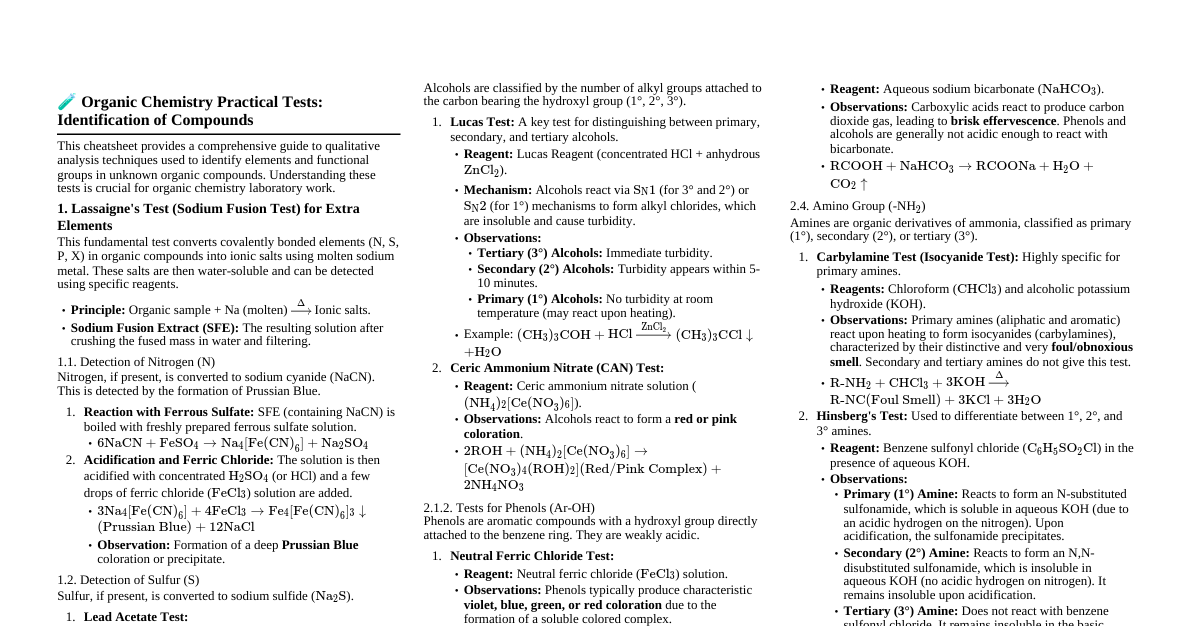
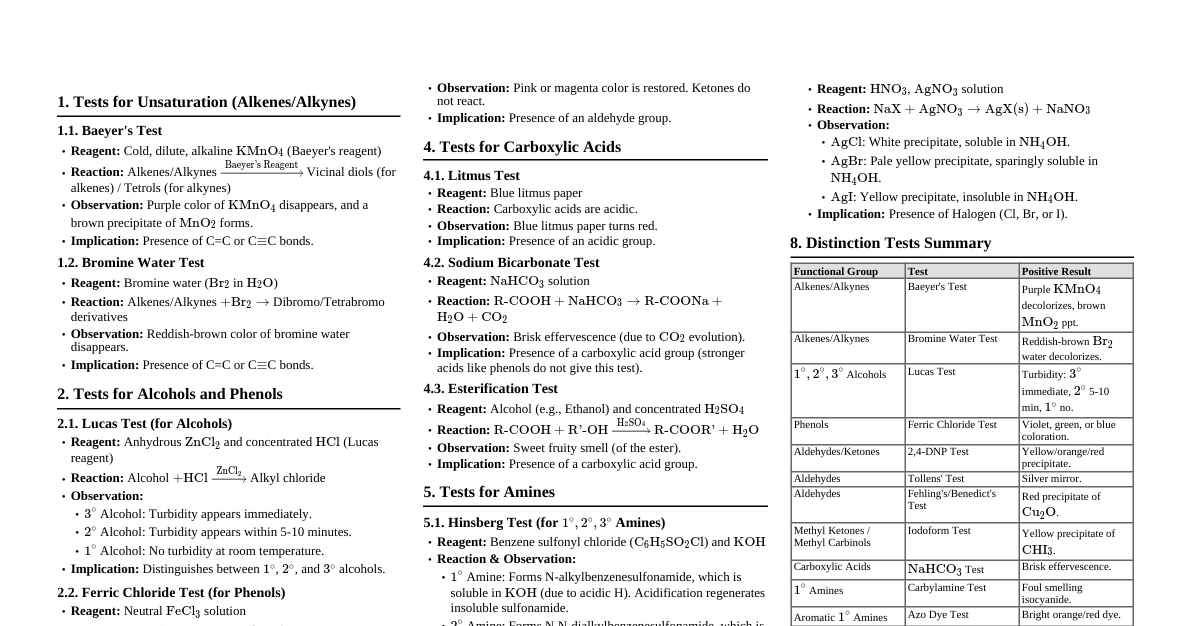
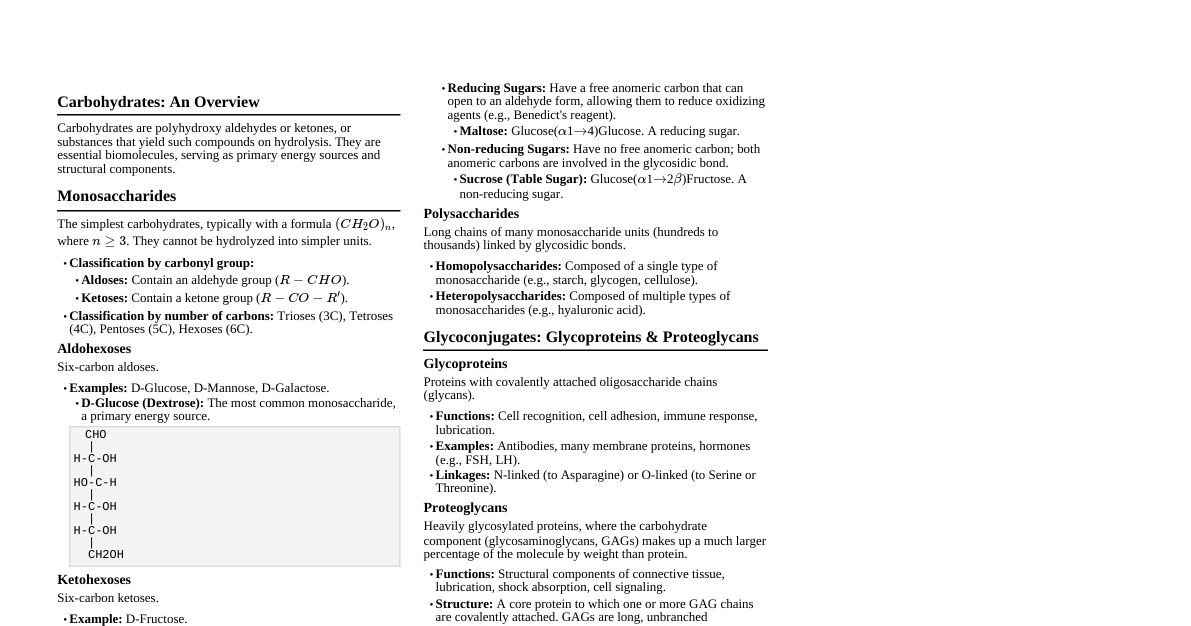
Carbohydrates Optically active polyhydroxy aldehydes, polyhydroxy ketones, or compounds yielding these units on hydrolysis. Monosaccharides: Cannot be hydrolysed further (e.g., glucose, fructose). Oligosaccharides: Yield 2-10 monosaccharide units on hydrolysis (e.g., disaccharides like sucrose, maltose). Polysaccharides: Yield many monosaccharide units on hydrolysis (e.g., starch, cellulose). Molisch's Test (General Test for Carbohydrates) Principle: Concentrated $\text{H}_2\text{SO}_4$ hydrolyses glycosidic bonds to monosaccharides, which dehydrate to furfural. Furfural reacts with 1-naphthol to form a deep violet condensation product. Procedure: Add 2-3 drops of 1% alcoholic 1-naphthol solution to the test tube. Carefully pour 2 mL conc. $\text{H}_2\text{SO}_4$ down the sides to form a separate layer. Positive Result: A purple ring at the interface indicates carbohydrates. Hazard Warning: 1-Naphthol in high concentration is destructive to tissues. Handle $\text{H}_2\text{SO}_4$ with care. Tests for Reducing Sugars Reducing sugars (containing aldehydic or $\alpha$-hydroxy ketonic groups) reduce $\text{Cu}^{2+}$ ions in alkaline medium. Fehling's Test & Benedict's Test Principle: Reducing sugars reduce $\text{Cu}^{2+}$ (blue) to $\text{Cu}_2\text{O}$ (orange-red precipitate). Tartarate ions (Fehling's) or citrate ions (Benedict's) complex $\text{Cu}^{2+}$ to prevent $\text{Cu}(\text{OH})_2$ precipitation. Reactions: $\text{Cu}(\text{OH})_2 \rightarrow \text{CuO (black)} + \text{H}_2\text{O}$ $2\text{Cu}(\text{OH})_2 + \text{Reducing Agent} \rightarrow \text{Cu}_2\text{O (orange-red)} + 2\text{H}_2\text{O} + [\text{O}]$ $\text{RCHO} + 2\text{Cu}^{2+} + 5\text{OH}^- \rightarrow \text{RCOO}^- + \text{Cu}_2\text{O} + 3\text{H}_2\text{O}$ Procedure (Fehling's): Mix 1 mL Fehling's solution A and 1 mL Fehling's solution B. Add to test tube and heat in a water bath. Positive Result: Orange-red precipitate indicates reducing sugar. Procedure (Benedict's): Add 1 mL Benedict's reagent to test tube. Heat in a water bath for 2 minutes. Positive Result: Orange-red precipitate ($\text{Cu}_2\text{O}$) indicates reducing sugar. Note: Sucrose (a disaccharide) does not react as it is a non-reducing sugar. Tollen's Test Principle: Reducing sugars reduce ammoniacal silver nitrate (Tollen's reagent) to metallic silver, which deposits as a silver mirror on the test tube walls. Reaction: $\text{RCHO} + 2[\text{Ag}(\text{NH}_3)_2]^+ + 2\text{OH}^- \rightarrow 2\text{Ag (silver mirror)} + \text{RCOONH}_4 + \text{H}_2\text{O} + 3\text{NH}_3$ Procedure: Prepare Tollen's reagent: add $\text{NaOH}$ to $\text{AgNO}_3$ solution to form $\text{Ag}_2\text{O}$ precipitate, then add $\text{NH}_4\text{OH}$ until $\text{Ag}_2\text{O}$ dissolves. Add reagent to sugar solution and warm in a water bath. Positive Result: Silver mirror formation indicates reducing sugar. Caution: Never heat test tube on direct flame (explosion risk). Distinguishing Monosaccharides from Disaccharides Barfoed's Test Principle: Cupric acetate in acetic acid solution is weakly acidic. Only monosaccharides reduce it to brick-red $\text{Cu}_2\text{O}$ within 5 minutes. Disaccharides react slower due to masked aldehyde function or hydrolysis. Reaction: $\text{RCHO} + 2\text{Cu}^{2+} \rightarrow \text{RCOOH} + \text{Cu}_2\text{O (brick-red)}$ Procedure: Add 1 mL Barfoed's reagent to 10 drops of 1% sugar solution. Heat in a water bath for 5 minutes. Positive Result: Orange-red precipitate indicates monosaccharides. Disaccharides do not give this test. Test for Sucrose (Hydrolysis) Sucrose is a non-reducing disaccharide. To test for its presence, it must first be hydrolysed into glucose and fructose (reducing monosaccharides). Procedure: Add 5 drops conc. $\text{HCl}$ to 5 mL 1% sucrose solution. Heat in a boiling water bath. Cool and neutralise with $\text{NaOH}$. Perform Fehling's, Benedict's, or Seliwanoff's test on the hydrolysed product. A positive result indicates sucrose (after hydrolysis). Distinguishing Ketose from Aldose Seliwanoff's Test Principle: Ketoses dehydrate rapidly under acidic conditions to form furfural, which reacts with resorcinol (1,3-dihydroxybenzene) to give a coloured product. Aldoses react slower. Procedure: Add 2 mL Seliwanoff's reagent to 10 drops of 1% sugar solution. Heat in boiling water for 2 minutes. Positive Result: Ketohexoses give red colour. Ketopentoses give blue-green colour. Aldoses give no colour within 2 minutes. Test for Polysaccharides (Starch) Iodine Test Principle: Starch forms a blue-coloured complex (starch iodide complex) with iodine solution. Procedure: Prepare a starch suspension: 0.5 g starch in 5 mL water, pour into 50 mL boiling water to get a colloidal solution. Add a few drops of aqueous iodine solution. Positive Result: Appearance of blue colour indicates starch. Tests for Oils and Fats Oils and fats are triglycerides (esters of glycerol and long-chain fatty acids). Acrolein Test Principle: On heating with potassium hydrogen sulphate ($\text{KHSO}_4$), glycerol (from fats/oils) dehydrates to acrolein, which has a pungent odour. Reaction: $\text{Glycerol} \xrightarrow{\text{Heat, KHSO}_4} \text{Acrolein} + 2\text{H}_2\text{O}$ Procedure: Add a few crystals (0.5g) of dry $\text{KHSO}_4$ to 3 mL of mustard oil/ghee. Heat gently. Positive Result: Pungent smell (acrolein) confirms the presence of oil or fat. Tests for Proteins Proteins are complex organic compounds of amino acids, containing nitrogen. Biuret Test (for Peptide Bonds) Principle: Alkaline copper sulphate reacts with compounds containing two or more peptide bonds to form violet-coloured complexes. Procedure: Prepare 0.5% casein/egg albumin solution in 0.1 M $\text{NaOH}$. Take 2-3 mL of solution, add 2 mL 10% $\text{NaOH}$ solution. Add a few drops of copper reagent and warm for ~5 minutes. Positive Result: Appearance of violet colour (complex of $\text{Cu}^{2+}$ ions with $-\text{CONH}-$ group) confirms protein. Ninhydrin Reaction Principle: Ninhydrin (a powerful oxidizing agent) reacts with proteins to form a blue-violet compound called Rhumann's purple. (Also reacts with amino acids, primary amines, ammonia). Procedure: Take 2-3 mL of aqueous egg albumin solution. Add 3-4 drops of ninhydrin solution and heat. Positive Result: Appearance of blue colour indicates protein. Xanthoproteic Reaction Principle: Aromatic groups in free amino acids or proteins undergo nitration on heating with concentrated nitric acid. The salts of these derivatives are orange in colour. Procedure: Take 1 mL egg albumin solution, add a few drops of conc. $\text{HNO}_3$. Heat for a few minutes over a Bunsen flame (yellow colour appears). Cool under running tap, add a few drops of 10M $\text{NaOH}$ solution (orange colour appears). Positive Result: Yellow colour turning orange after adding $\text{NaOH}$ indicates protein. Tests for Foodstuffs Apply the above tests to milk, wheat flour, rice flour, gram flour, and legume powder to detect carbohydrates, fats, and proteins. For liquid samples (milk): Use directly. For solid samples (flours, powders): Prepare a colloidal solution by boiling 100 mg sample in 10 mL distilled water. Sample Carbohydrates Present/Absent Fats Present/Absent Protein Present/Absent Milk Wheat flour Rice flour Gram flour Legumes Precautions Shake mixtures thoroughly when preparing extracts. Always use fresh reagents. Use only required quantities of reagents. Discussion Questions How to distinguish between sucrose and glucose? Glucose is a reducing sugar (positive Fehling's, Benedict's, Tollen's) and a monosaccharide (positive Barfoed's). Sucrose is a non-reducing disaccharide (negative Fehling's, Benedict's, Tollen's, Barfoed's). It must be hydrolysed first to show reducing sugar tests. Why does fructose reduce Fehling's solution despite having a ketonic group? Fructose is a ketohexose. In alkaline solutions (like Fehling's), fructose isomerizes to glucose and mannose (aldoses) through enediol formation. These aldoses then reduce $\text{Cu}^{2+}$ ions. What is the role of tartarate and citrate ions in Fehling's and Benedict's reagents? Tartarate (Fehling's) and citrate (Benedict's) ions complex with $\text{Cu}^{2+}$ ions. This prevents the precipitation of insoluble copper(II) hydroxide ($\text{Cu}(\text{OH})_2$) in alkaline conditions, ensuring that $\text{Cu}^{2+}$ remains in solution to react with reducing sugars.