Carbohydrate Metabolism
Shared 4/3/2026•75 views
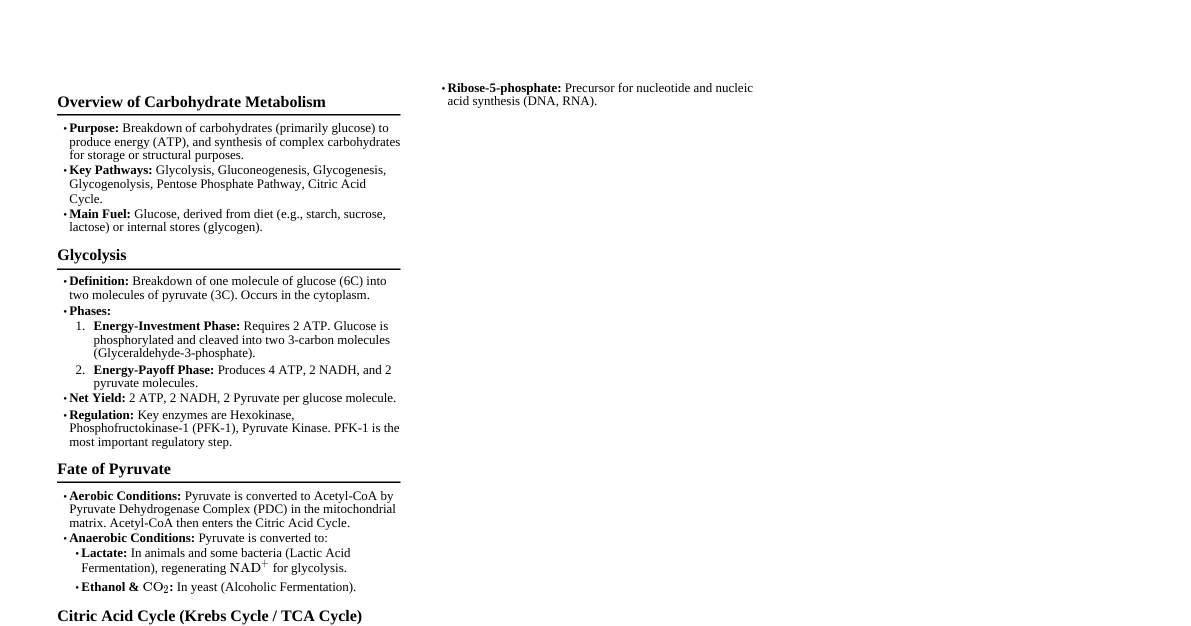
### Glycolysis - **Definition:** Breakdown of glucose (6C) into two pyruvate (3C) molecules. - **Location:** Cytoplasm. - **Phases:** 1. **Energy Investment Phase:** Uses 2 ATP. Glucose $\rightarrow$ Fructose-1,6-bisphosphate. 2. **Energy Payoff Phase:** Produces 4 ATP, 2 NADH. Glyceraldehyde-3-phosphate $\rightarrow$ Pyruvate. - **Net ATP:** 2 ATP per glucose. - **Net NADH:** 2 NADH per glucose. #### Fate of Pyruvate - **Aerobic Conditions (Presence of O2):** - Pyruvate enters mitochondria. - Converted to Acetyl-CoA by Pyruvate Dehydrogenase Complex (PDC). - Acetyl-CoA enters the Citric Acid Cycle (TCA Cycle). - Produces 1 NADH per pyruvate. - **Anaerobic Conditions (Absence of O2):** - **Lactic Acid Fermentation (Animals, some bacteria):** Pyruvate $\rightarrow$ Lactate. Regenerates NAD+ for glycolysis to continue. No additional ATP. - **Alcoholic Fermentation (Yeast):** Pyruvate $\rightarrow$ Acetaldehyde $\rightarrow$ Ethanol. Regenerates NAD+. No additional ATP. ### Pentose Phosphate Pathway (PPP) - **Definition:** Alternative glucose oxidation pathway. - **Location:** Cytoplasm. - **Phases:** 1. **Oxidative Phase:** Glucose-6-phosphate $\rightarrow$ Ribulose-5-phosphate. Produces 2 NADPH and CO2. 2. **Non-oxidative Phase:** Interconverts 3- to 7-carbon sugars. Produces precursors for nucleotide synthesis (Ribose-5-phosphate) and glycolysis intermediates (Fructose-6-phosphate, Glyceraldehyde-3-phosphate). - **Key Products:** - **NADPH:** Important for reductive biosynthesis (fatty acid synthesis) and protection against oxidative stress (reduces glutathione). - **Ribose-5-phosphate:** Precursor for DNA, RNA, and ATP synthesis. ### Gluconeogenesis - **Definition:** Synthesis of glucose from non-carbohydrate precursors (lactate, amino acids, glycerol). - **Location:** Primarily liver (90%), some kidney. - **Key Reactions (Bypasses of irreversible glycolysis steps):** - Pyruvate $\rightarrow$ Oxaloacetate $\rightarrow$ Phosphoenolpyruvate (uses Pyruvate Carboxylase and PEP Carboxykinase). - Fructose-1,6-bisphosphate $\rightarrow$ Fructose-6-phosphate (uses Fructose-1,6-bisphosphatase). - Glucose-6-phosphate $\rightarrow$ Glucose (uses Glucose-6-phosphatase). - **Energetics:** Requires 4 ATP, 2 GTP, 2 NADH. - **Regulation:** Reciprocally regulated with glycolysis. Inhibited by insulin, activated by glucagon and cortisol. ### Glycogen Metabolism #### Glycogenolysis - **Definition:** Breakdown of glycogen (stored glucose) into glucose-1-phosphate. - **Location:** Liver and muscle. - **Key Enzyme:** Glycogen Phosphorylase (cleaves $\alpha-1,4$ glycosidic bonds). Debranching enzyme handles $\alpha-1,6$ bonds. - **Regulation:** Activated by glucagon (liver) and epinephrine (muscle), inhibited by insulin. - **Purpose:** - **Liver:** Maintain blood glucose levels. - **Muscle:** Provide glucose for muscle contraction. #### Glycogen Synthesis (Glycogenesis) - **Definition:** Synthesis of glycogen from glucose. - **Location:** Liver and muscle. - **Key Enzyme:** Glycogen Synthase (forms $\alpha-1,4$ glycosidic bonds). Branching enzyme forms $\alpha-1,6$ bonds. - **Precursor:** UDP-Glucose. - **Regulation:** Activated by insulin, inhibited by glucagon and epinephrine. - **Purpose:** Store excess glucose. ### TCA Cycle (Krebs Cycle, Citric Acid Cycle) - **Definition:** Central metabolic pathway oxidizing Acetyl-CoA to CO2. - **Location:** Mitochondrial matrix. - **Input:** Acetyl-CoA (2C). - **Outputs per Acetyl-CoA:** - 2 CO2 - 3 NADH - 1 FADH2 - 1 GTP (converted to ATP) - **Purpose:** Generate reduced electron carriers (NADH, FADH2) for the Electron Transport Chain. - **Regulation:** Inhibited by ATP, NADH, Succinyl-CoA. Activated by ADP, Ca2+. ### Electron Transport Chain (ETC) - **Definition:** Series of protein complexes in the inner mitochondrial membrane that transfer electrons. - **Location:** Inner mitochondrial membrane. - **Components (Complexes I-IV):** - **Complex I (NADH Dehydrogenase):** Accepts electrons from NADH. - **Complex II (Succinate Dehydrogenase):** Accepts electrons from FADH2 (from TCA cycle). - **Complex III (Cytochrome bc1 complex):** Transfers electrons from CoQ to Cytochrome c. - **Complex IV (Cytochrome c Oxidase):** Transfers electrons to O2, forming H2O. - **Proton Pumping:** Complexes I, III, IV pump protons from matrix to intermembrane space, creating a proton gradient. ### Oxidative Phosphorylation - **Definition:** ATP synthesis driven by the proton gradient established by the ETC. - **Location:** Inner mitochondrial membrane. - **Key Enzyme:** ATP Synthase (Complex V). - **Mechanism:** Protons flow back into the matrix through ATP Synthase, driving the synthesis of ATP from ADP and Pi. - **Yield:** - NADH $\rightarrow$ ~2.5 ATP - FADH2 $\rightarrow$ ~1.5 ATP - **Overall ATP from Glucose (Aerobic):** ~30-32 ATP (Glycolysis, PDC, TCA, ETC/OxPhos). ### Beta-Oxidation of Fatty Acids - **Definition:** Catabolism of fatty acids to Acetyl-CoA. - **Location:** Mitochondrial matrix. - **Process:** 1. **Activation:** Fatty acid + CoA $\rightarrow$ Fatty acyl-CoA (uses 2 ATP equivalents). 2. **Transport:** Carnitine shuttle transports long-chain fatty acyl-CoA into mitochondria. 3. **Cyclical Steps (per cycle):** - Oxidation (produces FADH2) - Hydration - Oxidation (produces NADH) - Thiolysis (releases Acetyl-CoA) - **Products per cycle:** 1 FADH2, 1 NADH, 1 Acetyl-CoA. - **Fate of Acetyl-CoA:** Enters TCA cycle. - **Energetics:** Produces significant ATP (e.g., Palmitate (16C) yields ~106 ATP).