Carbohydrates Summary
Shared 3/25/2026•104 views
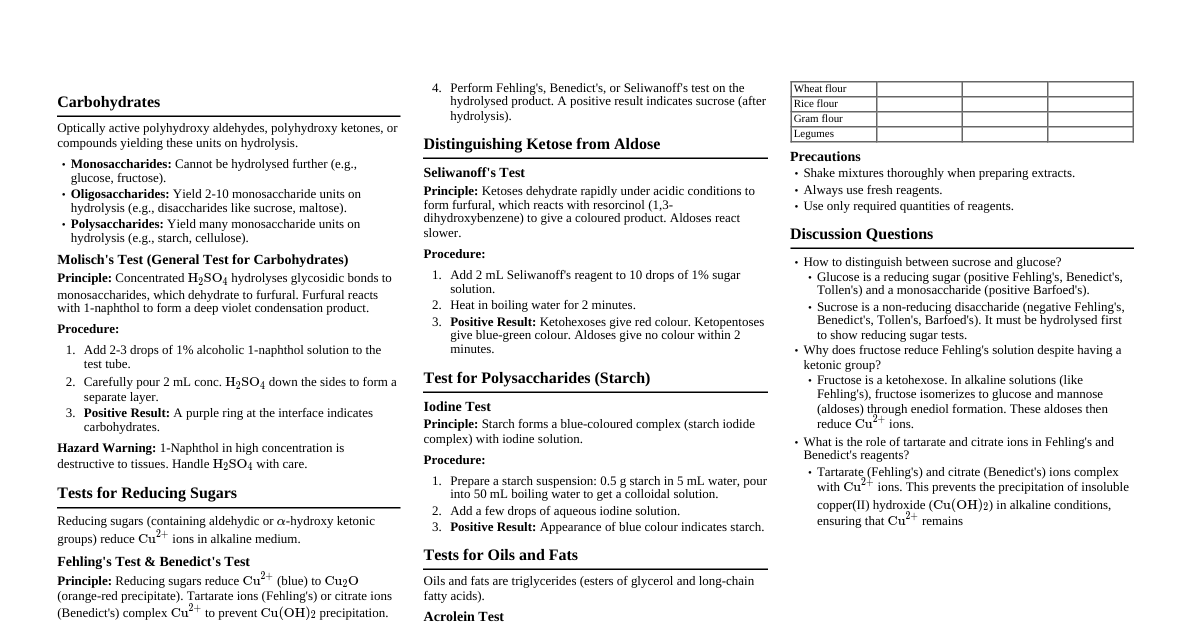
### Carbohydrates: An Overview Carbohydrates are polyhydroxy aldehydes or ketones, or substances that yield such compounds on hydrolysis. They are essential biomolecules, serving as primary energy sources and structural components. ### Monosaccharides The simplest carbohydrates, typically with a formula $(CH_2O)_n$, where $n \ge 3$. They cannot be hydrolyzed into simpler units. - **Classification by carbonyl group:** - **Aldoses:** Contain an aldehyde group ($R-CHO$). - **Ketoses:** Contain a ketone group ($R-CO-R'$). - **Classification by number of carbons:** Trioses (3C), Tetroses (4C), Pentoses (5C), Hexoses (6C). #### Aldohexoses Six-carbon aldoses. - **Examples:** D-Glucose, D-Mannose, D-Galactose. - **D-Glucose (Dextrose):** The most common monosaccharide, a primary energy source. ``` CHO | H-C-OH | HO-C-H | H-C-OH | H-C-OH | CH2OH ``` #### Ketohexoses Six-carbon ketoses. - **Example:** D-Fructose. - **D-Fructose (Levulose):** A common sugar found in fruits and honey. ``` CH2OH | C=O | HO-C-H | H-C-OH | H-C-OH | CH2OH ``` ### Cyclic Structures: Haworth & Anomers Monosaccharides with 5 or more carbons exist predominantly in cyclic forms in solution, formed by the reaction between the carbonyl group and a hydroxyl group. #### Haworth Projection A common way to represent the cyclic structure of monosaccharides. - **Pyranose Ring:** A six-membered ring containing five carbons and one oxygen (derived from pyran). - **Example: D-Glucose (Pyranose form)** ``` CH2OH / \ O C1 -OH (alpha or beta) / \ / \ C5--C4--C3--C2 | | OH OH ``` - **Furanose Ring:** A five-membered ring containing four carbons and one oxygen (derived from furan). - **Example: D-Fructose (Furanose form)** ``` CH2OH / \ O C2 -OH (alpha or beta) / \ / \ C5--C4--C3 | | OH OH ``` #### Anomeric Carbons & Anomers - **Anomeric Carbon:** The new chiral center formed when a monosaccharide cyclizes (C1 for aldoses, C2 for ketoses). - **Anomers:** Stereoisomers that differ in configuration only at the anomeric carbon. - **$\alpha$-anomer:** The hydroxyl group on the anomeric carbon is *trans* to the $CH_2OH$ group (below the ring in Haworth projection). - **$\beta$-anomer:** The hydroxyl group on the anomeric carbon is *cis* to the $CH_2OH$ group (above the ring in Haworth projection). #### Mutarotation The change in the optical rotation of a solution of a pure anomer of a sugar to an equilibrium value. This occurs as the $\alpha$ and $\beta$ anomeric forms interconvert via the open-chain aldehyde/ketone form in solution. - **Example: D-Glucose:** In solution, $\alpha$-D-glucose (36%) $\rightleftharpoons$ open-chain (0.02%) $\rightleftharpoons$ $\beta$-D-glucose (64%). ### Oligosaccharides & Polysaccharides #### Oligosaccharides Carbohydrates composed of 2 to 10 monosaccharide units linked by glycosidic bonds. - **Disaccharides:** Composed of two monosaccharide units. - **Reducing Sugars:** Have a free anomeric carbon that can open to an aldehyde form, allowing them to reduce oxidizing agents (e.g., Benedict's reagent). - **Maltose:** Glucose($\alpha$1$\rightarrow$4)Glucose. A reducing sugar. - **Non-reducing Sugars:** Have no free anomeric carbon; both anomeric carbons are involved in the glycosidic bond. - **Sucrose (Table Sugar):** Glucose($\alpha$1$\rightarrow$2$\beta$)Fructose. A non-reducing sugar. #### Polysaccharides Long chains of many monosaccharide units (hundreds to thousands) linked by glycosidic bonds. - **Homopolysaccharides:** Composed of a single type of monosaccharide (e.g., starch, glycogen, cellulose). - **Heteropolysaccharides:** Composed of multiple types of monosaccharides (e.g., hyaluronic acid). ### Glycoconjugates: Glycoproteins & Proteoglycans #### Glycoproteins Proteins with covalently attached oligosaccharide chains (glycans). - **Functions:** Cell recognition, cell adhesion, immune response, lubrication. - **Examples:** Antibodies, many membrane proteins, hormones (e.g., FSH, LH). - **Linkages:** N-linked (to Asparagine) or O-linked (to Serine or Threonine). #### Proteoglycans Heavily glycosylated proteins, where the carbohydrate component (glycosaminoglycans, GAGs) makes up a much larger percentage of the molecule by weight than protein. - **Functions:** Structural components of connective tissue, lubrication, shock absorption, cell signaling. - **Structure:** A core protein to which one or more GAG chains are covalently attached. GAGs are long, unbranched polysaccharides containing repeating disaccharide units, usually with an amino sugar and an uronic acid. - **Examples:** Aggrecan (in cartilage), syndecan (cell surface).