Carbohydrate Metabolism
Shared 3/25/2026•96 views
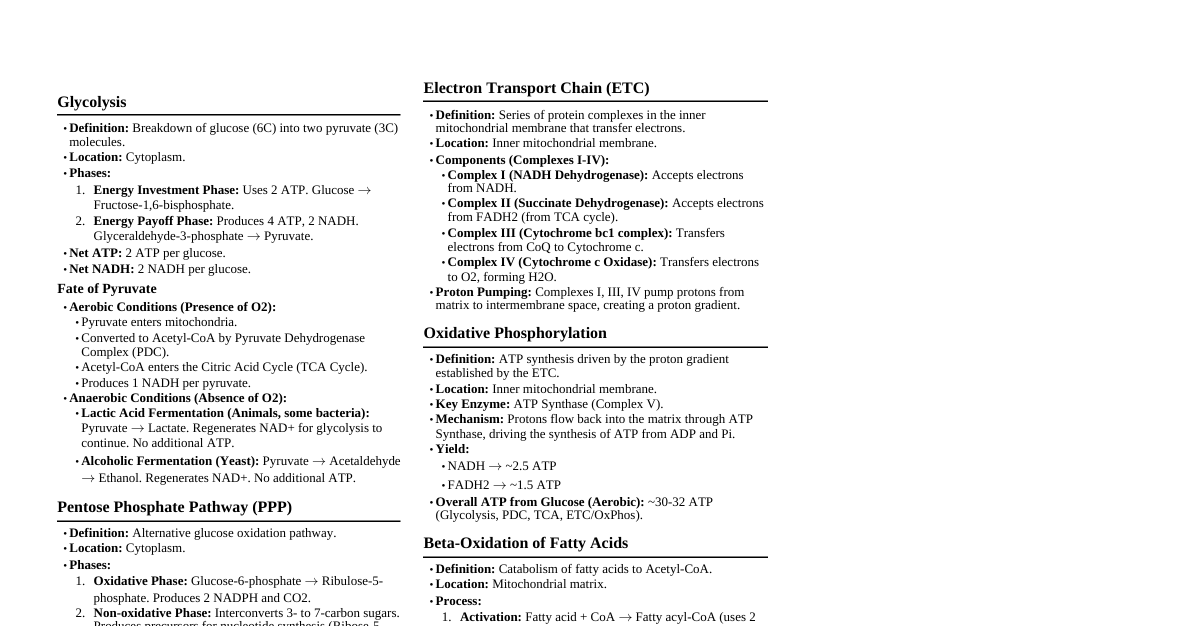
### Overview of Carbohydrate Metabolism - **Purpose:** Breakdown of carbohydrates (primarily glucose) to produce energy (ATP), and synthesis of complex carbohydrates for storage or structural purposes. - **Key Pathways:** Glycolysis, Gluconeogenesis, Glycogenesis, Glycogenolysis, Pentose Phosphate Pathway, Citric Acid Cycle. - **Main Fuel:** Glucose, derived from diet (e.g., starch, sucrose, lactose) or internal stores (glycogen). ### Glycolysis - **Definition:** Breakdown of one molecule of glucose (6C) into two molecules of pyruvate (3C). Occurs in the cytoplasm. - **Phases:** 1. **Energy-Investment Phase:** Requires 2 ATP. Glucose is phosphorylated and cleaved into two 3-carbon molecules (Glyceraldehyde-3-phosphate). 2. **Energy-Payoff Phase:** Produces 4 ATP, 2 NADH, and 2 pyruvate molecules. - **Net Yield:** 2 ATP, 2 NADH, 2 Pyruvate per glucose molecule. - **Regulation:** Key enzymes are Hexokinase, Phosphofructokinase-1 (PFK-1), Pyruvate Kinase. PFK-1 is the most important regulatory step. ### Fate of Pyruvate - **Aerobic Conditions:** Pyruvate is converted to Acetyl-CoA by Pyruvate Dehydrogenase Complex (PDC) in the mitochondrial matrix. Acetyl-CoA then enters the Citric Acid Cycle. - **Anaerobic Conditions:** Pyruvate is converted to: - **Lactate:** In animals and some bacteria (Lactic Acid Fermentation), regenerating $\text{NAD}^+$ for glycolysis. - **Ethanol & $\text{CO}_2$:** In yeast (Alcoholic Fermentation). ### Citric Acid Cycle (Krebs Cycle / TCA Cycle) - **Definition:** A series of reactions in the mitochondrial matrix that oxidizes Acetyl-CoA to $\text{CO}_2$, producing ATP, NADH, and $\text{FADH}_2$. - **Input:** Acetyl-CoA (2C). - **Output (per Acetyl-CoA):** 2 $\text{CO}_2$, 3 NADH, 1 $\text{FADH}_2$, 1 GTP (which converts to ATP). - **Purpose:** Generates electron carriers (NADH, $\text{FADH}_2$) for Oxidative Phosphorylation. ### Oxidative Phosphorylation (ETC) - **Definition:** The process where ATP is formed as a result of the transfer of electrons from NADH and $\text{FADH}_2$ to $\text{O}_2$ by a series of electron carriers. Occurs in the inner mitochondrial membrane. - **Components:** Electron Transport Chain (ETC) and ATP Synthase. - **Yield:** Approximately 2.5 ATP per NADH, 1.5 ATP per $\text{FADH}_2$. - **Total ATP from Glucose (Aerobic):** ~30-32 ATP. ### Gluconeogenesis - **Definition:** Synthesis of glucose from non-carbohydrate precursors (e.g., lactate, amino acids, glycerol). Primarily occurs in the liver, to a lesser extent in the kidneys. - **Purpose:** Maintain blood glucose levels during fasting or starvation. - **Irreversible Steps of Glycolysis Bypassed:** - Pyruvate to Phosphoenolpyruvate (PEP) - Fructose-1,6-bisphosphate to Fructose-6-phosphate - Glucose-6-phosphate to Glucose - **Energy Cost:** 4 ATP, 2 GTP, 2 NADH per glucose molecule synthesized. ### Glycogenesis - **Definition:** Synthesis of glycogen (a branched polymer of glucose) from glucose. Occurs primarily in the liver and muscle. - **Purpose:** Glucose storage. - **Key Enzyme:** Glycogen Synthase. - **Process:** Glucose is activated to UDP-Glucose, then added to growing glycogen chains. ### Glycogenolysis - **Definition:** Breakdown of glycogen into glucose-1-phosphate. - **Purpose:** Release glucose for energy. - **Key Enzyme:** Glycogen Phosphorylase. - **Liver Glycogenolysis:** Releases free glucose into the blood to maintain blood glucose levels. - **Muscle Glycogenolysis:** Provides glucose-6-phosphate for glycolysis within the muscle cell (not released into blood). ### Pentose Phosphate Pathway (PPP / HMP Shunt) - **Definition:** An alternative route for glucose-6-phosphate oxidation. Occurs in the cytoplasm. - **Phases:** 1. **Oxidative Phase:** Produces NADPH and Ribose-5-phosphate. 2. **Non-Oxidative Phase:** Interconverts 3-carbon to 7-carbon sugars. - **Key Products:** - **NADPH:** Used in reductive biosynthesis (e.g., fatty acid synthesis, cholesterol synthesis) and to counter oxidative stress (glutathione reductase). - **Ribose-5-phosphate:** Precursor for nucleotide and nucleic acid synthesis (DNA, RNA).