Maharashtra Board 10th Maths
Cheatsheet Content
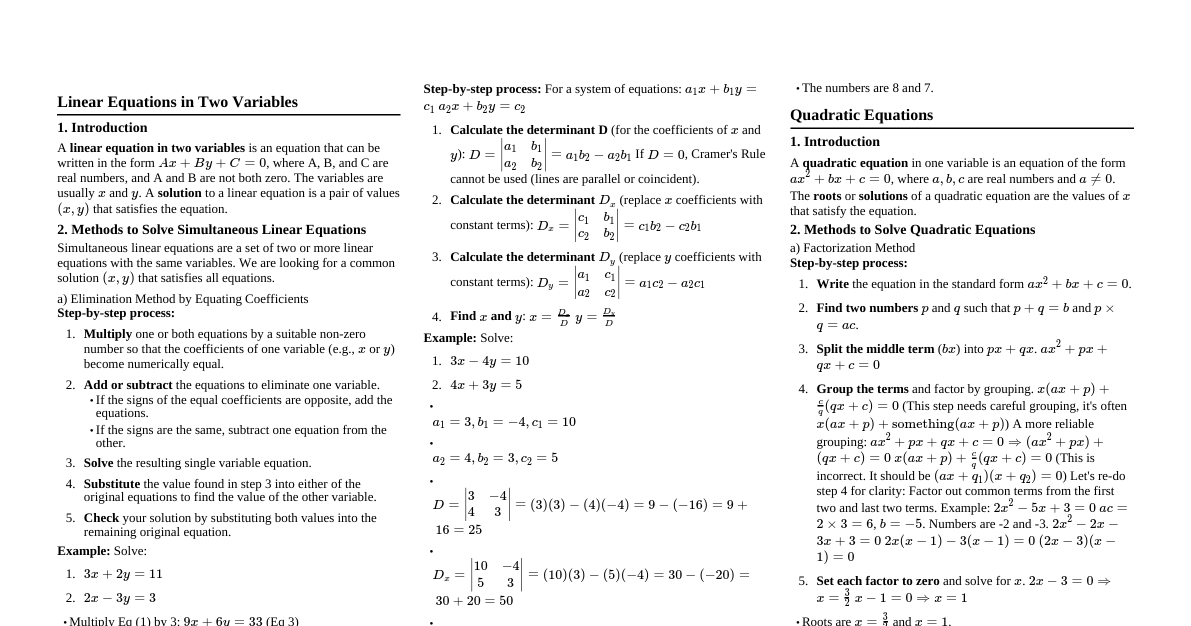
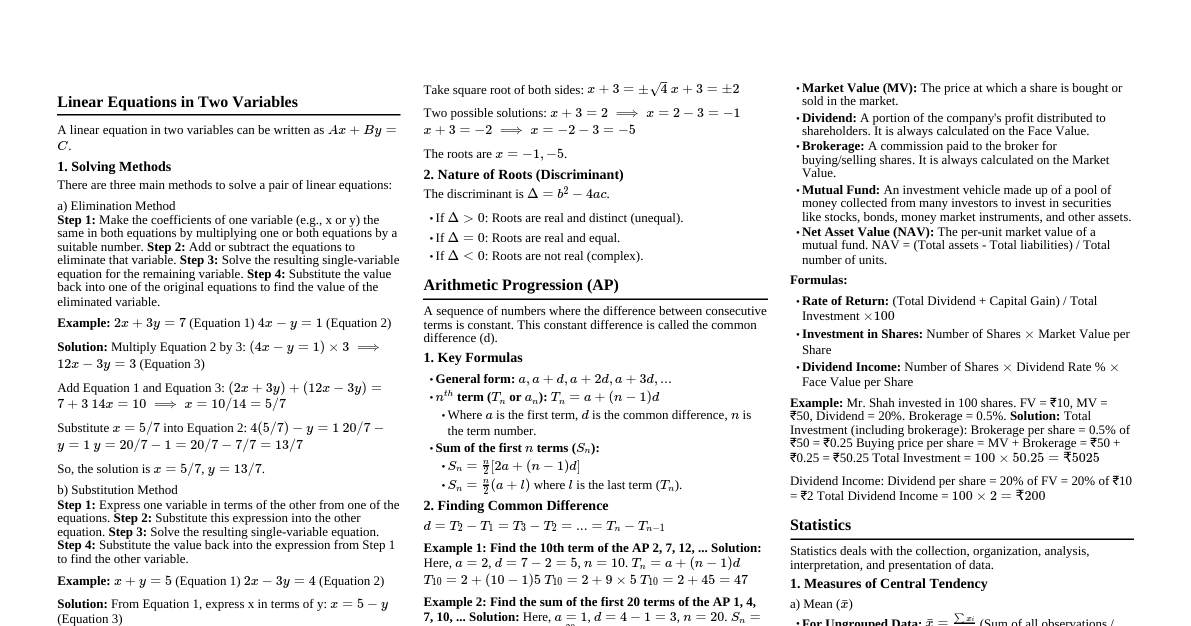
### Linear Equations in Two Variables (Algebra Part 1) Let's kick things off with a super useful topic: solving puzzles with two unknown numbers! Imagine you have two clues, and you need to find two numbers. That's exactly what linear equations in two variables are all about. #### What is a Linear Equation? - It's an equation where the highest power of any variable is 1. No $x^2$ or $\sqrt{y}$ allowed! - It looks like a straight line if you graph it (hence "linear"). - **Standard Form:** $Ax + By = C$ - Here, $A, B, C$ are real numbers (they can be fractions, decimals, positive, negative). - $A$ and $B$ are NOT both zero (otherwise, you wouldn't have two variables!). - $x$ and $y$ are our mystery numbers (variables). #### How to Solve Them? We need to find values for $x$ and $y$ that make *both* equations in a pair (called a "system") true. There are a few cool ways to do this: 1. **Elimination Method (My Favorite!):** - **Goal:** Make one variable disappear! We do this by making its coefficients (the number in front of it) the same or opposite, then adding or subtracting the equations. - **Step 1: Make Coefficients Equal (or Opposite):** Look at the $x$ or $y$ terms in both equations. Multiply one or both equations by numbers so that the coefficient of either $x$ or $y$ becomes the same (e.g., both become $5x$) or opposite (e.g., one is $3y$ and the other is $-3y$). - **Step 2: Add or Subtract:** - If the equal coefficients have *opposite signs* (like $3y$ and $-3y$), **add** the equations. The variable will cancel out! - If they have the *same sign* (like $5x$ and $5x$), **subtract** one equation from the other. The variable will cancel out! - **Step 3: Solve for One Variable:** Now you have a simple equation with only one variable left. Solve it! - **Step 4: Find the Other Variable:** Substitute the value you just found back into *either* of the original equations (pick the simpler one!) to find the second variable. - **Example:** Equation 1: $2x + 3y = 7$ Equation 2: $3x - y = 5$ *Let's eliminate $y$. The coefficients are $3$ and $-1$. If we multiply Equation 2 by 3, the $y$ terms will be $3y$ and $-3y$, which are opposites!* $3 \times (3x - y) = 3 \times 5 \Rightarrow 9x - 3y = 15$ (Call this New Equation 2) *Now, add Equation 1 and New Equation 2:* $(2x + 3y) + (9x - 3y) = 7 + 15$ $11x = 22$ *Solve for $x$:* $x = \frac{22}{11} \Rightarrow x = 2$ *Substitute $x=2$ into Equation 2 (original, it's simpler):* $3(2) - y = 5$ $6 - y = 5$ $y = 6 - 5 \Rightarrow y = 1$ *Solution: $(x, y) = (2, 1)$. Always check your answer by plugging these values into BOTH original equations!* 2. **Substitution Method:** - **Goal:** Express one variable in terms of the other, and then "substitute" that expression into the other equation. - **Step 1: Isolate a Variable:** From one of the equations, solve for $x$ in terms of $y$ (or $y$ in terms of $x$). Pick the equation where it's easiest to get a variable alone (e.g., if one variable has a coefficient of 1 or -1). - **Step 2: Substitute:** Plug this expression (e.g., "y = some expression with x") into the *other* equation. Now you have an equation with only one variable. - **Step 3: Solve for One Variable:** Solve this new equation. - **Step 4: Find the Other Variable:** Substitute the value you just found back into the expression you created in Step 1. - **Example:** (Using the same equations) Equation 1: $2x + 3y = 7$ Equation 2: $3x - y = 5$ *From Equation 2, it's easy to get $y$ alone:* $-y = 5 - 3x \Rightarrow y = 3x - 5$ (This is our expression for $y$) *Substitute this expression for $y$ into Equation 1:* $2x + 3(\mathbf{3x - 5}) = 7$ $2x + 9x - 15 = 7$ $11x - 15 = 7$ $11x = 7 + 15$ $11x = 22 \Rightarrow x = 2$ *Substitute $x=2$ back into our expression for $y$:* $y = 3(\mathbf{2}) - 5 = 6 - 5 = 1$ *Solution: $(x, y) = (2, 1)$* 3. **Graphical Method:** - **Goal:** See where the lines cross! Each linear equation represents a straight line. The solution is the point where these two lines intersect. - **Step 1: Graph Each Equation:** For each equation, find at least two points that satisfy it. The easiest way is often to find the $x$-intercept (set $y=0$, solve for $x$) and the $y$-intercept (set $x=0$, solve for $y$). Plot these points and draw a straight line through them. - **Step 2: Find Intersection:** The point where the two lines cross is your solution $(x, y)$. - **Remember:** This method is great for visualizing, but can be less precise if the intersection isn't on exact grid points. Use a ruler and graph paper for accuracy! #### Special Cases: - **No Solution:** If the lines are parallel (they never intersect), there's no solution. This happens when you do elimination and get something like $0 = 5$ (a false statement). - **Infinite Solutions:** If the lines are the exact same (they overlap perfectly), there are infinitely many solutions (every point on the line is a solution). This happens when you do elimination and get $0 = 0$ (a true statement). ### Quadratic Equations (Algebra Part 2) Get ready for equations with a bit more curve! Quadratic equations are super important and pop up everywhere, from designing bridges to calculating trajectories (like how a ball flies through the air). They involve a variable raised to the power of 2. #### What is a Quadratic Equation? - An equation where the highest power of the variable is 2. - **Standard Form:** $ax^2 + bx + c = 0$ - Here, $a, b, c$ are real numbers. - The most important rule: $a \neq 0$ (if $a$ were 0, it would just be a linear equation!). - $x$ is our variable. - The solutions to a quadratic equation are called its **roots** or **zeros**. A quadratic equation usually has two roots. #### How to Solve Them? We're looking for the values of $x$ that make the equation true. 1. **Factorization Method (The "Smart Guess" Method):** - **Goal:** Break down the quadratic expression into two simpler factors (like $(x+p)(x+q)$). - **Step 1: Standard Form:** Make sure your equation is in $ax^2 + bx + c = 0$ form. - **Step 2: Find Two Numbers:** This is the trickiest part. Look for two numbers that: - Multiply to give $a \times c$ - Add or subtract to give $b$ - **Step 3: Split the Middle Term:** Rewrite the $bx$ term using these two numbers. - **Step 4: Group and Factor:** Group the terms into pairs and factor out common parts from each pair. You should end up with two brackets that are identical. - **Step 5: Zero Product Property:** If $(bracket1)(bracket2) = 0$, then either $bracket1 = 0$ or $bracket2 = 0$. Solve these two simple linear equations for $x$. - **Example:** Solve $x^2 + 5x + 6 = 0$ *Here, $a=1, b=5, c=6$. We need two numbers that multiply to $1 \times 6 = 6$ and add to $5$. Those numbers are $2$ and $3$.* *Split the middle term ($5x$) into $2x + 3x$:* $x^2 + 2x + 3x + 6 = 0$ *Group terms and factor:* $x(x + 2) + 3(x + 2) = 0$ *Notice $(x+2)$ is common. Factor it out:* $(x + 2)(x + 3) = 0$ *Apply Zero Product Property:* $x + 2 = 0 \Rightarrow x = -2$ OR $x + 3 = 0 \Rightarrow x = -3$ *Roots are $x = -2, -3$* 2. **Completing the Square Method (The "Make it Perfect" Method):** - **Goal:** Turn the quadratic expression into a perfect square trinomial (like $(x+k)^2$). - **Step 1: Divide by $a$:** If $a \neq 1$, divide the entire equation by $a$ to make the $x^2$ coefficient 1. - **Step 2: Move $c$:** Move the constant term to the right side of the equation. - **Step 3: Add $(b/2)^2$ to Both Sides:** Take half of the coefficient of $x$ (which is $b$ after step 1), square it, and add it to both sides. This makes the left side a perfect square. - **Step 4: Factor and Solve:** Factor the left side as $(x + k)^2$ and take the square root of both sides (remember the $\pm$ sign!). Then solve for $x$. - **Example:** Solve $x^2 + 6x - 7 = 0$ *Move $c$ to the right side:* $x^2 + 6x = 7$ *Half of the $x$ coefficient ($6$) is $3$. Square it: $3^2 = 9$. Add 9 to both sides:* $x^2 + 6x + 9 = 7 + 9$ *Factor the left side as a perfect square:* $(x + 3)^2 = 16$ *Take the square root of both sides:* $x + 3 = \pm\sqrt{16}$ $x + 3 = \pm 4$ *Now solve for $x$ using both positive and negative values:* $x + 3 = 4 \Rightarrow x = 1$ OR $x + 3 = -4 \Rightarrow x = -7$ *Roots are $x = 1, -7$* 3. **Quadratic Formula (The "Always Works" Method):** - **Goal:** A direct formula to find the roots, no matter how tricky the numbers are. This is your go-to method if factorization or completing the square seem too hard. - **Formula:** For $ax^2 + bx + c = 0$, the roots are given by: $$x = \frac{-b \pm \sqrt{b^2 - 4ac}}{2a}$$ - **Step 1: Identify $a, b, c$:** Make sure the equation is in standard form ($ax^2 + bx + c = 0$) and identify the exact values of $a, b, c$ (including their signs!). - **Step 2: Substitute and Calculate:** Plug these values into the formula carefully and simplify. - **Example:** Solve $2x^2 + 5x - 3 = 0$ *Here, $a=2, b=5, c=-3$.* *Substitute into the formula:* $$x = \frac{-5 \pm \sqrt{5^2 - 4(2)(-3)}}{2(2)}$$ $$x = \frac{-5 \pm \sqrt{25 + 24}}{4}$$ $$x = \frac{-5 \pm \sqrt{49}}{4}$$ $$x = \frac{-5 \pm 7}{4}$$ *Now find the two roots:* $x_1 = \frac{-5 + 7}{4} = \frac{2}{4} = \frac{1}{2}$ $x_2 = \frac{-5 - 7}{4} = \frac{-12}{4} = -3$ *Roots are $x = 1/2, -3$* #### Nature of Roots (The "Predict the Future" Part): - The part under the square root in the quadratic formula, $b^2 - 4ac$, is super important! It's called the **discriminant** (we often use $\Delta$ or $D$ for it). - It tells us about the type of roots without actually solving the equation! - If $\Delta > 0$: The equation has two distinct real roots (two different numbers). The parabola (graph of quadratic) crosses the x-axis at two points. - If $\Delta = 0$: The equation has two equal real roots (both roots are the same number, often called a "repeated root"). The parabola touches the x-axis at exactly one point. - If $\Delta ### Arithmetic Progression (AP) (Algebra Part 3) Imagine counting by adding the same number each time: 2, 4, 6, 8... or 10, 7, 4, 1... That's an Arithmetic Progression! It's a sequence where the difference between consecutive terms is constant. Think of it like steps on a ladder, each step is the same height apart. #### Key Terms: - **Sequence:** A list of numbers in a specific order (like $t_1, t_2, t_3, ...$). - **Arithmetic Progression (AP):** A sequence where each term (after the first) is obtained by adding a fixed number to the preceding term. - **First Term ($a$ or $t_1$):** The starting number of the AP. - **Common Difference ($d$):** The fixed number that is added or subtracted to get the next term. - You can find $d$ by subtracting any term from its succeeding term: $d = t_2 - t_1 = t_3 - t_2$, etc. - If $d > 0$, the AP is increasing. - If $d ### Financial Planning (Algebra Part 4) Money matters! This section helps you understand how to manage money, especially when it comes to taxes and investments. It's about making smart choices with your earnings and savings. #### Income Tax (A Little Bit for Government): - **Income Tax:** A tax levied by the government on the income of individuals or businesses. It's how governments fund public services. - **Taxable Income:** The income on which tax is actually calculated. It's your total income minus certain allowed deductions (like investments in provident fund, insurance, etc.). - **Tax Slabs:** Government divides income into different ranges, and each range has a different tax rate. - Example (simplified, actual rates vary yearly in India): - Up to ₹2,50,000: No Tax (This is the basic exemption limit) - ₹2,50,001 to ₹5,00,000: 5% of income exceeding ₹2,50,000 - ₹5,00,001 to ₹10,00,000: 20% of income exceeding ₹5,00,000 (plus tax on previous slab) - Above ₹10,00,000: 30% of income exceeding ₹10,00,000 (plus tax on previous slabs) - **Rebate (under Section 87A):** A reduction in the tax payable. For example, in India, if your total taxable income is up to ₹5,00,000, you might get a tax rebate, effectively making your tax liability zero. - **Surcharge:** An additional charge on the tax payable, usually for very high-income earners (e.g., if income exceeds ₹50 lakh or ₹1 crore). - **Cess:** An additional tax levied for a specific purpose (e.g., Education Cess, Health and Education Cess). It's calculated as a percentage of the *tax amount*, not the income. #### Goods and Services Tax (GST - For Things You Buy and Sell): - **GST:** A value-added tax levied on most goods and services sold for domestic consumption. It's a "consumption tax." - It's a single tax replacing many indirect taxes (like excise duty, VAT, service tax) that existed earlier. The idea is "one nation, one tax." - **Components of GST (in India):** - **CGST (Central GST):** Collected by the Central Government on intra-state (within the same state) transactions. - **SGST (State GST):** Collected by the State Government on intra-state transactions. - **IGST (Integrated GST):** Collected by the Central Government on inter-state (between different states) transactions. IGST = CGST + SGST. - **Input Tax Credit (ITC):** This is a super cool feature for businesses! If a business pays GST on inputs (raw materials, services) for making a product, they can use this paid GST to reduce the GST they have to pay on their final sales. It avoids "tax on tax." - **Formula:** GST Payable = Output GST - Input Tax Credit #### Stocks and Shares (Investing in Companies): - **Share:** A unit of ownership in a company. When you buy a share, you become a small owner of that company. - **Shareholder:** An owner of shares in a company. - **Face Value (FV) / Nominal Value:** The original value of a share printed on the share certificate. It's a fixed value. - **Market Value (MV):** The price at which a share is actually bought or sold in the stock market. It fluctuates daily based on demand and supply. - If MV > FV: Share is at a **premium**. - If MV ### Probability (Algebra Part 5 - The Game of Chance) Life is full of uncertainties, but probability helps us measure how likely certain events are! From rolling dice to picking cards, it's all about chances. It's like predicting the future, but with numbers! #### Key Terms: - **Random Experiment:** An experiment where the outcome cannot be predicted with certainty, but all possible outcomes are known (e.g., tossing a coin, rolling a die, drawing a card). - **Outcome:** A possible result of a random experiment. - **Sample Space ($S$):** The set of all possible outcomes of a random experiment. It's like the complete list of everything that *could* happen. - Example: Tossing a coin: $S = \{H, T\}$ (Head, Tail) - Example: Rolling a die: $S = \{1, 2, 3, 4, 5, 6\}$ - **Event ($E$):** A subset of the sample space; a collection of one or more specific outcomes that we are interested in. - Example: Getting an even number when rolling a die: $E = \{2, 4, 6\}$ - **Number of Sample Points ($n(S)$):** The total count of outcomes in the sample space. - **Number of Event Points ($n(E)$):** The total count of outcomes in a specific event. #### The Big Formula (How to Calculate Probability): The probability of an event $E$, denoted as $P(E)$, is: $$P(E) = \frac{\text{Number of favorable outcomes (for event E)}}{\text{Total number of possible outcomes (in sample space S)}} = \frac{n(E)}{n(S)}$$ #### Important Properties of Probability: 1. **Range:** $0 \le P(E) \le 1$ - $P(E) = 0$ means the event is **impossible** (it will never happen, like getting a 7 on a single die roll). - $P(E) = 1$ means the event is **certain** (it will definitely happen, like getting a number less than 7 on a single die roll). 2. **Sum of Probabilities:** The sum of probabilities of all elementary events in a sample space is always 1. 3. **Complementary Events:** If $E$ is an event, then $E'$ (or $\bar{E}$ or $E^c$) is the event "not $E$". It means "E does not happen." $$P(E) + P(E') = 1 \implies P(E') = 1 - P(E)$$ - Example: If the probability of rain is 0.3, the probability of no rain is $1 - 0.3 = 0.7$. #### Let's Do Some Examples! 1. **Tossing a Coin:** - Sample space $S = \{H, T\} \Rightarrow n(S) = 2$ - Event: Getting a Head ($E_H = \{H\}$) $\Rightarrow n(E_H) = 1$ - $P(H) = \frac{1}{2}$ 2. **Rolling a Die:** - Sample space $S = \{1, 2, 3, 4, 5, 6\} \Rightarrow n(S) = 6$ - Event: Getting an even number ($E_{\text{even}} = \{2, 4, 6\}$) $\Rightarrow n(E_{\text{even}}) = 3$ - $P(\text{even}) = \frac{3}{6} = \frac{1}{2}$ - Event: Getting a number greater than 4 ($E_{>4} = \{5, 6\}$) $\Rightarrow n(E_{>4}) = 2$ - $P(>4) = \frac{2}{6} = \frac{1}{3}$ 3. **Drawing a Card from a Deck:** - A standard deck has 52 cards (no jokers). - $n(S) = 52$ - It has 4 suits: Spades (♠), Clubs (♣), Hearts (♥), Diamonds (♦). - Spades and Clubs are black cards (26 total). Hearts and Diamonds are red cards (26 total). - Each suit has 13 cards: A, 2, 3, 4, 5, 6, 7, 8, 9, 10, Jack (J), Queen (Q), King (K). - J, Q, K are called **face cards** (12 total: 3 per suit x 4 suits). - Event: Drawing a King ($E_K$) - There are 4 Kings (one in each suit). - $n(E_K) = 4$ - $P(K) = \frac{4}{52} = \frac{1}{13}$ - Event: Drawing a Red Card ($E_R$) - There are 26 red cards (13 Hearts + 13 Diamonds). - $n(E_R) = 26$ - $P(R) = \frac{26}{52} = \frac{1}{2}$ #### Types of Events: - **Mutually Exclusive Events:** Events that cannot happen at the same time. If one happens, the other cannot. - Example: When rolling a die, getting an even number and getting an odd number are mutually exclusive. - **Exhaustive Events:** A set of events where at least one of them must occur. Together, they cover the entire sample space. - Example: When rolling a die, getting an even number or getting an odd number are exhaustive events. #### Tips for Probability Problems: - Always list the sample space first if it's small (or at least calculate $n(S)$). - Clearly define your event and calculate $n(E)$. - Count carefully! - Simplify your final fraction (probability is usually given as a fraction). ### Statistics (Algebra Part 6 - Making Sense of Data) Probability is about predicting the future based on known chances. Statistics is about looking at the past (data) to understand what happened and make informed decisions about the future. It's all about collecting, organizing, analyzing, interpreting, and presenting data. #### Key Terms: - **Data:** Raw facts and figures collected for a specific purpose. - **Raw Data:** Data in its original, unorganized form. - **Grouped Data:** Data organized into classes or groups. - **Frequency:** The number of times a particular observation occurs. - **Frequency Distribution Table:** A table that shows how often each value or range of values occurs in a dataset. - **Class Interval:** A range of values (e.g., 0-10, 10-20). The lower limit is the starting value, the upper limit is the ending value. - **Class Mark (or Midpoint):** The middle value of a class interval. - Class Mark = (Lower Limit + Upper Limit) / 2 - **Cumulative Frequency:** The sum of frequencies up to a particular class. It tells you how many observations are "less than" or "more than" a certain value. #### Measures of Central Tendency (The "Average" Story): These tell us about the "center" or typical value of a dataset. They try to represent the whole dataset with a single number. 1. **Mean ($\bar{x}$):** The most common average. It's the sum of all values divided by the total number of values. - **For Ungrouped Data:** $$\bar{x} = \frac{\sum x_i}{N}$$ - $\sum x_i$: Sum of all observations. - $N$: Total number of observations. - **For Grouped Data (Frequency Distribution):** - **Direct Method:** This is straightforward but can involve large calculations. $$\bar{x} = \frac{\sum f_i x_i}{\sum f_i}$$ - $f_i$: Frequency of each class. - $x_i$: Class mark (midpoint) of each class. - $\sum f_i$: Total frequency (which is $N$). - **Assumed Mean Method:** This simplifies calculations by choosing an "assumed mean" and working with deviations. $$\bar{x} = A + \frac{\sum f_i d_i}{\sum f_i}$$ - $A$: Assumed mean (pick a class mark from roughly the middle of the data). - $d_i = x_i - A$: Deviation of each class mark from the assumed mean. - **Step Deviation Method:** Even more simplified, especially when class intervals are uniform. $$\bar{x} = A + h \left( \frac{\sum f_i u_i}{\sum f_i} \right)$$ - $h$: Class width (upper limit - lower limit). - $u_i = \frac{x_i - A}{h}$: Step deviation (deviation divided by class width). - *Why so many methods?* They help simplify calculations, especially with large numbers. Direct method is easiest for small numbers. Assumed mean and step deviation methods reduce calculation errors with large numbers. 2. **Median:** The middle value of the data when it's arranged in ascending or descending order. It divides the data into two equal halves. - **For Ungrouped Data:** - **Step 1:** Arrange data in ascending order. - **Step 2:** - If $N$ (number of observations) is odd, Median = $\left(\frac{N+1}{2}\right)^{th}$ observation. - If $N$ is even, Median = Average of $\left(\frac{N}{2}\right)^{th}$ and $\left(\frac{N}{2}+1\right)^{th}$ observations. - **For Grouped Data:** - **Step 1:** Create a cumulative frequency table ("less than" type). - **Step 2:** Find $\frac{N}{2}$ (half of the total frequency). - **Step 3:** Identify the **median class** - the class interval whose cumulative frequency is just greater than or equal to $\frac{N}{2}$. - **Formula:** $$ \text{Median} = L + \left(\frac{\frac{N}{2} - CF}{f}\right) \times h $$ - $L$: Lower boundary of the median class. - $N$: Total frequency. - $CF$: Cumulative frequency of the class *preceding* the median class. - $f$: Frequency of the median class. - $h$: Class width of the median class. 3. **Mode:** The value that appears most frequently in the data. It's the most "popular" value. - **For Ungrouped Data:** Just count which value repeats most. - **For Grouped Data:** - **Step 1:** Identify the **modal class** - the class interval with the highest frequency. - **Formula:** $$ \text{Mode} = L + \left(\frac{f_1 - f_0}{2f_1 - f_0 - f_2}\right) \times h $$ - $L$: Lower boundary of the modal class. - $f_1$: Frequency of the modal class. - $f_0$: Frequency of the class *preceding* the modal class. - $f_2$: Frequency of the class *succeeding* the modal class. - $h$: Class width of the modal class. #### Relationship Between Mean, Median, Mode: - For a moderately skewed distribution (not perfectly symmetrical), there's an empirical relationship: $$ \text{Mode} \approx 3 \times \text{Median} - 2 \times \text{Mean} $$ This is often used to find one measure if the other two are known. #### Graphical Representation of Data: - **Histogram:** A bar graph for continuous data, where the bars are adjacent (no gaps). The width of the bar represents the class interval, and the height represents the frequency. Used to visualize frequency distribution. - **Frequency Polygon:** A line graph that connects the midpoints of the tops of the bars in a histogram. It can also be drawn by plotting class marks vs. frequencies. - **Ogive (Cumulative Frequency Curve):** - **"Less than" Ogive:** Plots upper class limits against cumulative frequencies. It starts low and goes upwards. - **"More than" Ogive:** Plots lower class limits against cumulative frequencies. It starts high and goes downwards. - **Median from Ogive:** The x-coordinate of the point where the "less than" and "more than" ogives intersect gives the median of the data. Statistics helps us understand patterns, make predictions, and draw conclusions from data, empowering us to make better decisions! ### Similarity (Geometry Part 1 - Similar Shapes) Ever seen a small photo and a large poster of the same image? They look alike, but one is just a scaled-up or scaled-down version of the other. That's the idea behind "similarity" in geometry! #### What is Similarity? - Two figures are **similar** if they have the same shape but not necessarily the same size. - **Symbol:** $\sim$ (e.g., $\triangle ABC \sim \triangle PQR$) - **Key Properties of Similar Figures:** 1. Corresponding angles are equal. 2. Corresponding sides are in proportion (their ratios are equal). #### Similar Triangles (Our Main Focus): Two triangles are similar if: 1. **AAA Similarity Test (Angle-Angle-Angle):** - If the corresponding angles of two triangles are equal. - If $\angle A = \angle P$, $\angle B = \angle Q$, and $\angle C = \angle R$, then $\triangle ABC \sim \triangle PQR$. - *Remember: If two angles are equal (AA Similarity), the third one must also be equal! So, AA is enough for similarity.* 2. **SSS Similarity Test (Side-Side-Side):** - If the corresponding sides of two triangles are in proportion (their ratios are equal). - If $\frac{AB}{PQ} = \frac{BC}{QR} = \frac{AC}{PR}$, then $\triangle ABC \sim \triangle PQR$. 3. **SAS Similarity Test (Side-Angle-Side):** - If one angle of a triangle is equal to one angle of the other triangle, AND the sides including these angles are in proportion. - If $\angle A = \angle P$ and $\frac{AB}{PQ} = \frac{AC}{PR}$, then $\triangle ABC \sim \triangle PQR$. #### Basic Ratios of Areas of Triangles: - **General Formula:** The ratio of the areas of two triangles is equal to the ratio of the product of their bases and corresponding heights. $$\frac{\text{Area}(\triangle_1)}{\text{Area}(\triangle_2)} = \frac{\text{base}_1 \times \text{height}_1}{\text{base}_2 \times \text{height}_2}$$ - **Equal Heights:** If the heights of two triangles are equal, then the ratio of their areas is equal to the ratio of their corresponding bases. $$\frac{\text{Area}(\triangle_1)}{\text{Area}(\triangle_2)} = \frac{\text{base}_1}{\text{base}_2}$$ - **Equal Bases:** If the bases of two triangles are equal, then the ratio of their areas is equal to the ratio of their corresponding heights. $$\frac{\text{Area}(\triangle_1)}{\text{Area}(\triangle_2)} = \frac{\text{height}_1}{\text{height}_2}$$ #### Key Theorems for Similar Triangles: 1. **Basic Proportionality Theorem (BPT) or Thales Theorem:** - **Statement:** If a line parallel to one side of a triangle intersects the other two sides at two distinct points, then the line divides the two sides in the same proportion. - **Meaning:** If in $\triangle ABC$, line $DE \parallel BC$, where $D$ is on $AB$ and $E$ is on $AC$, then $\frac{AD}{DB} = \frac{AE}{EC}$. - **Converse of BPT:** If a line divides any two sides of a triangle in the same ratio, then the line is parallel to the third side. 2. **Property of Angle Bisector of a Triangle:** - **Statement:** The bisector of an angle of a triangle divides the side opposite to the angle in the ratio of the remaining sides. - **Meaning:** If in $\triangle ABC$, $AD$ is the angle bisector of $\angle A$ (where $D$ is on $BC$), then $\frac{AB}{AC} = \frac{BD}{DC}$. 3. **Property of Three Parallel Lines and their Transversals:** - **Statement:** The ratio of the intercepts made on a transversal by three parallel lines is equal to the ratio of the corresponding intercepts made on any other transversal by the same parallel lines. - **Meaning:** If line $l \parallel m \parallel n$ are cut by transversals $t_1$ and $t_2$, making intercepts $AB, BC$ on $t_1$ and $P, Q, R$ on $t_2$, then $\frac{AB}{BC} = \frac{PQ}{QR}$. 4. **Areas of Similar Triangles Theorem:** - **Statement:** The ratio of the areas of two similar triangles is equal to the square of the ratio of their corresponding sides. - **Meaning:** If $\triangle ABC \sim \triangle PQR$, then $$ \frac{\text{Area}(\triangle ABC)}{\text{Area}(\triangle PQR)} = \left(\frac{AB}{PQ}\right)^2 = \left(\frac{BC}{QR}\right)^2 = \left(\frac{AC}{PR}\right)^2 $$ Similarity is a powerful concept that allows us to find unknown lengths and angles by comparing shapes without having to measure them directly! ### Pythagoras Theorem (Geometry Part 2 - The Right-Angle Star!) This theorem is a cornerstone of geometry, revealing a fundamental relationship in right-angled triangles. It's named after the ancient Greek mathematician Pythagoras. #### What is a Right-Angled Triangle? - A triangle with one angle measuring exactly 90 degrees. - The side opposite the right angle is called the **hypotenuse** (always the longest side). The other two sides are called **legs** or **perpendicular sides**. #### Pythagoras Theorem: - **Statement:** In a right-angled triangle, the square of the hypotenuse is equal to the sum of the squares of the other two sides. - **Formula:** $c^2 = a^2 + b^2$ (where $c$ is the hypotenuse, $a$ and $b$ are the other two sides). - **Example:** If the legs are 3 cm and 4 cm, the hypotenuse $c = \sqrt{3^2 + 4^2} = \sqrt{9+16} = \sqrt{25} = 5$ cm. #### Converse of Pythagoras Theorem: - **Statement:** If in a triangle, the square of one side is equal to the sum of the squares of the other two sides, then the angle opposite the first side is a right angle. - **Use:** To determine if a given triangle is a right-angled triangle. If $c^2 = a^2 + b^2$ holds true for a triangle, then it must be a right-angled triangle. #### Pythagorean Triplets: - Sets of three positive integers $a, b, c$ such that $a^2 + b^2 = c^2$. These are the sides of a right-angled triangle. - **Common Examples:** (3, 4, 5), (5, 12, 13), (8, 15, 17), (7, 24, 25), (6, 8, 10) (which is $2 \times (3,4,5)$). - **Formula for generating triplets:** For any two natural numbers $m > n$, the numbers $(m^2 - n^2)$, $(2mn)$, and $(m^2 + n^2)$ form a Pythagorean triplet. $(m^2 + n^2)$ will be the hypotenuse. #### Properties of Special Right-Angled Triangles: 1. **30°-60°-90° Triangle Theorem:** - In a right-angled triangle where the angles are 30°, 60°, and 90°: - The side opposite 30° is half the hypotenuse. - The side opposite 60° is $\frac{\sqrt{3}}{2}$ times the hypotenuse. - The side opposite 90° is the hypotenuse. - **Converse:** If in a right-angled triangle, one side is half the hypotenuse, then the angle opposite that side is 30°. 2. **45°-45°-90° Triangle Theorem (Isosceles Right Triangle):** - In a right-angled triangle where the angles are 45°, 45°, and 90°: - The two perpendicular sides (legs) are equal. - Each of the perpendicular sides is $\frac{1}{\sqrt{2}}$ times the hypotenuse. - The hypotenuse is $\sqrt{2}$ times the length of a leg. #### Similarity in Right-Angled Triangles: - **Theorem:** In a right-angled triangle, if an altitude (perpendicular) is drawn to the hypotenuse from the opposite vertex, then the two triangles formed are similar to the original triangle and to each other. - If $\triangle ABC$ is right-angled at $B$ and $BD \perp AC$, then $\triangle ADB \sim \triangle BDC \sim \triangle ABC$. #### Theorem of Geometric Mean: - **Statement:** In a right-angled triangle, the perpendicular segment to the hypotenuse from the opposite vertex is the geometric mean of the segments into which the hypotenuse is divided. - If $BD \perp AC$ in right $\triangle ABC$, then $BD^2 = AD \times DC$. - Also, $AB^2 = AD \times AC$ and $BC^2 = DC \times AC$. #### Apollonius Theorem: - **Statement:** In any triangle $ABC$, if $M$ is the midpoint of side $BC$ (meaning $AM$ is a median), then $AB^2 + AC^2 = 2AM^2 + 2BM^2$. - **Use:** Relates the lengths of sides of a triangle to the length of a median. Pythagoras theorem and its applications help us solve many problems involving distances and lengths in various geometric figures, especially when dealing with right angles! ### Circles (Geometry Part 3 - The Round Wonders) Circles are everywhere! From wheels to planets, they are fundamental shapes. This section dives into their properties and related theorems, which are crucial for understanding geometry. #### Key Terms of a Circle: - **Center (O):** The fixed point inside the circle from which all points on the circle are equidistant. - **Radius ($r$):** The distance from the center to any point on the circle. - **Diameter ($d$):** A chord passing through the center. It's the longest chord ($d = 2r$). - **Chord:** A line segment connecting any two points on the circle. - **Arc:** A part of the circumference of a circle. - **Minor Arc:** An arc shorter than a semicircle. - **Major Arc:** An arc longer than a semicircle. - **Semicircle:** An arc that is exactly half of the circle. - **Sector:** The region enclosed by two radii and an arc. (Looks like a slice of pizza!) - **Segment:** The region enclosed by a chord and an arc. - **Tangent:** A line that touches the circle at exactly one point (the point of contact). - **Secant:** A line that intersects the circle at two distinct points. - **Circumference:** The perimeter or distance around the circle. #### Circles Through Points: - **One Point:** Infinite circles pass through a single point. - **Two Points:** Infinite circles pass through two distinct points. Their centers all lie on the perpendicular bisector of the segment joining the two points. - **Three Non-Collinear Points:** A unique circle passes through three non-collinear points. (This circle is called the circumcircle of the triangle formed by these points). - **Three Collinear Points:** No circle can pass through three collinear points. #### Important Theorems and Properties (Tangents): 1. **Tangent-Radius Theorem:** - **Statement:** The tangent at any point of a circle is perpendicular to the radius through the point of contact. - **Meaning:** If $OP$ is a radius and line $L$ is a tangent at point $P$, then $OP \perp L$. The angle between the radius and tangent at the point of contact is always $90^\circ$. - **Converse:** A line drawn through the end of a radius and perpendicular to it is a tangent to the circle. 2. **Tangent Segment Theorem:** - **Statement:** The lengths of tangents drawn from an external point to a circle are equal. - **Meaning:** If $PA$ and $PB$ are tangents from an external point $P$ to a circle, then $PA = PB$. - Also, the line segment joining the external point to the center of the circle bisects the angle between the two tangents. #### Touching Circles: - **Definition:** Two circles in the same plane that intersect at only one point. This point is called the point of contact. - **Theorem:** If two circles touch each other, their point of contact lies on the line joining their centers. - **Externally Touching Circles:** The distance between their centers is equal to the sum of their radii ($d = r_1 + r_2$). - **Internally Touching Circles:** The distance between their centers is equal to the absolute difference of their radii ($d = |r_1 - r_2|$). #### Important Theorems and Properties (Arcs and Angles): 1. **Measure of an Arc and Central Angle:** - The measure of a minor arc is equal to the measure of its corresponding central angle. - The measure of a major arc is $360^\circ$ minus the measure of its corresponding minor arc. - The measure of a semicircle is $180^\circ$. - **Congruent Arcs:** Two arcs are congruent if their measures and radii are equal. 2. **Chords and Arcs:** - **Theorem:** Chords corresponding to congruent arcs of a circle are congruent. (If arcs are equal, chords are equal). - **Theorem:** Corresponding arcs of congruent chords of a circle are congruent. (If chords are equal, arcs are equal). 3. **Inscribed Angle Theorem:** - **Statement:** The measure of an inscribed angle (an angle whose vertex is on the circle and whose sides are chords) is half of the measure of the arc intercepted by it. - **Corollaries (Super useful!):** - **Angles in the Same Segment:** Angles inscribed in the same arc are congruent (equal). - **Angle in a Semicircle:** An angle inscribed in a semicircle is a right angle ($90^\circ$). (This is a direct result of the inscribed angle theorem, as a semicircle intercepts an arc of $180^\circ$, and half of $180^\circ$ is $90^\circ$). 4. **Cyclic Quadrilateral:** - **Definition:** A quadrilateral whose all four vertices lie on a circle. - **Theorem:** Opposite angles of a cyclic quadrilateral are supplementary (they add up to $180^\circ$). - $\angle A + \angle C = 180^\circ$ and $\angle B + \angle D = 180^\circ$. - **Corollary:** An exterior angle of a cyclic quadrilateral is congruent (equal) to the interior opposite angle. - **Converse:** If a pair of opposite angles of a quadrilateral is supplementary, then the quadrilateral is cyclic. - **Concyclic Points Theorem:** If two points on a given line subtend equal angles at two distinct points which lie on the same side of the line, then the four points are concyclic. 5. **Theorem of Angle between Tangent and Secant:** - **Statement:** If an angle has its vertex on the circle, its one side touches the circle (tangent) and the other intersects the circle in one more point (secant/chord), then the measure of the angle is half the measure of its intercepted arc. - **Converse:** A line is a tangent to the circle if the angle between the chord and the line is half the measure of the arc intercepted by that angle. 6. **Theorem of Internal Division of Chords (Intersecting Chords Theorem):** - **Statement:** If two chords of a circle intersect each other in the interior of the circle, then the product of the lengths of the two segments of one chord is equal to the product of the lengths of the two segments of the other chord. - **Formula:** If chords $AB$ and $CD$ intersect at $E$ inside the circle, then $AE \times EB = CE \times ED$. 7. **Theorem of External Division of Chords (Secant-Secant Theorem):** - **Statement:** If secants containing chords $AB$ and $CD$ of a circle intersect outside the circle in point $E$, then $EA \times EB = EC \times ED$. (The product of the lengths of the segments from the external point to the points of intersection on the circle are equal). 8. **Tangent Secant Segments Theorem:** - **Statement:** If a tangent segment $ET$ and a secant segment $EAB$ are drawn from an external point $E$ to a circle, then $ET^2 = EA \times EB$. Circles are full of beautiful symmetries and relationships that make geometry fascinating and allow us to solve many complex problems! ### Geometric Constructions (Geometry Part 4 - Building Shapes) This section is all about building geometric figures accurately using only two basic tools: a **compass** (for drawing arcs and circles) and a **straightedge** (an unmarked ruler for drawing straight lines). No measuring angles with a protractor or lengths with a ruler directly! #### Basic Constructions (Recap from 9th Standard): These are foundational skills for more complex constructions: - Constructing a line parallel to a given line through an external point. - Constructing the perpendicular bisector of a line segment. - Constructing an angle bisector. - Constructing a triangle given its sides (SSS criterion). - Dividing a line segment into a given number of equal parts. - Dividing a line segment in a given ratio. - Constructing an angle congruent to a given angle. - Constructing perpendiculars to a line from a point on it and from a point outside it. #### Construction of Similar Triangles: - **Goal:** To construct a triangle similar to a given triangle, such that the ratio of their corresponding sides is a given value (called the scale factor). - **Method:** We use the properties of similar triangles (corresponding angles are equal, corresponding sides are proportional). There are two main scenarios: 1. **Case 1: When the new triangle is smaller than the given triangle (Scale factor 1).** - **Example:** Construct $\triangle A'BC'$ similar to $\triangle ABC$ such that $A'B = \frac{7}{5} AB$. - **Steps:** 1. Construct the given triangle $\triangle ABC$. 2. Draw a ray $BX$ from vertex $B$ (opposite to vertex $A$) forming an acute angle with $BC$. 3. Mark 7 points ($P_1, P_2, ..., P_7$) on ray $BX$ at equal distances. 4. Join $P_5$ (the denominator of the ratio) to $C$. 5. Extend $BC$ to form a ray. Draw a line through $P_7$ (the numerator of the ratio) parallel to $P_5C$, intersecting the extended $BC$ at $C'$. 6. Extend $AB$ to form a ray. Draw a line through $C'$ parallel to $AC$, intersecting the extended $AB$ at $A'$. 7. $\triangle A'BC'$ is the required similar triangle. #### Construction of a Tangent to a Circle: There are different methods depending on the given information: 1. **To construct a tangent at a point on the circle (using the center):** - **Principle:** The tangent at any point on a circle is perpendicular to the radius through the point of contact. - **Steps:** 1. Draw the circle and mark its center $O$. 2. Mark a point $P$ on the circle where you want to draw the tangent. 3. Draw the radius segment $OP$. 4. Draw a line perpendicular to radius $OP$ passing through point $P$. This line is the required tangent. (You can construct this perpendicular using a compass). 2. **To construct a tangent at a point on the circle (without using the center):** - **Principle:** The angle between a tangent and a chord through the point of contact is equal to the angle in the alternate segment. - **Steps:** 1. Draw the circle and mark a point $P$ on it where you want the tangent. 2. Draw any chord $PQ$ through $P$. 3. Take any point $R$ on the circle (different from $P$ and $Q$) and draw chord $PR$ and $QR$. So, $\triangle PQR$ is inscribed in the circle. 4. Construct an angle congruent to $\angle PRQ$ at point $P$, such that one arm is chord $PQ$. Let the other arm be line $L$. 5. Line $L$ is the required tangent. 3. **To construct tangents from a point outside the circle:** - **Principle:** Tangent segments from an external point to a circle are equal. Also, the radius at the point of contact is perpendicular to the tangent, and an angle inscribed in a semicircle is a right angle. - **Steps:** 1. Draw the circle with center $O$ and mark the external point $P$. 2. Draw the line segment $OP$. 3. Construct the perpendicular bisector of $OP$ to find its midpoint $M$. 4. With $M$ as center and $OM$ (or $MP$) as radius, draw a circle. 5. This new circle will intersect the original circle at two points, say $A$ and $B$. These are the points of tangency. 6. Draw lines $PA$ and $PB$. These are the required tangents. Geometric constructions help in visualizing and understanding geometric properties by accurately drawing them, which is a fundamental skill in geometry! ### Coordinate Geometry (Geometry Part 5 - Addresses in Space) Imagine a treasure map where every location has an address! That's what coordinate geometry does – it gives "addresses" to points in a plane using numbers. This helps us study geometric shapes using algebraic equations and formulas. It's the bridge between algebra and geometry! #### The Basics: - **Cartesian Coordinate System:** This is our map! It consists of two perpendicular number lines: - The **x-axis** (horizontal line). - The **y-axis** (vertical line). - They intersect at the **origin (0,0)**. - **Coordinates of a Point:** Every point in the plane is uniquely identified by an ordered pair $(x, y)$. - $x$ is the **x-coordinate** (or abscissa), representing the horizontal distance from the y-axis. - $y$ is the **y-coordinate** (or ordinate), representing the vertical distance from the x-axis. #### Key Formulas: 1. **Distance Formula:** - **Goal:** Find the distance between any two points in the coordinate plane. - **Formula:** The distance $D$ between two points $P(x_1, y_1)$ and $Q(x_2, y_2)$ is: $$D = \sqrt{(x_2 - x_1)^2 + (y_2 - y_1)^2}$$ - **Distance from Origin:** If $P(x, y)$ is a point, its distance from the origin $O(0,0)$ is $\sqrt{x^2 + y^2}$. - **Special Cases:** - If two points are on the X-axis (e.g., $(x_1, 0)$ and $(x_2, 0)$), their distance is $|x_2 - x_1|$. - If two points are on the Y-axis (e.g., $(0, y_1)$ and $(0, y_2)$), their distance is $|y_2 - y_1|$. - If two points have the same y-coordinate (line parallel to X-axis, e.g., $(x_1, y_1)$ and $(x_2, y_1)$), their distance is $|x_2 - x_1|$. - If two points have the same x-coordinate (line parallel to Y-axis, e.g., $(x_1, y_1)$ and $(x_1, y_2)$), their distance is $|y_2 - y_1|$. 2. **Section Formula:** - **Goal:** Find the coordinates of a point that divides a line segment joining two given points in a specific ratio. - **Internal Division:** If point $P(x, y)$ divides the line segment joining $A(x_1, y_1)$ and $B(x_2, y_2)$ *internally* in the ratio $m:n$, then its coordinates are: $$x = \frac{mx_2 + nx_1}{m+n}, \quad y = \frac{my_2 + ny_1}{m+n}$$ - **Midpoint Formula (Special Case of Section Formula):** If point $P(x, y)$ is the midpoint of $AB$ (meaning the ratio is $1:1$, so $m=1, n=1$), then: $$x = \frac{x_1 + x_2}{2}, \quad y = \frac{y_1 + y_2}{2}$$ - **Example:** Find the midpoint of the segment joining $(1, -1)$ and $(-5, 3)$. $x = \frac{1 + (-5)}{2} = \frac{-4}{2} = -2$ $y = \frac{-1 + 3}{2} = \frac{2}{2} = 1$ *The midpoint is $(-2, 1)$* 3. **Centroid Formula:** - **Goal:** Find the coordinates of the centroid of a triangle. The centroid is the point where the three medians of a triangle intersect. - **Formula:** If $A(x_1, y_1)$, $B(x_2, y_2)$, and $C(x_3, y_3)$ are the vertices of a triangle, its centroid $G(x, y)$ is: $$x = \frac{x_1 + x_2 + x_3}{3}, \quad y = \frac{y_1 + y_2 + y_3}{3}$$ - **Note:** The centroid divides each median in the ratio $2:1$. 4. **Slope of a Line ($m$):** - **Goal:** Measure the steepness or inclination of a line. It tells you how much the line rises or falls for a given horizontal change. - **Formula (using two points):** If a line passes through points $(x_1, y_1)$ and $(x_2, y_2)$, its slope $m$ is: $$m = \frac{y_2 - y_1}{x_2 - x_1}$$ - **Formula (using angle):** If a line makes an angle $\theta$ with the positive X-axis, its slope $m = \tan \theta$. - **Properties:** - Slope of the X-axis and any line parallel to the X-axis is $\mathbf{0}$. - Slope of the Y-axis and any line parallel to the Y-axis is **undefined**. - **Parallel Lines:** Have equal slopes ($m_1 = m_2$). - **Perpendicular Lines:** The product of their slopes is -1 ($m_1 \times m_2 = -1$). (For non-vertical lines). - **Collinearity:** Three points $A, B, C$ are collinear (lie on the same straight line) if and only if the slope of $AB$ is equal to the slope of $BC$. Coordinate geometry is a powerful tool that allows us to describe geometric figures using numbers and equations, and solve geometric problems using algebraic techniques! ### Trigonometry (Geometry Part 6 - The Study of Triangles) Trigonometry literally means "measurement of triangles." It's all about the relationships between the angles and sides of right-angled triangles. It's super useful in fields like engineering, physics, navigation, and even video game development! #### Basic Trigonometric Ratios (The "SOH CAH TOA" Mantra!): For a **right-angled triangle** with an acute angle $\theta$: - **Hypotenuse (H):** The side opposite the right angle (always the longest side). - **Opposite Side (O):** The side directly across from angle $\theta$. - **Adjacent Side (A):** The side next to angle $\theta$ that is not the hypotenuse. Now, the ratios: - **Sine ($\sin \theta$):** $\frac{\text{Opposite}}{\text{Hypotenuse}}$ (SOH) - **Cosine ($\cos \theta$):** $\frac{\text{Adjacent}}{\text{Hypotenuse}}$ (CAH) - **Tangent ($\tan \theta$):** $\frac{\text{Opposite}}{\text{Adjacent}}$ (TOA) And their reciprocal ratios: - **Cosecant ($\csc \theta$ or $\text{cosec } \theta$):** $\frac{\text{Hypotenuse}}{\text{Opposite}} = \frac{1}{\sin \theta}$ - **Secant ($\sec \theta$):** $\frac{\text{Hypotenuse}}{\text{Adjacent}} = \frac{1}{\cos \theta}$ - **Cotangent ($\cot \theta$):** $\frac{\text{Adjacent}}{\text{Opposite}} = \frac{1}{\tan \theta}$ #### Other Useful Relationships: - $\tan \theta = \frac{\sin \theta}{\cos \theta}$ (This is because $\frac{O/H}{A/H} = \frac{O}{A}$) - $\cot \theta = \frac{\cos \theta}{\sin \theta}$ #### Important Trigonometric Identities (Your Trigonometric Superpowers!): These are equations that are true for all values of $\theta$ (for which the terms are defined). They are derived from the Pythagorean theorem. 1. $\sin^2 \theta + \cos^2 \theta = 1$ - **Derived forms:** $\sin^2 \theta = 1 - \cos^2 \theta$ and $\cos^2 \theta = 1 - \sin^2 \theta$ 2. $1 + \tan^2 \theta = \sec^2 \theta$ - **Derived forms:** $\tan^2 \theta = \sec^2 \theta - 1$ and $\sec^2 \theta - \tan^2 \theta = 1$ 3. $1 + \cot^2 \theta = \csc^2 \theta$ - **Derived forms:** $\cot^2 \theta = \csc^2 \theta - 1$ and $\csc^2 \theta - \cot^2 \theta = 1$ #### Trigonometric Ratios of Standard/Special Angles: You MUST memorize these values! They frequently appear in problems and are exact. | Angle ($\theta$) | $0^\circ$ | $30^\circ$ | $45^\circ$ | $60^\circ$ | $90^\circ$ | |------------------|-----------|------------|------------|------------|------------| | $\sin \theta$ | 0 | $1/2$ | $1/\sqrt{2}$ | $\sqrt{3}/2$ | 1 | | $\cos \theta$ | 1 | $\sqrt{3}/2$ | $1/\sqrt{2}$ | $1/2$ | 0 | | $\tan \theta$ | 0 | $1/\sqrt{3}$ | 1 | $\sqrt{3}$ | Undefined | | $\csc \theta$ | Undefined | 2 | $\sqrt{2}$ | $2/\sqrt{3}$ | 1 | | $\sec \theta$ | 1 | $2/\sqrt{3}$ | $\sqrt{2}$ | 2 | Undefined | | $\cot \theta$ | Undefined | $\sqrt{3}$ | 1 | $1/\sqrt{3}$ | 0 | #### Ratios of Complementary Angles: - If two angles add up to $90^\circ$, they are called complementary angles (e.g., $30^\circ$ and $60^\circ$). - $\sin(90^\circ - \theta) = \cos \theta$ - $\cos(90^\circ - \theta) = \sin \theta$ - $\tan(90^\circ - \theta) = \cot \theta$ - $\cot(90^\circ - \theta) = \tan \theta$ - $\sec(90^\circ - \theta) = \csc \theta$ - $\csc(90^\circ - \theta) = \sec \theta$ - **Example:** $\sin 30^\circ = \cos(90^\circ - 30^\circ) = \cos 60^\circ = 1/2$. This makes sense! #### Applications of Trigonometry (Heights and Distances): - This is where trigonometry becomes super practical! We use it to find heights of objects or distances between them that are hard to measure directly. - **Line of Sight:** The straight line from the eye of an observer to the object being viewed. - **Angle of Elevation:** The angle formed by the line of sight with the horizontal line when we look *up* at an object. - **Angle of Depression:** The angle formed by the line of sight with the horizontal line when we look *down* at an object. - **Important Note:** The angle of elevation from point A to point B is equal to the angle of depression from point B to point A (alternate interior angles for parallel horizontal lines). - By forming right-angled triangles with these angles and known distances, we can use $\sin, \cos, \tan$ to find unknown heights or distances. Trigonometry helps us measure and navigate the world by understanding the hidden relationships within triangles, solving real-world problems with simple ratios! ### Mensuration (Geometry Part 7 - Measuring Shapes) Time to measure! Mensuration is all about calculating the perimeter, area, surface area, and volume of different geometric shapes. It's super practical, from painting a room to building a swimming pool, or figuring out how much water a tank can hold. #### 2D Shapes (Area and Perimeter): These are flat shapes. 1. **Circle:** - **Circumference (Perimeter):** The distance around the circle. $C = 2\pi r$ or $C = \pi d$ - ($\pi \approx 22/7$ or $3.14$) - **Area:** The space enclosed by the circle. $A = \pi r^2$ - **Area of Sector (angle $\theta$ in degrees):** A "slice" of the circle. $A_{\text{sector}} = \frac{\theta}{360^\circ} \times \pi r^2$ - **Length of Arc (angle $\theta$ in degrees):** The curved length of the "crust" of the slice. $L_{\text{arc}} = \frac{\theta}{360^\circ} \times 2\pi r$ - **Relation between Arc Length and Sector Area:** $A_{\text{sector}} = \frac{1}{2} \times L_{\text{arc}} \times r$ - **Area of Segment:** The region enclosed by a chord and its corresponding arc. - Area of Minor Segment = Area of Sector - Area of Triangle formed by radii and chord. - $A_{\text{segment}} = \frac{\theta}{360^\circ} \times \pi r^2 - \frac{1}{2} r^2 \sin \theta$ (This formula is for when you know $\theta$. For angles like $90^\circ$, $\sin 90^\circ = 1$, for $60^\circ$, $\sin 60^\circ = \sqrt{3}/2$ etc.) #### 3D Shapes (Surface Area and Volume): These are solid objects that take up space. 1. **Cuboid:** (Like a brick, a shoebox, or a room) - Let length $= l$, breadth $= b$, height $= h$ - **Lateral Surface Area (LSA) / Area of 4 walls:** The area of the sides, excluding top and bottom. $2(l+b)h$ - **Total Surface Area (TSA):** The area of all six faces. $2(lb + bh + hl)$ - **Volume:** The space it occupies or capacity it holds. $V = l \times b \times h$ 2. **Cube:** (A special cuboid where all sides are equal, like a dice) - Let side $= a$ - **LSA:** $4a^2$ - **TSA:** $6a^2$ - **Volume:** $V = a^3$ 3. **Cylinder:** (Like a can, a pipe, or a water tank) - Let radius of base $= r$, height $= h$ - **Curved Surface Area (CSA):** The area of the curved side. $2\pi rh$ - **Total Surface Area (TSA):** CSA + Area of two circular bases. $2\pi r(r+h)$ - **Volume:** $V = \pi r^2 h$ 4. **Cone:** (Like an ice cream cone, a party hat, or a funnel) - Let radius of base $= r$, perpendicular height $= h$, slant height $= l$ - **Relationship between $r, h, l$:** $l^2 = r^2 + h^2$ (from Pythagoras theorem!) - **Curved Surface Area (CSA):** $\pi rl$ - **Total Surface Area (TSA):** CSA + Area of circular base. $\pi r(r+l)$ - **Volume:** $V = \frac{1}{3}\pi r^2 h$ (Notice it's exactly one-third of the volume of a cylinder with the same base radius and height!) 5. **Sphere:** (Like a ball, a globe, or a perfectly round fruit) - Let radius $= r$ - **Surface Area:** The total area of its outer surface. $A = 4\pi r^2$ - **Volume:** $V = \frac{4}{3}\pi r^3$ 6. **Hemisphere:** (Exactly half of a sphere, like a bowl) - Let radius $= r$ - **Curved Surface Area (CSA):** Half the surface area of a sphere. $2\pi r^2$ - **Total Surface Area (TSA):** CSA + Area of the flat circular base. $3\pi r^2$ - **Volume:** Half the volume of a sphere. $V = \frac{2}{3}\pi r^3$ #### Frustum of a Cone (A Truncated Cone): - Imagine cutting the top off a cone with a plane parallel to its base. The remaining part is a frustum. (Like a bucket or a drinking glass). - Let $R$ be the radius of the larger base, $r$ be the radius of the smaller base, $h$ be the height, and $l$ be the slant height. - **Slant Height:** $l = \sqrt{h^2 + (R-r)^2}$ - **Curved Surface Area (CSA):** $\pi(R+r)l$ - **Total Surface Area (TSA):** CSA + Area of larger base + Area of smaller base. $\pi l(R+r) + \pi R^2 + \pi r^2$ - **Volume:** $V = \frac{1}{3}\pi h (R^2 + Rr + r^2)$ Mensuration helps us quantify the world around us and solve practical problems related to space, capacity, and surface coverage! It's super useful in daily life and various industries.