Maharashtra Board 10th Maths
Cheatsheet Content
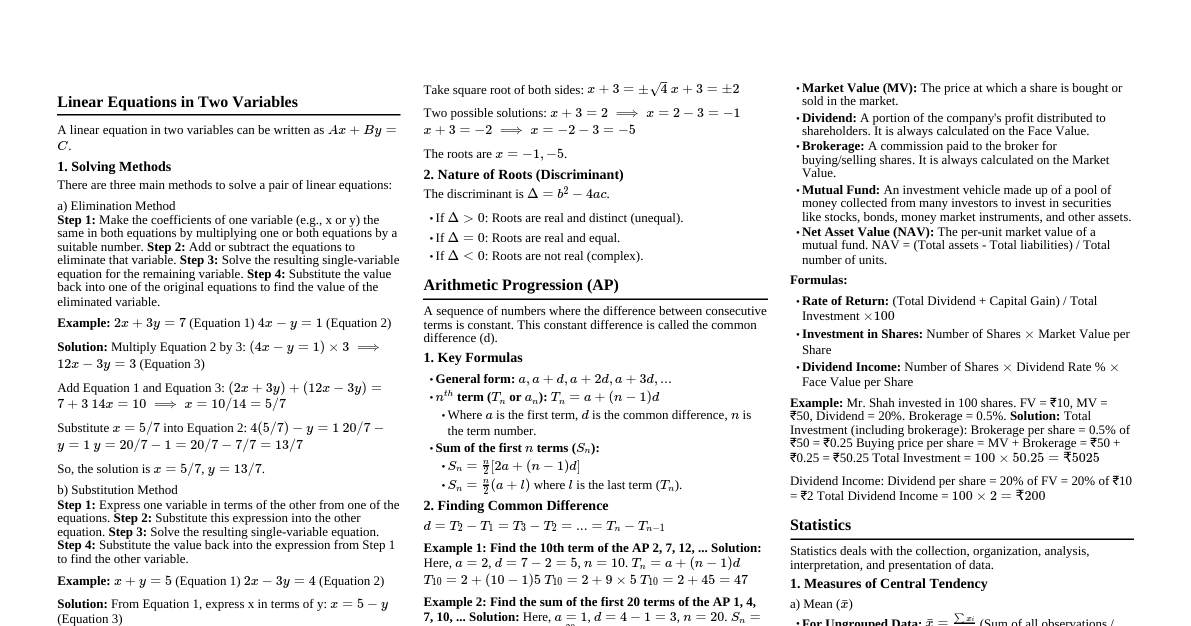
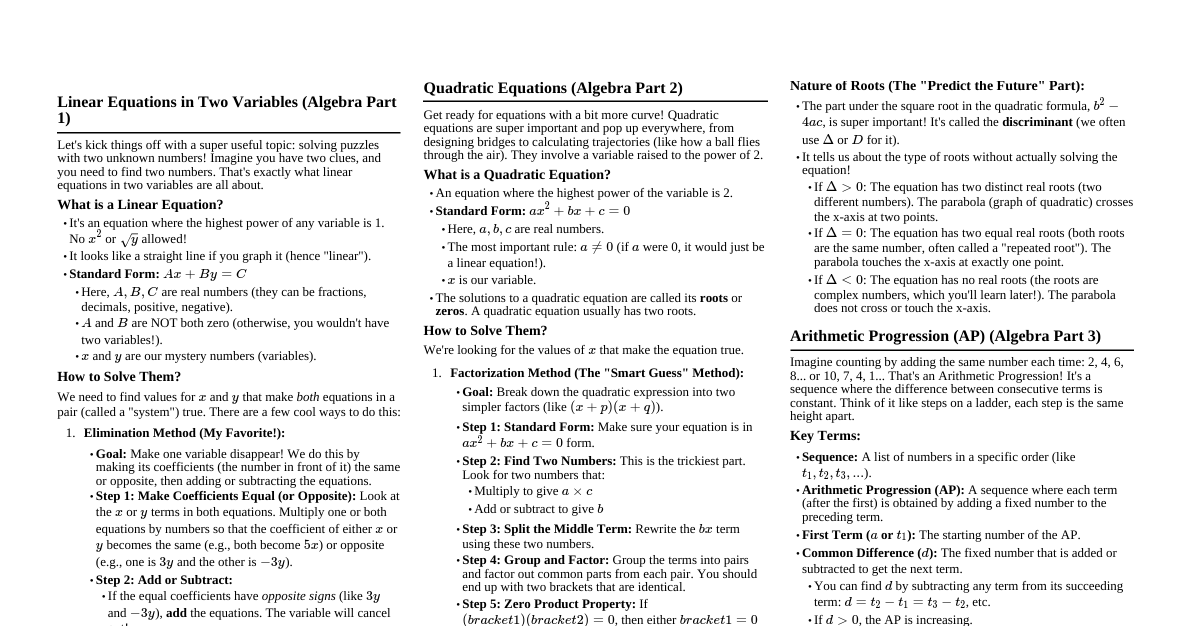
### Linear Equations in Two Variables #### 1. Introduction A **linear equation in two variables** is an equation that can be written in the form $Ax + By + C = 0$, where A, B, and C are real numbers, and A and B are not both zero. The variables are usually $x$ and $y$. A **solution** to a linear equation is a pair of values $(x, y)$ that satisfies the equation. #### 2. Methods to Solve Simultaneous Linear Equations Simultaneous linear equations are a set of two or more linear equations with the same variables. We are looking for a common solution $(x, y)$ that satisfies all equations. ##### a) Elimination Method by Equating Coefficients **Step-by-step process:** 1. **Multiply** one or both equations by a suitable non-zero number so that the coefficients of one variable (e.g., $x$ or $y$) become numerically equal. 2. **Add or subtract** the equations to eliminate one variable. * If the signs of the equal coefficients are opposite, add the equations. * If the signs are the same, subtract one equation from the other. 3. **Solve** the resulting single variable equation. 4. **Substitute** the value found in step 3 into either of the original equations to find the value of the other variable. 5. **Check** your solution by substituting both values into the remaining original equation. **Example:** Solve: 1. $3x + 2y = 11$ 2. $2x - 3y = 3$ * Multiply Eq (1) by 3: $9x + 6y = 33$ (Eq 3) * Multiply Eq (2) by 2: $4x - 6y = 6$ (Eq 4) * Add Eq (3) and Eq (4) (because $6y$ and $-6y$ have opposite signs): $(9x + 6y) + (4x - 6y) = 33 + 6$ $13x = 39$ $x = 3$ * Substitute $x=3$ into Eq (1): $3(3) + 2y = 11$ $9 + 2y = 11$ $2y = 2$ $y = 1$ * Solution: $(x, y) = (3, 1)$ ##### b) Substitution Method **Step-by-step process:** 1. **Express** one variable in terms of the other from one of the equations. (e.g., $y = f(x)$ or $x = g(y)$). 2. **Substitute** this expression into the *other* equation. This will result in a single variable equation. 3. **Solve** the single variable equation. 4. **Substitute** the value found in step 3 back into the expression from step 1 to find the value of the second variable. 5. **Check** your solution. **Example:** Solve: 1. $x + y = 5$ 2. $2x - 3y = 5$ * From Eq (1), express $x$ in terms of $y$: $x = 5 - y$ (Eq 3) * Substitute $x = 5 - y$ into Eq (2): $2(5 - y) - 3y = 5$ $10 - 2y - 3y = 5$ $10 - 5y = 5$ $-5y = -5$ $y = 1$ * Substitute $y = 1$ into Eq (3): $x = 5 - 1$ $x = 4$ * Solution: $(x, y) = (4, 1)$ ##### c) Graphical Method **Step-by-step process:** 1. For each linear equation, **find at least two solutions** $(x, y)$. It's good practice to find three points to ensure accuracy. 2. **Plot** these points on a graph paper. 3. **Draw a straight line** passing through the plotted points for each equation. 4. The **point of intersection** of the two lines is the solution to the simultaneous equations. 5. If the lines are parallel, there is no solution. If the lines are coincident (same line), there are infinitely many solutions. **Example:** Solve: 1. $x + y = 3$ 2. $x - y = 1$ * For $x + y = 3$: * If $x=0$, $y=3 \Rightarrow (0, 3)$ * If $y=0$, $x=3 \Rightarrow (3, 0)$ * If $x=1$, $y=2 \Rightarrow (1, 2)$ * For $x - y = 1$: * If $x=0$, $y=-1 \Rightarrow (0, -1)$ * If $y=0$, $x=1 \Rightarrow (1, 0)$ * If $x=2$, $y=1 \Rightarrow (2, 1)$ * Plot these points and draw lines. The lines will intersect at $(2, 1)$. * Solution: $(x, y) = (2, 1)$ ##### d) Cramer's Rule (Determinant Method) **Step-by-step process:** For a system of equations: $a_1x + b_1y = c_1$ $a_2x + b_2y = c_2$ 1. **Calculate the determinant D** (for the coefficients of $x$ and $y$): $$D = \begin{vmatrix} a_1 & b_1 \\ a_2 & b_2 \end{vmatrix} = a_1b_2 - a_2b_1$$ If $D=0$, Cramer's Rule cannot be used (lines are parallel or coincident). 2. **Calculate the determinant $D_x$** (replace $x$ coefficients with constant terms): $$D_x = \begin{vmatrix} c_1 & b_1 \\ c_2 & b_2 \end{vmatrix} = c_1b_2 - c_2b_1$$ 3. **Calculate the determinant $D_y$** (replace $y$ coefficients with constant terms): $$D_y = \begin{vmatrix} a_1 & c_1 \\ a_2 & c_2 \end{vmatrix} = a_1c_2 - a_2c_1$$ 4. **Find $x$ and $y$**: $$x = \frac{D_x}{D}$$ $$y = \frac{D_y}{D}$$ **Example:** Solve: 1. $3x - 4y = 10$ 2. $4x + 3y = 5$ * $a_1=3, b_1=-4, c_1=10$ * $a_2=4, b_2=3, c_2=5$ * $D = \begin{vmatrix} 3 & -4 \\ 4 & 3 \end{vmatrix} = (3)(3) - (4)(-4) = 9 - (-16) = 9 + 16 = 25$ * $D_x = \begin{vmatrix} 10 & -4 \\ 5 & 3 \end{vmatrix} = (10)(3) - (5)(-4) = 30 - (-20) = 30 + 20 = 50$ * $D_y = \begin{vmatrix} 3 & 10 \\ 4 & 5 \end{vmatrix} = (3)(5) - (4)(10) = 15 - 40 = -25$ * $x = \frac{D_x}{D} = \frac{50}{25} = 2$ * $y = \frac{D_y}{D} = \frac{-25}{25} = -1$ * Solution: $(x, y) = (2, -1)$ #### 3. Equations Reducible to Linear Form Some equations are not linear but can be transformed into linear equations by making suitable substitutions. **Example:** Solve: 1. $\frac{2}{x} + \frac{3}{y} = 13$ 2. $\frac{5}{x} - \frac{4}{y} = -2$ * Let $m = \frac{1}{x}$ and $n = \frac{1}{y}$. * The equations become: 1. $2m + 3n = 13$ 2. $5m - 4n = -2$ * Solve these linear equations for $m$ and $n$ using any method (e.g., elimination): * Multiply Eq (1) by 4: $8m + 12n = 52$ (Eq 3) * Multiply Eq (2) by 3: $15m - 12n = -6$ (Eq 4) * Add Eq (3) and Eq (4): $23m = 46 \Rightarrow m = 2$ * Substitute $m=2$ into Eq (1): $2(2) + 3n = 13 \Rightarrow 4 + 3n = 13 \Rightarrow 3n = 9 \Rightarrow n = 3$ * Now substitute back: * $\frac{1}{x} = m \Rightarrow \frac{1}{x} = 2 \Rightarrow x = \frac{1}{2}$ * $\frac{1}{y} = n \Rightarrow \frac{1}{y} = 3 \Rightarrow y = \frac{1}{3}$ * Solution: $(x, y) = (\frac{1}{2}, \frac{1}{3})$ #### 4. Word Problems **Step-by-step process:** 1. **Read** the problem carefully to understand the context and what is being asked. 2. **Identify** the unknown quantities and assign variables (e.g., $x$ and $y$) to them. 3. **Formulate** two linear equations based on the given conditions/relationships in the problem. 4. **Solve** the system of equations using any suitable method. 5. **Check** if the solution makes sense in the context of the problem. 6. **Write** the final answer clearly with appropriate units. **Example:** The sum of two numbers is 15. If three times the first number is added to two times the second number, the sum is 38. Find the numbers. * Let the first number be $x$ and the second number be $y$. * Equation 1 (sum of two numbers is 15): $x + y = 15$ * Equation 2 (three times the first + two times the second is 38): $3x + 2y = 38$ * Solve using substitution: From Eq 1, $y = 15 - x$. * Substitute into Eq 2: $3x + 2(15 - x) = 38$ $3x + 30 - 2x = 38$ $x + 30 = 38$ $x = 8$ * Substitute $x=8$ back into $y = 15 - x$: $y = 15 - 8 = 7$ * The numbers are 8 and 7. ### Quadratic Equations #### 1. Introduction A **quadratic equation** in one variable is an equation of the form $ax^2 + bx + c = 0$, where $a, b, c$ are real numbers and $a \neq 0$. The **roots** or **solutions** of a quadratic equation are the values of $x$ that satisfy the equation. #### 2. Methods to Solve Quadratic Equations ##### a) Factorization Method **Step-by-step process:** 1. **Write** the equation in the standard form $ax^2 + bx + c = 0$. 2. **Find two numbers** $p$ and $q$ such that $p + q = b$ and $p \times q = ac$. 3. **Split the middle term** ($bx$) into $px + qx$. $ax^2 + px + qx + c = 0$ 4. **Group the terms** and factor by grouping. $x(ax + p) + \frac{c}{q}(qx + c) = 0$ (This step needs careful grouping, it's often $x(ax+p) + \text{something}(ax+p)$) A more reliable grouping: $ax^2 + px + qx + c = 0 \Rightarrow (ax^2 + px) + (qx + c) = 0$ $x(ax + p) + \frac{c}{q}(qx + c) = 0$ (This is incorrect. It should be $(ax+q_1)(x+q_2)=0$) Let's re-do step 4 for clarity: Factor out common terms from the first two and last two terms. Example: $2x^2 - 5x + 3 = 0$ $ac = 2 \times 3 = 6$, $b = -5$. Numbers are -2 and -3. $2x^2 - 2x - 3x + 3 = 0$ $2x(x - 1) - 3(x - 1) = 0$ $(2x - 3)(x - 1) = 0$ 5. **Set each factor to zero** and solve for $x$. $2x - 3 = 0 \Rightarrow x = \frac{3}{2}$ $x - 1 = 0 \Rightarrow x = 1$ * Roots are $x = \frac{3}{2}$ and $x = 1$. ##### b) Completing the Square Method **Step-by-step process:** 1. **Write** the equation in the form $ax^2 + bx + c = 0$. 2. **Divide by $a$** (if $a \neq 1$) to make the coefficient of $x^2$ equal to 1. $x^2 + \frac{b}{a}x + \frac{c}{a} = 0$ 3. **Move the constant term** to the right side. $x^2 + \frac{b}{a}x = -\frac{c}{a}$ 4. **Add the square of half of the coefficient of $x$** to both sides. Coefficient of $x$ is $\frac{b}{a}$. Half of it is $\frac{b}{2a}$. Square is $(\frac{b}{2a})^2$. $x^2 + \frac{b}{a}x + (\frac{b}{2a})^2 = -\frac{c}{a} + (\frac{b}{2a})^2$ 5. **Factor the left side** as a perfect square and simplify the right side. $(x + \frac{b}{2a})^2 = \frac{b^2}{4a^2} - \frac{c}{a}$ $(x + \frac{b}{2a})^2 = \frac{b^2 - 4ac}{4a^2}$ 6. **Take the square root** of both sides. Remember to include $\pm$. $x + \frac{b}{2a} = \pm \sqrt{\frac{b^2 - 4ac}{4a^2}}$ $x + \frac{b}{2a} = \frac{\pm \sqrt{b^2 - 4ac}}{2a}$ 7. **Solve for $x$**. $x = -\frac{b}{2a} \pm \frac{\sqrt{b^2 - 4ac}}{2a}$ $x = \frac{-b \pm \sqrt{b^2 - 4ac}}{2a}$ **Example:** Solve $x^2 + 6x + 5 = 0$ by completing the square. * $x^2 + 6x = -5$ * Half of coefficient of $x$ is $\frac{6}{2} = 3$. Square is $3^2 = 9$. * $x^2 + 6x + 9 = -5 + 9$ * $(x + 3)^2 = 4$ * $x + 3 = \pm \sqrt{4}$ * $x + 3 = \pm 2$ * Case 1: $x + 3 = 2 \Rightarrow x = -1$ * Case 2: $x + 3 = -2 \Rightarrow x = -5$ * Roots are $x = -1$ and $x = -5$. ##### c) Quadratic Formula Method **Step-by-step process:** For $ax^2 + bx + c = 0$: The quadratic formula directly gives the roots: $$x = \frac{-b \pm \sqrt{b^2 - 4ac}}{2a}$$ **Example:** Solve $2x^2 + 5x - 3 = 0$ using the quadratic formula. * Here $a=2, b=5, c=-3$. * Substitute values into the formula: $x = \frac{-5 \pm \sqrt{5^2 - 4(2)(-3)}}{2(2)}$ $x = \frac{-5 \pm \sqrt{25 - (-24)}}{4}$ $x = \frac{-5 \pm \sqrt{25 + 24}}{4}$ $x = \frac{-5 \pm \sqrt{49}}{4}$ $x = \frac{-5 \pm 7}{4}$ * Case 1: $x = \frac{-5 + 7}{4} = \frac{2}{4} = \frac{1}{2}$ * Case 2: $x = \frac{-5 - 7}{4} = \frac{-12}{4} = -3$ * Roots are $x = \frac{1}{2}$ and $x = -3$. #### 3. Nature of Roots (Discriminant) The expression $b^2 - 4ac$ from the quadratic formula is called the **discriminant**, denoted by $\Delta$ (Delta). The nature of the roots depends on the value of the discriminant: 1. If $\Delta > 0$: The roots are **real and unequal** (distinct). 2. If $\Delta = 0$: The roots are **real and equal**. 3. If $\Delta ### Arithmetic Progression (AP) #### 1. Introduction An **Arithmetic Progression (AP)** is a sequence of numbers where the difference between consecutive terms is constant. This constant difference is called the **common difference** ($d$). **General form of an AP:** $a, a+d, a+2d, a+3d, ...$ Where $a$ is the first term. #### 2. Term of an AP ($n$-th Term) The formula for the $n$-th term of an AP is: $$T_n = a + (n-1)d$$ Where: * $T_n$ is the $n$-th term * $a$ is the first term * $n$ is the term number * $d$ is the common difference **How to find $d$**: $d = T_2 - T_1 = T_3 - T_2$, etc. **Example:** Find the 10th term of the AP: 2, 7, 12, ... * $a = 2$ * $d = 7 - 2 = 5$ * $n = 10$ * $T_{10} = a + (10-1)d = 2 + (9)(5) = 2 + 45 = 47$ * The 10th term is 47. #### 3. Sum of the First $n$ Terms of an AP The sum of the first $n$ terms of an AP is denoted by $S_n$. The formula is: $$S_n = \frac{n}{2}[2a + (n-1)d]$$ Alternatively, if the last term ($T_n$ or $l$) is known: $$S_n = \frac{n}{2}(a + T_n)$$ or $$S_n = \frac{n}{2}(a + l)$$ **Example:** Find the sum of the first 10 terms of the AP: 2, 7, 12, ... * $a = 2$ * $d = 5$ * $n = 10$ * $S_{10} = \frac{10}{2}[2(2) + (10-1)5]$ $S_{10} = 5[4 + (9)(5)]$ $S_{10} = 5[4 + 45]$ $S_{10} = 5[49]$ $S_{10} = 245$ * The sum of the first 10 terms is 245. #### 4. Properties of AP * If $a, b, c$ are in AP, then $2b = a + c$. ($b$ is the arithmetic mean of $a$ and $c$). * If a constant is added to or subtracted from each term of an AP, the resulting sequence is also an AP. * If each term of an AP is multiplied or divided by a non-zero constant, the resulting sequence is also an AP. #### 5. Word Problems on AP **Step-by-step process:** 1. **Identify** if the problem describes an AP. Look for phrases like "constant increase/decrease", "at regular intervals." 2. **Determine** the first term ($a$), common difference ($d$), and the number of terms ($n$) or the sum ($S_n$) asked for. 3. **Use** the appropriate formula ($T_n$ or $S_n$) to solve. **Example:** A man saves ₹10 in the first month, ₹20 in the second month, ₹30 in the third month, and so on. How much will he save in 10 months? * The savings form an AP: 10, 20, 30, ... * $a = 10$ * $d = 20 - 10 = 10$ * $n = 10$ * We need to find the total saving, which is $S_{10}$. * $S_{10} = \frac{10}{2}[2(10) + (10-1)10]$ $S_{10} = 5[20 + (9)(10)]$ $S_{10} = 5[20 + 90]$ $S_{10} = 5[110]$ $S_{10} = 550$ * He will save ₹550 in 10 months. ### Probability #### 1. Introduction **Probability** is the measure of the likelihood that an event will occur. It is expressed as a number between 0 and 1, where 0 indicates impossibility and 1 indicates certainty. * **Random Experiment:** An experiment in which all possible outcomes are known in advance, but the exact outcome cannot be predicted. * **Outcome:** A possible result of a random experiment. * **Sample Space (S):** The set of all possible outcomes of a random experiment. $n(S)$ denotes the number of elements in the sample space. * **Event (A):** A subset of the sample space. $n(A)$ denotes the number of outcomes favorable to event A. #### 2. Formula for Probability The probability of an event A, denoted by $P(A)$, is given by: $$P(A) = \frac{\text{Number of favorable outcomes to event A}}{\text{Total number of possible outcomes}} = \frac{n(A)}{n(S)}$$ **Key Properties:** * $0 \le P(A) \le 1$ * $P(\text{certain event}) = 1$ * $P(\text{impossible event}) = 0$ * $P(A') = 1 - P(A)$, where $A'$ is the complement of event A (not A). #### 3. Examples of Sample Spaces * **Tossing a coin:** $S = \{H, T\}$, $n(S) = 2$ * **Tossing two coins:** $S = \{HH, HT, TH, TT\}$, $n(S) = 4$ * **Tossing three coins:** $S = \{HHH, HHT, HTH, THH, HTT, THT, TTH, TTT\}$, $n(S) = 8$ * **Rolling a single die:** $S = \{1, 2, 3, 4, 5, 6\}$, $n(S) = 6$ * **Rolling two dice:** $S = \{(1,1), (1,2), ..., (6,6)\}$, $n(S) = 36$ * **Drawing a card from a standard deck of 52 cards:** $n(S) = 52$ * Number of red cards = 26 (Hearts, Diamonds) * Number of black cards = 26 (Spades, Clubs) * Number of face cards = 12 (J, Q, K of each suit) * Number of Ace cards = 4 #### 4. Solved Examples **Example 1: Single Die Roll** A single die is rolled. * **Sample Space:** $S = \{1, 2, 3, 4, 5, 6\}$, $n(S) = 6$ * **Event A: Getting an even number.** * $A = \{2, 4, 6\}$, $n(A) = 3$ * $P(A) = \frac{n(A)}{n(S)} = \frac{3}{6} = \frac{1}{2}$ * **Event B: Getting a prime number.** * $B = \{2, 3, 5\}$, $n(B) = 3$ * $P(B) = \frac{n(B)}{n(S)} = \frac{3}{6} = \frac{1}{2}$ * **Event C: Getting a number greater than 6.** * $C = \{\}$, $n(C) = 0$ * $P(C) = \frac{0}{6} = 0$ (Impossible event) **Example 2: Two Coins Tossed** Two coins are tossed simultaneously. * **Sample Space:** $S = \{HH, HT, TH, TT\}$, $n(S) = 4$ * **Event A: Getting at least one head.** * $A = \{HH, HT, TH\}$, $n(A) = 3$ * $P(A) = \frac{n(A)}{n(S)} = \frac{3}{4}$ * **Event B: Getting exactly two tails.** * $B = \{TT\}$, $n(B) = 1$ * $P(B) = \frac{n(B)}{n(S)} = \frac{1}{4}$ **Example 3: Deck of Cards** A card is drawn from a well-shuffled deck of 52 playing cards. * **Sample Space:** $n(S) = 52$ * **Event A: Drawing a King.** * There are 4 Kings in a deck. $n(A) = 4$ * $P(A) = \frac{4}{52} = \frac{1}{13}$ * **Event B: Drawing a Red card.** * There are 26 red cards (13 Hearts + 13 Diamonds). $n(B) = 26$ * $P(B) = \frac{26}{52} = \frac{1}{2}$ * **Event C: Drawing a Face card.** * There are 12 face cards (J, Q, K of each of 4 suits). $n(C) = 12$ * $P(C) = \frac{12}{52} = \frac{3}{13}$ #### 5. Mutually Exclusive Events Two events A and B are **mutually exclusive** if they cannot occur at the same time (i.e., their intersection is empty, $A \cap B = \emptyset$). If A and B are mutually exclusive, then $P(A \text{ or } B) = P(A \cup B) = P(A) + P(B)$. **Example:** In a single die roll, getting an even number (A) and getting an odd number (B) are mutually exclusive. $A = \{2, 4, 6\}$, $B = \{1, 3, 5\}$. $A \cap B = \emptyset$. $P(A) = 3/6 = 1/2$, $P(B) = 3/6 = 1/2$. $P(A \text{ or } B) = P(A) + P(B) = 1/2 + 1/2 = 1$. (Getting an even or an odd number is a certain event). #### 6. Complementary Events If A is an event, then $A'$ (or $\bar{A}$) is its **complementary event**, meaning "not A". $P(A') = 1 - P(A)$ **Example:** The probability of passing an exam is 0.7. What is the probability of failing? $P(\text{Pass}) = 0.7$ $P(\text{Fail}) = 1 - P(\text{Pass}) = 1 - 0.7 = 0.3$. ### Financial Planning This section in Maharashtra Board 10th Maths primarily deals with calculating GST, shares, mutual funds, and income tax. #### 1. Goods and Services Tax (GST) GST is a consumption tax in India. It is levied on most goods and services. * **Taxable Value:** The price of the product/service before GST. * **GST Rate:** Percentage at which GST is charged. * **CGST (Central GST):** Half of the total GST, collected by the Central Government. * **SGST (State GST):** Half of the total GST, collected by the State Government. * **IGST (Integrated GST):** Levied on inter-state transactions. It is equal to the total GST. **Calculations:** * **Total GST Amount = GST Rate % of Taxable Value** * **CGST Amount = SGST Amount = (Total GST Amount) / 2** * **Invoice Value (Amount with GST) = Taxable Value + Total GST Amount** **Example:** A product has a taxable value of ₹1000 and the GST rate is 18%. * Total GST Amount = 18% of ₹1000 = $0.18 \times 1000 = ₹180$ * CGST Amount = ₹180 / 2 = ₹90 * SGST Amount = ₹180 / 2 = ₹90 * Invoice Value = ₹1000 + ₹180 = ₹1180 #### 2. Shares and Dividends * **Share:** A unit of ownership in a company. * **Shareholder:** An owner of shares. * **Face Value (FV) / Nominal Value / Par Value:** The value written on the share certificate. * **Market Value (MV):** The price at which a share is bought or sold in the market. This value fluctuates. * **At Par:** MV = FV * **At Premium:** MV > FV (MV = FV + Premium) * **At Discount:** MV ₹5 lakh) = ₹0 6. Cess = 4% of ₹32,500 = $0.04 \times 32,500 = ₹1300$ 7. Total Tax Payable = ₹32,500 + ₹1300 = ₹33,800 ### Probability Distribution (Not typically in 10th Maharashtra Board - this is usually higher level stats) (This section title suggests content that is generally not part of the 10th-grade curriculum in Maharashtra Board. Assuming this was a misinterpretation, I will omit content for Probability Distribution and focus on other 10th-grade topics. If you specifically need content on Probability Distribution, please clarify.) ### Statistics #### 1. Measures of Central Tendency These are single values that attempt to describe a set of data by identifying the central position within that set of data. ##### a) Mean ($\bar{x}$) The average of a set of numbers. * **For ungrouped data:** $$\bar{x} = \frac{\sum x_i}{N}$$ Where $\sum x_i$ is the sum of all observations and $N$ is the total number of observations. * **For grouped data (Direct Method):** $$\bar{x} = \frac{\sum f_i x_i}{\sum f_i}$$ Where $f_i$ is the frequency of each class and $x_i$ is the class mark (mid-point) of each class. * **For grouped data (Assumed Mean Method):** $$\bar{x} = A + \frac{\sum f_i d_i}{\sum f_i}$$ Where $A$ is the assumed mean, $d_i = x_i - A$ is the deviation. * **For grouped data (Step-Deviation Method):** $$\bar{x} = A + \left(\frac{\sum f_i u_i}{\sum f_i}\right) h$$ Where $A$ is the assumed mean, $u_i = \frac{x_i - A}{h}$, and $h$ is the class width. **Example (Direct Method):** | Class Interval | Frequency ($f_i$) | Class Mark ($x_i$) | $f_i x_i$ | |----------------|-------------------|--------------------|-----------| | 0-10 | 2 | 5 | 10 | | 10-20 | 3 | 15 | 45 | | 20-30 | 5 | 25 | 125 | | **Total** | $\sum f_i = 10$ | | $\sum f_i x_i = 180$ | $$\bar{x} = \frac{180}{10} = 18$$ ##### b) Median The middle-most value of a data set when the data is arranged in ascending or descending order. * **For ungrouped data:** * If $N$ is odd, Median = $\left(\frac{N+1}{2}\right)$-th observation. * If $N$ is even, Median = Average of $\left(\frac{N}{2}\right)$-th and $\left(\frac{N}{2}+1\right)$-th observations. * **For grouped data:** $$Median = L + \left(\frac{N/2 - CF}{f}\right) h$$ Where: * $L$ = Lower boundary of the median class * $N$ = Total frequency ($\sum f_i$) * $CF$ = Cumulative frequency of the class preceding the median class * $f$ = Frequency of the median class * $h$ = Class width of the median class **Steps to find Median for grouped data:** 1. Create a cumulative frequency (CF) column. 2. Find $N/2$. 3. Locate the median class: the class interval whose CF is just greater than or equal to $N/2$. 4. Apply the formula. **Example (Grouped Data):** | Class Interval | Frequency ($f_i$) | Cumulative Frequency (CF) | |----------------|-------------------|---------------------------| | 0-10 | 5 | 5 | | 10-20 | 8 | 13 | | 20-30 | 12 | 25 (Median Class) | | 30-40 | 7 | 32 | | 40-50 | 3 | 35 | | **Total** | $N = 35$ | | * $N/2 = 35/2 = 17.5$ * Median class is 20-30 (CF=25, which is just greater than 17.5). * $L = 20$ * $CF$ (preceding median class) = 13 * $f$ (of median class) = 12 * $h = 10$ $$Median = 20 + \left(\frac{17.5 - 13}{12}\right) 10 = 20 + \left(\frac{4.5}{12}\right) 10 = 20 + \frac{45}{12} = 20 + 3.75 = 23.75$$ ##### c) Mode The value that appears most frequently in a data set. * **For ungrouped data:** The observation with the highest frequency. * **For grouped data:** $$Mode = L + \left(\frac{f_1 - f_0}{2f_1 - f_0 - f_2}\right) h$$ Where: * $L$ = Lower boundary of the modal class * $f_1$ = Frequency of the modal class * $f_0$ = Frequency of the class preceding the modal class * $f_2$ = Frequency of the class succeeding the modal class * $h$ = Class width of the modal class **Steps to find Mode for grouped data:** 1. Identify the modal class: the class interval with the highest frequency. 2. Apply the formula. **Example (Grouped Data):** | Class Interval | Frequency ($f_i$) | |----------------|-------------------| | 0-10 | 5 | | 10-20 | 8 | | 20-30 | 12 (Modal Class) | | 30-40 | 7 | | 40-50 | 3 | * Modal class is 20-30 (highest frequency = 12). * $L = 20$ * $f_1 = 12$ * $f_0 = 8$ * $f_2 = 7$ * $h = 10$ $$Mode = 20 + \left(\frac{12 - 8}{2(12) - 8 - 7}\right) 10 = 20 + \left(\frac{4}{24 - 15}\right) 10 = 20 + \left(\frac{4}{9}\right) 10 = 20 + \frac{40}{9} \approx 20 + 4.44 = 24.44$$ #### 2. Relationship between Mean, Median, Mode For a moderately skewed distribution, there is an empirical relationship: **Mode $\approx$ 3 Median - 2 Mean** #### 3. Graphical Representation of Data * **Histogram:** A graphical representation of grouped frequency distribution in the form of rectangles with class intervals as bases and frequencies as heights. Useful for finding the Mode graphically. * **Frequency Polygon:** Can be drawn by joining the midpoints of the tops of the rectangles in a histogram, or by plotting class marks against frequencies. * **Ogive (Cumulative Frequency Curve):** * **Less than ogive:** Plots upper class limits against "less than" cumulative frequencies. * **More than ogive:** Plots lower class limits against "more than" cumulative frequencies. * The point where the "less than" and "more than" ogives intersect gives the **Median**. ### Coordinate Geometry #### 1. Distance Formula The distance between two points $P(x_1, y_1)$ and $Q(x_2, y_2)$ is given by: $$D = \sqrt{(x_2 - x_1)^2 + (y_2 - y_1)^2}$$ The distance of a point $P(x, y)$ from the origin $O(0, 0)$ is $\sqrt{x^2 + y^2}$. **Example:** Find the distance between $(2, 3)$ and $(5, 7)$. $D = \sqrt{(5 - 2)^2 + (7 - 3)^2} = \sqrt{3^2 + 4^2} = \sqrt{9 + 16} = \sqrt{25} = 5$ units. #### 2. Section Formula Used to find the coordinates of a point that divides a line segment joining two points internally in a given ratio. If point $P(x, y)$ divides the line segment joining $A(x_1, y_1)$ and $B(x_2, y_2)$ internally in the ratio $m:n$, then: $$x = \frac{mx_2 + nx_1}{m+n}$$ $$y = \frac{my_2 + ny_1}{m+n}$$ **Example:** Find the coordinates of the point that divides the line segment joining $(1, 7)$ and $(4, -3)$ in the ratio $2:3$. $x_1=1, y_1=7, x_2=4, y_2=-3, m=2, n=3$. $x = \frac{2(4) + 3(1)}{2+3} = \frac{8 + 3}{5} = \frac{11}{5}$ $y = \frac{2(-3) + 3(7)}{2+3} = \frac{-6 + 21}{5} = \frac{15}{5} = 3$ The point is $(\frac{11}{5}, 3)$. #### 3. Midpoint Formula A special case of the section formula where the ratio is $1:1$. The midpoint $M(x, y)$ of the line segment joining $A(x_1, y_1)$ and $B(x_2, y_2)$ is: $$x = \frac{x_1 + x_2}{2}$$ $$y = \frac{y_1 + y_2}{2}$$ **Example:** Find the midpoint of the line segment joining $(2, 5)$ and $(8, 1)$. $x = \frac{2 + 8}{2} = \frac{10}{2} = 5$ $y = \frac{5 + 1}{2} = \frac{6}{2} = 3$ The midpoint is $(5, 3)$. #### 4. Area of a Triangle The area of a triangle with vertices $A(x_1, y_1)$, $B(x_2, y_2)$, and $C(x_3, y_3)$ is: $$Area = \frac{1}{2} |x_1(y_2 - y_3) + x_2(y_3 - y_1) + x_3(y_1 - y_2)|$$ The absolute value is taken because area cannot be negative. **Condition for Collinearity:** Three points are collinear (lie on the same straight line) if the area of the triangle formed by them is zero. $x_1(y_2 - y_3) + x_2(y_3 - y_1) + x_3(y_1 - y_2) = 0$ **Example:** Find the area of the triangle with vertices $(1, -1)$, $(-4, 6)$, and $(-3, -5)$. $x_1=1, y_1=-1$ $x_2=-4, y_2=6$ $x_3=-3, y_3=-5$ $Area = \frac{1}{2} |1(6 - (-5)) + (-4)(-5 - (-1)) + (-3)(-1 - 6)|$ $Area = \frac{1}{2} |1(6 + 5) - 4(-5 + 1) - 3(-7)|$ $Area = \frac{1}{2} |1(11) - 4(-4) - 3(-7)|$ $Area = \frac{1}{2} |11 + 16 + 21|$ $Area = \frac{1}{2} |48| = 24$ square units. #### 5. Slope of a Line The slope ($m$) of a line passing through two points $A(x_1, y_1)$ and $B(x_2, y_2)$ is: $$m = \frac{y_2 - y_1}{x_2 - x_1}$$ The slope of a line also represents the tangent of the angle ($\theta$) it makes with the positive x-axis: $$m = \tan \theta$$ **Properties of Slopes:** * **Parallel Lines:** If two lines are parallel, their slopes are equal ($m_1 = m_2$). * **Perpendicular Lines:** If two non-vertical lines are perpendicular, the product of their slopes is -1 ($m_1 m_2 = -1$). (A vertical line has an undefined slope, and a horizontal line has a slope of 0. They are perpendicular.) **Example:** Find the slope of the line passing through $(3, 2)$ and $(7, 5)$. $m = \frac{5 - 2}{7 - 3} = \frac{3}{4}$ #### 6. Equation of a Line * **Slope-Intercept Form:** $y = mx + c$ Where $m$ is the slope and $c$ is the y-intercept. * **Point-Slope Form:** $y - y_1 = m(x - x_1)$ Where $m$ is the slope and $(x_1, y_1)$ is a point on the line. * **Two-Point Form:** $\frac{y - y_1}{y_2 - y_1} = \frac{x - x_1}{x_2 - x_1}$ (Derived from point-slope form, using $m = \frac{y_2 - y_1}{x_2 - x_1}$) * **General Form:** $Ax + By + C = 0$ **Example:** Find the equation of a line passing through $(1, 2)$ with a slope of 3. Using point-slope form: $y - 2 = 3(x - 1)$ $y - 2 = 3x - 3$ $y = 3x - 1$ (or $3x - y - 1 = 0$) ### Trigonometry #### 1. Introduction to Trigonometric Ratios Trigonometry is the study of relationships between the sides and angles of right-angled triangles. Consider a right-angled triangle ABC, right-angled at B. For angle A: * **Opposite Side:** BC * **Adjacent Side:** AB * **Hypotenuse:** AC The six trigonometric ratios are: * **Sine (sin A)** = Opposite / Hypotenuse = BC / AC * **Cosine (cos A)** = Adjacent / Hypotenuse = AB / AC * **Tangent (tan A)** = Opposite / Adjacent = BC / AB * **Cosecant (csc A)** = 1 / sin A = Hypotenuse / Opposite = AC / BC * **Secant (sec A)** = 1 / cos A = Hypotenuse / Adjacent = AC / AB * **Cotangent (cot A)** = 1 / tan A = Adjacent / Opposite = AB / BC **Relationship between ratios:** * $\tan A = \frac{\sin A}{\cos A}$ * $\cot A = \frac{\cos A}{\sin A}$ #### 2. Trigonometric Ratios of Specific Angles | Angle ($\theta$) | $0^\circ$ | $30^\circ$ | $45^\circ$ | $60^\circ$ | $90^\circ$ | |------------------|-----------|------------|------------|------------|------------| | $\sin \theta$ | 0 | $1/2$ | $1/\sqrt{2}$ | $\sqrt{3}/2$ | 1 | | $\cos \theta$ | 1 | $\sqrt{3}/2$ | $1/\sqrt{2}$ | $1/2$ | 0 | | $\tan \theta$ | 0 | $1/\sqrt{3}$ | 1 | $\sqrt{3}$ | Undefined | | $\csc \theta$ | Undefined | 2 | $\sqrt{2}$ | $2/\sqrt{3}$ | 1 | | $\sec \theta$ | 1 | $2/\sqrt{3}$ | $\sqrt{2}$ | 2 | Undefined | | $\cot \theta$ | Undefined | $\sqrt{3}$ | 1 | $1/\sqrt{3}$ | 0 | #### 3. Trigonometric Identities These are equations that are true for all values of the angles for which the functions are defined. 1. $\sin^2 \theta + \cos^2 \theta = 1$ * From this, we can derive: $\sin^2 \theta = 1 - \cos^2 \theta$ and $\cos^2 \theta = 1 - \sin^2 \theta$ 2. $1 + \tan^2 \theta = \sec^2 \theta$ * From this, we can derive: $\tan^2 \theta = \sec^2 \theta - 1$ and $\sec^2 \theta - \tan^2 \theta = 1$ 3. $1 + \cot^2 \theta = \csc^2 \theta$ * From this, we can derive: $\cot^2 \theta = \csc^2 \theta - 1$ and $\csc^2 \theta - \cot^2 \theta = 1$ **Example:** Prove that $(\sec \theta - \cos \theta)(\cot \theta + \tan \theta) = \tan \theta \sec \theta$. LHS = $(\sec \theta - \cos \theta)(\cot \theta + \tan \theta)$ $= \left(\frac{1}{\cos \theta} - \cos \theta\right) \left(\frac{\cos \theta}{\sin \theta} + \frac{\sin \theta}{\cos \theta}\right)$ $= \left(\frac{1 - \cos^2 \theta}{\cos \theta}\right) \left(\frac{\cos^2 \theta + \sin^2 \theta}{\sin \theta \cos \theta}\right)$ $= \left(\frac{\sin^2 \theta}{\cos \theta}\right) \left(\frac{1}{\sin \theta \cos \theta}\right)$ (Using $\sin^2 \theta + \cos^2 \theta = 1$) $= \frac{\sin^2 \theta}{\sin \theta \cos^2 \theta}$ $= \frac{\sin \theta}{\cos^2 \theta}$ $= \frac{\sin \theta}{\cos \theta} \cdot \frac{1}{\cos \theta}$ $= \tan \theta \sec \theta$ = RHS. Hence Proved. #### 4. Heights and Distances (Applications of Trigonometry) This involves using trigonometric ratios to find heights of objects or distances between objects based on angles of elevation/depression. * **Angle of Elevation:** The angle formed by the line of sight with the horizontal when the observer looks *up* at an object. * **Angle of Depression:** The angle formed by the line of sight with the horizontal when the observer looks *down* at an object. (Angle of depression = Angle of elevation from the object's perspective to the observer). **Step-by-step process:** 1. **Draw a neat diagram** representing the problem. 2. **Label** known quantities (angles, distances) and unknown quantities ($h$ for height, $x$ for distance). 3. **Identify right-angled triangles** in the diagram. 4. **Choose appropriate trigonometric ratios** (sin, cos, tan) to relate the known and unknown quantities. 5. **Solve** the equations to find the unknowns. **Example:** A ladder 10m long reaches a window 8m above the ground. Find the distance of the foot of the ladder from the base of the wall. * Let the ladder be AC = 10m. * Let the height of the window from the ground be BC = 8m. * We need to find AB (distance from the base of the wall). * Triangle ABC is a right-angled triangle at B. * Using Pythagoras theorem: $AC^2 = AB^2 + BC^2$ $10^2 = AB^2 + 8^2$ $100 = AB^2 + 64$ $AB^2 = 100 - 64 = 36$ $AB = \sqrt{36} = 6$m. * The distance of the foot of the ladder from the base of the wall is 6m. (Note: This example uses Pythagoras, but many heights and distances problems directly use trig ratios with angles). **Example using angles:** A tower is 30m high. The angle of elevation of its top from a point on the ground is $30^\circ$. Find the distance of the point from the base of the tower. * Let the height of the tower be AB = 30m. * Let the point on the ground be C. Angle of elevation $\angle ACB = 30^\circ$. * We need to find BC (distance from the base). * In right $\triangle ABC$: $\tan C = \frac{AB}{BC}$ $\tan 30^\circ = \frac{30}{BC}$ $\frac{1}{\sqrt{3}} = \frac{30}{BC}$ $BC = 30\sqrt{3}$m. * The distance of the point from the base of the tower is $30\sqrt{3}$ meters. ### Mensuration #### 1. Surface Area and Volume of 3D Shapes ##### a) Cuboid * **Lateral Surface Area (LSA):** $2h(l+b)$ * **Total Surface Area (TSA):** $2(lb + bh + lh)$ * **Volume (V):** $l \times b \times h$ ##### b) Cube * **Lateral Surface Area (LSA):** $4s^2$ * **Total Surface Area (TSA):** $6s^2$ * **Volume (V):** $s^3$ ##### c) Cylinder * **Curved Surface Area (CSA):** $2\pi rh$ * **Total Surface Area (TSA):** $2\pi r(r+h)$ * **Volume (V):** $\pi r^2 h$ ##### d) Cone * **Slant Height (l):** $l = \sqrt{r^2 + h^2}$ * **Curved Surface Area (CSA):** $\pi rl$ * **Total Surface Area (TSA):** $\pi r(r+l)$ * **Volume (V):** $\frac{1}{3}\pi r^2 h$ ##### e) Sphere * **Surface Area (SA):** $4\pi r^2$ * **Volume (V):** $\frac{4}{3}\pi r^3$ ##### f) Hemisphere * **Curved Surface Area (CSA):** $2\pi r^2$ * **Total Surface Area (TSA):** $3\pi r^2$ * **Volume (V):** $\frac{2}{3}\pi r^3$ #### 2. Frustum of a Cone When a cone is cut by a plane parallel to its base, the part between the cutting plane and the base is called a frustum. Let $R$ be the radius of the base, $r$ be the radius of the top, $h$ be the height, and $l$ be the slant height. * **Slant Height (l):** $l = \sqrt{h^2 + (R-r)^2}$ * **Curved Surface Area (CSA):** $\pi (R+r)l$ * **Total Surface Area (TSA):** $\pi (R+r)l + \pi R^2 + \pi r^2$ * **Volume (V):** $\frac{1}{3}\pi h (R^2 + Rr + r^2)$ #### 3. Combination of Solids Problems often involve finding the surface area or volume of solids formed by combining two or more basic solids. **Key Idea:** * **Surface Area:** When combining solids, some surfaces might be hidden. Only the exposed surfaces contribute to the total surface area. Calculate the individual exposed surface areas and sum them up. * **Volume:** The total volume of a combined solid is simply the sum of the volumes of the individual solids. **Example (Volume):** A toy is in the form of a cone mounted on a hemisphere. The diameter of the base of the cone and the hemisphere is 6 cm, and the height of the cone is 4 cm. Find the volume of the toy. * Radius ($r$) = Diameter / 2 = 6 / 2 = 3 cm. * Height of cone ($h$) = 4 cm. * Volume of hemisphere = $\frac{2}{3}\pi r^3 = \frac{2}{3}\pi (3)^3 = \frac{2}{3}\pi (27) = 18\pi$ cm$^3$. * Volume of cone = $\frac{1}{3}\pi r^2 h = \frac{1}{3}\pi (3)^2 (4) = \frac{1}{3}\pi (9)(4) = 12\pi$ cm$^3$. * Total Volume of toy = Volume of hemisphere + Volume of cone $= 18\pi + 12\pi = 30\pi$ cm$^3$. (Using $\pi = 3.14$, Volume = $30 \times 3.14 = 94.2$ cm$^3$) **Example (Surface Area):** A solid is in the shape of a cylinder with two hemispherical ends. The total length of the solid is 20 cm and the diameter of the cylinder is 7 cm. Find the total surface area of the solid. * Radius ($r$) = Diameter / 2 = 7 / 2 = 3.5 cm. * Total length = 20 cm. * Length of cylindrical part ($h_{cyl}$) = Total length - 2 $\times$ radius of hemisphere $h_{cyl} = 20 - 2(3.5) = 20 - 7 = 13$ cm. * Total Surface Area = CSA of cylinder + CSA of two hemispheres $= 2\pi r h_{cyl} + 2(2\pi r^2)$ $= 2\pi r h_{cyl} + 4\pi r^2$ $= 2\pi r (h_{cyl} + 2r)$ $= 2 \times \frac{22}{7} \times 3.5 (13 + 2 \times 3.5)$ $= 2 \times \frac{22}{7} \times \frac{7}{2} (13 + 7)$ $= 22 \times 20 = 440$ cm$^2$.