Maharashtra Board 10th Maths
Cheatsheet Content
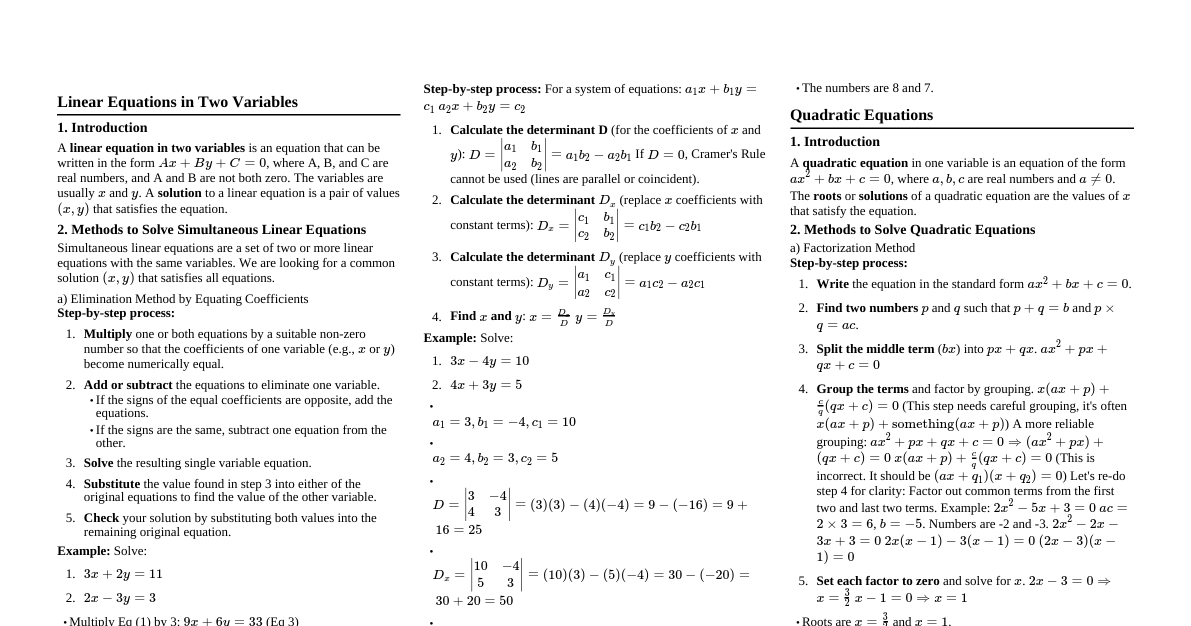
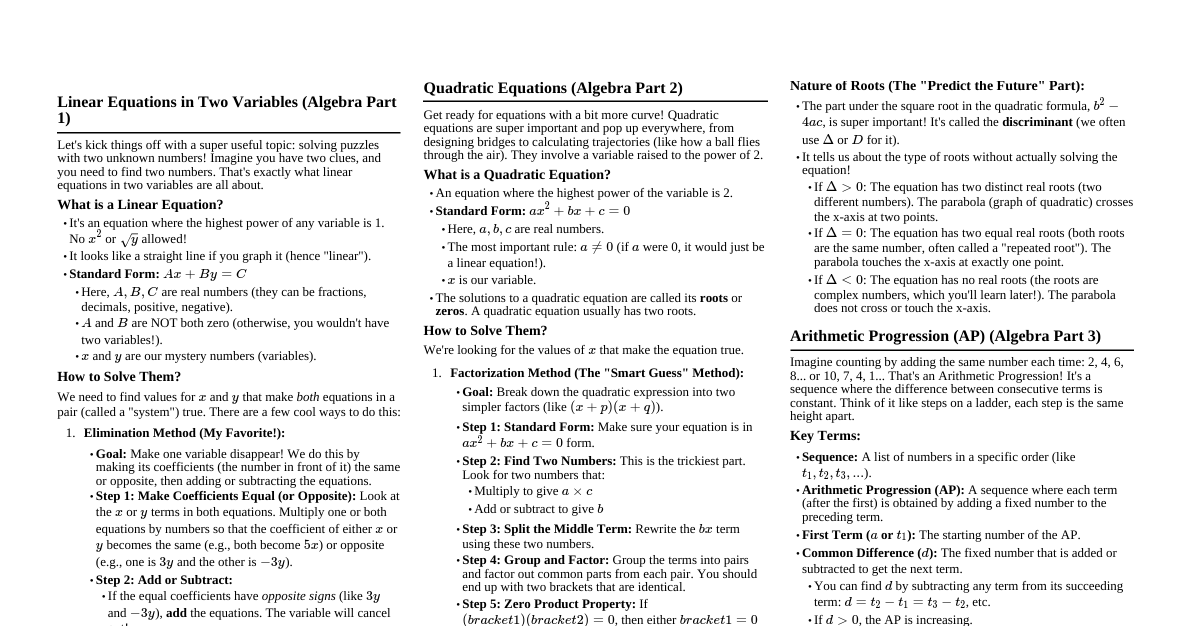
### Linear Equations in Two Variables A linear equation in two variables can be written as $Ax + By = C$. #### 1. Solving Methods There are three main methods to solve a pair of linear equations: ##### a) Elimination Method **Step 1:** Make the coefficients of one variable (e.g., x or y) the same in both equations by multiplying one or both equations by a suitable number. **Step 2:** Add or subtract the equations to eliminate that variable. **Step 3:** Solve the resulting single-variable equation for the remaining variable. **Step 4:** Substitute the value back into one of the original equations to find the value of the eliminated variable. **Example:** $2x + 3y = 7$ (Equation 1) $4x - y = 1$ (Equation 2) **Solution:** Multiply Equation 2 by 3: $(4x - y = 1) \times 3 \implies 12x - 3y = 3$ (Equation 3) Add Equation 1 and Equation 3: $(2x + 3y) + (12x - 3y) = 7 + 3$ $14x = 10 \implies x = 10/14 = 5/7$ Substitute $x = 5/7$ into Equation 2: $4(5/7) - y = 1$ $20/7 - y = 1$ $y = 20/7 - 1 = 20/7 - 7/7 = 13/7$ So, the solution is $x = 5/7$, $y = 13/7$. ##### b) Substitution Method **Step 1:** Express one variable in terms of the other from one of the equations. **Step 2:** Substitute this expression into the other equation. **Step 3:** Solve the resulting single-variable equation. **Step 4:** Substitute the value back into the expression from Step 1 to find the other variable. **Example:** $x + y = 5$ (Equation 1) $2x - 3y = 4$ (Equation 2) **Solution:** From Equation 1, express x in terms of y: $x = 5 - y$ (Equation 3) Substitute Equation 3 into Equation 2: $2(5 - y) - 3y = 4$ $10 - 2y - 3y = 4$ $10 - 5y = 4$ $5y = 10 - 4 = 6 \implies y = 6/5$ Substitute $y = 6/5$ into Equation 3: $x = 5 - 6/5 = 25/5 - 6/5 = 19/5$ So, the solution is $x = 19/5$, $y = 6/5$. ##### c) Graphical Method **Step 1:** Find at least two points for each equation by choosing values for x and calculating y (or vice-versa). **Step 2:** Plot these points on a graph paper and draw a straight line through them for each equation. **Step 3:** The point where the two lines intersect is the solution to the system of equations. ### Quadratic Equations A quadratic equation is of the form $ax^2 + bx + c = 0$, where $a \neq 0$. #### 1. Solving Methods ##### a) Factorization Method **Step 1:** Write the equation in standard form $ax^2 + bx + c = 0$. **Step 2:** Find two numbers such that their product is $ac$ and their sum is $b$. **Step 3:** Split the middle term ($bx$) using these two numbers. **Step 4:** Group the terms and factor out common monomials. **Step 5:** Set each factor equal to zero and solve for x. **Example:** $x^2 + 5x + 6 = 0$ **Solution:** Here, $a=1, b=5, c=6$. Product $ac = 1 \times 6 = 6$. Sum $b = 5$. The numbers are 2 and 3 ($2 \times 3 = 6$, $2 + 3 = 5$). Split the middle term: $x^2 + 2x + 3x + 6 = 0$ Group and factor: $x(x + 2) + 3(x + 2) = 0$ $(x + 2)(x + 3) = 0$ Set each factor to zero: $x + 2 = 0 \implies x = -2$ $x + 3 = 0 \implies x = -3$ The roots are $x = -2, -3$. ##### b) Quadratic Formula Method The roots of $ax^2 + bx + c = 0$ are given by the formula: $$x = \frac{-b \pm \sqrt{b^2 - 4ac}}{2a}$$ **Example:** $2x^2 + 5x + 2 = 0$ **Solution:** Here, $a=2, b=5, c=2$. Substitute values into the formula: $x = \frac{-5 \pm \sqrt{5^2 - 4(2)(2)}}{2(2)}$ $x = \frac{-5 \pm \sqrt{25 - 16}}{4}$ $x = \frac{-5 \pm \sqrt{9}}{4}$ $x = \frac{-5 \pm 3}{4}$ Two possible solutions: $x_1 = \frac{-5 + 3}{4} = \frac{-2}{4} = -1/2$ $x_2 = \frac{-5 - 3}{4} = \frac{-8}{4} = -2$ The roots are $x = -1/2, -2$. ##### c) Completing the Square Method **Step 1:** Divide the equation by 'a' to make the coefficient of $x^2$ equal to 1. **Step 2:** Move the constant term to the right side of the equation. **Step 3:** Add the square of half the coefficient of x to both sides. $(b/2a)^2$. **Step 4:** Factor the left side as a perfect square $(x + b/2a)^2$. **Step 5:** Take the square root of both sides and solve for x. **Example:** $x^2 + 6x + 5 = 0$ **Solution:** Move constant term: $x^2 + 6x = -5$ Half of coefficient of x is $6/2 = 3$. Square of this is $3^2 = 9$. Add 9 to both sides: $x^2 + 6x + 9 = -5 + 9$ $(x + 3)^2 = 4$ Take square root of both sides: $x + 3 = \pm\sqrt{4}$ $x + 3 = \pm2$ Two possible solutions: $x + 3 = 2 \implies x = 2 - 3 = -1$ $x + 3 = -2 \implies x = -2 - 3 = -5$ The roots are $x = -1, -5$. #### 2. Nature of Roots (Discriminant) The discriminant is $\Delta = b^2 - 4ac$. - If $\Delta > 0$: Roots are real and distinct (unequal). - If $\Delta = 0$: Roots are real and equal. - If $\Delta ### Arithmetic Progression (AP) A sequence of numbers where the difference between consecutive terms is constant. This constant difference is called the common difference (d). #### 1. Key Formulas - **General form:** $a, a+d, a+2d, a+3d, ...$ - **$n^{th}$ term ($T_n$ or $a_n$):** $T_n = a + (n-1)d$ - Where $a$ is the first term, $d$ is the common difference, $n$ is the term number. - **Sum of the first $n$ terms ($S_n$):** - $S_n = \frac{n}{2}[2a + (n-1)d]$ - $S_n = \frac{n}{2}(a + l)$ where $l$ is the last term ($T_n$). #### 2. Finding Common Difference $d = T_2 - T_1 = T_3 - T_2 = ... = T_n - T_{n-1}$ **Example 1: Find the 10th term of the AP 2, 7, 12, ...** **Solution:** Here, $a = 2$, $d = 7 - 2 = 5$, $n = 10$. $T_n = a + (n-1)d$ $T_{10} = 2 + (10-1)5$ $T_{10} = 2 + 9 \times 5$ $T_{10} = 2 + 45 = 47$ **Example 2: Find the sum of the first 20 terms of the AP 1, 4, 7, 10, ...** **Solution:** Here, $a = 1$, $d = 4 - 1 = 3$, $n = 20$. $S_n = \frac{n}{2}[2a + (n-1)d]$ $S_{20} = \frac{20}{2}[2(1) + (20-1)3]$ $S_{20} = 10[2 + 19 \times 3]$ $S_{20} = 10[2 + 57]$ $S_{20} = 10[59] = 590$ ### Probability Probability is the measure of the likelihood that an event will occur. #### 1. Key Concepts - **Random Experiment:** An experiment whose outcome cannot be predicted with certainty. - **Outcome:** A possible result of a random experiment. - **Sample Space (S):** The set of all possible outcomes of a random experiment. $n(S)$ is the number of outcomes in the sample space. - **Event (E):** A subset of the sample space. $n(E)$ is the number of outcomes favorable to the event. - **Probability of an Event P(E):** $$P(E) = \frac{\text{Number of favorable outcomes}}{\text{Total number of outcomes}} = \frac{n(E)}{n(S)}$$ #### 2. Properties of Probability - $0 \le P(E) \le 1$ - $P(\text{certain event}) = 1$ - $P(\text{impossible event}) = 0$ - $P(E') = 1 - P(E)$ (where $E'$ is the complement of event E, i.e., not E) #### 3. Examples - **Tossing a Coin:** - Sample Space $S = \{H, T\}$, $n(S) = 2$ - Event of getting a Head $E = \{H\}$, $n(E) = 1$ - $P(H) = 1/2$ - **Rolling a Die:** - Sample Space $S = \{1, 2, 3, 4, 5, 6\}$, $n(S) = 6$ - Event of getting an even number $E = \{2, 4, 6\}$, $n(E) = 3$ - $P(\text{even number}) = 3/6 = 1/2$ - **Drawing a Card from a Deck:** - Total cards $n(S) = 52$ - Event of drawing a King $E = \{\text{King of Spades, King of Hearts, King of Diamonds, King of Clubs}\}$, $n(E) = 4$ - $P(\text{drawing a King}) = 4/52 = 1/13$ ### Financial Planning This section covers topics like GST and shares/mutual funds. #### 1. Goods and Services Tax (GST) - GST is a consumption tax levied on most goods and services sold for domestic consumption. - **Formula:** GST Amount = (GST Rate / 100) $\times$ Taxable Value - **Total Bill Amount:** Taxable Value + GST Amount **Example:** A product has a taxable value of ₹1000 and GST rate is 18%. **Solution:** GST Amount = $(18/100) \times 1000 = ₹180$ Total Bill Amount = $1000 + 180 = ₹1180$ #### 2. Shares and Mutual Funds - **Share:** A unit of ownership in a company. - **Face Value (FV):** The original value of a share printed on the share certificate. - **Market Value (MV):** The price at which a share is bought or sold in the market. - **Dividend:** A portion of the company's profit distributed to shareholders. It is always calculated on the Face Value. - **Brokerage:** A commission paid to the broker for buying/selling shares. It is always calculated on the Market Value. - **Mutual Fund:** An investment vehicle made up of a pool of money collected from many investors to invest in securities like stocks, bonds, money market instruments, and other assets. - **Net Asset Value (NAV):** The per-unit market value of a mutual fund. NAV = (Total assets - Total liabilities) / Total number of units. **Formulas:** - **Rate of Return:** (Total Dividend + Capital Gain) / Total Investment $\times 100\%$ - **Investment in Shares:** Number of Shares $\times$ Market Value per Share - **Dividend Income:** Number of Shares $\times$ Dividend Rate % $\times$ Face Value per Share **Example:** Mr. Shah invested in 100 shares. FV = ₹10, MV = ₹50, Dividend = 20%. Brokerage = 0.5%. **Solution:** Total Investment (including brokerage): Brokerage per share = 0.5% of ₹50 = ₹0.25 Buying price per share = MV + Brokerage = ₹50 + ₹0.25 = ₹50.25 Total Investment = $100 \times 50.25 = ₹5025$ Dividend Income: Dividend per share = 20% of FV = 20% of ₹10 = ₹2 Total Dividend Income = $100 \times 2 = ₹200$ ### Statistics Statistics deals with the collection, organization, analysis, interpretation, and presentation of data. #### 1. Measures of Central Tendency ##### a) Mean ($\bar{x}$) - **For Ungrouped Data:** $\bar{x} = \frac{\sum x_i}{N}$ (Sum of all observations / Number of observations) - **For Grouped Data (Frequency Distribution):** - **Direct Method:** $\bar{x} = \frac{\sum f_i x_i}{\sum f_i}$ - **Assumed Mean Method:** $\bar{x} = A + \frac{\sum f_i d_i}{\sum f_i}$, where $A$ is the assumed mean and $d_i = x_i - A$. - **Step Deviation Method:** $\bar{x} = A + h \left(\frac{\sum f_i u_i}{\sum f_i}\right)$, where $u_i = \frac{x_i - A}{h}$ and $h$ is the class width. **Example (Direct Method):** | Class Interval | Frequency ($f_i$) | Class Mark ($x_i$) | $f_i x_i$ | |---|---|---|---| | 0-10 | 2 | 5 | 10 | | 10-20 | 3 | 15 | 45 | | 20-30 | 5 | 25 | 125 | | **Total** | $\sum f_i = 10$ | | $\sum f_i x_i = 180$ | $\bar{x} = \frac{180}{10} = 18$ ##### b) Median (M) - The middle-most value of data arranged in ascending or descending order. - **For Ungrouped Data:** - If N is odd, Median = $((N+1)/2)^{th}$ observation. - If N is even, Median = Average of $(N/2)^{th}$ and $((N/2)+1)^{th}$ observations. - **For Grouped Data:** $$Median = L + \left(\frac{N/2 - cf}{f}\right) \times h$$ - $L$ = lower boundary of median class - $N$ = total frequency - $cf$ = cumulative frequency of class preceding the median class - $f$ = frequency of the median class - $h$ = class width - **Median Class:** The class interval whose cumulative frequency is just greater than or equal to $N/2$. ##### c) Mode (Z) - The observation that occurs most frequently. - **For Ungrouped Data:** The value with the highest frequency. - **For Grouped Data:** $$Mode = L + \left(\frac{f_1 - f_0}{2f_1 - f_0 - f_2}\right) \times h$$ - $L$ = lower boundary of modal class - $f_1$ = frequency of the modal class - $f_0$ = frequency of the class preceding the modal class - $f_2$ = frequency of the class succeeding the modal class - $h$ = class width - **Modal Class:** The class interval with the highest frequency. #### 2. Graphical Representation - **Histogram:** Used for continuous grouped frequency distribution. - **Frequency Polygon:** Can be drawn using class marks or from a histogram. - **Ogive (Cumulative Frequency Curve):** - **Less than type:** Plots upper class limits against less than cumulative frequencies. - **More than type:** Plots lower class limits against more than cumulative frequencies. - The intersection point of less than and more than ogives gives the Median. ### Similarity Two figures are similar if they have the same shape but not necessarily the same size. For polygons, corresponding angles are equal and corresponding sides are proportional. #### 1. Similarity of Triangles Two triangles are similar if: - **AAA (Angle-Angle-Angle) or AA (Angle-Angle):** If two angles of one triangle are respectively equal to two angles of another triangle. - **SSS (Side-Side-Side):** If the ratio of the corresponding sides of two triangles are equal. - **SAS (Side-Angle-Side):** If one angle of a triangle is equal to one angle of another triangle and the sides including these angles are proportional. #### 2. Basic Proportionality Theorem (Thales Theorem) If a line is drawn parallel to one side of a triangle to intersect the other two sides in distinct points, then the other two sides are divided in the same ratio. In $\triangle ABC$, if $DE \parallel BC$, then $\frac{AD}{DB} = \frac{AE}{EC}$. #### 3. Converse of BPT If a line divides any two sides of a triangle in the same ratio, then the line is parallel to the third side. #### 4. Areas of Similar Triangles The ratio of the areas of two similar triangles is equal to the square of the ratio of their corresponding sides. If $\triangle ABC \sim \triangle PQR$, then $\frac{Area(\triangle ABC)}{Area(\triangle PQR)} = \left(\frac{AB}{PQ}\right)^2 = \left(\frac{BC}{QR}\right)^2 = \left(\frac{AC}{PR}\right)^2$. ### Pythagoras Theorem In a right-angled triangle, the square of the hypotenuse is equal to the sum of the squares of the other two sides. In $\triangle ABC$ with $\angle B = 90^\circ$, $AC^2 = AB^2 + BC^2$. #### 1. Converse of Pythagoras Theorem If in a triangle, the square of one side is equal to the sum of the squares of the other two sides, then the angle opposite the first side is a right angle. #### 2. Pythagorean Triplets A set of three positive integers $a, b, c$ such that $a^2 + b^2 = c^2$. **Examples:** (3, 4, 5), (5, 12, 13), (8, 15, 17), (7, 24, 25). #### 3. Theorem of Geometric Mean In a right-angled triangle, the altitude drawn to the hypotenuse, the square of the altitude is equal to the product of the segments into which it divides the hypotenuse. In $\triangle ABC$ with $\angle B = 90^\circ$ and $BD \perp AC$, then $BD^2 = AD \times DC$. ### Circles A circle is a set of all points in a plane that are equidistant from a fixed point (center). #### 1. Basic Terms - **Radius (r):** Distance from center to any point on the circle. - **Diameter (d):** Chord passing through the center, $d = 2r$. - **Chord:** A line segment connecting two points on the circle. - **Tangent:** A line that touches the circle at exactly one point. - **Secant:** A line that intersects the circle at two distinct points. - **Arc:** A part of the circumference of a circle. #### 2. Theorems Related to Chords - The perpendicular from the center to a chord bisects the chord. - The converse is also true: The line drawn through the center to bisect a chord is perpendicular to the chord. - Equal chords of a circle subtend equal angles at the center. - Equal chords are equidistant from the center. #### 3. Theorems Related to Tangents - The tangent at any point of a circle is perpendicular to the radius through the point of contact. - The lengths of tangents drawn from an external point to a circle are equal. #### 4. Angle Properties - The angle subtended by an arc at the center is double the angle subtended by it at any point on the remaining part of the circle. - Angles in the same segment of a circle are equal. - Angle in a semicircle is a right angle ($90^\circ$). - Opposite angles of a cyclic quadrilateral are supplementary (sum to $180^\circ$). - The exterior angle of a cyclic quadrilateral is equal to the interior opposite angle. #### 5. Tangent-Secant Theorem (Tangent-Secant Segment Theorem) If a tangent segment and a secant segment are drawn to a circle from an exterior point, then the square of the length of the tangent segment is equal to the product of the lengths of the secant segment and its external segment. $PT^2 = PA \times PB$ (where PT is tangent, PAB is secant) ### Coordinate Geometry The study of geometry using a coordinate system. #### 1. Distance Formula The distance between two points $A(x_1, y_1)$ and $B(x_2, y_2)$ is: $$d = \sqrt{(x_2 - x_1)^2 + (y_2 - y_1)^2}$$ #### 2. Section Formula The coordinates of a point $P(x, y)$ that divides the line segment joining $A(x_1, y_1)$ and $B(x_2, y_2)$ internally in the ratio $m:n$ are: $$x = \frac{mx_2 + nx_1}{m+n}, \quad y = \frac{my_2 + ny_1}{m+n}$$ #### 3. Midpoint Formula The coordinates of the midpoint of the line segment joining $A(x_1, y_1)$ and $B(x_2, y_2)$ are: $$x = \frac{x_1 + x_2}{2}, \quad y = \frac{y_1 + y_2}{2}$$ #### 4. Area of a Triangle The area of a triangle with vertices $A(x_1, y_1)$, $B(x_2, y_2)$, and $C(x_3, y_3)$ is: $$Area = \frac{1}{2} |x_1(y_2 - y_3) + x_2(y_3 - y_1) + x_3(y_1 - y_2)|$$ - If the area is 0, the points are collinear. #### 5. Slope of a Line The slope ($m$) of a line passing through $A(x_1, y_1)$ and $B(x_2, y_2)$ is: $$m = \frac{y_2 - y_1}{x_2 - x_1}$$ - If two lines are parallel, their slopes are equal ($m_1 = m_2$). - If two lines are perpendicular, the product of their slopes is -1 ($m_1 m_2 = -1$). ### Trigonometry Trigonometry is the study of relationships between the sides and angles of triangles. #### 1. Trigonometric Ratios (Right-Angled Triangle) - $\sin \theta = \frac{\text{Opposite}}{\text{Hypotenuse}}$ - $\cos \theta = \frac{\text{Adjacent}}{\text{Hypotenuse}}$ - $\tan \theta = \frac{\text{Opposite}}{\text{Adjacent}} = \frac{\sin \theta}{\cos \theta}$ - $\csc \theta = \frac{1}{\sin \theta} = \frac{\text{Hypotenuse}}{\text{Opposite}}$ - $\sec \theta = \frac{1}{\cos \theta} = \frac{\text{Hypotenuse}}{\text{Adjacent}}$ - $\cot \theta = \frac{1}{\tan \theta} = \frac{\text{Adjacent}}{\text{Opposite}}$ #### 2. Standard Angles | Angle ($\theta$) | $0^\circ$ | $30^\circ$ | $45^\circ$ | $60^\circ$ | $90^\circ$ | |---|---|---|---|---|---| | $\sin \theta$ | 0 | $1/2$ | $1/\sqrt{2}$ | $\sqrt{3}/2$ | 1 | | $\cos \theta$ | 1 | $\sqrt{3}/2$ | $1/\sqrt{2}$ | $1/2$ | 0 | | $\tan \theta$ | 0 | $1/\sqrt{3}$ | 1 | $\sqrt{3}$ | Undefined | #### 3. Trigonometric Identities - $\sin^2 \theta + \cos^2 \theta = 1$ - $1 + \tan^2 \theta = \sec^2 \theta$ - $1 + \cot^2 \theta = \csc^2 \theta$ #### 4. Heights and Distances (Applications of Trigonometry) - **Angle of Elevation:** The angle formed by the line of sight with the horizontal when the object is above the horizontal level. - **Angle of Depression:** The angle formed by the line of sight with the horizontal when the object is below the horizontal level. **Example:** A ladder 10m long rests against a vertical wall. If the ladder makes an angle of $60^\circ$ with the ground, how high up the wall does it reach? **Solution:** Let the height be $h$. The ladder is the hypotenuse. $\sin 60^\circ = \frac{\text{height}}{\text{ladder length}}$ $\sqrt{3}/2 = h/10$ $h = 10 \times \sqrt{3}/2 = 5\sqrt{3}$ meters. ### Mensuration Mensuration is the branch of mathematics that deals with the measurement of length, area, and volume of geometric shapes. #### 1. Area and Perimeter of 2D Shapes | Shape | Perimeter/Circumference | Area | |---|---|---| | Square (side $a$) | $4a$ | $a^2$ | | Rectangle (length $l$, width $w$) | $2(l+w)$ | $l \times w$ | | Triangle (base $b$, height $h$) | $a+b+c$ | $\frac{1}{2} \times b \times h$ | | Circle (radius $r$) | $2\pi r$ | $\pi r^2$ | #### 2. Surface Area and Volume of 3D Shapes | Shape | Curved Surface Area (CSA) | Total Surface Area (TSA) | Volume (V) | |---|---|---|---| | Cuboid (l, w, h) | $2h(l+w)$ | $2(lw + wh + hl)$ | $lwh$ | | Cube (side $a$) | $4a^2$ | $6a^2$ | $a^3$ | | Cylinder (radius $r$, height $h$) | $2\pi rh$ | $2\pi r(r+h)$ | $\pi r^2 h$ | | Cone (radius $r$, height $h$, slant height $l$) | $\pi r l$ | $\pi r(r+l)$ | $\frac{1}{3}\pi r^2 h$ | | Sphere (radius $r$) | $4\pi r^2$ | $4\pi r^2$ | $\frac{4}{3}\pi r^3$ | | Hemisphere (radius $r$) | $2\pi r^2$ | $3\pi r^2$ | $\frac{2}{3}\pi r^3$ | - **Slant height of cone:** $l = \sqrt{r^2 + h^2}$ **Example: Find the volume of a cylinder with radius 7 cm and height 10 cm.** **Solution:** $V = \pi r^2 h$ $V = (22/7) \times 7^2 \times 10$ $V = (22/7) \times 49 \times 10$ $V = 22 \times 7 \times 10 = 1540 \text{ cm}^3$