Oscillations for JEE Advanced
Cheatsheet Content
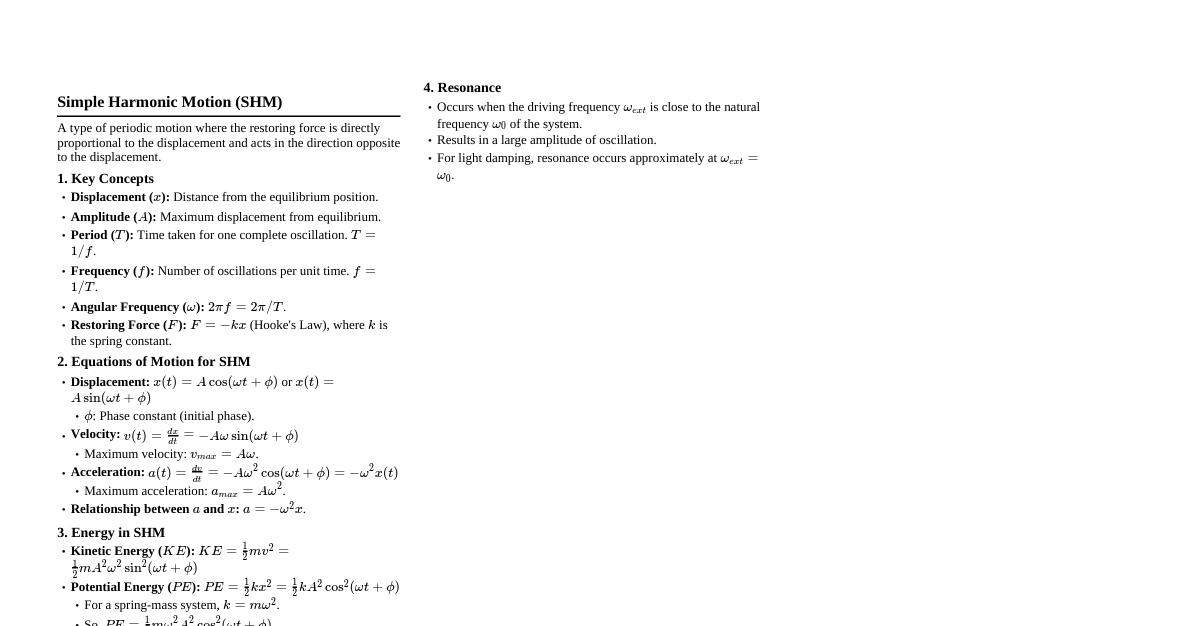
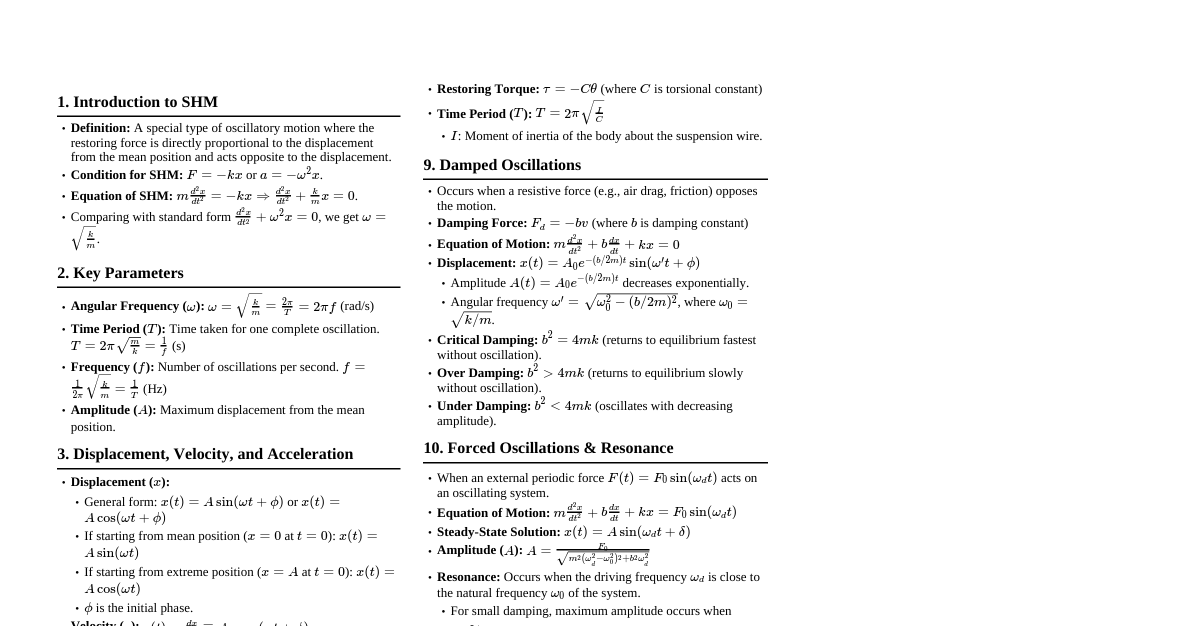
1. Periodic Motion Motion that repeats itself after a fixed interval of time. Examples: Planetary motion, rotation of Earth, pendulum swing. Period ($T$): Time taken for one complete cycle. Unit: seconds (s). Frequency ($f$ or $\nu$): Number of cycles per unit time. $f = 1/T$. Unit: Hertz (Hz). Angular Frequency ($\omega$): $\omega = 2\pi f = 2\pi/T$. Unit: rad/s. 2. Oscillatory Motion To and fro motion about a mean position. All oscillatory motions are periodic, but not all periodic motions are oscillatory. Example: Simple pendulum, spring-mass system. 3. Simple Harmonic Motion (SHM) 3.1 Definition and Conditions A special type of oscillatory motion where the restoring force ($F$) is directly proportional to the displacement ($x$) from the mean position and acts opposite to the displacement. $F = -kx$, where $k$ is the spring constant/force constant. Acceleration $a = F/m = -(k/m)x$. Differential equation of SHM: $\frac{d^2x}{dt^2} + \omega^2 x = 0$, where $\omega^2 = k/m$. 3.2 Displacement, Velocity, and Acceleration General solution for displacement: $x(t) = A \sin(\omega t + \phi)$ or $x(t) = A \cos(\omega t + \phi')$ Displacement ($x$): $x(t) = A \sin(\omega t + \phi)$ $A$: Amplitude (maximum displacement). $\omega$: Angular frequency. $\phi$: Initial phase or phase constant. $(\omega t + \phi)$: Phase. Velocity ($v$): $v(t) = \frac{dx}{dt} = A\omega \cos(\omega t + \phi)$ $v_{max} = A\omega$ (at mean position, $x=0$). $v = \pm \omega \sqrt{A^2 - x^2}$. Acceleration ($a$): $a(t) = \frac{dv}{dt} = -A\omega^2 \sin(\omega t + \phi) = -\omega^2 x$ $a_{max} = A\omega^2$ (at extreme positions, $x=\pm A$). At mean position, $a=0$. 3.3 Energy in SHM Kinetic Energy (KE): $KE = \frac{1}{2}mv^2 = \frac{1}{2}m\omega^2 (A^2 - x^2) = \frac{1}{2}kA^2 \cos^2(\omega t + \phi)$ Potential Energy (PE): $PE = \frac{1}{2}kx^2 = \frac{1}{2}kA^2 \sin^2(\omega t + \phi)$ Total Mechanical Energy (E): $E = KE + PE = \frac{1}{2}kA^2 = \frac{1}{2}m\omega^2 A^2$ (constant) Energy is conserved in SHM. KE is max at mean, PE is max at extremes. 3.4 Time Period of SHM $T = 2\pi \sqrt{\frac{m}{k}}$ (for mass-spring system) $T = 2\pi \sqrt{\frac{\text{inertia factor}}{\text{spring factor}}}$ 4. Simple Pendulum Mass $m$ suspended by a light inextensible string of length $L$. For small angular displacements ($\theta Restoring torque $\tau = -mgL \sin\theta \approx -mgL\theta$. Equation of motion: $I \frac{d^2\theta}{dt^2} = -mgL\theta \implies mL^2 \frac{d^2\theta}{dt^2} = -mgL\theta \implies \frac{d^2\theta}{dt^2} + \frac{g}{L}\theta = 0$. Angular frequency $\omega = \sqrt{g/L}$. Time Period $T = 2\pi \sqrt{L/g}$. Factors affecting $T$: Length ($L$): $T \propto \sqrt{L}$. Acceleration due to gravity ($g$): $T \propto 1/\sqrt{g}$. Does NOT depend on mass of bob or amplitude (for small angles). 5. Physical Pendulum Any rigid body capable of oscillating in a vertical plane about a horizontal axis passing through it. Distance between suspension point and center of mass (CM) is $d$. Moment of inertia about the axis of rotation is $I$. Time Period $T = 2\pi \sqrt{\frac{I}{mgd}}$. If $I = I_{CM} + md^2$ (by parallel axis theorem). 6. Torsional Pendulum A body suspended by a wire, oscillating due to restoring torque produced by twisting the wire. Restoring torque $\tau = -C\theta$, where $C$ is torsional constant. Equation of motion: $I \frac{d^2\theta}{dt^2} = -C\theta \implies \frac{d^2\theta}{dt^2} + \frac{C}{I}\theta = 0$. Time Period $T = 2\pi \sqrt{\frac{I}{C}}$. 7. Spring-Mass Systems 7.1 Single Spring Horizontal: $T = 2\pi \sqrt{m/k}$. Vertical: $T = 2\pi \sqrt{m/k}$. (Equilibrium position shifts, but $k$ and $m$ are same for oscillation). At equilibrium, $kx_0 = mg$. If displaced by $x$, net force $F = mg - k(x_0+x) = mg - kx_0 - kx = -kx$. 7.2 Springs in Series $k_{eq} = \frac{k_1 k_2}{k_1 + k_2}$ for two springs. $\frac{1}{k_{eq}} = \sum \frac{1}{k_i}$. $T = 2\pi \sqrt{m/k_{eq}}$. 7.3 Springs in Parallel $k_{eq} = k_1 + k_2$ for two springs. $k_{eq} = \sum k_i$. $T = 2\pi \sqrt{m/k_{eq}}$. 7.4 Combination of Springs Identify if springs are effectively in series or parallel based on how they stretch/compress together. If same force acts on each spring, they are in series. If same displacement occurs across each spring, they are in parallel. 8. Superposition of SHMs (Same Direction) If $x_1 = A_1 \sin(\omega t + \phi_1)$ and $x_2 = A_2 \sin(\omega t + \phi_2)$. Resultant displacement $x = x_1 + x_2 = A \sin(\omega t + \phi)$. Resultant amplitude $A = \sqrt{A_1^2 + A_2^2 + 2A_1 A_2 \cos(\phi_2 - \phi_1)}$. Resultant phase $\tan\phi = \frac{A_1 \sin\phi_1 + A_2 \sin\phi_2}{A_1 \cos\phi_1 + A_2 \cos\phi_2}$. Special cases: If $\phi_2 - \phi_1 = 0$ (in phase): $A = A_1 + A_2$. If $\phi_2 - \phi_1 = \pi$ (out of phase): $A = |A_1 - A_2|$. 9. Damped Oscillations Oscillations where energy is dissipated due to resistive forces (e.g., air resistance, friction). Damping force $F_d = -bv$, where $b$ is damping constant. Equation of motion: $m\frac{d^2x}{dt^2} + b\frac{dx}{dt} + kx = 0$. Displacement: $x(t) = A_0 e^{-bt/2m} \cos(\omega' t + \phi)$. Amplitude decreases exponentially with time: $A(t) = A_0 e^{-bt/2m}$. Angular frequency of damped oscillation: $\omega' = \sqrt{\omega_0^2 - (b/2m)^2}$, where $\omega_0 = \sqrt{k/m}$ (natural frequency). If $b^2 If $b^2 = 4mk$ (critically damped): System returns to equilibrium fastest without oscillation. If $b^2 > 4mk$ (overdamped): System returns to equilibrium slowly without oscillation. Quality factor ($Q$): $Q = \frac{\omega_0}{\Delta\omega} = \frac{\omega_0 m}{b}$. High $Q$ means less damping. 10. Forced Oscillations and Resonance When an oscillating system is subjected to an external periodic force $F(t) = F_0 \sin(\omega_d t)$, where $\omega_d$ is driving frequency. Equation of motion: $m\frac{d^2x}{dt^2} + b\frac{dx}{dt} + kx = F_0 \sin(\omega_d t)$. After transients die out, the system oscillates with the driving frequency $\omega_d$. Amplitude of forced oscillation: $A = \frac{F_0}{\sqrt{m^2(\omega_d^2 - \omega_0^2)^2 + b^2\omega_d^2}}$. Resonance: Occurs when the driving frequency $\omega_d$ is close to the natural frequency $\omega_0$ of the system. At resonance ($\omega_d \approx \omega_0$), the amplitude of oscillation becomes maximum. For light damping ($b$ is small), resonance frequency $\omega_r \approx \omega_0 = \sqrt{k/m}$. The sharpness of resonance depends on damping. Lower damping leads to a sharper resonance peak. 11. Important Concepts & Formulas Relationship between SHM and Uniform Circular Motion (UCM): Projection of UCM on a diameter is SHM. If a body oscillates in a tunnel through Earth, it performs SHM with $T = 2\pi \sqrt{R/g}$, where $R$ is Earth's radius. Effective length of pendulum in accelerated frame: $L_{eff} = L$. $g_{eff}$ replaces $g$. Lift accelerating up ($a$): $g_{eff} = g+a$. $T = 2\pi \sqrt{L/(g+a)}$. Lift accelerating down ($a$): $g_{eff} = g-a$. $T = 2\pi \sqrt{L/(g-a)}$. Pendulum in a cart accelerating horizontally ($a$): $g_{eff} = \sqrt{g^2+a^2}$. $T = 2\pi \sqrt{L/\sqrt{g^2+a^2}}$. Oscillation of a liquid column in a U-tube: $T = 2\pi \sqrt{L/(2g)}$, where $L$ is total length of liquid column. Oscillation of a floating cylinder: $T = 2\pi \sqrt{h/(g)}$, where $h$ is submerged height.