Modals Cheatsheet
Cheatsheet Content
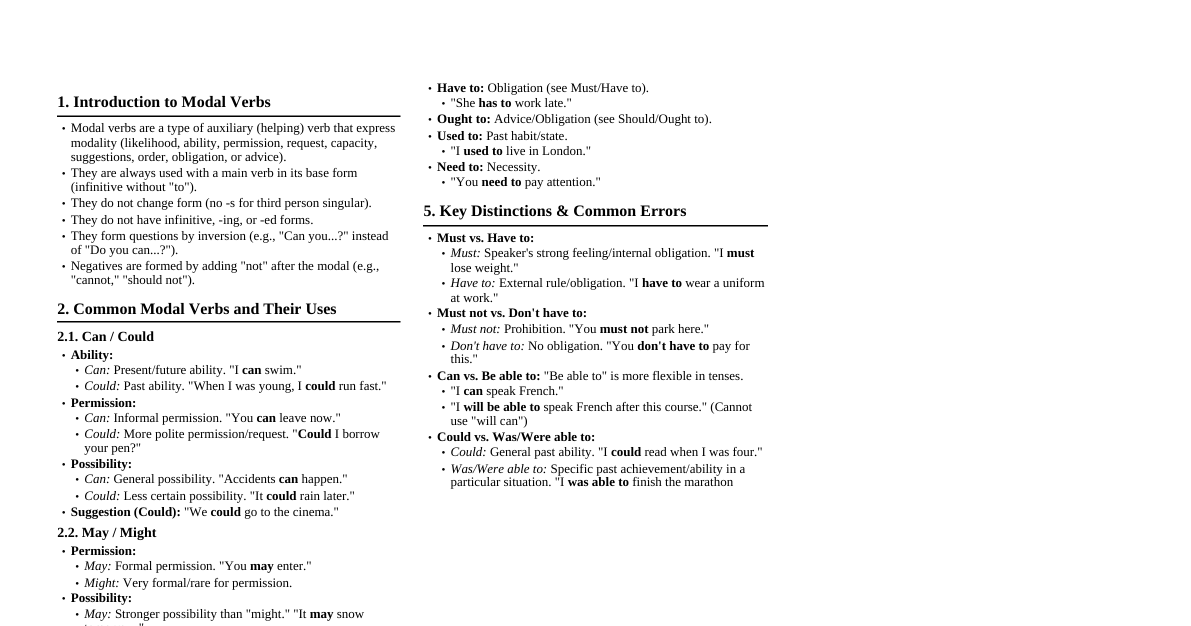
1. Introduction to Modals Modals are auxiliary verbs that express modality (likelihood, ability, permission, request, capacity, suggestions, order, obligation, advice, etc.). They always precede the main verb, which is in its base form (infinitive without 'to'). Do not change form for different subjects (e.g., "he can," not "he cans"). Do not take 's' in the third person singular. Negatives are formed by adding 'not' after the modal (e.g., "cannot," "should not"). Questions are formed by inverting the modal and the subject (e.g., "Can he...?"). 2. Core Modals and Their Uses 2.1. Can / Could Ability: Present/Future: "I can swim." "She can speak French." Past: "He could run fast when he was young." Permission: Informal: " Can I borrow your pen?" More polite (past ability): " Could I use your phone?" Possibility: General (can): "It can get very cold here in winter." Slight possibility (could): "It could rain later." Requests: " Can you help me?" " Could you please pass the salt?" Offers: "I can help you with that." 2.2. May / Might Possibility / Probability: May (stronger possibility): "It may rain tomorrow." Might (weaker possibility): "She might be at home." Past possibility: "He may have missed the bus." "They might have gone to the party." Permission (formal): "You may begin your exams now." " May I come in?" (More formal than 'can/could') Wishes/Hopes: " May you have a long and happy life!" 2.3. Will / Would Future Actions / Predictions: "I will call you later." "It will be cold tomorrow." Volition / Willingness: "I will help you." Habitual Past Action (would): "Every summer, we would go to the beach." Requests (polite): " Would you mind closing the door?" " Will you open the window?" Offers / Invitations (would): " Would you like some tea?" Conditional Sentences (would): "If I were rich, I would travel the world." 2.4. Shall / Should Offers / Suggestions (shall - formal/dated, mainly 'I/we'): " Shall I open the window?" " Shall we go?" Obligation / Advice (should): "You should study for your exams." (Strong advice) "He should have arrived by now." (Expectation) Past obligation not met: "You should have told me." Expectation / Probability (should): "The train should arrive any minute." 2.5. Must / Have to Obligation / Necessity: Must (internal obligation, speaker's authority): "I must finish this report today." Have to (external obligation, rules/laws): "You have to wear a seatbelt." Past: "I had to work late yesterday." Future: "I will have to leave early tomorrow." Strong Deduction / Logical Conclusion (must): "She hasn't eaten all day; she must be hungry." Prohibition (must not / mustn't): "You must not smoke here." Lack of Obligation (don't have to): "You don't have to come if you don't want to." (Not 'must not') 3. Semi-Modals / Quasi-Modals Expressions that function like modals but are formed with 'to'. They conjugate like regular verbs (e.g., 'he has to'). 3.1. Ought to Duty / Strong Advice: "You ought to apologize." (Similar to 'should', often slightly stronger or more formal). Probability / Expectation: "He ought to be here soon." Past: "You ought to have told me." 3.2. Used to Past Habit / State: "I used to live in London." (No longer true). Negative: "I didn't use to like olives." Question: " Did you use to play piano?" 3.3. Need to / Needn't Necessity: "I need to study." (Similar to 'have to'). Lack of Necessity (needn't - modal form): "You needn't worry." (Only in negative/interrogative). Lack of Necessity (don't need to - main verb form): "You don't need to worry." (More common). Past lack of necessity: "You needn't have bought me a gift." (You bought it, but it wasn't necessary). 3.4. Dare (to) Challenge / Courage: Modal form (mostly negative/interrogative): "How dare you speak to me like that?" "I daren't tell her." Main verb form: "He dares to challenge the boss." "She doesn't dare to go alone." 4. Modals in Perfect Forms Modal + have + past participle. Express actions or states in the past, or past possibility/deduction. Modal Perfect Meaning Example could have + PP Past ability not used; past possibility. "I could have gone to the party, but I didn't." "It could have been worse." may have + PP Past possibility (stronger). "She may have forgotten about the meeting." might have + PP Past possibility (weaker). "He might have missed the train." must have + PP Strong deduction about the past. "You must have been tired after that long flight." should have + PP Past obligation not met; regret. "You should have studied harder." "I should have called her." ought to have + PP Same as 'should have + PP', slightly more formal. "They ought to have arrived by now." would have + PP Hypothetical past (third conditional). "If I had known, I would have helped you." needn't have + PP An action was done, but it was unnecessary. "You needn't have bought me flowers." (But you did). 5. Common Confusions and Nuances Must vs. Have to: 'Must' often implies internal obligation or speaker's authority; 'have to' implies external rules or circumstances. "I must lose weight." (Personal decision) "I have to wear a uniform at work." (Company rule) Mustn't vs. Don't have to: 'Mustn't' is prohibition; 'don't have to' is lack of obligation. "You mustn't park here." (It's forbidden) "You don't have to pay now." (It's not necessary) Can vs. Be able to: 'Can' is more common for general ability. 'Be able to' is used when 'can' cannot be used (e.g., future, perfect tenses, or after other modals). "I can speak French." "I will be able to speak French after this course." (Not 'will can') "I haven't been able to concentrate today." (Not 'haven't could') Could vs. Was/Were able to: 'Could' for general past ability: "He could swim when he was five." 'Was/Were able to' for specific achievement in the past: "Despite the difficulty, she was able to finish the marathon." Should vs. Ought to: Interchangeable in most contexts for advice/obligation, 'ought to' is slightly more formal and less common. May vs. Might: 'May' suggests a slightly higher probability than 'might'. 6. Modals in Passive Voice Modal + be + past participle. Active Passive "You must submit the report." "The report must be submitted ." "They should clean the room." "The room should be cleaned ." "Someone may find the keys." "The keys may be found ." "We can solve this problem." "This problem can be solved ."