Modal Auxiliary Verbs
Cheatsheet Content
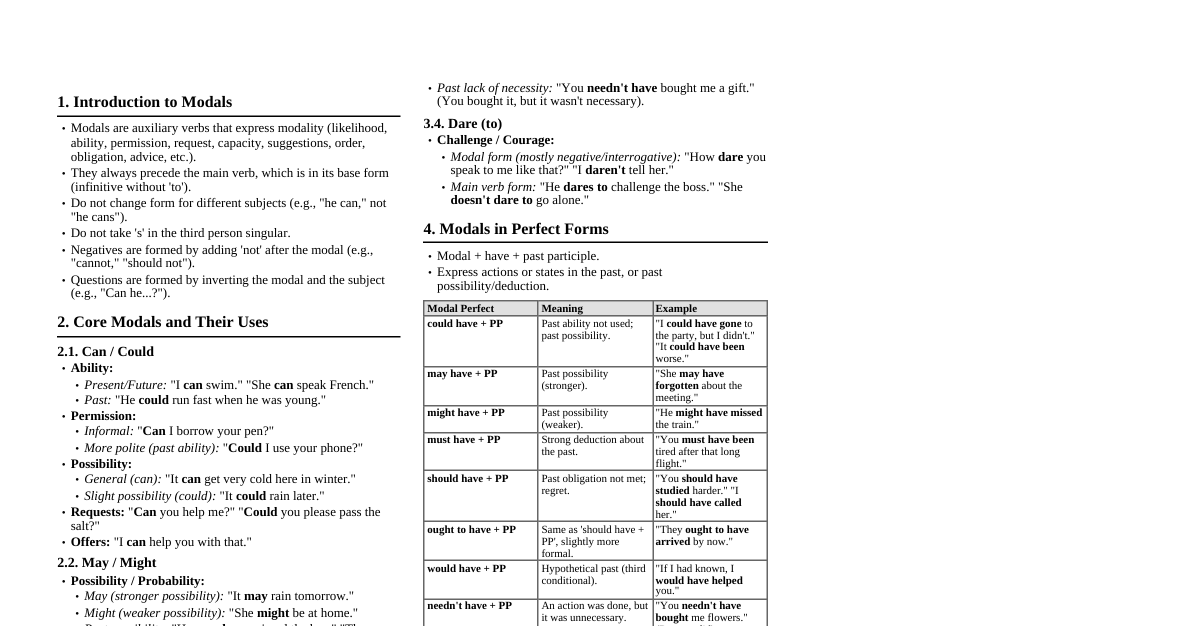
1. Introduction to Modal Verbs Modal verbs are a type of auxiliary (helping) verb that express modality (likelihood, ability, permission, request, capacity, suggestions, order, obligation, or advice). They are always used with a main verb in its base form (infinitive without "to"). They do not change form (no -s for third person singular). They do not have infinitive, -ing, or -ed forms. They form questions by inversion (e.g., "Can you...?" instead of "Do you can...?"). Negatives are formed by adding "not" after the modal (e.g., "cannot," "should not"). 2. Common Modal Verbs and Their Uses 2.1. Can / Could Ability: Can: Present/future ability. "I can swim." Could: Past ability. "When I was young, I could run fast." Permission: Can: Informal permission. "You can leave now." Could: More polite permission/request. " Could I borrow your pen?" Possibility: Can: General possibility. "Accidents can happen." Could: Less certain possibility. "It could rain later." Suggestion (Could): "We could go to the cinema." 2.2. May / Might Permission: May: Formal permission. "You may enter." Might: Very formal/rare for permission. Possibility: May: Stronger possibility than "might." "It may snow tomorrow." Might: Weaker possibility. "She might be at home." Wish (May): " May you have a happy life!" 2.3. Must / Have to Obligation/Necessity: Must: Something the speaker believes is necessary (internal obligation). "I must finish this report." Have to: External obligation/rule. "You have to wear a seatbelt." Strong Probability/Deduction (Must): "He's late; he must be stuck in traffic." Prohibition (Must not/Mustn't): "You must not smoke here." No Obligation (Don't have to): "You don't have to come if you're busy." (NOT "must not") 2.4. Should / Ought to Advice/Recommendation: Should: "You should study harder." Ought to: Similar to "should," slightly more formal. "You ought to apologize." Expectation: "He should be here by now." Duty/Correctness: "You should respect your elders." 2.5. Will / Would Future (Will): "I will go to the party." Request/Offer (Will/Would): Will: " Will you help me?" Would: More polite. " Would you mind closing the door?" Habitual action in the past (Would): "Every summer, we would go to the beach." Conditional (Would): "If I had money, I would buy a car." Refusal (Will not/Won't): "The car won't start." 2.6. Shall / Should Offer/Suggestion (Shall - often with I/we): " Shall I open the window?" Future (Shall - formal/legal, with I/we): "We shall overcome." Should: See Should/Ought to section. 3. Modals in Perfect Tenses (Past Actions) Modal + have + past participle Could have: Past ability not used, or past possibility. "I could have gone to the party, but I was tired." (Ability not used) "She could have won the race." (Past possibility) May have / Might have: Past possibility/speculation. "He may have forgotten about the meeting." "They might have left already." Must have: Past deduction/certainty. "You must have been tired after that long flight." Should have / Ought to have: Past advice not followed; regret. "You should have studied more for the exam." "I ought to have called her." Would have: Hypothetical past action (often in conditionals). "If I had known, I would have helped you." 4. Semi-Modal Verbs (Quasi-Modals) These expressions function like modals but behave grammatically like main verbs (e.g., they change form, need "do" for questions/negatives). Be able to: Ability (can be used in all tenses). "I am able to swim." "I will be able to help you tomorrow." Have to: Obligation (see Must/Have to). "She has to work late." Ought to: Advice/Obligation (see Should/Ought to). Used to: Past habit/state. "I used to live in London." Need to: Necessity. "You need to pay attention." 5. Key Distinctions & Common Errors Must vs. Have to: Must: Speaker's strong feeling/internal obligation. "I must lose weight." Have to: External rule/obligation. "I have to wear a uniform at work." Must not vs. Don't have to: Must not: Prohibition. "You must not park here." Don't have to: No obligation. "You don't have to pay for this." Can vs. Be able to: "Be able to" is more flexible in tenses. "I can speak French." "I will be able to speak French after this course." (Cannot use "will can") Could vs. Was/Were able to: Could: General past ability. "I could read when I was four." Was/Were able to: Specific past achievement/ability in a particular situation. "I was able to finish the marathon despite my injury." Always use the base form of the main verb after a modal: "He can play the piano." (NOT "can plays" or "can to play").