Biology Panic Revision
Cheatsheet Content
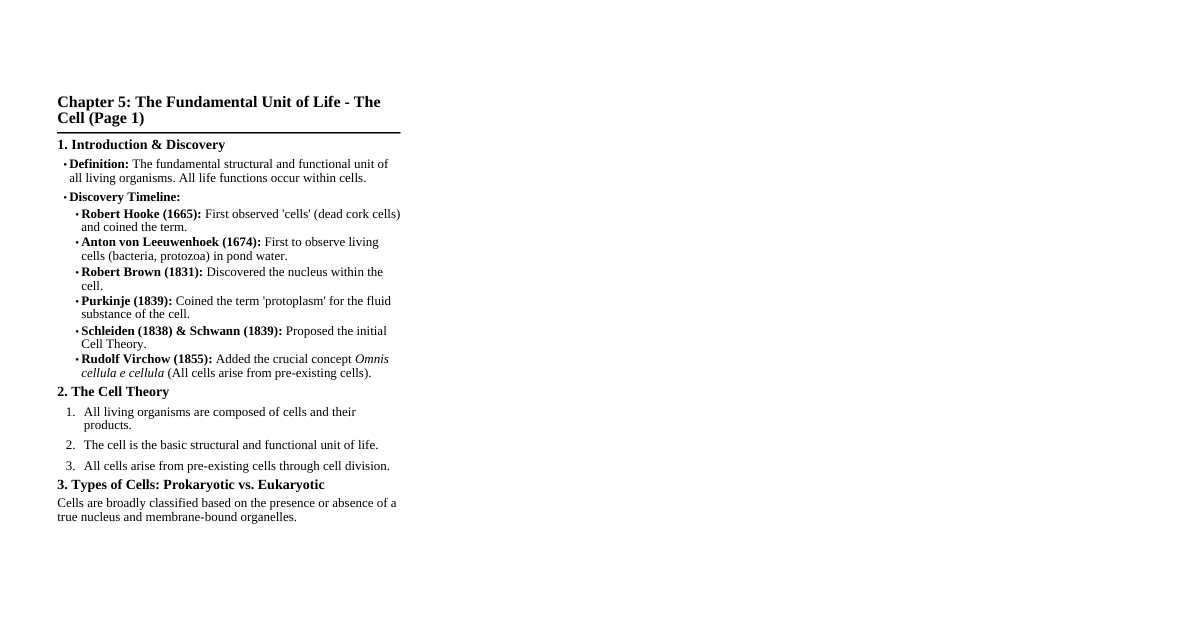
### Chapter 5: The Fundamental Unit of Life - Definitions Snapshot - **Cell:** Structural and functional unit of all living organisms. - **Plasma membrane:** Selectively permeable membrane regulating cell entry/exit. - **Cell wall:** Outer rigid covering of plant cells, fungi, bacteria. - **Nucleoid:** Undefined nuclear region in prokaryotes, containing genetic material. - **Protoplasm:** Living substance of the cell, including cytoplasm and nucleus. - **Cytoplasm:** Fluid content inside plasma membrane, without nucleus. - **Endocytosis:** Cell engulfing food/substances from external environment. - **Exocytosis:** Cell expelling substances from inside to outside. - **Diffusion:** Movement of substance from high concentration to low concentration. - **Osmosis:** Movement of water from high water concentration (low solute) to low water concentration (high solute) through a semipermeable membrane. - **Hypertonic solution:** Solution with higher solute concentration than cell cytoplasm; cell loses water, shrinks. - **Hypotonic solution:** Solution with lower solute concentration than cell cytoplasm; cell gains water, swells. - **Isotonic solution:** Solution with same solute concentration as cell cytoplasm; no net water movement. - **Plasmolysis:** Shrinkage of protoplast in plant cell when water is lost through osmosis. - **Endoplasmic Reticulum (ER):** Network of membrane-bound tubes and sheets. - **Ribosomes:** Sites of protein synthesis. - **Golgi apparatus:** System of membrane-bound vesicles (cisternae), involved in storage, modification, packaging. - **Lysosomes:** Waste disposal system, contain digestive enzymes. - **Mitochondria:** Powerhouse of the cell, release energy in ATP. - **Plastids:** Large organelles in plant cells, includes chloroplasts, chromoplasts, leucoplasts. - **Chloroplasts:** Plastids containing chlorophyll, site of photosynthesis. - **Vacuoles:** Storage sacs for solid or liquid contents. ### Chapter 5: Diagrams Zone #### Plant Cell #### Animal Cell #### Prokaryotic Cell (Bacterial Cell) #### Osmosis Setup ### Chapter 5: Structure / Label Lists #### Plant Cell - Cell wall - Plasma membrane - Nucleus - Cytoplasm - Chloroplast - Mitochondrion - Vacuole - Golgi apparatus - Endoplasmic Reticulum - Ribosomes #### Animal Cell - Plasma membrane - Nucleus - Cytoplasm - Mitochondrion - Golgi apparatus - Endoplasmic Reticulum - Ribosomes - Lysosome - Centriole #### Prokaryotic Cell - Cell wall - Plasma membrane - Nucleoid (genetic material) - Ribosomes - Cytoplasm #### Osmosis Setup - Concentrated sugar solution - Water - Potato cup - Beaker - Level of sugar solution ### Chapter 5: Process Flows - Cell → Tissue → Organ → Organ system → Organism - Photosynthesis → Chloroplast - Protein synthesis → Ribosomes - Lipid/Steroid synthesis → SER - Detoxifying poisons/drugs → SER (liver cells) - Packaging/Dispatching materials → Golgi apparatus - Intracellular digestion → Lysosomes - ATP production → Mitochondria - Water movement → Osmosis - Gas movement → Diffusion ### Chapter 5: Important Fact Zone - **Nucleus:** Controls all cell activities, contains chromosomes (DNA + protein). - **Chromosomes:** Contain genetic information (DNA), visible during cell division. - **Rough ER (RER):** Has ribosomes, synthesizes proteins. - **Smooth ER (SER):** Lacks ribosomes, synthesizes lipids, detoxifies drugs/poisons. - **Mitochondria:** Have their own DNA and ribosomes. - **Plastids:** Have their own DNA and ribosomes. - **Leucoplasts:** White/colourless plastids, store starch, oil, protein granules. - **Vacuoles:** Large in plant cells (central), small/absent in animal cells. - **Unicellular organisms:** Perform all functions within a single cell. - **Multicellular organisms:** Have division of labor among specialized cells. ### Chapter 5: NCERT Traps - **Cell wall** is only in plants, fungi, bacteria; **plasma membrane** is in all cells. - **Prokaryotes** lack a true nucleus and membrane-bound organelles. - **Eukaryotes** have a true nucleus and membrane-bound organelles. - **Mitochondria** are absent in prokaryotes. - **Ribosomes** are present in both prokaryotes and eukaryotes. ### Chapter 6: Tissues - Definitions Snapshot - **Tissue:** Group of cells similar in structure, function, and origin. - **Meristematic tissue:** Plant tissue with continuously dividing cells, found in growth regions. - **Permanent tissue:** Plant tissue formed from meristematic tissue, cells lose ability to divide. - **Simple permanent tissue:** Made of one type of cell. - **Complex permanent tissue:** Made of more than one type of cell. - **Parenchyma:** Simple permanent tissue, loosely packed, large intercellular spaces, stores food. - **Collenchyma:** Simple permanent tissue, thickened at corners, provides flexibility. - **Sclerenchyma:** Simple permanent tissue, cells dead, walls thickened with lignin, provides strength/rigidity. - **Xylem:** Complex permanent tissue, conducts water and minerals upwards. - **Phloem:** Complex permanent tissue, conducts food from leaves to other parts. - **Epidermis:** Outermost protective layer of cells in plants. - **Stomata:** Small pores on epidermis, for gas exchange and transpiration. - **Guard cells:** Two kidney-shaped cells enclosing each stomata. - **Animal tissues:** Epithelial, connective, muscular, nervous. - **Epithelial tissue:** Covering or protective tissue. - **Connective tissue:** Connects various organs, provides support. - **Muscular tissue:** Responsible for movement. - **Nervous tissue:** Carries messages, coordinates body functions. - **Striated muscles (Skeletal/Voluntary):** Cylindrical, unbranched, multinucleate, show striations, attached to bones. - **Smooth muscles (Involuntary):** Spindle-shaped, uninucleate, no striations, control involuntary movements. - **Cardiac muscles (Involuntary):** Cylindrical, branched, uninucleate, show faint striations, found in heart. - **Neuron:** Functional unit of nervous tissue, conducts impulses. ### Chapter 6: Diagrams Zone #### Meristematic Tissue (Longitudinal section) #### Permanent Tissue Types #### Xylem and Phloem #### Muscle Tissues #### Neuron ### Chapter 6: Structure / Label Lists #### Meristematic Tissue - Apical meristem - Intercalary meristem - Lateral meristem #### Permanent Tissue Types - Parenchyma (Cell wall, Intercellular space, Nucleus, Cytoplasm) - Collenchyma (Cell wall, Cytoplasm, Vacuole, Nucleus) - Sclerenchyma (Thick cell wall, Lumen) #### Xylem and Phloem - Xylem (Tracheid, Vessel, Xylem parenchyma, Xylem fibre) - Phloem (Sieve plate, Sieve tube, Phloem parenchyma, Companion cell) #### Muscle Tissues - Striated muscle (Nucleus, Striations) - Smooth muscle (Nucleus, Spindle shape) - Cardiac muscle (Nucleus, Striations, Branching) #### Neuron - Cell body (Cyton) - Nucleus - Dendrite - Axon - Nerve ending ### Chapter 6: Classification Tables #### Plant Tissues | Tissue Type | Characteristics | Location | Function | |--------------------|-------------------------------------------------|----------------------------------------------|--------------------------------------------| | **Meristematic** | Actively dividing cells, dense cytoplasm, thin cell walls, prominent nuclei, no vacuoles. | Apical (root/stem tips), Lateral (stem girth), Intercalary (base of leaves/internodes). | Growth, formation of new cells. | | **Permanent** | Cells lose ability to divide, specialized. | Formed from meristematic tissue. | Protection, support, transport, storage. | | *Parenchyma* | Living, loosely packed, large intercellular spaces. | Cortex, pith of stems/roots, leaves. | Food storage, photosynthesis (chlorenchyma). | | *Collenchyma* | Living, thickened at corners, little intercellular space. | Leaf stalks, below epidermis of stems. | Mechanical support, flexibility. | | *Sclerenchyma* | Dead, thick lignified walls, no internal space (lumen). | Stem, around vascular bundles, veins of leaves, hard seed coats, nuts. | Strength, rigidity, support. | | *Epidermis* | Outermost layer, often waxy cuticle. | Entire plant surface. | Protection against water loss, infection. | | *Xylem* | Tracheids, vessels, xylem parenchyma, xylem fibers. | Vascular bundles. | Water and mineral transport (unidirectional). | | *Phloem* | Sieve tubes, companion cells, phloem parenchyma, phloem fibers. | Vascular bundles. | Food transport (bidirectional). | #### Animal Tissues | Tissue Type | Sub-types / Characteristics | Location | Function | |--------------------|-------------------------------------------------|----------------------------------------------|--------------------------------------------| | **Epithelial** | Simple (Squamous, Cuboidal, Columnar), Stratified. | Covering/lining of organs, cavities, glands. | Protection, secretion, absorption, excretion. | | *Squamous* | Flat, thin, delicate lining. | Oesophagus, mouth, lining of blood vessels, lung alveoli. | Protection, diffusion. | | *Cuboidal* | Cube-shaped, often with microvilli. | Kidney tubules, duct of salivary glands. | Secretion, absorption, mechanical support. | | *Columnar* | Tall, pillar-like, often ciliated. | Inner lining of intestine, respiratory tract. | Absorption, secretion, movement of mucus. | | **Connective** | Loose, Dense, Skeletal, Fluid. | All over body, between other tissues. | Support, binding, packing, transport. | | *Areolar* | Loose, fills space, supports organs. | Between skin and muscles, around blood vessels/nerves. | Fills space, supports internal organs. | | *Adipose* | Fat cells, stores fat. | Below skin, between internal organs. | Fat storage, insulation, shock absorption. | | *Tendons* | Connects muscle to bone. | Muscle-bone junctions. | Strength, limited flexibility. | | *Ligaments* | Connects bone to bone. | Bone-bone junctions. | Elasticity, strength. | | *Cartilage* | Smooth, elastic, strong. | Nose tip, ear, trachea, larynx, joints. | Smooth surfaces at joints, support. | | *Bone* | Hard, porous, strong, non-flexible. | Skeleton. | Support, protection, muscle attachment. | | *Blood* | Fluid matrix (plasma), RBCs, WBCs, platelets. | Circulatory system. | Transport (gases, food, hormones, waste), defense. | | **Muscular** | Striated, Smooth, Cardiac. | Attached to bones, internal organs, heart. | Movement. | | *Striated (Skeletal)* | Voluntary, cylindrical, unbranched, multinucleate, striations. | Limbs, attached to bones. | Voluntary movement. | | *Smooth (Involuntary)* | Involuntary, spindle-shaped, uninucleate, no striations. | Alimentary canal, blood vessels, iris. | Involuntary movements (e.g., food passage). | | *Cardiac* | Involuntary, cylindrical, branched, uninucleate, faint striations. | Heart. | Rhythmic contraction/relaxation of heart. | | **Nervous** | Neurons (nerve cells). | Brain, spinal cord, nerves. | Transmit stimuli rapidly. | ### Chapter 6: Important Fact Zone - **Meristematic cells:** Small, have thin cell walls, dense cytoplasm, prominent nuclei, lack vacuoles. - **Parenchyma:** Sometimes contains chlorophyll (chlorenchyma) for photosynthesis; or air cavities (aerenchyma) for buoyancy. - **Sclerenchyma fibres:** Long, unbranched cells, tapered ends. - **Sclereids:** Short, rounded cells, very thick lignified walls. - **Xylem:** Tracheids and vessels are tubular structures, allow water to flow vertically. - **Phloem:** Sieve tubes are tubular with perforated walls (sieve plates). - **Companion cells:** Associated with sieve tubes, help in phloem transport. - **Epithelial tissue:** Cells are tightly packed, form continuous sheet, little intercellular material. - **Stratified squamous epithelium:** Forms skin, prevents wear and tear. - **Ciliated columnar epithelium:** In respiratory tract, moves mucus. - **Glandular epithelium:** Cells specialize for secretion. - **Blood:** Plasma, red blood corpuscles (RBCs), white blood corpuscles (WBCs), and platelets. - **Bone matrix:** Made of calcium and phosphorus compounds. - **Ligaments:** Very elastic, contain little matrix. - **Tendons:** Great strength, limited flexibility. ### Chapter 6: NCERT Traps - **Meristematic cells** divide continuously; **permanent cells** do not. - **Xylem** conducts water; **phloem** conducts food. - **Sclerenchyma** provides strength; **collenchyma** provides flexibility. - **Tendons** connect muscle to bone; **ligaments** connect bone to bone. - **Striated muscles** are voluntary; **smooth and cardiac muscles** are involuntary. ### Chapter 12: Improvement in Food Resources - Definitions Snapshot - **Sustainable agriculture:** Practices that maintain ecological balance and food production. - **Mixed farming:** Raising livestock along with crop production. - **Crop rotation:** Growing different crops on the same land in pre-planned succession. - **Intercropping:** Growing two or more crops simultaneously in definite row patterns. - **Mixed cropping:** Growing two or more crops simultaneously on the same piece of land. - **Hybridization:** Cross-breeding between genetically dissimilar plants/animals. - **Manure:** Organic substance derived from decomposition of animal excreta and plant waste. - **Fertilizers:** Commercially produced plant nutrients, supplied to soil. - **Organic farming:** Farming system with minimal or no use of chemicals (fertilizers, pesticides, herbicides). - **Weeds:** Unwanted plants in a cultivated field. - **Pests:** Organisms that damage crops (insects, mites, nematodes). - **Biological control:** Using natural predators or parasites to control pests. - **Storage losses:** Damage to grains during storage by biotic (insects, rodents, fungi) and abiotic (moisture, temperature) factors. - **Animal husbandry:** Scientific management of animal livestock. - **White revolution:** Increase in milk production. - **Blue revolution:** Increase in fish production. - **Apiculture:** Rearing of honeybees for honey and wax. - **Sericulture:** Rearing of silkworms for silk. ### Chapter 12: Diagrams Zone #### Flower Parts (Generalized) #### Cross Breeding Flow (Plant Hybridization) #### Crop Production Cycle ### Chapter 12: Structure / Label Lists #### Flower Parts - Petal - Sepal - Stamen (Anther, Filament) - Pistil/Carpel (Stigma, Style, Ovary) #### Cross Breeding Flow - Parent A (Desired traits) - Parent B (Desired traits) - Cross-pollination / Hybridization - Progeny (Hybrid Seeds) - Selection (for desired traits) - New variety #### Crop Production Cycle - Preparation of soil - Sowing - Manuring / Fertilizing - Irrigation - Weeding - Crop protection - Harvesting - Storage ### Chapter 12: Classification Tables #### Kharif vs Rabi Crops | Feature | Kharif Crops | Rabi Crops | |--------------|---------------------------------------------|---------------------------------------------| | **Season** | Rainy season (June to October) | Winter season (November to April) | | **Examples** | Paddy, soybean, maize, cotton, groundnut. | Wheat, gram, peas, mustard, linseed. | | **Water** | Require plenty of water, depend on monsoon. | Require less water, often irrigated. | #### Manure vs Fertilizer | Feature | Manure | Fertilizer | |----------------|------------------------------------------|----------------------------------------------| | **Origin** | Natural, organic (animal waste, plant residue). | Artificial, inorganic chemicals. | | **Nutrients** | Supplies small amounts of nutrients, rich in organic matter. | Supplies specific nutrients (N, P, K) in large amounts. | | **Humus** | Adds humus to soil, improves soil texture. | Does not add humus. | | **Water** | Improves water holding capacity of soil. | Does not improve water holding capacity. | | **Cost** | Relatively cheap. | Relatively expensive. | | **Pollution** | Environmentally friendly, no pollution. | Can cause water pollution from runoff. | #### Mixed Cropping vs Intercropping vs Crop Rotation | Feature | Mixed Cropping | Intercropping | Crop Rotation | |------------------|---------------------------------------------------|-----------------------------------------------|----------------------------------------------| | **Method** | Growing two or more crops simultaneously on same land. | Growing two or more crops simultaneously in definite row patterns. | Growing different crops on same land in pre-planned succession. | | **Risk** | Reduces risk of crop failure. | Reduces risk, better nutrient utilization. | Improves soil fertility, reduces pest/disease. | | **Example** | Wheat + Gram, Wheat + Mustard. | Soyabean + Maize, Finger millet + Cowpea. | Legume crop followed by non-legume crop. | | **Pattern** | No definite pattern. | Definite row pattern (e.g., 1:1, 1:2). | Sequential planting over seasons/years. | ### Chapter 12: Important Fact Zone - **Crop improvement:** For higher yield, improved quality, biotic/abiotic resistance, wider adaptability, desirable agronomic characteristics. - **Biotic factors:** Diseases, insects, pests, nematodes. - **Abiotic factors:** Drought, salinity, waterlogging, heat, cold, frost. - **Nutrient management:** Macronutrients (N, P, K, Ca, Mg, S), Micronutrients (Fe, Mn, B, Zn, Cu, Mo, Cl). - **Irrigation methods:** Wells (dug, tube), Canals, River lift systems, Tanks, Rainwater harvesting. - **Weed control:** Mechanical removal, herbicides, biological control. - **Insect pest control:** Insecticides, biological control, resistant varieties, timely sowing. - **Storage protection:** Drying, proper hygienic godowns, fumigation. - **Cattle farming:** For milk (dairy animals) and draught labour (draught animals). - **Milch animals:** Milk-producing animals (e.g., cows, buffaloes). - **Poultry farming:** For egg and chicken meat. - **Broilers:** Chickens reared for meat. - **Layers:** Chickens reared for eggs. - **Fish production:** Fin-fisheries (true fish) and Shell-fisheries (prawns, molluscs). - **Mariculture:** Culture of marine fish in coastal waters. - **Aquaculture:** Culture of aquatic organisms (both fresh and marine). - **Composite fish culture:** Growing 5-6 different fish species in a single pond. - **Honeybee products:** Honey, beeswax. - **Bee varieties:** Apis cerana indica (Indian bee), Apis dorsata (rock bee), Apis florea (little bee), Apis mellifera (Italian bee). - **Italian bee (Apis mellifera):** High honey collection capacity, stings less, breeds well. ### Chapter 12: NCERT Traps - **Manure** provides organic matter; **fertilizers** provide specific nutrients. - **Hybridization** is cross-breeding; **GMO** involves genetic engineering. - **Kharif crops** are rainy season crops; **Rabi crops** are winter crops. - **Intercropping** has definite patterns; **mixed cropping** does not. - **White revolution** is for milk; **blue revolution** is for fish.