Cell Biology Fundamentals
Cheatsheet Content
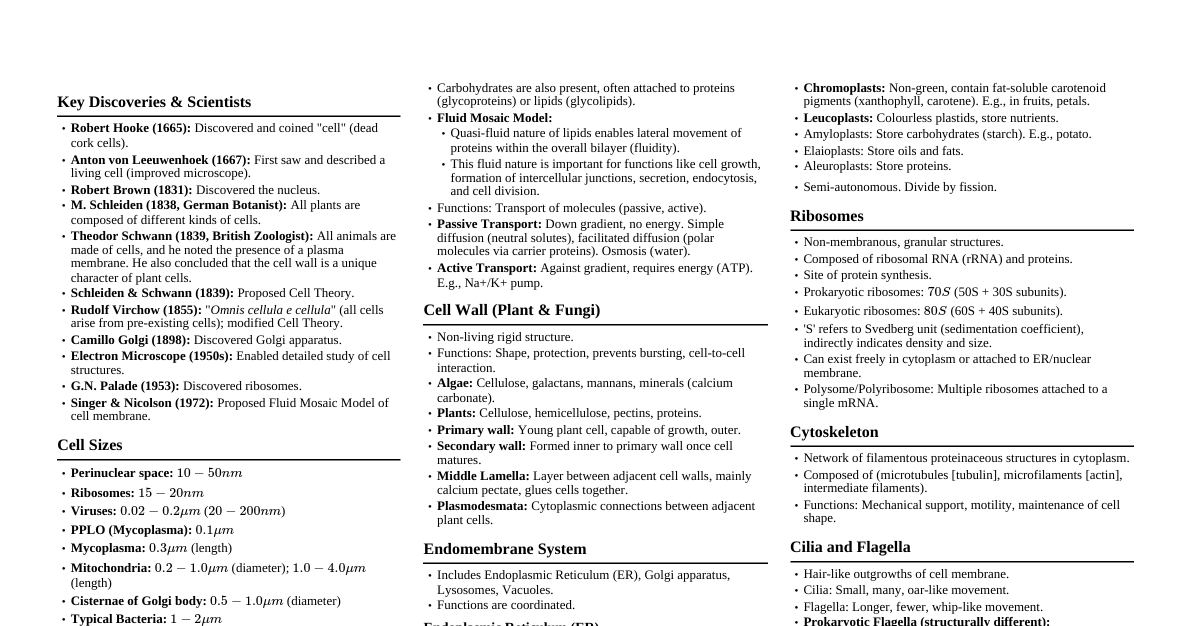
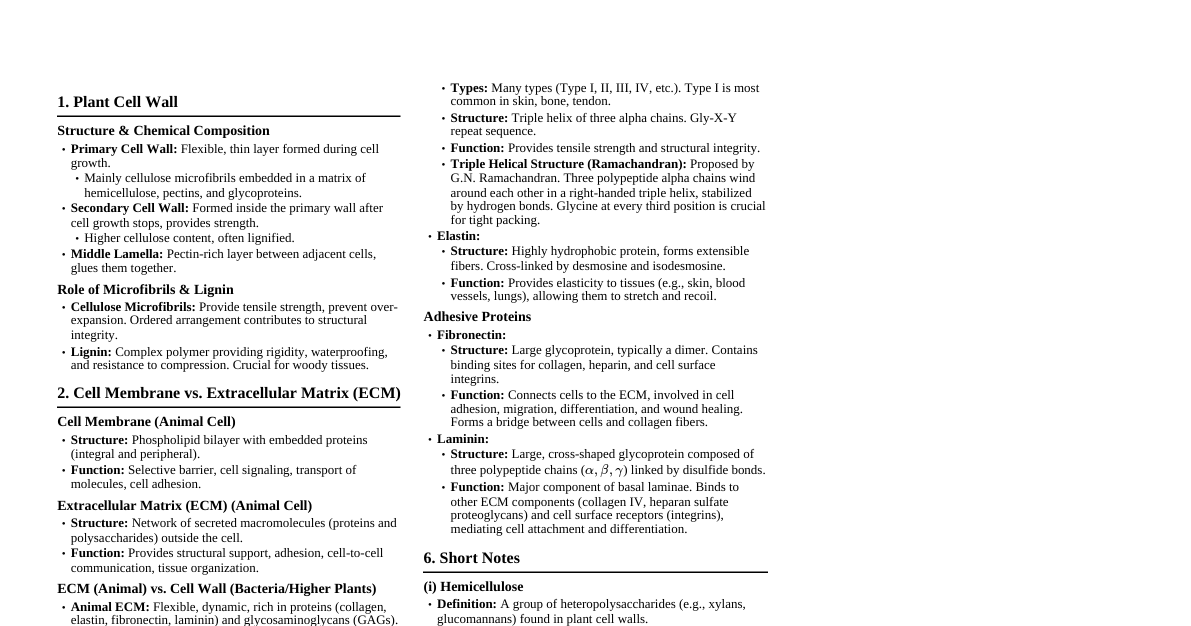
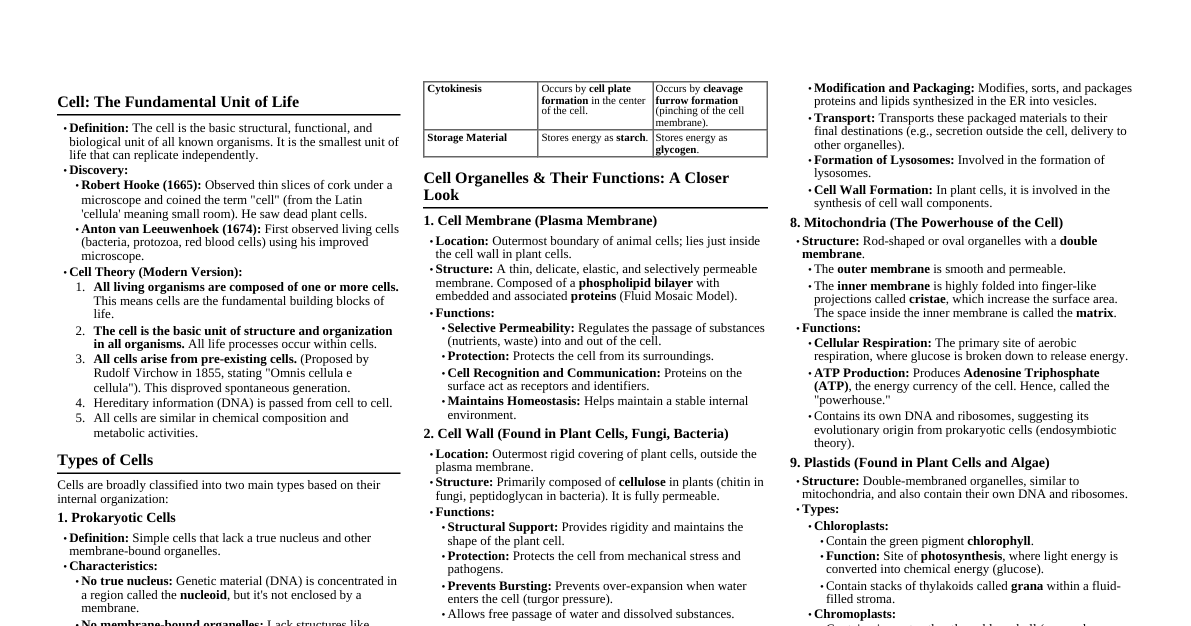
1. Introduction to Cells Definition: The basic structural, functional, and biological unit of all known organisms. Often called the "building blocks of life." Cell Theory: All living organisms are composed of one or more cells. The cell is the basic unit of structure and organization in organisms. All cells arise from pre-existing cells. Size: Most cells are microscopic, ranging from 1 to 100 micrometers ($\mu m$). 2. Types of Cells 2.1. Prokaryotic Cells Characteristics: No membrane-bound nucleus. Genetic material (nucleoid) is free in the cytoplasm. No membrane-bound organelles (e.g., mitochondria, ER, Golgi). Smaller and simpler than eukaryotic cells (typically 0.1-5 $\mu m$). Reproduce by binary fission. Examples: Bacteria, Archaea. Key Structures: Cell Wall: Provides structural support and protection (often peptidoglycan). Cell Membrane: Regulates passage of substances. Cytoplasm: Jelly-like substance filling the cell. Ribosomes: Protein synthesis. Nucleoid: Region containing the circular DNA. Flagella/Pili: For movement and adhesion (optional). 2.2. Eukaryotic Cells Characteristics: Possess a membrane-bound nucleus containing genetic material. Contain various membrane-bound organelles. Larger and more complex than prokaryotic cells (typically 10-100 $\mu m$). Reproduce by mitosis and meiosis. Examples: Animal cells, plant cells, fungi, protists. 3. Eukaryotic Cell Organelles Each organelle performs specific functions vital for cell survival. Organelle Structure/Function Nucleus Contains DNA (chromosomes), controls cell activities, site of DNA replication and transcription. Nuclear envelope with pores. Mitochondria "Powerhouse" of the cell; site of cellular respiration and ATP production. Double membrane (inner folds = cristae). Endoplasmic Reticulum (ER) Network of membranes. Rough ER: Ribosomes attached, protein synthesis and modification. Smooth ER: Lipid synthesis, detoxification, calcium storage. Golgi Apparatus Modifies, sorts, and packages proteins and lipids for secretion or delivery to other organelles. Stack of flattened sacs (cisternae). Ribosomes Synthesize proteins (found in cytoplasm, RER, mitochondria, chloroplasts). Made of rRNA and protein. Lysosomes Contain digestive enzymes to break down waste materials and cellular debris. "Recycling centers." (Animal cells only) Peroxisomes Break down fatty acids and detoxify harmful substances, producing hydrogen peroxide. Cytoskeleton Network of protein filaments (microtubules, microfilaments, intermediate filaments) providing structural support, cell shape, and enabling movement. Cell Membrane Phospholipid bilayer with embedded proteins; regulates passage of substances, cell signaling, adhesion. Centrosomes Organize microtubules, form spindle fibers during cell division. (Animal cells only) 3.1. Plant Cell Specific Organelles Cell Wall: Rigid outer layer (primarily cellulose) providing structural support, protection, and preventing excessive water uptake. Chloroplasts: Site of photosynthesis (convert light energy to chemical energy). Contains chlorophyll. Double membrane with thylakoids. Central Vacuole: Large, fluid-filled sac storing water, nutrients, waste products; maintains turgor pressure. 4. Cell Membrane Structure and Function Fluid Mosaic Model: Describes the cell membrane as a mosaic of components (phospholipids, cholesterol, proteins, carbohydrates) that are able to move fluidly within the membrane. Components: Phospholipid Bilayer: Hydrophilic heads face outwards, hydrophobic tails face inwards, forming a barrier. Proteins: Integral (transmembrane) and peripheral proteins; functions include transport, enzymatic activity, signal transduction, cell-cell recognition, attachment. Cholesterol: Regulates membrane fluidity. Carbohydrates: Glycoproteins and glycolipids on outer surface for cell recognition and adhesion. Transport Mechanisms: Passive Transport: No energy required. Diffusion: Movement of substances from high to low concentration. Osmosis: Diffusion of water across a selectively permeable membrane. Facilitated Diffusion: Diffusion aided by membrane proteins (channels or carriers). Active Transport: Requires energy (ATP) to move substances against their concentration gradient. Pumps: e.g., Sodium-Potassium pump. Bulk Transport: Endocytosis: Cell takes in substances (Phagocytosis - solids, Pinocytosis - liquids). Exocytosis: Cell releases substances. 5. Cell Division Mitosis: Somatic cell division, produces two identical diploid daughter cells. Essential for growth, repair, and asexual reproduction. Phases: Prophase, Metaphase, Anaphase, Telophase (PMAT). Meiosis: Germ cell division, produces four haploid daughter cells (gametes). Essential for sexual reproduction and genetic diversity. Meiosis I (reductional division) and Meiosis II (equational division). 6. Genetic Material DNA (Deoxyribonucleic Acid): Genetic blueprint of the cell, double helix structure. RNA (Ribonucleic Acid): Involved in gene expression (mRNA, tRNA, rRNA). Chromosomes: Condensed DNA structures carrying genetic information.