Chemical Equilibrium
Cheatsheet Content
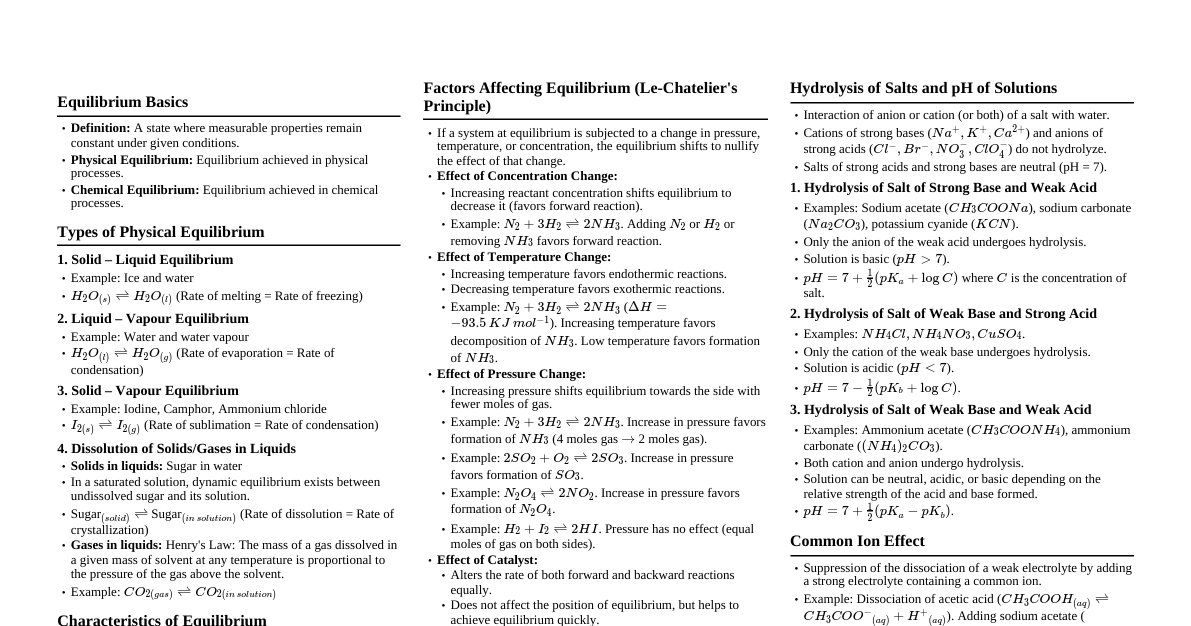
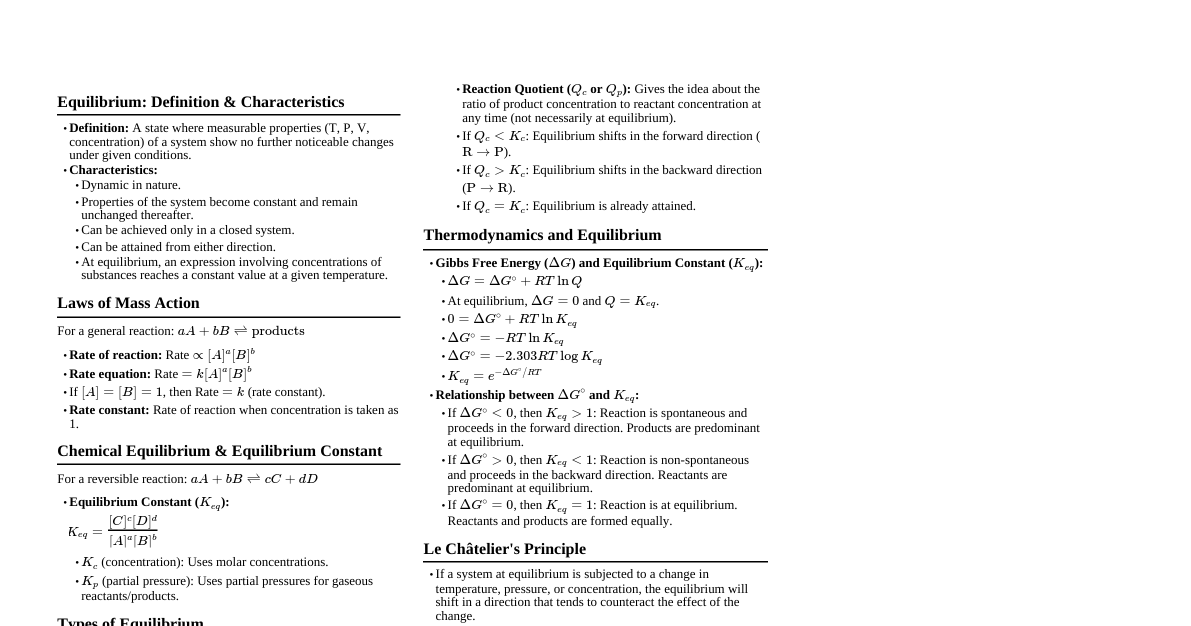
1. Introduction to Chemical Equilibrium Reversible Reactions: Reactions that proceed in both forward and reverse directions simultaneously. Represented by $\rightleftharpoons$. Equilibrium State: The state where the rate of forward reaction equals the rate of reverse reaction. Concentrations of reactants and products become constant, but the reaction is dynamic (still proceeding in both directions). Extent of Reaction: $\xi$ (ksi) represents the progress of a reaction. At equilibrium, $\Delta G = 0$. 2. Law of Mass Action and Equilibrium Constant For a general reversible reaction: $aA + bB \rightleftharpoons cC + dD$ Rate of forward reaction: $R_f = k_f [A]^a [B]^b$ Rate of reverse reaction: $R_r = k_r [C]^c [D]^d$ At equilibrium, $R_f = R_r \Rightarrow k_f [A]_{eq}^a [B]_{eq}^b = k_r [C]_{eq}^c [D]_{eq}^d$ Equilibrium Constant ($K_c$): $K_c = \frac{k_f}{k_r} = \frac{[C]_{eq}^c [D]_{eq}^d}{[A]_{eq}^a [B]_{eq}^b}$ (for concentrations) Equilibrium Constant ($K_p$): For gaseous reactions, based on partial pressures. $K_p = \frac{(P_C)_{eq}^c (P_D)_{eq}^d}{(P_A)_{eq}^a (P_B)_{eq}^b}$ Relationship between $K_p$ and $K_c$: $K_p = K_c (RT)^{\Delta n_g}$ $\Delta n_g = (\text{sum of stoichiometric coefficients of gaseous products}) - (\text{sum of stoichiometric coefficients of gaseous reactants})$ $R = 0.0821 \text{ L atm mol}^{-1} \text{ K}^{-1}$ (if pressure in atm) $R = 8.314 \text{ J mol}^{-1} \text{ K}^{-1}$ (if pressure in Pa) Units of K: Generally unitless if concentrations/pressures are expressed relative to standard states (unit activity/fugacity), but often written with units for convenience. 3. Characteristics of Equilibrium Constant Independent of initial concentrations. Independent of the presence of a catalyst. Dependent only on temperature. If reaction is reversed, $K' = 1/K$. If reaction is multiplied by $n$, $K' = K^n$. If reactions are added, $K_{overall} = K_1 \times K_2$. For heterogeneous equilibria, pure solids and liquids are not included in the equilibrium expression (their activities are considered 1). 4. Reaction Quotient ($Q$) $Q_c = \frac{[C]^c [D]^d}{[A]^a [B]^b}$ (calculated at any point in time, not necessarily equilibrium) Comparing Q and K: If $Q If $Q > K$: Net reaction proceeds in the reverse direction to reach equilibrium. If $Q = K$: System is at equilibrium. 5. Le Chatelier's Principle "If a system at equilibrium is subjected to a change in temperature, pressure, or concentration of a component, the system will shift in a direction that counteracts the change." Effect of Concentration Change: Adding reactant: Equilibrium shifts forward. Adding product: Equilibrium shifts backward. Removing reactant: Equilibrium shifts backward. Removing product: Equilibrium shifts forward. Effect of Pressure Change (for gaseous systems): Increasing pressure: Equilibrium shifts towards the side with fewer moles of gas. Decreasing pressure: Equilibrium shifts towards the side with more moles of gas. If $\Delta n_g = 0$, pressure change has no effect on equilibrium position. Effect of Temperature Change: Endothermic Reaction ($\Delta H > 0$): Increasing temperature shifts equilibrium forward (K increases). Decreasing temperature shifts backward (K decreases). Exothermic Reaction ($\Delta H Increasing temperature shifts equilibrium backward (K decreases). Decreasing temperature shifts forward (K increases). Effect of Catalyst: A catalyst speeds up both forward and reverse reactions equally, thus helping to achieve equilibrium faster but does not change the equilibrium position or the value of K. Effect of Adding Inert Gas: At constant volume: No effect on partial pressures, hence no effect on equilibrium. At constant pressure: Volume increases, partial pressures decrease. Equilibrium shifts towards more moles of gas (similar to decreasing total pressure). 6. Thermodynamics of Equilibrium Standard Gibbs Free Energy Change ($\Delta G^\circ$): $\Delta G = \Delta G^\circ + RT \ln Q$ At equilibrium, $\Delta G = 0$ and $Q = K$: $0 = \Delta G^\circ + RT \ln K \Rightarrow \Delta G^\circ = -RT \ln K$ Van't Hoff Equation (Effect of Temperature on K): $\ln \frac{K_2}{K_1} = -\frac{\Delta H^\circ}{R} \left( \frac{1}{T_2} - \frac{1}{T_1} \right)$ or $\frac{d(\ln K)}{dT} = \frac{\Delta H^\circ}{RT^2}$ If $\Delta H^\circ > 0$ (endothermic), K increases with T. If $\Delta H^\circ 7. Degree of Dissociation ($\alpha$) Fraction of the total number of moles of a reactant that dissociates at equilibrium. For a reaction $A \rightleftharpoons nB$: Initial moles of A: $C$ Moles of A at equilibrium: $C(1-\alpha)$ Moles of B at equilibrium: $nC\alpha$ Total moles at equilibrium: $C(1-\alpha) + nC\alpha = C(1 + (n-1)\alpha)$ Observed molecular weight/Vapour density: $D_{obs} = D_{theo} / (1 + (n-1)\alpha)$ 8. Solved JEE Advanced/Olympiad Problems Problem 1 (JEE Advanced): For the reaction $A(g) + B(g) \rightleftharpoons C(g) + D(g)$, the equilibrium constant $K_c$ is $100$ at $298 \text{ K}$. If $1 \text{ mol}$ of $A$, $1 \text{ mol}$ of $B$, $1 \text{ mol}$ of $C$, and $1 \text{ mol}$ of $D$ are mixed in a $1 \text{ L}$ vessel at $298 \text{ K}$, what will be the concentration of $A$ at equilibrium? Solution: Initial concentrations: $[A]=[B]=[C]=[D]=1 \text{ M}$. Calculate reaction quotient $Q_c = \frac{[C][D]}{[A][B]} = \frac{1 \times 1}{1 \times 1} = 1$. Since $Q_c Let $x$ be the change in concentration of $A$ at equilibrium. Species Initial (M) Change (M) Equilibrium (M) A 1 $-x$ $1-x$ B 1 $-x$ $1-x$ C 1 $+x$ $1+x$ D 1 $+x$ $1+x$ $K_c = \frac{(1+x)(1+x)}{(1-x)(1-x)} = \left(\frac{1+x}{1-x}\right)^2 = 100$ Taking square root: $\frac{1+x}{1-x} = \sqrt{100} = 10$ $1+x = 10(1-x) = 10 - 10x$ $11x = 9 \Rightarrow x = 9/11$ Equilibrium concentration of $A = 1-x = 1 - 9/11 = 2/11 \text{ M}$. Problem 2 (Olympiad/JEE Advanced Concept): For the reaction $N_2(g) + 3H_2(g) \rightleftharpoons 2NH_3(g)$, $K_p = 4.34 \times 10^{-3} \text{ atm}^{-2}$ at $300^\circ \text{C}$. Calculate $K_c$ for the reaction at the same temperature. ($R = 0.082 \text{ L atm mol}^{-1} \text{ K}^{-1}$) Solution: The reaction is $N_2(g) + 3H_2(g) \rightleftharpoons 2NH_3(g)$. $\Delta n_g = (\text{moles of gaseous products}) - (\text{moles of gaseous reactants}) = 2 - (1+3) = 2 - 4 = -2$. Temperature $T = 300^\circ \text{C} = 300 + 273 = 573 \text{ K}$. The relationship is $K_p = K_c (RT)^{\Delta n_g}$. $K_c = K_p (RT)^{-\Delta n_g} = K_p (RT)^{|\Delta n_g|}$ $K_c = K_p (RT)^2$ $K_c = 4.34 \times 10^{-3} \times (0.082 \times 573)^2$ $K_c = 4.34 \times 10^{-3} \times (46.986)^2$ $K_c = 4.34 \times 10^{-3} \times 2207.68$ $K_c \approx 9.58 \text{ L}^2 \text{ mol}^{-2}$. Problem 3 (Olympiad/JEE Advanced Concept): A $1.0 \text{ L}$ vessel contains $0.20 \text{ mol}$ of $N_2$, $0.40 \text{ mol}$ of $H_2$, and $0.60 \text{ mol}$ of $NH_3$ at $400 \text{ K}$. If $K_c$ for $N_2(g) + 3H_2(g) \rightleftharpoons 2NH_3(g)$ is $0.50 \text{ M}^{-2}$ at $400 \text{ K}$, predict the direction of the reaction. Solution: Given concentrations (since volume is $1.0 \text{ L}$, moles = molarity): $[N_2] = 0.20 \text{ M}$ $[H_2] = 0.40 \text{ M}$ $[NH_3] = 0.60 \text{ M}$ Calculate the reaction quotient $Q_c$: $Q_c = \frac{[NH_3]^2}{[N_2][H_2]^3} = \frac{(0.60)^2}{(0.20)(0.40)^3}$ $Q_c = \frac{0.36}{0.20 \times 0.064} = \frac{0.36}{0.0128} = 28.125$ Given $K_c = 0.50$. Since $Q_c (28.125) > K_c (0.50)$, the reaction will proceed in the reverse direction to reach equilibrium.