Chemical Equilibrium Basics (JEE)
Cheatsheet Content
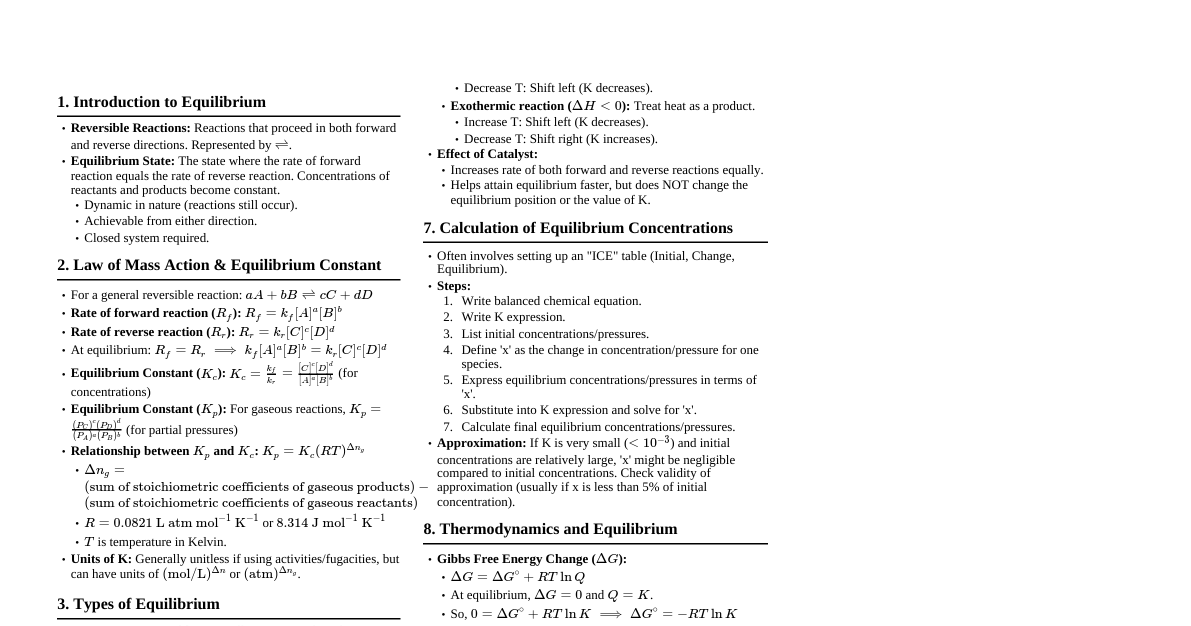
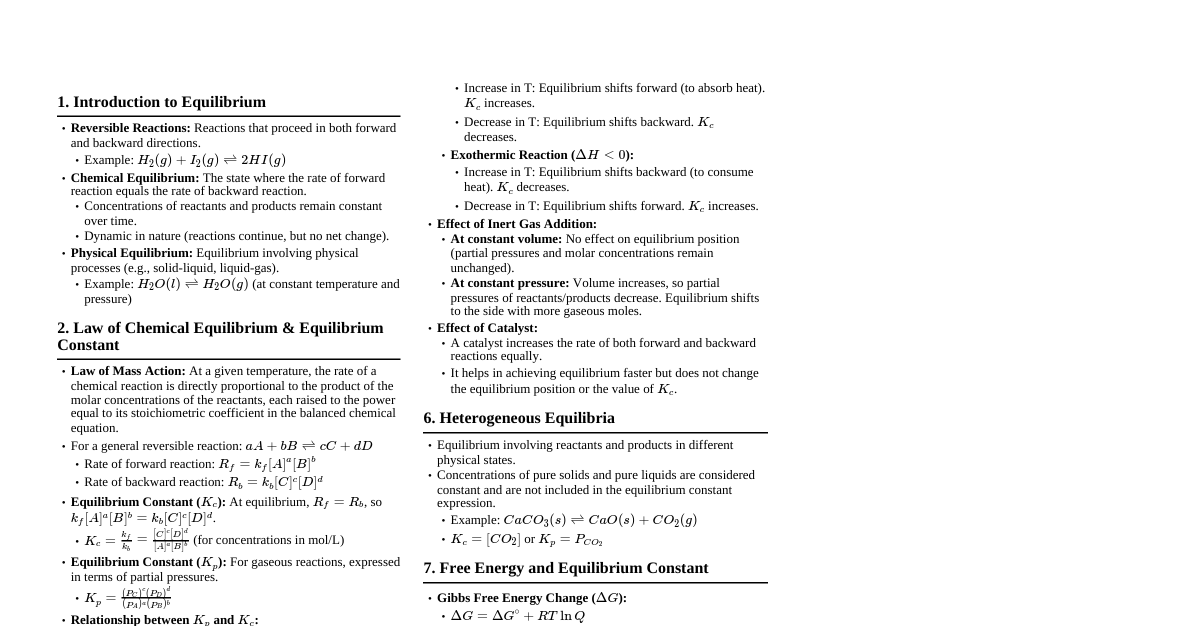
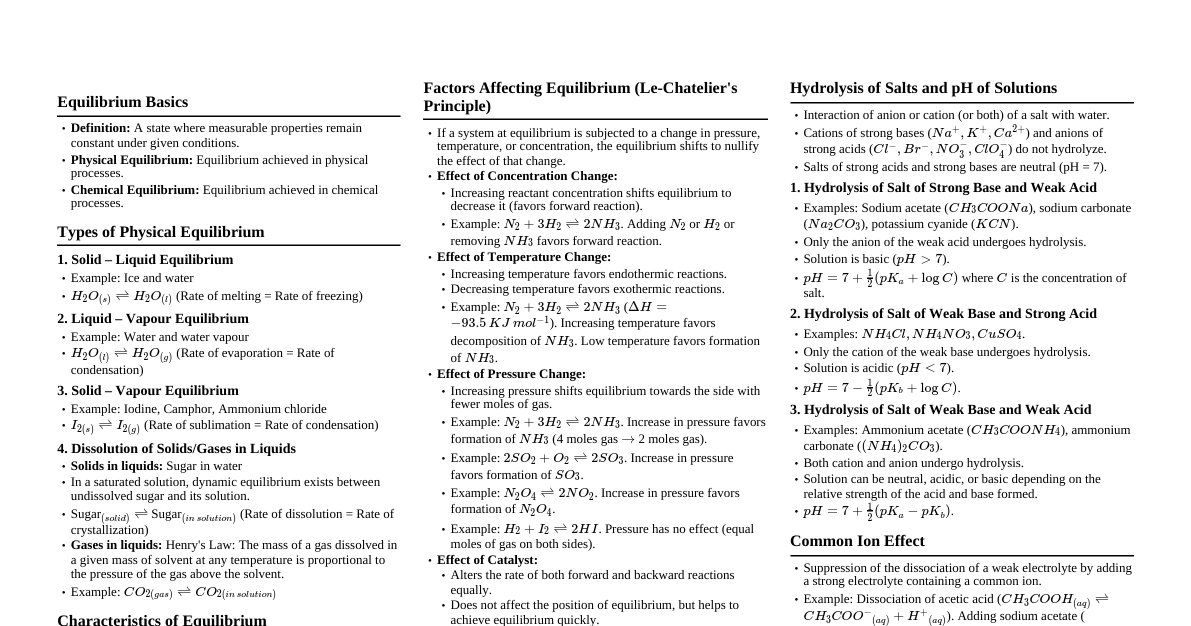
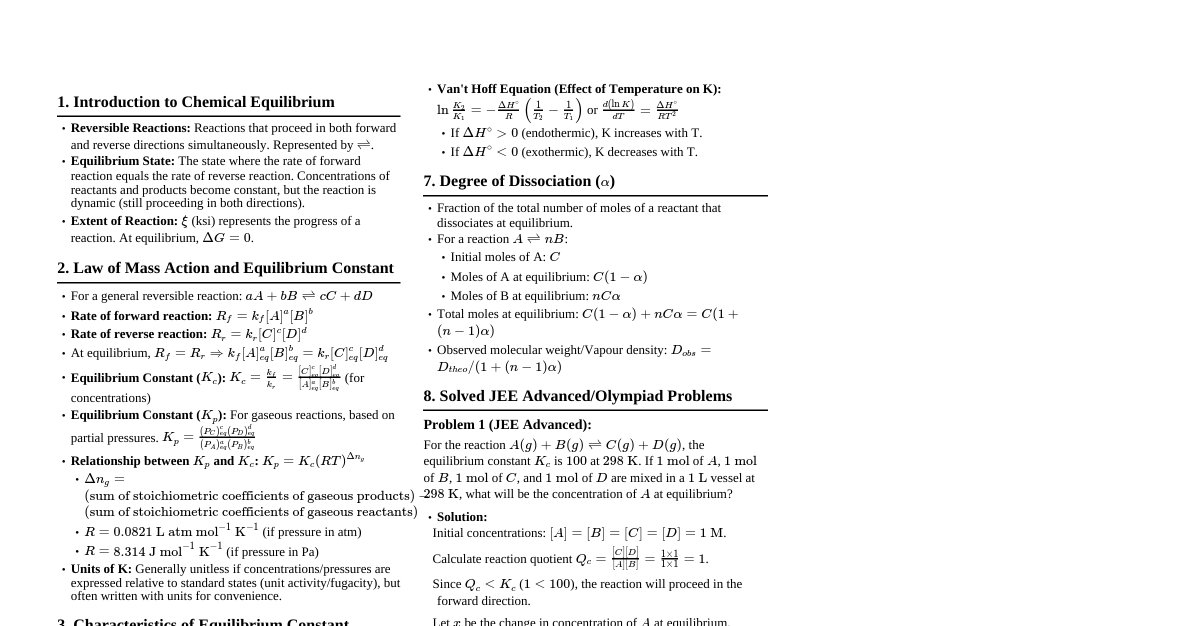
1. Introduction to Equilibrium Reversible Reactions: Reactions that proceed in both forward and backward directions simultaneously. Example: $A + B \rightleftharpoons C + D$ Dynamic Equilibrium: A state where the rate of the forward reaction equals the rate of the backward reaction. Concentrations of reactants and products remain constant, but the reactions are still occurring. It's a dynamic, not static, state. Irreversible Reactions: Reactions that proceed predominantly in one direction until one reactant is consumed. Example: Precipitation reactions, strong acid-base neutralizations. 2. Law of Mass Action (Guldberg and Waage) At a given temperature, the rate of a chemical reaction is directly proportional to the product of the molar concentrations of the reactants, each raised to the power equal to its stoichiometric coefficient in the balanced chemical equation. For a general reversible reaction: $aA + bB \rightleftharpoons cC + dD$ Rate of forward reaction ($R_f$) $\propto [A]^a [B]^b \implies R_f = k_f [A]^a [B]^b$ Rate of backward reaction ($R_b$) $\propto [C]^c [D]^d \implies R_b = k_b [C]^c [D]^d$ At equilibrium: $R_f = R_b \implies k_f [A]^a [B]^b = k_b [C]^c [D]^d$ 3. Equilibrium Constant ($K$) 3.1. Definition The ratio of the rate constants for the forward and backward reactions at equilibrium. $K_{eq} = \frac{k_f}{k_b} = \frac{[C]^c [D]^d}{[A]^a [B]^b}$ (for $aA + bB \rightleftharpoons cC + dD$) The value of $K$ is constant at a given temperature and does not depend on initial concentrations. 3.2. Types of Equilibrium Constants Concentration Equilibrium Constant ($K_c$): Expressed in terms of molar concentrations. $K_c = \frac{[C]^c [D]^d}{[A]^a [B]^b}$ (units depend on $\Delta n$) Pressure Equilibrium Constant ($K_p$): Expressed in terms of partial pressures for gaseous reactions. $K_p = \frac{(P_C)^c (P_D)^d}{(P_A)^a (P_B)^b}$ (units depend on $\Delta n$) 3.3. Relationship between $K_p$ and $K_c$ $K_p = K_c (RT)^{\Delta n_g}$ $R$: Gas constant ($0.0821 \text{ L atm mol}^{-1} \text{ K}^{-1}$ or $8.314 \text{ J mol}^{-1} \text{ K}^{-1}$) $T$: Absolute temperature in Kelvin $\Delta n_g = (\text{sum of stoichiometric coefficients of gaseous products}) - (\text{sum of stoichiometric coefficients of gaseous reactants})$ 3.4. Characteristics of $K$ For the reverse reaction, $K'_{eq} = 1/K_{eq}$. If a reaction is multiplied by a factor $n$, the new $K''_{eq} = (K_{eq})^n$. If reactions are added, their equilibrium constants are multiplied. Pure solids and pure liquids are not included in the equilibrium constant expression ($[solid] = 1$, $[liquid] = 1$). Their concentrations are considered constant. $K_{eq}$ depends only on temperature. 4. Reaction Quotient ($Q$) Definition: A measure of the relative amounts of products and reactants present in a reaction at any given time. It is calculated using the same formula as $K_{eq}$, but for non-equilibrium concentrations. $Q_c = \frac{[C]^c [D]^d}{[A]^a [B]^b}$ (at any time 't') Predicting Reaction Direction: If $Q If $Q > K$: Net reaction proceeds in the backward direction (towards reactants) to reach equilibrium. If $Q = K$: The system is at equilibrium. 5. Le Chatelier's Principle If a change of condition is applied to a system in equilibrium, the system will shift in a direction that relieves the stress. 5.1. Effect of Concentration Change Adding Reactant: Equilibrium shifts forward (towards products). Adding Product: Equilibrium shifts backward (towards reactants). Removing Reactant: Equilibrium shifts backward. Removing Product: Equilibrium shifts forward. 5.2. Effect of Pressure/Volume Change (for gaseous reactions) Increasing Pressure (decreasing Volume): Equilibrium shifts towards the side with fewer moles of gas. Decreasing Pressure (increasing Volume): Equilibrium shifts towards the side with more moles of gas. If $\Delta n_g = 0$, pressure change has no effect on equilibrium position. 5.3. Effect of Temperature Change Increasing Temperature: For Endothermic reactions ($\Delta H > 0$): Equilibrium shifts forward (towards products). $K$ increases. For Exothermic reactions ($\Delta H Decreasing Temperature: For Endothermic reactions: Equilibrium shifts backward. $K$ decreases. For Exothermic reactions: Equilibrium shifts forward. $K$ increases. 5.4. Effect of Adding Inert Gas At constant volume: No effect on equilibrium position as partial pressures/concentrations of reactants/products remain unchanged. At constant pressure: Volume increases, so equilibrium shifts towards the side with more moles of gas (similar to decreasing pressure). 5.5. Effect of Catalyst A catalyst increases the rates of both forward and backward reactions equally. It helps in attaining equilibrium faster but does not change the equilibrium position or the value of $K$. 6. Calculations Involving Equilibrium ICE Table: A common method to solve equilibrium problems. I nitial concentrations/pressures. C hange in concentrations/pressures (based on stoichiometry and a variable $x$). E quilibrium concentrations/pressures (I + C). Substitute equilibrium values into the $K_c$ or $K_p$ expression and solve for $x$. Example: $H_2(g) + I_2(g) \rightleftharpoons 2HI(g)$ Initial: $[H_2]_0$, $[I_2]_0$, $[HI]_0$ Change: $-x$, $-x$, $+2x$ Equilibrium: $[H_2]_0-x$, $[I_2]_0-x$, $[HI]_0+2x$ $K_c = \frac{([HI]_0+2x)^2}{([H_2]_0-x)([I_2]_0-x)}$