Equilibrium Cheatsheet (Class 11 Chemist
Cheatsheet Content
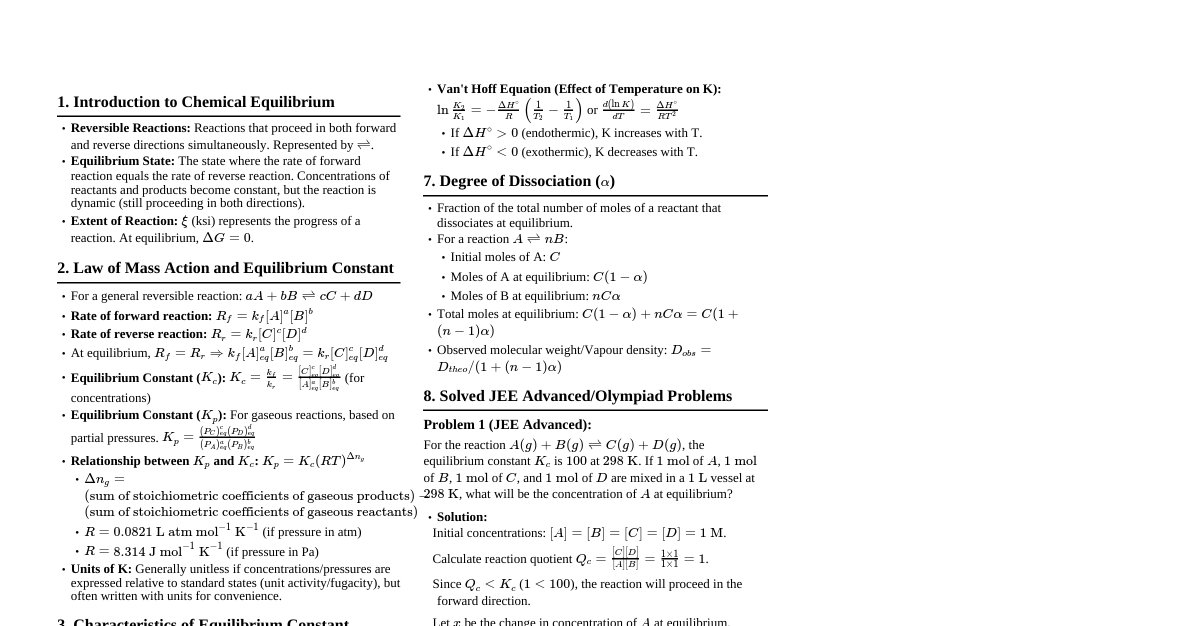
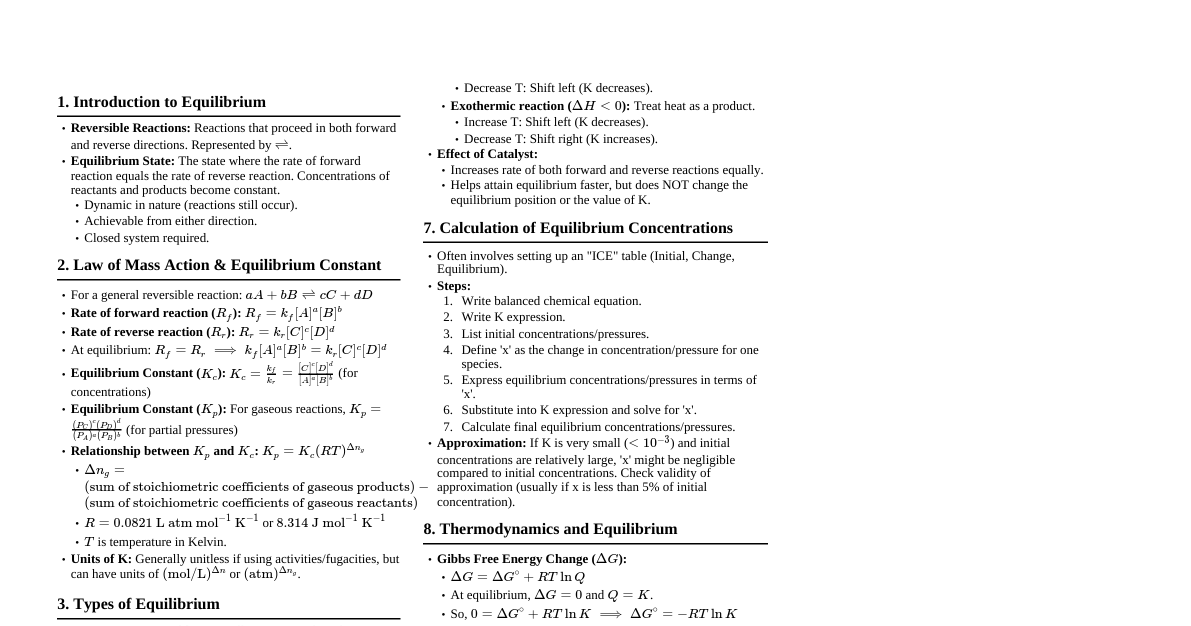
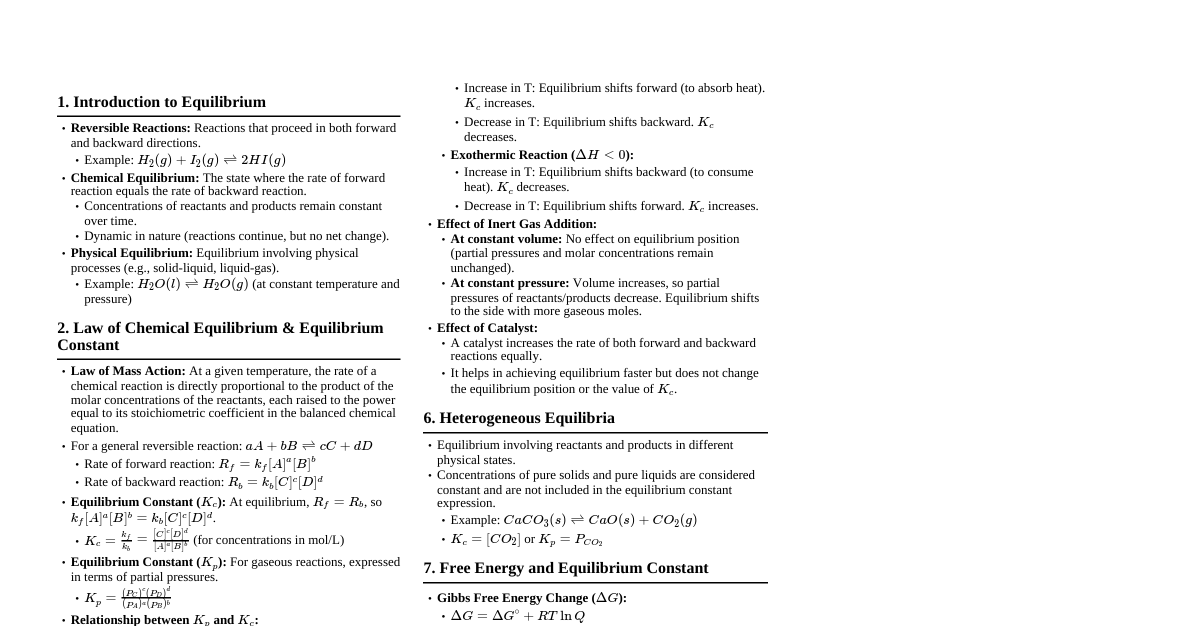
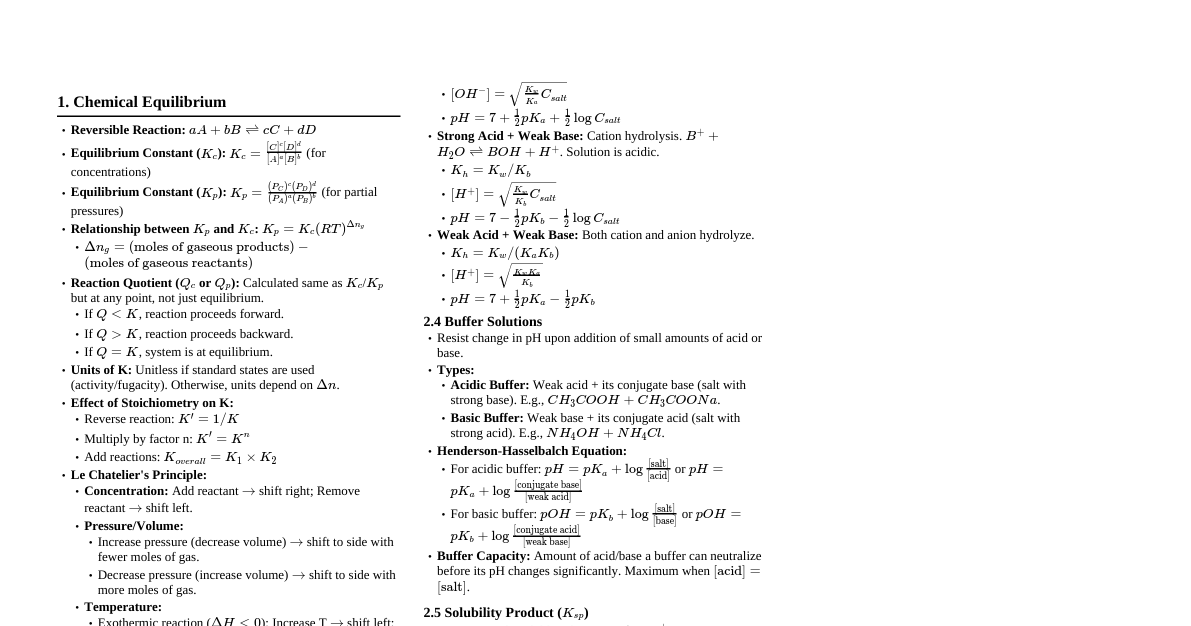
I. Chemical Equilibrium 1. Law of Chemical Equilibrium Definition: At a given temperature, the ratio of the product of molar concentrations (or partial pressures) of products to that of reactants, each raised to the power of their stoichiometric coefficients, is constant. For a reversible reaction $aA + bB \rightleftharpoons cC + dD$: Equilibrium Constant ($K_c$): Expressed in terms of molar concentrations (mol/L). $$K_c = \frac{[C]^c [D]^d}{[A]^a [B]^b}$$ Example: For $N_2(g) + 3H_2(g) \rightleftharpoons 2NH_3(g)$, $K_c = \frac{[NH_3]^2}{[N_2][H_2]^3}$ Equilibrium Constant ($K_p$): Expressed in terms of partial pressures (atm or bar). $$K_p = \frac{(P_C)^c (P_D)^d}{(P_A)^a (P_B)^b}$$ Example: For $N_2(g) + 3H_2(g) \rightleftharpoons 2NH_3(g)$, $K_p = \frac{(P_{NH_3})^2}{(P_{N_2})(P_{H_2})^3}$ Pure solids/liquids: Their concentrations (or partial pressures) are considered constant and are not included in $K_c$ or $K_p$ expressions. Example: For $CaCO_3(s) \rightleftharpoons CaO(s) + CO_2(g)$, $K_p = P_{CO_2}$ and $K_c = [CO_2]$ 2. Relationship between $K_c$ and $K_p$ The general formula relating $K_p$ and $K_c$ is: $$K_p = K_c (RT)^{\Delta n_g}$$ Where: $R$ = Gas constant ($0.0821 \text{ L atm mol}^{-1} \text{ K}^{-1}$ or $8.314 \text{ J mol}^{-1} \text{ K}^{-1}$) $T$ = Temperature in Kelvin $\Delta n_g$ = (Sum of stoichiometric coefficients of gaseous products) - (Sum of stoichiometric coefficients of gaseous reactants) Example: For $N_2(g) + 3H_2(g) \rightleftharpoons 2NH_3(g)$ $\Delta n_g = (2) - (1+3) = 2 - 4 = -2$. So, $K_p = K_c (RT)^{-2}$. 3. Reaction Quotient ($Q$) Definition: The reaction quotient is calculated in the same way as the equilibrium constant, but using non-equilibrium concentrations or partial pressures. It helps to predict the direction a reaction will shift to reach equilibrium. Condition for Equilibrium: $Q = K$ (The system is at equilibrium) If $Q forward direction to form more products. If $Q > K$: The ratio of products to reactants is too large; the reaction will proceed in the reverse direction to form more reactants. 4. Le Chatelier's Principle Principle: "If a system at equilibrium is subjected to a change in concentration, pressure, or temperature, the equilibrium will shift in a direction that tends to counteract the change." Effect of Concentration: Adding a reactant or removing a product shifts equilibrium to the right (forward). Removing a reactant or adding a product shifts equilibrium to the left (backward). Example: For $N_2(g) + 3H_2(g) \rightleftharpoons 2NH_3(g)$ Adding $N_2$ or $H_2$: Equilibrium shifts to the right, producing more $NH_3$. Removing $NH_3$: Equilibrium shifts to the right, producing more $NH_3$. Effect of Pressure (for gaseous reactions): Increase pressure: Equilibrium shifts towards the side with fewer moles of gas to reduce the pressure. Decrease pressure: Equilibrium shifts towards the side with more moles of gas to increase the pressure. No change: If the number of moles of gaseous reactants equals the number of moles of gaseous products ($\Delta n_g = 0$). Example: For $N_2(g) + 3H_2(g) \rightleftharpoons 2NH_3(g)$ (4 moles of gas on left, 2 moles on right) Increasing pressure: Shifts to the right (fewer moles of gas). Effect of Temperature: Exothermic Reaction ($\Delta H Increase temperature: Equilibrium shifts backward (to consume heat). Decrease temperature: Equilibrium shifts forward (to produce heat). Endothermic Reaction ($\Delta H > 0$, heat is a reactant): Increase temperature: Equilibrium shifts forward (to consume heat). Decrease temperature: Equilibrium shifts backward (to produce heat). Effect of Inert Gas: Added at constant volume: The partial pressures of reactants and products do not change, so there is no effect on equilibrium position. Added at constant pressure: The volume increases, causing partial pressures to decrease. Equilibrium shifts towards the side with more moles of gas . Effect of Catalyst: A catalyst speeds up both the forward and reverse reactions equally. It helps to reach equilibrium faster but does not change the equilibrium position or the value of $K$. II. Ionic Equilibrium 1. Definitions of Acids and Bases Arrhenius Concept: Acid: A substance that produces hydrogen ions ($H^+$) or hydronium ions ($H_3O^+$) when dissolved in water. Example: $HCl(aq) \rightarrow H^+(aq) + Cl^-(aq)$ Base: A substance that produces hydroxide ions ($OH^-$) when dissolved in water. Example: $NaOH(aq) \rightarrow Na^+(aq) + OH^-(aq)$ Brønsted-Lowry Concept: Acid: A species that donates a proton ($H^+$). Example: $HCl$, $H_2O$ (can donate $H^+$ to $NH_3$) Base: A species that accepts a proton ($H^+$). Example: $NH_3$, $OH^-$, $H_2O$ (can accept $H^+$ from $HCl$) Conjugate Acid-Base Pair: Two species that differ by a single proton ($H^+$). Example: $HCl$ (acid) and $Cl^-$ (conjugate base); $NH_3$ (base) and $NH_4^+$ (conjugate acid). $HCl + H_2O \rightleftharpoons H_3O^+ + Cl^-$ (Acid1 + Base2 $\rightleftharpoons$ Acid2 + Base1) Lewis Concept: (Broader definition) Acid: An electron pair acceptor. These often have an incomplete octet or vacant orbitals. Example: $BF_3$, $AlCl_3$, $H^+$ Base: An electron pair donor. These typically have lone pairs of electrons. Example: $NH_3$, $H_2O$, $OH^-$ 2. Ionic Product of Water ($K_w$) Definition: The product of the molar concentrations of hydrogen ions (or hydronium ions) and hydroxide ions in water at a specific temperature. Water undergoes auto-ionization: $H_2O (l) + H_2O (l) \rightleftharpoons H_3O^+ (aq) + OH^- (aq)$ or simply $H_2O (l) \rightleftharpoons H^+ (aq) + OH^- (aq)$ The equilibrium constant for this reaction is $K_w = [H^+][OH^-]$. At $298 \text{ K}$ ($25^\circ C$): The value of $K_w = 1.0 \times 10^{-14}$. In pure water at $298 \text{ K}$: $[H^+] = [OH^-] = 1.0 \times 10^{-7} \text{ M}$. 3. pH and pOH Scale Definition: A scale used to specify the acidity or basicity of an aqueous solution. $\text{pH} = -\log_{10}[H^+]$ (where $[H^+]$ is molar concentration of hydrogen ions) $\text{pOH} = -\log_{10}[OH^-]$ (where $[OH^-]$ is molar concentration of hydroxide ions) Relationship between pH and pOH: $\text{pH} + \text{pOH} = 14$ (at $298 \text{ K}$) Acidic solution: $\text{pH} 10^{-7} \text{ M}$ Basic solution: $\text{pH} > 7$; $[H^+] Neutral solution: $\text{pH} = 7$; $[H^+] = 10^{-7} \text{ M}$ Example: If $[H^+] = 1.0 \times 10^{-3} \text{ M}$, then $\text{pH} = -\log(10^{-3}) = 3$. The solution is acidic. 4. Weak Acids/Bases Definition: Electrolytes that dissociate only partially in aqueous solutions. Dissociation Constant of Weak Acid ($K_a$): For a weak acid $HA$: $HA (aq) \rightleftharpoons H^+ (aq) + A^- (aq)$ $$K_a = \frac{[H^+][A^-]}{[HA]}$$ A larger $K_a$ indicates a stronger weak acid. Dissociation Constant of Weak Base ($K_b$): For a weak base $BOH$: $BOH (aq) \rightleftharpoons B^+ (aq) + OH^- (aq)$ $$K_b = \frac{[B^+][OH^-]}{[BOH]}$$ A larger $K_b$ indicates a stronger weak base. Relationship for Conjugate Pairs: For a conjugate acid-base pair ($HA/A^-$ or $BH^+/B$): $$K_a (\text{acid}) \cdot K_b (\text{conjugate base}) = K_w$$ This implies that the stronger the acid, the weaker its conjugate base, and vice-versa. Ostwald's Dilution Law: Relates the degree of dissociation ($\alpha$) of a weak electrolyte to its dissociation constant and concentration. For a weak acid $HA$ with initial concentration $C$: $\alpha = \sqrt{\frac{K_a}{C}}$ (valid when $\alpha$ is small, i.e., $1-\alpha \approx 1$) or $K_a = C\alpha^2$ For a weak base $BOH$ with initial concentration $C$: $\alpha = \sqrt{\frac{K_b}{C}}$ (valid when $\alpha$ is small) or $K_b = C\alpha^2$ Example: For a $0.1 \text{ M}$ weak acid with $K_a = 1.0 \times 10^{-5}$, $\alpha = \sqrt{\frac{1.0 \times 10^{-5}}{0.1}} = \sqrt{1.0 \times 10^{-4}} = 0.01$. 5. Salt Hydrolysis Definition: The reaction of a cation or anion (or both) of a salt with water to produce acidity or basicity. 1. Salt of Strong Acid + Strong Base: (e.g., $NaCl$, $KNO_3$) Ions ($Na^+$, $Cl^-$) do not react with water. Solution is neutral ($\text{pH} = 7$). 2. Salt of Strong Acid + Weak Base: (e.g., $NH_4Cl$, $CuSO_4$) Cation ($NH_4^+$) hydrolyzes: $NH_4^+ + H_2O \rightleftharpoons NH_3 + H_3O^+$ Solution is acidic ($\text{pH} Hydrolysis constant: $K_h = \frac{K_w}{K_b}$ 3. Salt of Weak Acid + Strong Base: (e.g., $CH_3COONa$, $KCN$) Anion ($CH_3COO^-$) hydrolyzes: $CH_3COO^- + H_2O \rightleftharpoons CH_3COOH + OH^-$ Solution is basic ($\text{pH} > 7$). Hydrolysis constant: $K_h = \frac{K_w}{K_a}$ 4. Salt of Weak Acid + Weak Base: (e.g., $CH_3COONH_4$) Both cation ($NH_4^+$) and anion ($CH_3COO^-$) hydrolyze. The $\text{pH}$ of the solution depends on the relative strengths of $K_a$ and $K_b$. If $K_a > K_b \rightarrow$ Acidic If $K_b > K_a \rightarrow$ Basic If $K_a \approx K_b \rightarrow$ Neutral (or nearly neutral) Hydrolysis constant: $K_h = \frac{K_w}{K_a K_b}$ 6. Buffer Solutions Definition: A solution that resists significant changes in its pH upon the addition of small amounts of strong acid or strong base. Typically consists of: A weak acid and its conjugate base (e.g., $CH_3COOH/CH_3COONa$) $\rightarrow$ Acidic Buffer A weak base and its conjugate acid (e.g., $NH_3/NH_4Cl$) $\rightarrow$ Basic Buffer Henderson-Hasselbalch Equation: Used to calculate the pH of a buffer solution. For Acidic Buffer: (weak acid $HA$ and its salt $A^-$) $$\text{pH} = \text{p}K_a + \log_{10} \frac{[\text{Salt}]}{[\text{Acid}]}$$ or $$\text{pH} = \text{p}K_a + \log_{10} \frac{[\text{Conjugate Base}]}{[\text{Weak Acid}]}$$ Example: For a buffer of $CH_3COOH$ and $CH_3COONa$. For Basic Buffer: (weak base $B$ and its salt $BH^+$) $$\text{pOH} = \text{p}K_b + \log_{10} \frac{[\text{Salt}]}{[\text{Base}]}$$ or $$\text{pOH} = \text{p}K_b + \log_{10} \frac{[\text{Conjugate Acid}]}{[\text{Weak Base}]}$$ Example: For a buffer of $NH_3$ and $NH_4Cl$. 7. Solubility Product ($K_{sp}$) Definition: For a sparingly soluble ionic compound, the solubility product is the product of the molar concentrations of its constituent ions, each raised to the power of its stoichiometric coefficient in the balanced dissolution equilibrium equation. For a generic sparingly soluble salt $A_x B_y (s)$, its dissolution equilibrium is: $A_x B_y (s) \rightleftharpoons xA^{y+} (aq) + yB^{x-} (aq)$ The Solubility Product is: $K_{sp} = [A^{y+}]^x [B^{x-}]^y$ Relationship between Solubility ($s$) and $K_{sp}$: (where $s$ is the molar solubility in mol/L) For $AB$ type salt (e.g., $AgCl$): $K_{sp} = s \cdot s = s^2$ For $A_2B$ or $AB_2$ type salt (e.g., $CaF_2$, $Ag_2S$): $K_{sp} = (s)^1 (2s)^2 = 4s^3$ For $A_x B_y$ type salt: $K_{sp} = (xs)^x (ys)^y = x^x y^y s^{(x+y)}$ Example: For $AgCl(s) \rightleftharpoons Ag^+(aq) + Cl^-(aq)$, if $s$ is solubility, then $[Ag^+]=s$, $[Cl^-]=s$. $K_{sp} = s^2$. Example: For $CaF_2(s) \rightleftharpoons Ca^{2+}(aq) + 2F^-(aq)$, if $s$ is solubility, then $[Ca^{2+}]=s$, $[F^-]=2s$. $K_{sp} = (s)(2s)^2 = 4s^3$. Condition for Precipitation: Ionic Product ($Q_{sp}$): Calculated in the same way as $K_{sp}$ but using current (non-equilibrium) ion concentrations. If $Q_{sp} > K_{sp}$: The solution is supersaturated; precipitation occurs until $Q_{sp} = K_{sp}$. If $Q_{sp} no precipitation , more solid can dissolve. If $Q_{sp} = K_{sp}$: The solution is saturated; system is at equilibrium. Common Ion Effect: The solubility of a sparingly soluble salt is significantly decreased when a solution containing a common ion is added. This is due to Le Chatelier's principle, as the added common ion shifts the dissolution equilibrium of the salt to the left, reducing its solubility. Example: Adding $NaCl$ to a saturated solution of $AgCl$ will decrease the solubility of $AgCl$ because of the common $Cl^-$ ion.