Chemical Equilibrium
Cheatsheet Content
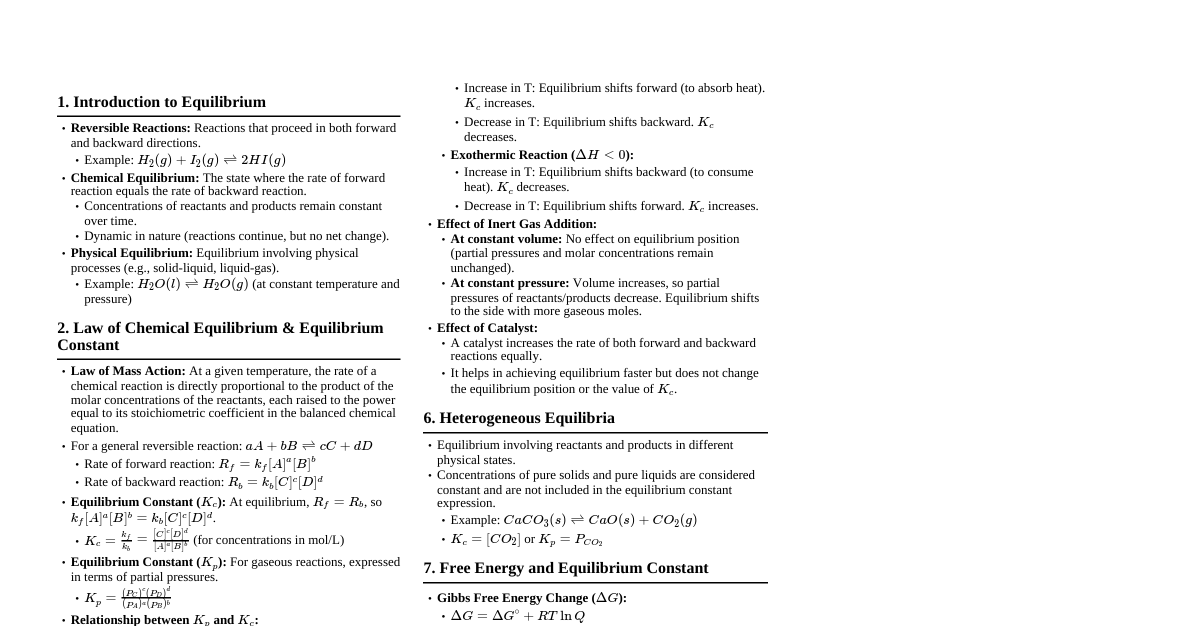
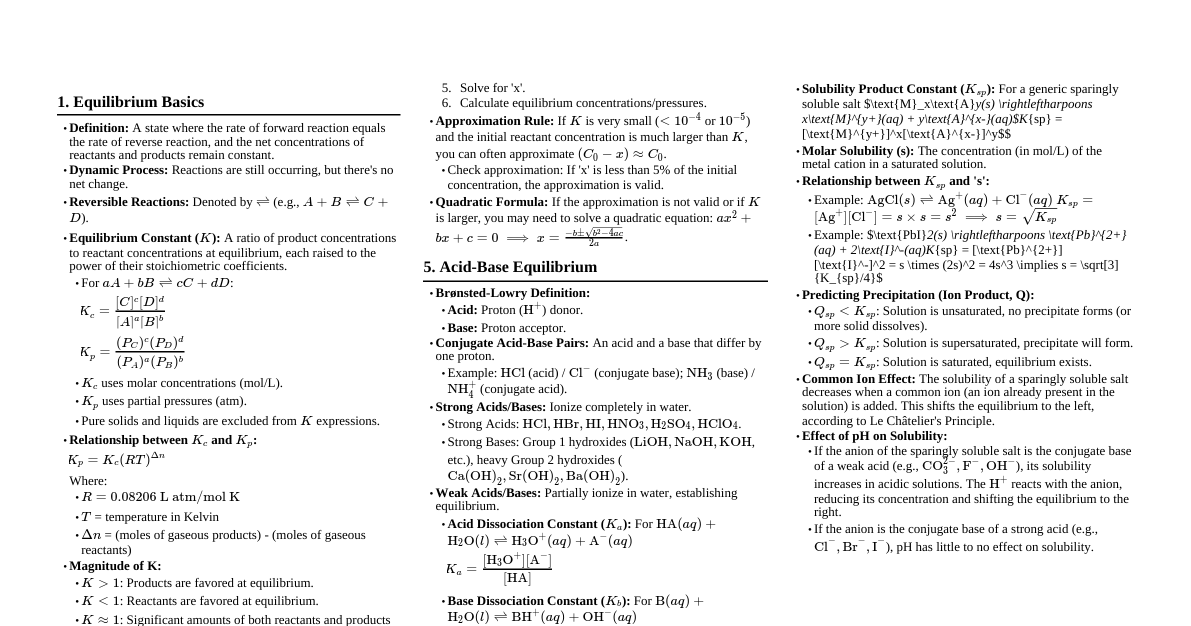
### Equilibrium: Definition & Characteristics - **Definition:** A state where measurable properties (T, P, V, concentration) of a system show no further noticeable changes under given conditions. - **Characteristics:** - Dynamic in nature. - Properties of the system become constant and remain unchanged thereafter. - Can be achieved only in a closed system. - Can be attained from either direction. - At equilibrium, an expression involving concentrations of substances reaches a constant value at a given temperature. ### Laws of Mass Action For a general reaction: $aA + bB \rightleftharpoons \text{products}$ - **Rate of reaction:** Rate $\propto [A]^a[B]^b$ - **Rate equation:** Rate $= k[A]^a[B]^b$ - If $[A]=[B]=1$, then Rate $= k$ (rate constant). - **Rate constant:** Rate of reaction when concentration is taken as 1. ### Chemical Equilibrium & Equilibrium Constant For a reversible reaction: $aA + bB \rightleftharpoons cC + dD$ - **Equilibrium Constant ($K_{eq}$):** $$K_{eq} = \frac{[C]^c[D]^d}{[A]^a[B]^b}$$ - $K_c$ (concentration): Uses molar concentrations. - $K_p$ (partial pressure): Uses partial pressures for gaseous reactants/products. ### Types of Equilibrium 1. **Homogeneous Equilibrium:** All reactants and products are in a single phase. - Example: $\text{N}_2(g) + 3\text{H}_2(g) \rightleftharpoons 2\text{NH}_3(g)$ - Example: $\text{CH}_3\text{COOC}_2\text{H}_5(aq) + \text{H}_2\text{O}(l) \rightleftharpoons \text{CH}_3\text{COOH}(aq) + \text{C}_2\text{H}_5\text{OH}(aq)$ 2. **Heterogeneous Equilibrium:** Reactants and products are in more than one phase. - Example: $\text{CaCO}_3(s) \rightleftharpoons \text{CaO}(s) + \text{CO}_2(g)$ - Example: $2\text{NaHCO}_3(s) \rightleftharpoons \text{Na}_2\text{CO}_3(s) + \text{CO}_2(g) + \text{H}_2\text{O}(g)$ - **Note:** Concentration of pure solids and pure liquids are taken as unity (1) in equilibrium constant expressions. ### Relationship between $K_p$ and $K_c$ - **Equation:** $K_p = K_c(RT)^{\Delta n}$ - $\Delta n = (c+d) - (a+b)$ (sum of stoichiometric coefficients of gaseous products minus sum of gaseous reactants). - $R$ is the ideal gas constant, $T$ is temperature in Kelvin. - **Conditions:** - If $\Delta n 0$, then $K_p > K_c$. - If $\Delta n = 0$, then $K_p = K_c$. ### Properties of Equilibrium Constant - **Independent of initial concentrations:** The value of $K_{eq}$ is independent of the initial concentrations of reactants. - **Temperature dependent:** $K_{eq}$ has a definite value for a particular reaction at a particular temperature. - **Reversed reaction:** The equilibrium constant of the backward reaction is the inverse of the equilibrium constant of the forward reaction. - **Multiplied reaction:** If an equilibrium equation is multiplied by a factor, the new equilibrium constant is raised to the power of that factor. - Example: If $K$ is for $\text{N}_2(g) + 3\text{H}_2(g) \rightleftharpoons 2\text{NH}_3(g)$, then $K'$ for $\frac{1}{2}\text{N}_2(g) + \frac{3}{2}\text{H}_2(g) \rightleftharpoons \text{NH}_3(g)$ is $K' = K^{1/2}$. - **Combined reactions:** If two or more equilibrium reactions are added, the new equilibrium constant is the product of the individual equilibrium constants. - **Catalyst effect:** Equilibrium constant does not depend on a catalyst. ### Units of Equilibrium Constant - $K_c$: $(\text{mol/L})^{\Delta n}$ - $K_p$: $(\text{bar})^{\Delta n}$ or $(\text{atm})^{\Delta n}$ - **Note:** In the standard state, $K_p$ and $K_c$ are dimensionless when concentrations are compared to $1M$ and pressures to $1$ bar or $1$ atm. ### Applications of Equilibrium Constant 1. **Extent of reaction:** Predicts the extent of completion of a reaction. - If $K_c/K_p > 10^3$: Reaction has nearly reached completion and attained equilibrium. - If $K_c/K_p K_c$: Equilibrium shifts in the backward direction ($\text{P} \rightarrow \text{R}$). - If $Q_c = K_c$: Equilibrium is already attained. ### Thermodynamics and Equilibrium - **Gibbs Free Energy ($\Delta G$) and Equilibrium Constant ($K_{eq}$):** - $\Delta G = \Delta G^\circ + RT \ln Q$ - At equilibrium, $\Delta G = 0$ and $Q = K_{eq}$. - $0 = \Delta G^\circ + RT \ln K_{eq}$ - $\Delta G^\circ = -RT \ln K_{eq}$ - $\Delta G^\circ = -2.303 RT \log K_{eq}$ - $K_{eq} = e^{-\Delta G^\circ/RT}$ - **Relationship between $\Delta G^\circ$ and $K_{eq}$:** - If $\Delta G^\circ 1$: Reaction is spontaneous and proceeds in the forward direction. Products are predominant at equilibrium. - If $\Delta G^\circ > 0$, then $K_{eq} ### Le Châtelier's Principle - If a system at equilibrium is subjected to a change in temperature, pressure, or concentration, the equilibrium will shift in a direction that tends to counteract the effect of the change. 1. **Effect of Concentration:** - If reactant concentration increases, equilibrium shifts forward. - If product concentration increases, equilibrium shifts backward. - If reactant concentration decreases, equilibrium shifts backward. - If product concentration decreases, equilibrium shifts forward. 2. **Effect of Temperature:** - **Endothermic reactions ($\Delta H > 0$):** - Increasing temperature shifts equilibrium forward (absorbs heat). $K_2 > K_1$. - Decreasing temperature shifts equilibrium backward. - **Exothermic reactions ($\Delta H 0$ (more moles of gas products), increasing pressure shifts backward. 4. **Effect of Catalyst:** - A catalyst has no effect on the position of equilibrium. It only speeds up the rate at which equilibrium is reached. ### Ionic Equilibrium - **Arrhenius Concept:** - **Acid:** Substance that produces $\text{H}^+$ ions in water ($\text{H}^+ + \text{H}_2\text{O} \rightarrow \text{H}_3\text{O}^+$). - **Base:** Substance that produces $\text{OH}^-$ ions in water. - **Brønsted-Lowry Concept:** (Acid-Base pairs differ by a single proton) - **Acid:** Proton ($\text{H}^+$) donor. - **Base:** Proton ($\text{H}^+$) acceptor. - **Conjugate Acid-Base Pairs:** - $\text{HCl}$ (acid) $\rightarrow \text{Cl}^-$ (conjugate base) - $\text{NH}_3$ (base) $\rightarrow \text{NH}_4^+$ (conjugate acid) - Example: $\text{HCl} + \text{NH}_3 \rightleftharpoons \text{Cl}^- + \text{NH}_4^+$ (acid-base pair: $\text{HCl}/\text{Cl}^-$, $\text{NH}_3/\text{NH}_4^+$) - Example: $\text{HCl} + \text{H}_2\text{O} \rightleftharpoons \text{Cl}^- + \text{H}_3\text{O}^+$ - Example: $\text{NH}_3 + \text{H}_2\text{O} \rightleftharpoons \text{NH}_4^+ + \text{OH}^-$ - **Lewis Concept:** - **Acid:** Electron pair acceptor (electrophile). - **Base:** Electron pair donor (nucleophile). - **Examples of Lewis Acids:** $\text{BF}_3$, $\text{AlCl}_3$, $\text{SO}_3$, $\text{Ag}^+$, $\text{Cu}^{2+}$ - **Examples of Lewis Bases:** $\text{NH}_3$, $\text{H}_2\text{O}$, $\text{ROH}$, $\text{OR}^-$, $\text{Cl}^-$, $\text{Br}^-$ - **Reaction:** $\text{CaO} + \text{CO}_2 \rightarrow \text{CaCO}_3$ ($\text{O}^{2-}$ from $\text{CaO}$ is Lewis base, $\text{CO}_2$ is Lewis acid) - **Complex Formation:** $\text{Ag}^+ + 2\text{NH}_3 \rightarrow [\text{Ag}(\text{NH}_3)_2]^+$ ($\text{Ag}^+$ is Lewis acid, $\text{NH}_3$ is Lewis base) - **Amphoteric Solvents:** Can act as both acid and base (e.g., $\text{H}_2\text{O}$).