Organic Chemistry Basics
Cheatsheet Content
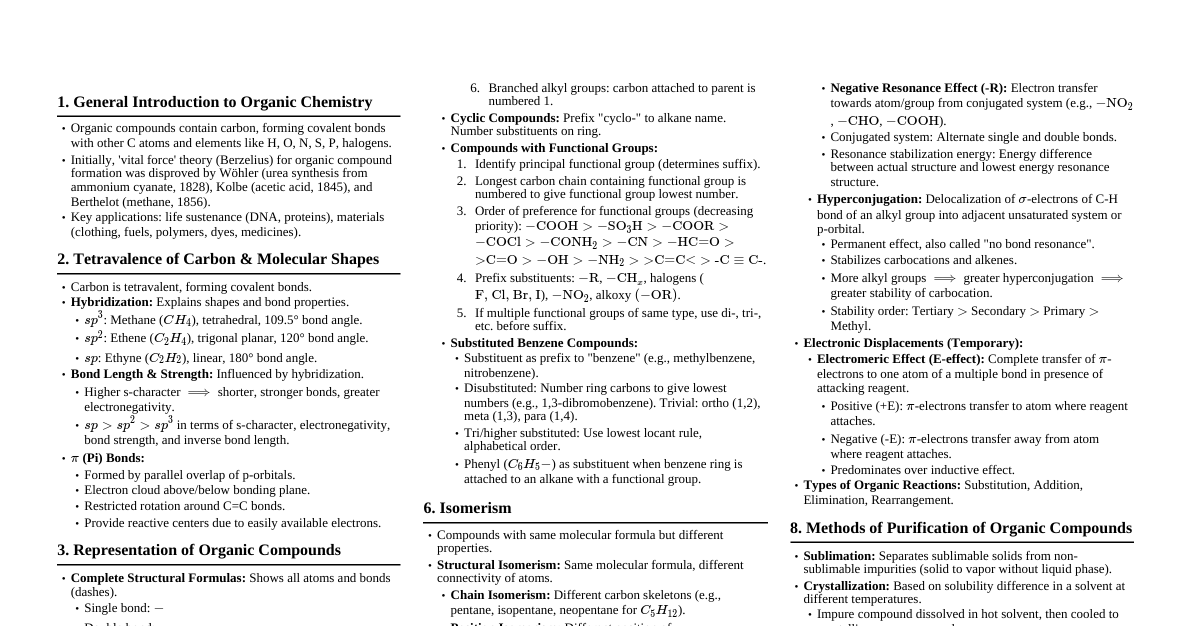
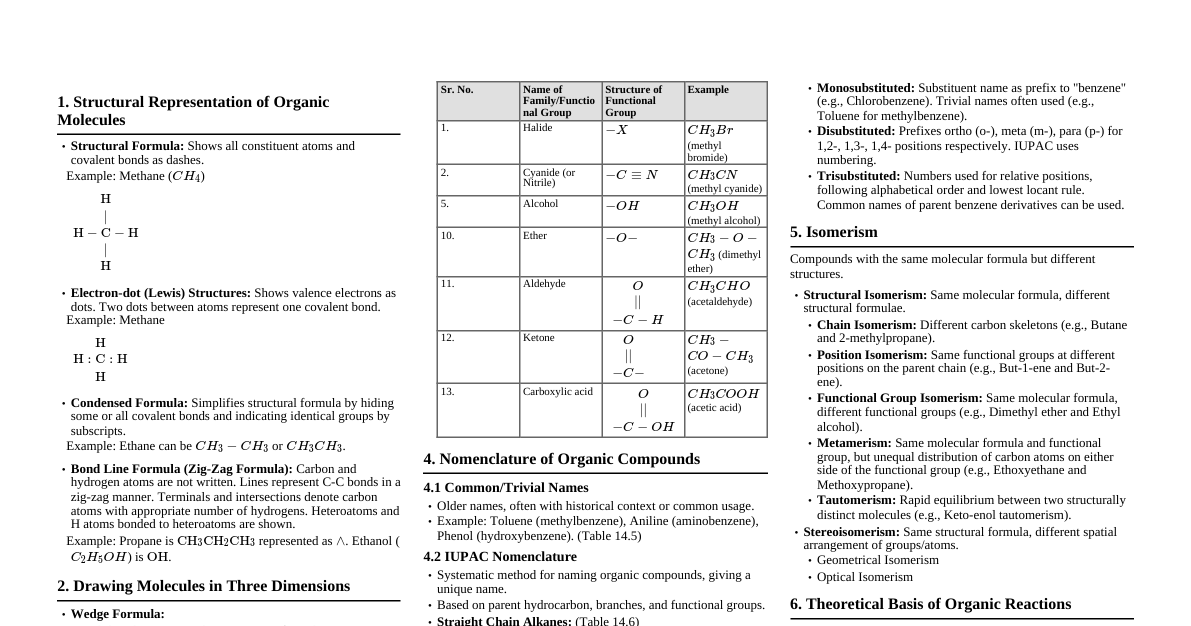
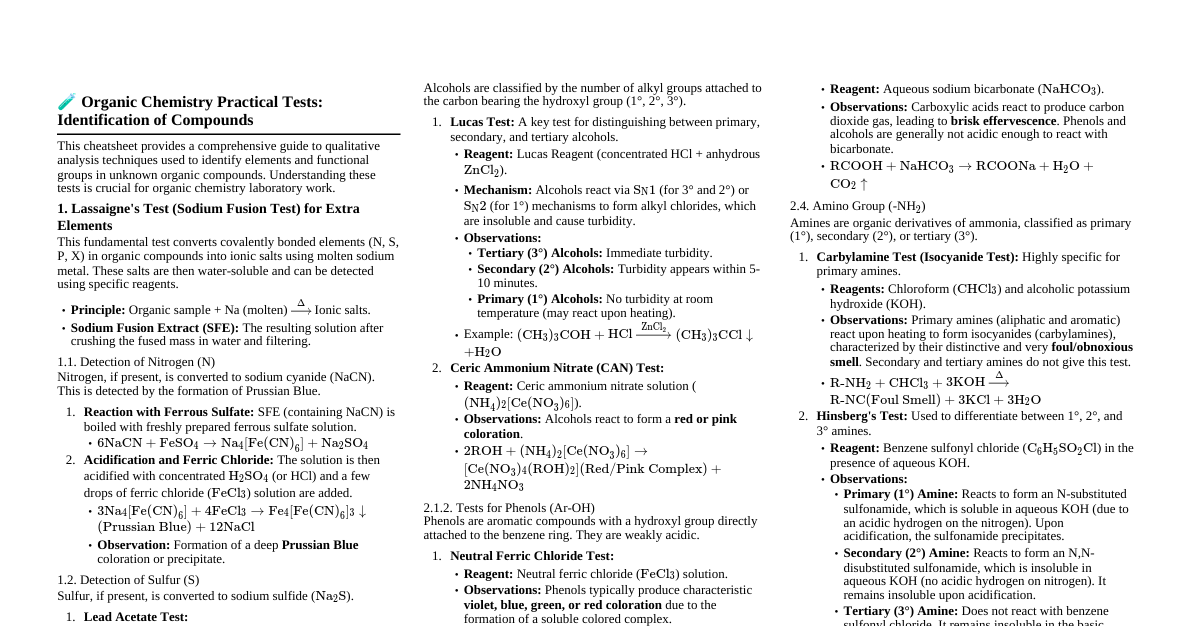
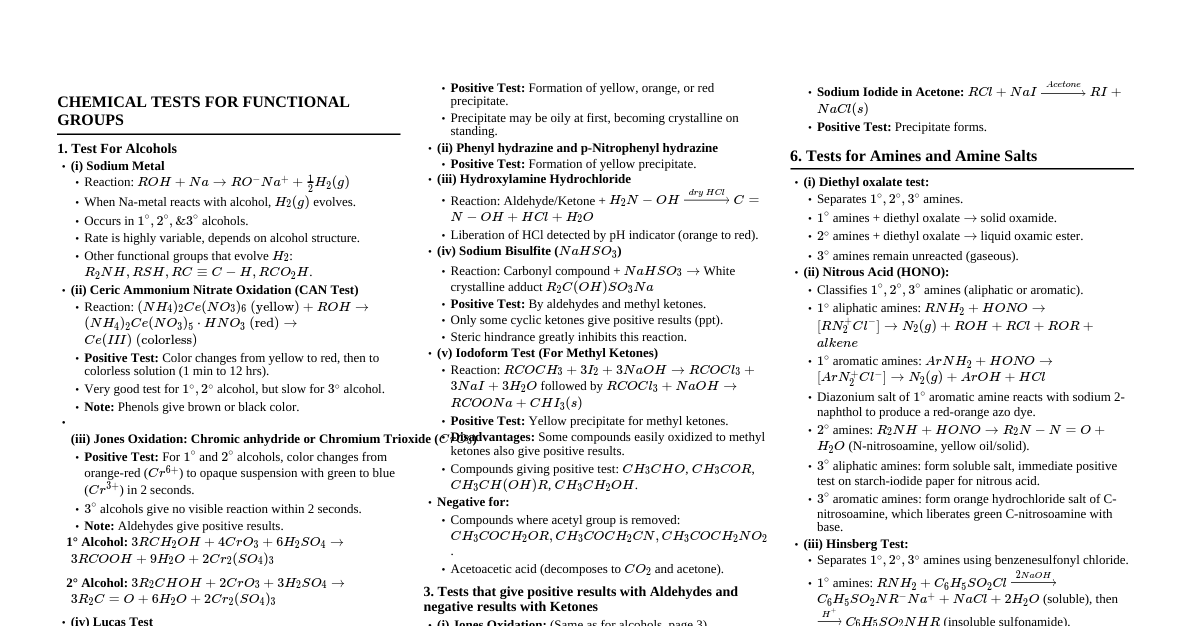
1. General Introduction to Organic Chemistry Organic compounds contain carbon, forming covalent bonds with other carbon atoms (catenation) and other elements (H, O, N, S, P, halogens). Historically, organic compounds were thought to originate only from living organisms ("vital force" theory by Berzilius). F. Wohler (1828) synthesized urea ($\text{NH}_2\text{CONH}_2$) from inorganic ammonium cyanate ($\text{NHCNO}$), disproving the vital force theory: $$ \text{NHCNO} \xrightarrow{\text{Heat}} \text{NH}_2\text{CONH}_2 $$ Later syntheses: Acetic acid by Kolbe (1845) and methane by Berthelot (1856). 2. Tetravalence of Carbon & Shapes of Organic Compounds 2.1 Hybridisation Carbon exhibits tetravalence and forms covalent bonds. Its electronic configuration allows for hybridisation of $s$ and $p$ orbitals. $sp^3$ Hybridisation: Example: Methane ($\text{CH}_4$) Geometry: Tetrahedral Bond Angle: $109.5^\circ$ s-character: 25% $sp^2$ Hybridisation: Example: Ethene ($\text{C}_2\text{H}_4$) Geometry: Trigonal planar Bond Angle: $120^\circ$ s-character: 33.3% $sp$ Hybridisation: Example: Ethyne ($\text{C}_2\text{H}_2$) Geometry: Linear Bond Angle: $180^\circ$ s-character: 50% Electronegativity: Increases with increasing s-character ($sp > sp^2 > sp^3$). Bond Length & Strength: Bonds formed by $sp$ orbitals are shorter and stronger than those by $sp^2$ or $sp^3$ orbitals. 2.2 Characteristic Features of $\pi$ Bonds Formed by sideways overlap of parallel $p$ orbitals. Requires atoms to be in the same plane. Restricts rotation around carbon-carbon double bonds. Electron cloud is located above and below the plane of bonding atoms, making electrons easily available to attacking reagents. $\pi$ bonds provide reactive centers in molecules with multiple bonds. 3. Structural Representations of Organic Compounds 3.1 Types of Formulas Complete Structural Formulas: Shows all atoms and all bonds (e.g., $\text{H}-\text{C}\equiv\text{C}-\text{H}$ for Ethyne). Condensed Structural Formulas: Omits some or all dashes and indicates identical groups with subscripts (e.g., $\text{CH}_3\text{CH}_3$ for Ethane, $\text{H}_2\text{C}=\text{CH}_2$ for Ethene). Bond-line Structural Formulas (Zig-zag): Carbon and hydrogen atoms are not explicitly shown (implied at vertices and termini). Lines represent carbon-carbon bonds. Heteroatoms (O, Cl, N, etc.) are explicitly written. Terminals generally denote $\text{CH}_3$ groups. Line junctions denote carbon atoms bonded to appropriate number of hydrogens to satisfy carbon's valency. 3.2 Three-Dimensional Representation Uses wedge and dash formulas to represent 3D structure on a 2D surface. Solid-wedge ($\blacktriangle$): Bond projecting out of the plane, towards the observer. Dashed-wedge ($\cdots$): Bond projecting out of the plane, away from the observer. Normal line (—): Bond lying in the plane of the paper. Molecular Models: Framework, Ball-and-stick, and Space-filling models aid in visualizing 3D shapes. 4. Classification of Organic Compounds 4.1 Based on Structure Acyclic or Open Chain Compounds (Aliphatic): Straight or branched chain compounds (e.g., Ethane, Isobutane). Cyclic or Closed Chain Compounds (Ring): Alicyclic Compounds: Aliphatic cyclic compounds (e.g., Cyclopropane, Cyclohexane). Aromatic Compounds: Special types of cyclic compounds. Benzenoid: Contain benzene ring (e.g., Benzene, Aniline, Naphthalene). Non-benzenoid: Do not contain benzene ring (e.g., Tropone). Heterocyclic Compounds: Rings contain atoms other than carbon (e.g., Tetrahydrofuran, Furan, Thiophene, Pyridine). 4.2 Based on Functional Groups & Homologous Series Functional Group: Atom or group of atoms responsible for characteristic chemical properties (e.g., -OH (hydroxyl), -CHO (aldehyde), -COOH (carboxylic acid)). Homologous Series: Series of compounds with the same functional group, differing by a $-\text{CH}_2-$ unit, and represented by a general molecular formula. Members are called homologues. 5. Nomenclature of Organic Compounds (IUPAC) 5.1 Common/Trivial Names Based on origin or certain properties (e.g., Formic acid from ants (formica), Acetic acid from vinegar (acetum)). Some common names are still widely used (e.g., Methane, n-Butane, Isobutane, Neopentane, Acetone, Chloroform, Benzene, Anisole, Aniline, Acetophenone). 5.2 IUPAC System of Nomenclature Systematic naming based on parent hydrocarbon and functional groups. Parent Chain: Longest continuous carbon chain containing the functional group (if any). Numbering: Assign lowest possible numbers to functional groups, then multiple bonds, then substituents. If equivalent positions, number from the end that gives lower numbers to the first substituent in alphabetical order. Alkyl Groups: Formed by removing a hydrogen from an alkane. Named by replacing '-ane' with '-yl' (e.g., Methyl ($\text{CH}_3$), Ethyl ($\text{C}_2\text{H}_5$)). Branched Alkyl Groups: Have specific trivial names (e.g., Isopropyl, sec-Butyl, tert-Butyl, Isobutyl, Neopentyl). Substituents: Listed alphabetically with their position numbers. Prefixes di-, tri-, tetra- are not considered for alphabetical order. Cyclic Compounds: Prefix 'cyclo-' to the corresponding alkane name. Functional Groups: One functional group: Identified by appropriate suffix. Polyfunctional compounds: One is chosen as principal functional group (suffix), others are named as substituents (prefixes). Priority Order (decreasing): $-\text{COOH} > -\text{SO}_3\text{H} > -\text{COOR} > -\text{COCl} > -\text{CONH}_2 > -\text{CN} > -\text{CHO} > \text{C}=\text{O} > -\text{OH} > -\text{NH}_2 > \text{C}=\text{C} > \text{C}\equiv\text{C}$. Prefix substituents: $-\text{R}$ (alkyl), $-\text{X}$ (halo), $-\text{NO}_2$ (nitro), $-\text{OR}$ (alkoxy). 5.3 Substituted Benzene Compounds Substituent named as prefix to 'benzene' (e.g., Nitrobenzene, Bromobenzene). Disubstituted Benzenes: Use numbers (1,2-, 1,3-, 1,4-) or trivial prefixes ortho ( o -), meta ( m -), para ( p -). Tri- or higher substituted benzenes: Use lowest locant rule for numbering. If a benzene ring is attached to an alkane with a functional group, it is considered a substituent called phenyl ($\text{C}_6\text{H}_5-$ or Ph). 6. Isomerism Compounds with the same molecular formula but different properties. 6.1 Structural Isomerism Same molecular formula, different connectivity (structure) of atoms. Chain Isomerism: Different carbon skeletons (e.g., Pentane, Isopentane, Neopentane). Position Isomerism: Different positions of substituent atom or functional group on the carbon skeleton (e.g., Propan-1-ol, Propan-2-ol). Functional Group Isomerism: Different functional groups (e.g., Propanal, Propanone). Metamerism: Different alkyl chains on either side of the functional group (e.g., Methoxypropane, Ethoxyethane). 6.2 Stereoisomerism Same constitution and sequence of covalent bonds, but different relative positions of atoms/groups in space. Geometrical Isomerism (e.g., cis-trans isomers). Optical Isomerism (e.g., enantiomers, diastereomers). 7. Fundamental Concepts in Organic Reaction Mechanism Organic reaction: Substrate + Attacking Reagent $\to$ Intermediate(s) $\to$ Product(s) + Byproducts. Substrate: Supplies carbon for new bond formation. Reagent: The other reactant. Reaction Mechanism: Sequential account of each step, including electron movement, energetics, and rates. 7.1 Fission of a Covalent Bond Heterolytic Cleavage: Shared electron pair remains with one fragment. Forms: Carbocation (sextet, positive charge, $sp^2$ hybridised, trigonal planar) and Anion. Stability of Carbocations: Tertiary > Secondary > Primary > Methyl ($\text{CH}_3^+ Forms: Carbanion (octet, negative charge, $sp^3$ hybridised, distorted tetrahedral). Reactions: Ionic or heteropolar reactions. Homolytic Cleavage: Each bonded atom takes one electron from the shared pair (shown by half-headed arrows "$\curvearrowright$"). Forms: Free Radicals (neutral species with unpaired electron). Stability of Free Radicals: Tertiary > Secondary > Primary > Methyl ($\dot{\text{C}}\text{H}_3 Reactions: Free radical or homopolar reactions. 7.2 Substrate and Reagent Classification Nucleophile (Nu:): Nucleus-seeking, electron-rich species (donates electron pair). Attacks electron-deficient centers. Examples: $\text{HO}^-$, $\text{CN}^-$, $\text{R}_3\text{C}^-$, $\text{H}_2\text{O:}$, $\text{R}_3\text{N:}$. Electrophile (E+): Electron-seeking, electron-deficient species (accepts electron pair). Attacks electron-rich centers. Examples: $\text{R}_3\text{C}^+$, carbonyl groups ($>\text{C}=\text{O}$), alkyl halides ($\text{R}-\text{X}$). 7.3 Electron Movement in Organic Reactions Curved arrows: Show movement of electron pairs. Start from electron source, end at electron sink. Half-headed arrows: Show movement of single electrons. 7.4 Electron Displacement Effects in Covalent Bonds Inductive Effect (I-effect): Permanent polarisation of a $\sigma$-bond due to electronegativity difference. Transmitted through chain, decreases rapidly after 3 bonds. +I effect (electron donating): Alkyl groups (e.g., $-\text{CH}_3$, $-\text{CH}_2\text{CH}_3$). -I effect (electron withdrawing): Halogens, $-\text{NO}_2$, $-\text{CN}$, $-\text{COOH}$, $-\text{COOR}$, $-\text{OAr}$. Resonance Effect (R-effect) / Mesomeric Effect (M-effect): Polarity produced by interaction of $\pi$-bonds or between a $\pi$-bond and lone pair on adjacent atom. +R effect (electron donating): Transfer of electrons away from atom/group to conjugated system. (e.g., Halogen, $-\text{OH}$, $-\text{OR}$, $-\text{OCOR}$, $-\text{NH}_2$, $-\text{NHR}$, $-\text{NR}_2$, $-\text{NHCOR}$). -R effect (electron withdrawing): Transfer of electrons towards atom/group from conjugated system. (e.g., $-\text{COOH}$, $-\text{CHO}$, $>\text{C}=\text{O}$, $-\text{CN}$, $-\text{NO}_2$). Resonance Structures (Canonical/Contributing Structures): Hypothetical structures contributing to the actual structure (resonance hybrid). Hybrid is more stable than any single canonical structure. Electromeric Effect (E-effect): Temporary effect in multiple bonds in presence of attacking reagent. Complete transfer of $\pi$-electrons to one atom. +E effect: $\pi$-electrons transferred to atom to which reagent gets attached. -E effect: $\pi$-electrons transferred to atom to which reagent does NOT get attached. Electromeric effect dominates over inductive effect when they oppose each other. Hyperconjugation: Permanent stabilising interaction involving delocalisation of $\sigma$-electrons of $\text{C}-\text{H}$ bond of an alkyl group directly attached to an unsaturated system or an atom with an unshared $p$-orbital. Greater the number of alkyl groups, greater the hyperconjugation and stabilisation. Also known as "no bond resonance". 7.5 Types of Organic Reactions Substitution Reactions Addition Reactions Elimination Reactions Rearrangement Reactions 8. Methods of Purification of Organic Compounds Purity is ascertained by sharp melting/boiling points. New methods use chromatographic and spectroscopic techniques. 8.1 Sublimation Separates sublimable compounds from non-sublimable impurities (e.g., benzoic acid, naphthalene). Substance changes directly from solid to vapor phase on heating. 8.2 Crystallisation Common method for solid organic compounds. Based on difference in solubilities of compound and impurities in a suitable solvent. Compound is sparingly soluble at room temperature, appreciably soluble at higher temperature. Impurities remain in mother liquor. Activated charcoal can remove colored impurities. 8.3 Distillation Separates (i) volatile liquids from non-volatile impurities, and (ii) liquids with sufficient difference in boiling points. Vapors are condensed and collected. Fractional Distillation: For liquids with small boiling point differences. Uses a fractionating column to provide surfaces for heat exchange, enriching vapours in more volatile component. Distillation under Reduced Pressure: For liquids with very high boiling points or those that decompose at/below their boiling points. Boiling occurs at lower temperature by reducing external pressure. Steam Distillation: For steam volatile and water immiscible substances. Liquid boils below its normal boiling point when sum of vapor pressures ($p_{\text{organic}} + p_{\text{water}}$) equals atmospheric pressure. 8.4 Differential Extraction Separates organic compounds from aqueous medium using an immiscible organic solvent in which the compound is more soluble. Continuous Extraction: Used when organic compound is less soluble in the organic solvent, by repeatedly using the same solvent. 8.5 Chromatography Separates mixtures, purifies compounds, tests purity. Based on differential movement of components in a mixture over a stationary phase by a mobile phase. Adsorption Chromatography: Based on differential adsorption on an adsorbent (stationary phase). Column Chromatography: Mixture applied to top of adsorbent-packed column, eluted with solvent. Thin Layer Chromatography (TLC): Mixture spotted on adsorbent-coated glass plate, eluted with solvent rising by capillary action. $R_f$ value (retardation factor) is characteristic. Partition Chromatography: Based on continuous differential partitioning between stationary and mobile phases. Paper Chromatography: Stationary phase is water trapped in paper, mobile phase is a suitable solvent. 9. Qualitative Analysis of Organic Compounds 9.1 Detection of Carbon and Hydrogen Heat compound with $\text{CuO}$. Carbon $\to \text{CO}_2$ (turns lime-water turbid). Hydrogen $\to \text{H}_2\text{O}$ (turns anhydrous $\text{CuSO}_4$ blue). 9.2 Detection of Other Elements (Lassaigne's Test) Convert covalent elements to ionic form by fusing with sodium metal. Sodium Fusion Extract (SFE): Fused mass extracted with distilled water. Nitrogen: SFE + $\text{FeSO}_4$ + conc. $\text{H}_2\text{SO}_4$. Prussian blue color (due to $\text{Fe}_4[\text{Fe}(\text{CN})_6]_3\cdot x\text{H}_2\text{O}$) indicates nitrogen. Sulphur: SFE + acetic acid + lead acetate. Black precipitate ($\text{PbS}$) indicates sulphur. SFE + sodium nitroprusside. Violet color indicates sulphur. Halogens ($\text{X}$ = Cl, Br, I): SFE + $\text{HNO}_3$ + $\text{AgNO}_3$. White precipitate soluble in $\text{NH}_4\text{OH}$ ($\text{AgCl}$) $\to$ Chlorine. Yellowish precipitate sparingly soluble in $\text{NH}_4\text{OH}$ ($\text{AgBr}$) $\to$ Bromine. Yellow precipitate insoluble in $\text{NH}_4\text{OH}$ ($\text{AgI}$) $\to$ Iodine. Boil SFE with $\text{HNO}_3$ first if N or S are present, to remove $\text{CN}^-$ or $\text{S}^{2-}$ ions. Phosphorus: Heat compound with oxidizing agent ($\text{Na}_2\text{O}_2$). Forms phosphate. Add $\text{HNO}_3$ + ammonium molybdate. Yellow color/precipitate indicates phosphorus. 10. Quantitative Analysis Determines mass percent of elements for empirical/molecular formula. 10.1 Carbon and Hydrogen Burn known mass of organic compound with excess $\text{O}_2$ and $\text{CuO}$. $\text{C} \to \text{CO}_2$, $\text{H} \to \text{H}_2\text{O}$. $\text{H}_2\text{O}$ absorbed by anhydrous $\text{CaCl}_2$. $\text{CO}_2$ absorbed by $\text{KOH}$ solution. Calculations: $$ \text{Percentage of C} = \frac{12 \times m_{\text{CO}_2}}{44 \times m_{\text{organic}}} \times 100 $$ $$ \text{Percentage of H} = \frac{2 \times m_{\text{H}_2\text{O}}}{18 \times m_{\text{organic}}} \times 100 $$ 10.2 Nitrogen Dumas Method: Heat compound with $\text{CuO}$ in $\text{CO}_2$ atmosphere. $\text{N} \to \text{N}_2$ gas. Collect $\text{N}_2$ over $\text{KOH}$ solution (absorbs $\text{CO}_2$). $$ \text{Percentage of N} = \frac{28 \times V_{\text{N}_2} \text{ (at STP)}}{22400 \times m_{\text{organic}}} \times 100 $$ Kjeldahl's Method: Heat compound with conc. $\text{H}_2\text{SO}_4$. $\text{N} \to (\text{NH}_4)_2\text{SO}_4$. Treat with $\text{NaOH}$ to liberate $\text{NH}_3$. Absorb $\text{NH}_3$ in standard $\text{H}_2\text{SO}_4$. Titrate excess $\text{H}_2\text{SO}_4$ with standard alkali. $$ \text{Percentage of N} = \frac{1.4 \times M \times 2(V - V_1/2)}{m_{\text{organic}}} $$ (Not applicable for nitro, azo, and ring-N compounds). 10.3 Halogens (Carius Method) Heat compound with fuming $\text{HNO}_3$ and $\text{AgNO}_3$ in a Carius tube. Halogen $\text{X} \to \text{AgX}$ precipitate. Weigh $\text{AgX}$. $$ \text{Percentage of X} = \frac{\text{Atomic mass of X} \times m_{\text{AgX}}}{\text{Molecular mass of AgX} \times m_{\text{organic}}} \times 100 $$ 10.4 Sulphur Heat compound with $\text{Na}_2\text{O}_2$ or fuming $\text{HNO}_3$. $\text{S} \to \text{H}_2\text{SO}_4$. Precipitate as $\text{BaSO}_4$ by adding $\text{BaCl}_2$. Weigh $\text{BaSO}_4$. $$ \text{Percentage of S} = \frac{32 \times m_{\text{BaSO}_4}}{233 \times m_{\text{organic}}} \times 100 $$ 10.5 Phosphorus Heat compound with fuming $\text{HNO}_3$. $\text{P} \to \text{H}_3\text{PO}_4$. Precipitate as ammonium phosphomolybdate or $\text{Mg}_2\text{P}_2\text{O}_7$. $$ \text{Percentage of P} = \frac{31 \times m_{\text{phosphomolybdate}}}{1877 \times m_{\text{organic}}} \times 100 \quad \text{or} \quad \frac{62 \times m_{\text{Mg}_2\text{P}_2\text{O}_7}}{222 \times m_{\text{organic}}} \times 100 $$ 10.6 Oxygen Usually found by difference: $100\% - (\% \text{C} + \% \text{H} + \% \text{N} + \dots)$. Direct method: Decompose in $\text{N}_2$ stream. Pass products over red-hot coke. $\text{O} \to \text{CO}$. Pass $\text{CO}$ over $\text{I}_2\text{O}_5$. $\text{CO} \to \text{CO}_2 + \text{I}_2$. Measure $\text{CO}_2$ or $\text{I}_2$. $$ \text{Percentage of O} = \frac{32 \times m_{\text{CO}_2}}{88 \times m_{\text{organic}}} \times 100 $$