Hydrocarbons for NEET
Cheatsheet Content
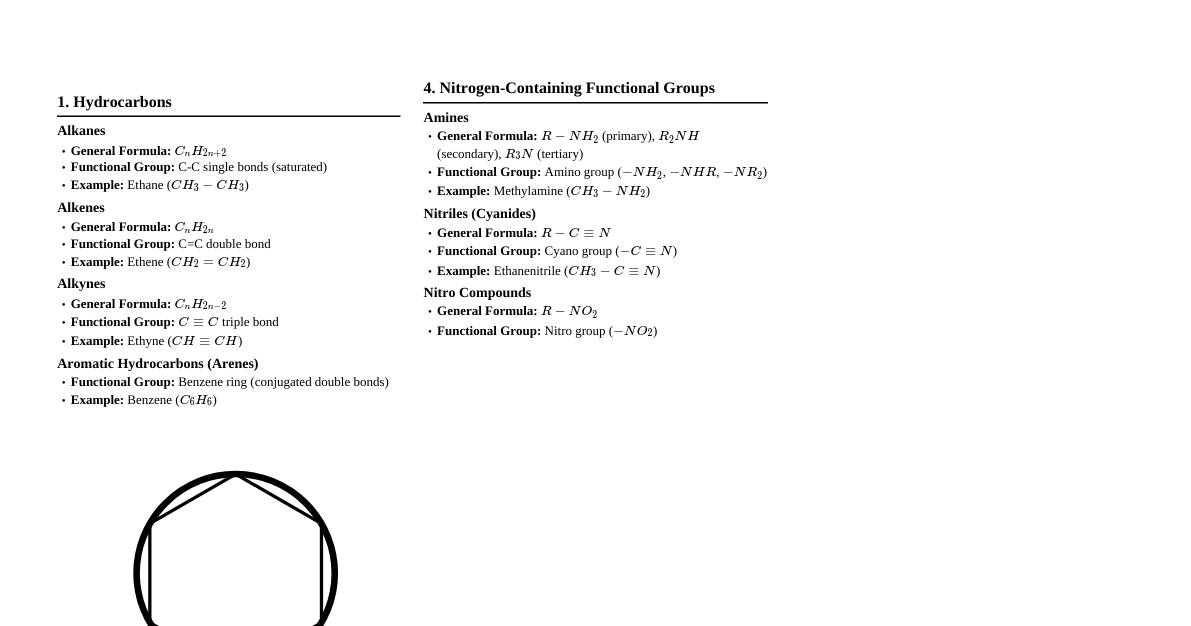
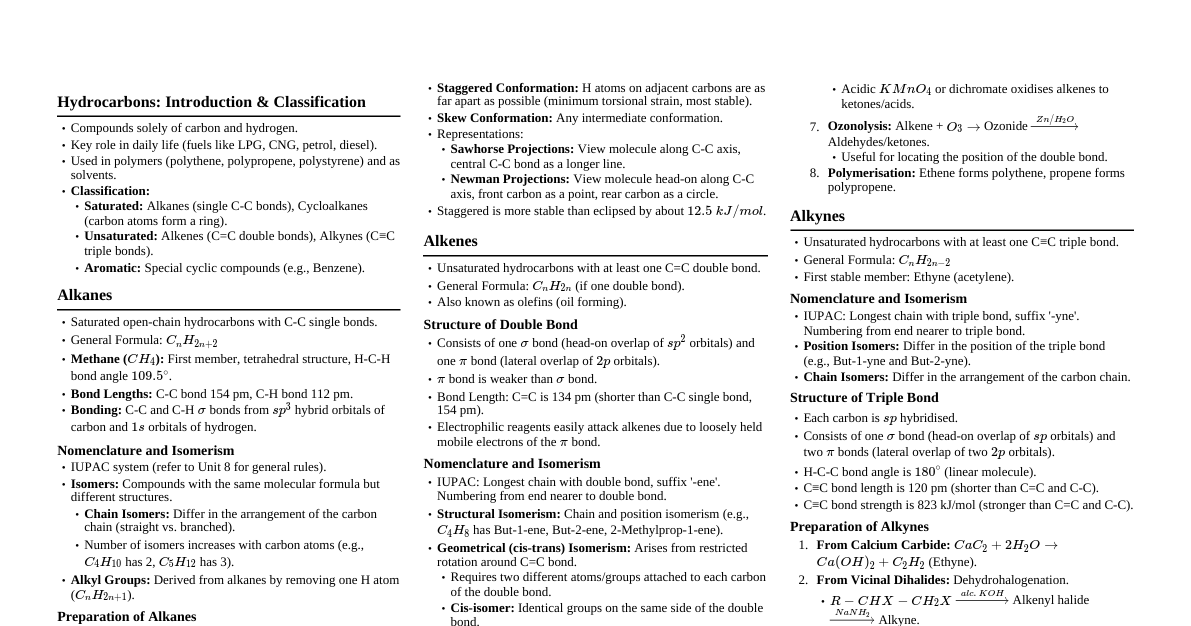
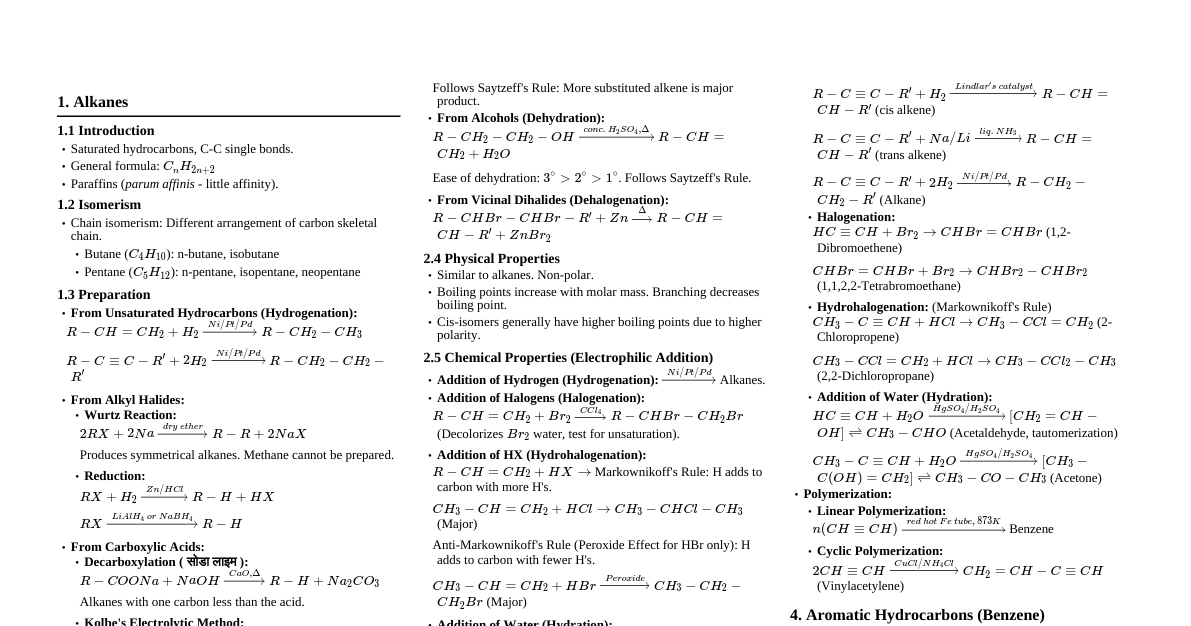
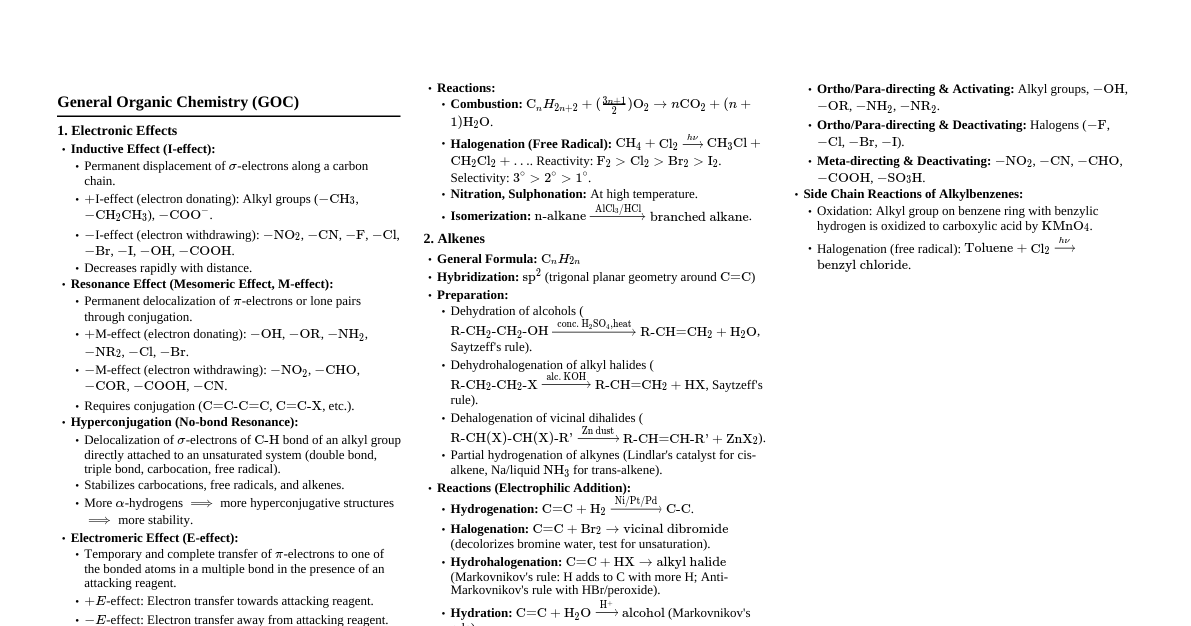
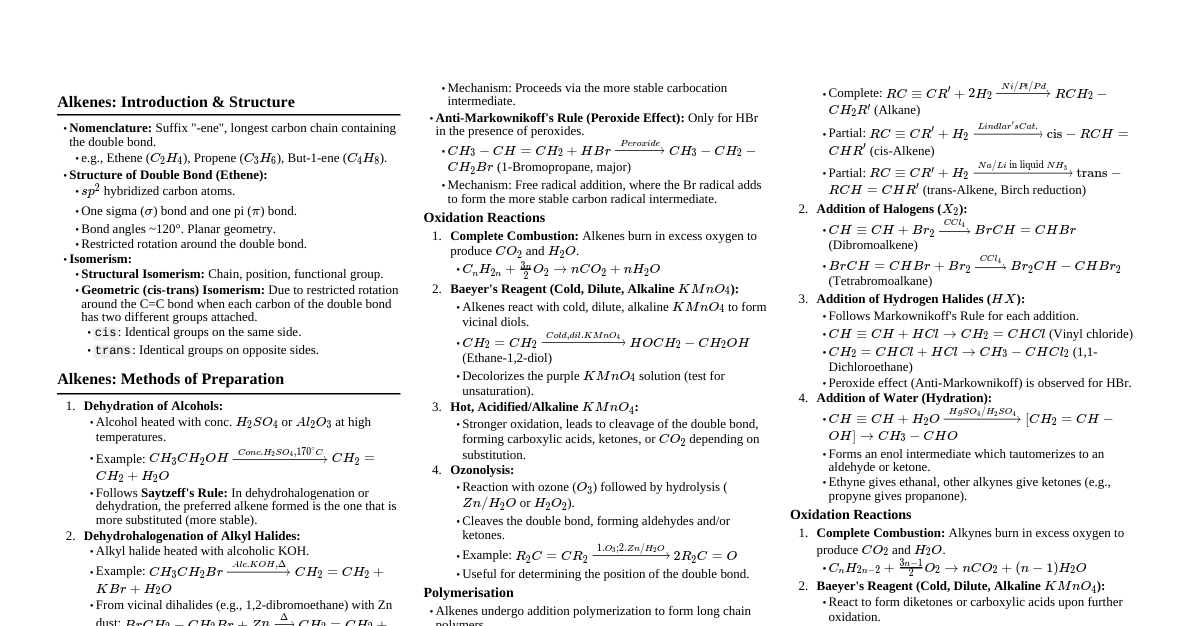
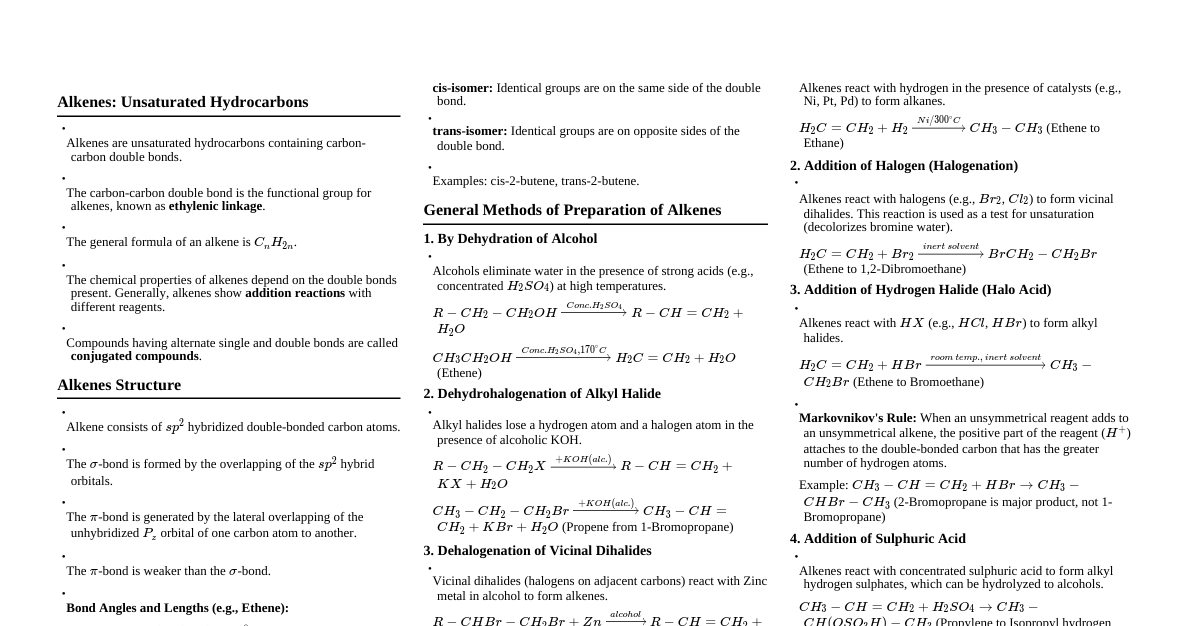
1. Hydrocarbons: Introduction & Classification Definition: Compounds of carbon and hydrogen only. Importance: Fuels (LPG, CNG, LNG, Petrol, Diesel), polymers (polythene), solvents, starting materials for dyes/drugs. Classification: Saturated: Alkanes (single C-C bonds), Cycloalkanes. Unsaturated: Alkenes (C=C double bond), Alkynes (C≡C triple bond). Aromatic: Special cyclic compounds (e.g., Benzene). 2. Alkanes General Formula: $C_nH_{2n+2}$ Structure: Methane ($CH_4$): Tetrahedral, $109.5^\circ$ H-C-H bond angles. C-C bond length: $154 \, pm$. C-H bond length: $112 \, pm$. Bonds: $sp^3$ hybrid orbitals of C and $1s$ orbitals of H. Nomenclature & Isomerism: First three (Methane, Ethane, Propane) have one structure. Higher alkanes show structural isomerism (chain isomers). Primary ($1^\circ$): C attached to no other C or one C. Secondary ($2^\circ$): C attached to two C atoms. Tertiary ($3^\circ$): C attached to three C atoms. Quaternary ($4^\circ$): C attached to four C atoms. Preparation: From Unsaturated Hydrocarbons (Hydrogenation): Alkenes/Alkynes + $H_2 \xrightarrow{Pt/Pd/Ni}$ Alkanes. Catalysts (Pt, Pd) work at room temp, Ni needs higher temp/pressure. From Alkyl Halides: Reduction: $R-X + H_2 \xrightarrow{Zn/H^+}$ Alkane + $HX$. Wurtz Reaction: $2R-X + 2Na \xrightarrow{dry \, ether} R-R + 2NaX$. Forms higher alkanes with an even number of carbon atoms. From Carboxylic Acids: Decarboxylation: $R-COO^-Na^+ + NaOH \xrightarrow{CaO, \Delta} R-H + Na_2CO_3$. Alkane has one less C atom. Kolbe's Electrolytic Method: $2R-COO^-Na^+ + 2H_2O \xrightarrow{electrolysis} R-R + 2CO_2 + H_2 + 2NaOH$. Forms even-carbon alkanes. Methane cannot be prepared. Physical Properties: Non-polar, weak van der Waals forces. $C_1-C_4$: Gases; $C_5-C_{17}$: Liquids; $C_{18}$ onwards: Solids. Colourless, odourless, insoluble in water, soluble in non-polar solvents. Boiling point increases with molecular mass. Branching decreases boiling point (smaller surface area, weaker van der Waals forces). Chemical Properties (Generally inert): Substitution Reactions: (Halogenation, Nitration, Sulphonation) Halogenation: $CH_4 + Cl_2 \xrightarrow{hv \, or \, 573-773K} CH_3Cl + HCl$. Proceeds via free radical mechanism. Rate of reaction: $F_2 > Cl_2 > Br_2 > I_2$. Rate of H replacement: $3^\circ > 2^\circ > 1^\circ$. Mechanism: Initiation: $Cl-Cl \xrightarrow{hv} 2Cl^\bullet$ (homolysis). Propagation: $CH_4 + Cl^\bullet \rightarrow CH_3^\bullet + HCl$; $CH_3^\bullet + Cl_2 \rightarrow CH_3Cl + Cl^\bullet$. Termination: $Cl^\bullet + Cl^\bullet \rightarrow Cl_2$; $CH_3^\bullet + CH_3^\bullet \rightarrow C_2H_6$; $CH_3^\bullet + Cl^\bullet \rightarrow CH_3Cl$. Combustion: Complete: $C_nH_{2n+2} + (\frac{3n+1}{2})O_2 \rightarrow nCO_2 + (n+1)H_2O + Heat$. (Used as fuels). Incomplete: Forms carbon black ($C(s)$). Controlled Oxidation: $2CH_4 + O_2 \xrightarrow{Cu/523K/100atm} 2CH_3OH$ (Methanol). $CH_4 + O_2 \xrightarrow{Mo_2O_3/\Delta} HCHO + H_2O$ (Methanal). Isomerisation: $n$-Alkanes $\xrightarrow{Anhyd. \, AlCl_3/HCl}$ Branched chain alkanes. Aromatization (Reforming): $n$-Alkanes ($\ge 6C$) $\xrightarrow{Cr_2O_3 \, or \, V_2O_5 \, or \, Mo_2O_3, \, 773K} Benzene/homologues$. Reaction with Steam: $CH_4 + H_2O \xrightarrow{Ni/1273K} CO + 3H_2$. Pyrolysis (Cracking): Higher alkanes $\xrightarrow{Heat}$ Lower alkanes, alkenes, etc. (Free radical mechanism). Conformations (Ethane): Free rotation around C-C single bond. Eclipsed: H atoms on adjacent carbons are as close as possible (higher energy, less stable, maximum torsional strain). Staggered: H atoms on adjacent carbons are as far apart as possible (lower energy, more stable, least torsional strain). Skew: Intermediate conformations. Representations: Sawhorse projections, Newman projections. 3. Alkenes General Formula: $C_nH_{2n}$ (one double bond). Structure of Double Bond: One $\sigma$ bond (head-on overlap of $sp^2$ orbitals) and one $\pi$ bond (sideways overlap of $2p$ orbitals). $\sigma$ bond: $397 \, kJ/mol$. $\pi$ bond: $284 \, kJ/mol$. Total bond strength: $681 \, kJ/mol$. C=C bond length: $134 \, pm$ (shorter than C-C single bond). $\pi$ electrons are loosely held, making alkenes susceptible to electrophilic reagents . Nomenclature & Isomerism: Suffix: '-ene'. Longest chain must contain double bond. Number from end nearer to double bond. Show structural isomerism (chain, position) and geometrical isomerism (cis-trans). Geometrical Isomerism: Restricted rotation around C=C bond. Occurs when each C of the double bond is attached to two different groups. Cis: Identical groups on the same side. Trans: Identical groups on opposite sides. Trans isomers are generally more stable and have higher melting points. Cis isomers are more polar (e.g., cis-but-2-ene has dipole moment, trans-but-2-ene has zero). Preparation: From Alkynes (Partial Reduction): Alkynes + $H_2 \xrightarrow{Pd/C, \, Lindlar's \, catalyst}$ Cis-alkenes . (Lindlar's catalyst: partially deactivated palladized charcoal). Alkynes + $Na \xrightarrow{liquid \, NH_3}$ Trans-alkenes . (Birch reduction). From Alkyl Halides (Dehydrohalogenation): $R-CH_2-CH_2-X \xrightarrow{alc. \, KOH, \, \Delta}$ Alkene. ($\beta$-elimination). Rate: $I > Br > Cl$. $3^\circ > 2^\circ > 1^\circ$. From Vicinal Dihalides (Dehalogenation): $R-CHBr-CHBr-R' + Zn \rightarrow R-CH=CH-R' + ZnBr_2$. From Alcohols (Acidic Dehydration): $R-CH_2-CH_2-OH \xrightarrow{Conc. \, H_2SO_4, \, \Delta}$ Alkene + $H_2O$. ($\beta$-elimination). Chemical Properties (Addition Reactions due to $\pi$ bond): Addition of Dihydrogen: Alkenes + $H_2 \xrightarrow{Pt/Pd/Ni}$ Alkanes. Addition of Halogens: Alkenes + $X_2 \rightarrow$ Vicinal dihalides. (Electrophilic addition via cyclic halonium ion). Bromine water test: Reddish-orange $Br_2$ colour disappears (test for unsaturation). Addition of Hydrogen Halides: Alkenes + $HX \rightarrow$ Alkyl halides. (Electrophilic addition). Reactivity: $HI > HBr > HCl$. Markovnikov's Rule: Negative part of addendum ($HX$) attaches to the carbon atom with fewer hydrogen atoms. (Mechanism: proceeds via more stable carbocation intermediate). Anti-Markovnikov's Rule (Peroxide Effect/Kharash Effect): Only for $HBr$ in presence of peroxide. Negative part of addendum ($HBr$) attaches to the carbon atom with more hydrogen atoms. (Free radical mechanism). Addition of Sulphuric Acid: Alkenes + Cold, conc. $H_2SO_4 \rightarrow$ Alkyl hydrogen sulphate (Markovnikov's rule). Addition of Water: Alkenes + $H_2O \xrightarrow{H^+}$ Alcohols (Markovnikov's rule). Oxidation: Baeyer's Reagent (Cold, dilute, alkaline $KMnO_4$): Alkenes $\rightarrow$ Vicinal diols (glycols). Test for unsaturation. Acidic $KMnO_4$ or $K_2Cr_2O_7$: Cleaves double bond, forms ketones/acids. Ozonolysis: Alkene + $O_3 \rightarrow$ Ozonide $\xrightarrow{Zn/H_2O}$ Aldehydes/Ketones. (Used to locate double bond position). Polymerisation: Alkenes polymerize to form polymers (e.g., polythene from ethene). 4. Alkynes General Formula: $C_nH_{2n-2}$ (one triple bond). Structure of Triple Bond: One $\sigma$ bond (head-on overlap of $sp$ orbitals) and two $\pi$ bonds (sideways overlap of $2p$ orbitals). C≡C bond strength: $823 \, kJ/mol$. C≡C bond length: $120 \, pm$. Linear molecule. Nomenclature & Isomerism: Suffix: '-yne'. Longest chain must contain triple bond. Number from end nearer to triple bond. Show structural isomerism (chain, position). Preparation: From Calcium Carbide: $CaC_2 + 2H_2O \rightarrow Ca(OH)_2 + C_2H_2$ (Ethyne). From Vicinal Dihalides (Dehydrohalogenation): Vicinal dihalide $\xrightarrow{alc. \, KOH}$ Alkenyl halide $\xrightarrow{NaNH_2}$ Alkyne. Physical Properties: $C_1-C_3$: Gases; $C_4-C_{11}$: Liquids; Higher: Solids. Colourless, odourless (ethyne has characteristic odour). Weakly polar, lighter than water, insoluble in water, soluble in organic solvents. Melting point, boiling point, density increase with molar mass. Chemical Properties: Acidic Character of Alkynes: Terminal alkynes (H-C≡C-R) have acidic H due to $sp$ hybridized carbon (50% $s$-character, highly electronegative). React with strong bases (Na, $NaNH_2$) to form metal acetylides and liberate $H_2$. $HC≡CH + Na \rightarrow HC≡C^-Na^+ + 1/2 H_2$. Acidic strength: Alkynes ($sp$) > Alkenes ($sp^2$) > Alkanes ($sp^3$). Addition Reactions: (Two $\pi$ bonds, so add two molecules of reagent). Addition of Dihydrogen: Alkynes + $2H_2 \xrightarrow{Pt/Pd/Ni}$ Alkanes. Addition of Halogens: Alkynes + $X_2 \rightarrow$ Dihaloalkenes $\xrightarrow{X_2}$ Tetrahaloalkanes. (Bromine water test for unsaturation). Addition of Hydrogen Halides: Alkynes + $HX \rightarrow$ Vinyl halides $\xrightarrow{HX}$ Geminal dihalides (Markovnikov's rule applies). Addition of Water: Alkynes + $H_2O \xrightarrow{Hg^{2+}/H^+, \, 333K}$ Carbonyl compounds (enol-keto tautomerism). $HC≡CH + H_2O \rightarrow CH_3CHO$ (Ethanal). $CH_3-C≡CH + H_2O \rightarrow CH_3COCH_3$ (Propanone). Polymerisation: Linear: Ethyne $\rightarrow$ Polyacetylene (conducts electricity). Cyclic: $3HC≡CH \xrightarrow{Red \, hot \, Fe \, tube, \, 873K} C_6H_6$ (Benzene). 5. Aromatic Hydrocarbons (Arenes) Definition: Cyclic, unsaturated compounds, usually containing benzene ring. Aromaticity (Hückel's Rule): Planar. Complete delocalization of $\pi$ electrons. $(4n+2)\pi$ electrons, where $n = 0, 1, 2, ...$ Benzene ($C_6H_6$): Hybrid of Kekulé structures (oscillating double bonds). All C-C bonds are equivalent ($139 \, pm$, intermediate between single and double). All C atoms are $sp^2$ hybridized. Six $\pi$ electrons delocalized in two rings (above/below plane). Highly stable due to resonance energy. Nomenclature & Isomerism: Monosubstituted: Only one product. Disubstituted: ortho (1,2), meta (1,3), para (1,4) isomers. Preparation: Cyclic Polymerisation of Ethyne: $3C_2H_2 \xrightarrow{Red \, hot \, Fe \, tube, \, 873K} C_6H_6$. Decarboxylation of Aromatic Acids: $C_6H_5COONa + NaOH \xrightarrow{CaO, \, \Delta} C_6H_6 + Na_2CO_3$. Reduction of Phenol: $C_6H_5OH + Zn \rightarrow C_6H_6 + ZnO$. Chemical Properties (Electrophilic Substitution Reactions): Benzene resists addition reactions due to aromaticity. Mechanism: Generation of Electrophile ($E^+$). Formation of Carbocation (Arenium ion) - resonance stabilized. Removal of proton to restore aromaticity. Reactions: Halogenation: $C_6H_6 + Cl_2 \xrightarrow{Anhyd. \, AlCl_3} C_6H_5Cl + HCl$. ($\text{E}^+ = Cl^+$). Nitration: $C_6H_6 + HNO_3 \xrightarrow{Conc. \, H_2SO_4} C_6H_5NO_2 + H_2O$. ($\text{E}^+ = NO_2^+$). Sulphonation: $C_6H_6 + Conc. \, H_2SO_4 \xrightarrow{\Delta} C_6H_5SO_3H + H_2O$. ($\text{E}^+ = SO_3$). Friedel-Crafts Alkylation: $C_6H_6 + R-X \xrightarrow{Anhyd. \, AlCl_3} C_6H_5-R + HX$. ($\text{E}^+ = R^+$). Friedel-Crafts Acylation: $C_6H_6 + RCOCl \xrightarrow{Anhyd. \, AlCl_3} C_6H_5COR + HCl$. ($\text{E}^+ = RCO^+$). Directive Influence of Substituents: Ortho-Para Directing Groups: Electron donating groups (e.g., $-OH, -NH_2, -R, -OCH_3$) activate the ring and direct incoming $\text{E}^+$ to ortho and para positions. Halogens (e.g., $-Cl, -Br$) are deactivating but o-p directing (due to resonance effects overriding inductive effects). Meta Directing Groups: Electron withdrawing groups (e.g., $-NO_2, -COOH, -CHO, -CN, -SO_3H$) deactivate the ring and direct incoming $\text{E}^+$ to meta position. Carcinogenicity & Toxicity: Polynuclear hydrocarbons (e.g., 1,2-Benzanthracene, 3-Methylcholanthrene) are carcinogenic (cancer-causing). Formed from incomplete combustion of organic materials.