Hydrocarbons Class 11
Cheatsheet Content
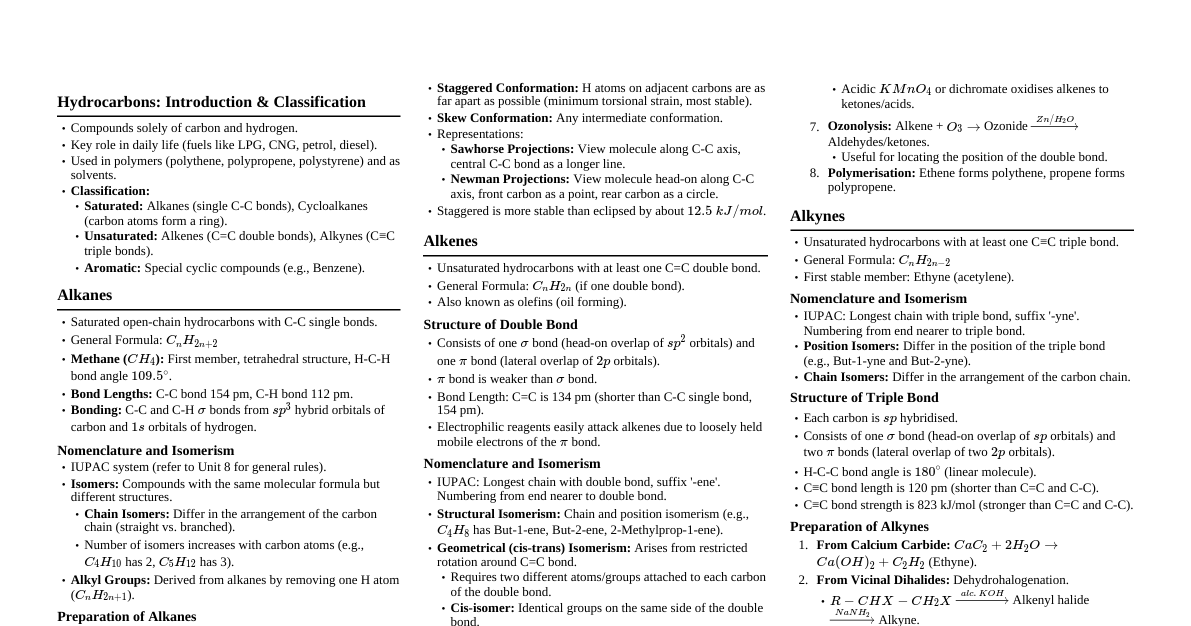
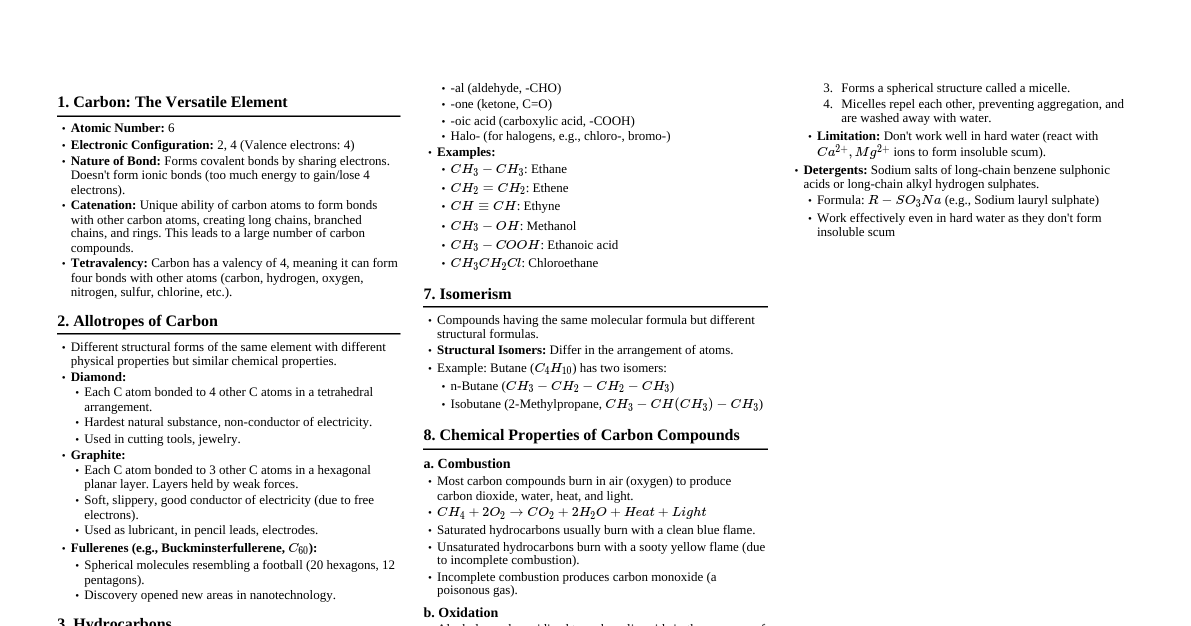
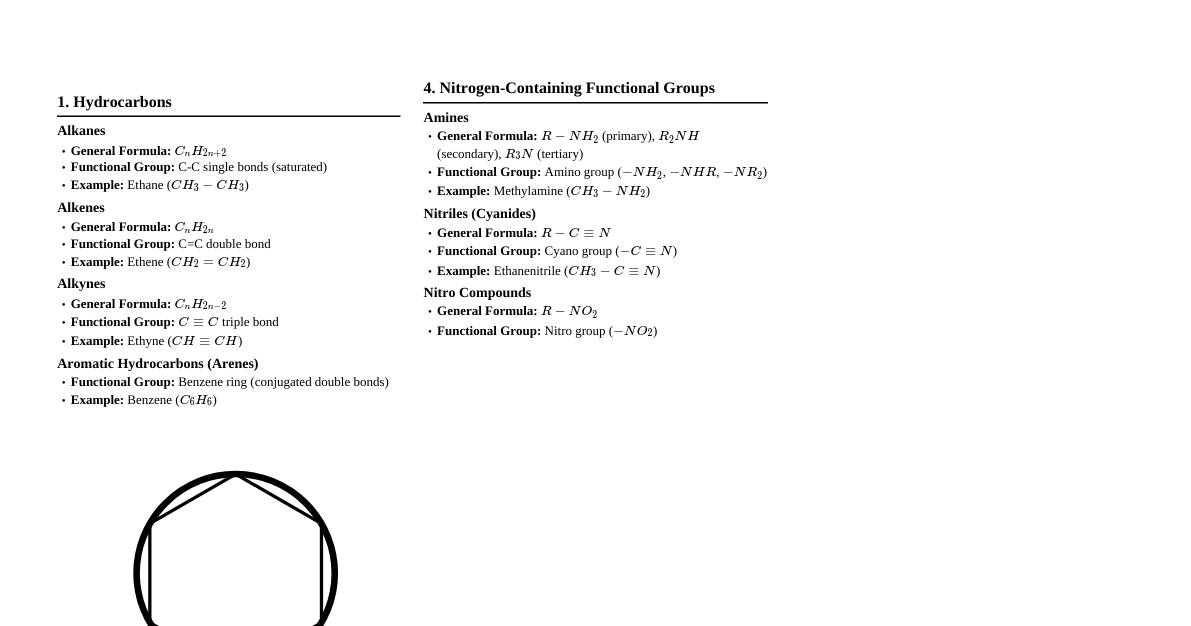
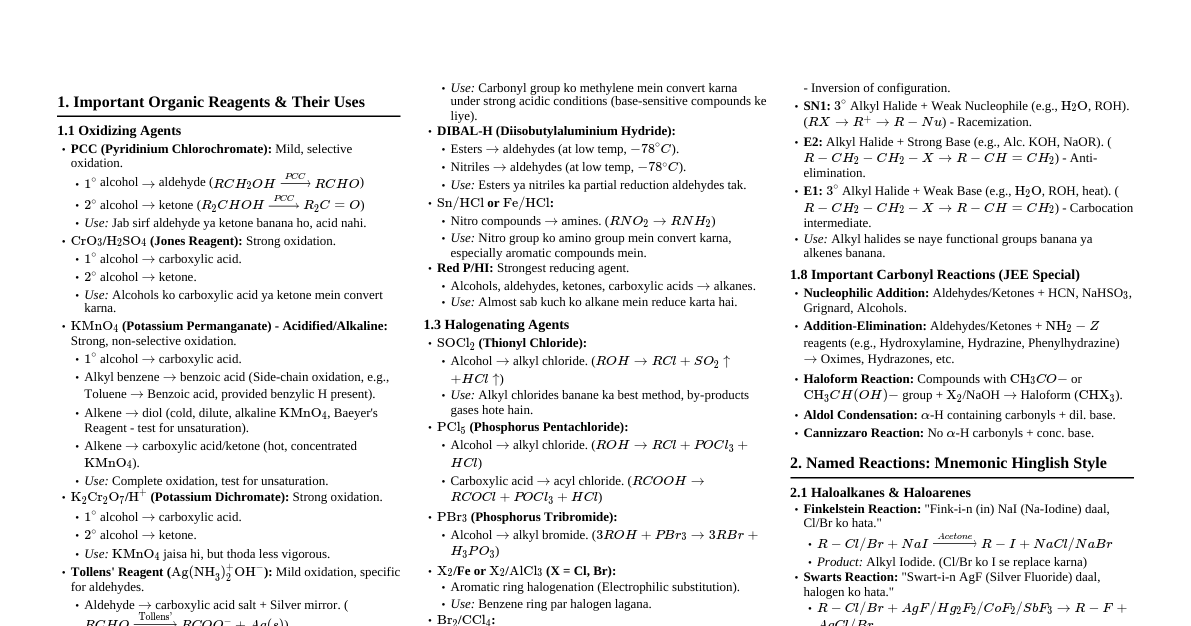
### Introduction to Hydrocarbons - **Definition:** Organic compounds composed solely of hydrogen and carbon atoms. - **Sources:** Primarily petroleum, natural gas, and coal. - **Classification:** - **Open-chain (Acyclic):** Alkanes, Alkenes, Alkynes. - **Cyclic:** Alicyclic (Cycloalkanes, Cycloalkenes) and Aromatic. ### Alkanes (Saturated Hydrocarbons) - **General Formula:** $C_nH_{2n+2}$ - **Bonding:** All C-C and C-H bonds are single bonds ($sp^3$ hybridization). - **Structure:** Tetrahedral geometry around each carbon. - **Nomenclature (IUPAC):** 1. Longest continuous carbon chain is parent. 2. Number chain from end giving lowest numbers to substituents. 3. Name substituents alphabetically. 4. Use prefixes: di-, tri-, tetra- for multiple identical substituents. - **Examples:** Methane ($CH_4$), Ethane ($C_2H_6$), Propane ($C_3H_8$). - **Isomerism:** Chain isomerism (e.g., n-butane and isobutane). - **Physical Properties:** - Nonpolar, insoluble in water, soluble in organic solvents. - Boiling points increase with molecular mass (due to increased van der Waals forces). - Branching decreases boiling point. - **Chemical Properties (Low Reactivity):** - **Combustion:** $C_nH_{2n+2} + (\frac{3n+1}{2})O_2 \rightarrow nCO_2 + (n+1)H_2O + \text{Energy}$ (Complete combustion) - **Halogenation (Free Radical Substitution):** - Initiated by UV light or heat. - $CH_4 + Cl_2 \xrightarrow{hv} CH_3Cl + HCl$ - Mechanism: Initiation, Propagation, Termination. - **Pyrolysis/Cracking:** Decomposition at high temperatures to smaller hydrocarbons. ### Alkenes (Unsaturated Hydrocarbons) - **General Formula:** $C_nH_{2n}$ - **Bonding:** Contain at least one C=C double bond ($sp^2$ hybridization). - **Structure:** Planar geometry around double bond carbons. - **Nomenclature (IUPAC):** 1. Longest chain containing C=C is parent. 2. Number chain to give lowest number to double bond. 3. Suffix '-ene'. - **Examples:** Ethene ($C_2H_4$), Propene ($C_3H_6$). - **Isomerism:** - **Structural:** Chain and Position. - **Geometric (cis-trans):** Due to restricted rotation around C=C bond. Requires two different groups on each double-bonded carbon. - **Physical Properties:** Similar to alkanes, slightly lower boiling points than corresponding alkanes. - **Chemical Properties (More Reactive than Alkanes):** - **Addition Reactions (Electrophilic Addition):** - **Hydrogenation:** $CH_2=CH_2 + H_2 \xrightarrow{Ni, Pt, Pd} CH_3-CH_3$ - **Halogenation:** $CH_2=CH_2 + Br_2 \rightarrow CH_2Br-CH_2Br$ (Decolorizes bromine water, test for unsaturation). - **Hydrohalogenation:** $CH_2=CH_2 + HCl \rightarrow CH_3-CH_2Cl$ - **Markovnikov's Rule:** In addition of unsymmetrical reagent to unsymmetrical alkene, negative part of reagent adds to carbon with fewer hydrogen atoms. - **Anti-Markovnikov's Rule (Peroxide Effect):** With HBr and peroxides, addition is opposite to Markovnikov's. - **Hydration:** $CH_2=CH_2 + H_2O \xrightarrow{H_2SO_4} CH_3-CH_2OH$ (Forms alcohol). - **Ozonolysis:** Oxidative cleavage of C=C bond to form aldehydes/ketones. - $CH_2=CH_2 \xrightarrow{O_3, Zn/H_2O} 2HCHO$ (Formaldehyde) - **Polymerization:** Formation of long chains (e.g., polyethylene from ethene). ### Alkynes (Unsaturated Hydrocarbons) - **General Formula:** $C_nH_{2n-2}$ - **Bonding:** Contain at least one C≡C triple bond ($sp$ hybridization). - **Structure:** Linear geometry around triple bond carbons. - **Nomenclature (IUPAC):** 1. Longest chain containing C≡C is parent. 2. Number chain to give lowest number to triple bond. 3. Suffix '-yne'. - **Examples:** Ethyne (Acetylene, $C_2H_2$), Propyne ($C_3H_4$). - **Physical Properties:** Similar to alkanes and alkenes. Ethyne is a gas. - **Chemical Properties (Highly Reactive):** - **Acidity of Terminal Alkynes:** Terminal alkynes (e.g., $CH≡CH$) have acidic hydrogens due to high electronegativity of $sp$ hybridized carbon. - React with strong bases (e.g., $NaNH_2$) to form alkynides. - $CH≡CH + NaNH_2 \rightarrow CH≡C^-Na^+ + NH_3$ - Also react with ammoniacal silver nitrate (Tollens' reagent) and ammoniacal cuprous chloride. - **Addition Reactions (Electrophilic Addition):** - **Hydrogenation:** $CH≡CH + H_2 \xrightarrow{Pd/C} CH_2=CH_2 \xrightarrow{H_2} CH_3-CH_3$ (Can be stopped at alkene stage using Lindlar's catalyst or Na/liquid $NH_3$). - **Halogenation:** $CH≡CH + Br_2 \rightarrow CHBr=CHBr \xrightarrow{Br_2} CHBr_2-CHBr_2$ - **Hydrohalogenation:** $CH≡CH + HCl \rightarrow CH_2=CHCl \xrightarrow{HCl} CH_3-CHCl_2$ (Follows Markovnikov's rule). - **Hydration:** $CH≡CH + H_2O \xrightarrow{HgSO_4/H_2SO_4} CH_3-CHO$ (Ethanal, via enol intermediate). - **Polymerization:** - Linear polymerization: $nCH≡CH \xrightarrow{Cu_2Cl_2} (-CH=CH-CH=CH-)_n$ (Polyacetylene) - Cyclic polymerization: $3CH≡CH \xrightarrow{\text{Red hot Fe tube}} C_6H_6$ (Benzene) ### Aromatic Hydrocarbons (Arenes) - **Definition:** Cyclic unsaturated compounds exhibiting aromaticity (extra stability). - **Benzene ($C_6H_6$):** Simplest aromatic hydrocarbon. - **Kekulé Structure:** Alternating single and double bonds. - **Resonance:** Delocalized $\pi$-electron cloud above and below the ring. All C-C bond lengths are identical (intermediate between single and double). - **Aromaticity (Hückel's Rule):** Planar, cyclic, conjugated system with $(4n+2)$ $\pi$-electrons ($n=0, 1, 2, ...$). - **Nomenclature:** - Monosubstituted: Benzene derivative (e.g., Methylbenzene/Toluene). - Disubstituted: ortho- (1,2), meta- (1,3), para- (1,4). - Polysubstituted: Numbering to give lowest sum. - **Physical Properties:** Nonpolar, insoluble in water, soluble in organic solvents. Higher boiling points than corresponding open-chain compounds. - **Chemical Properties (Electrophilic Substitution):** - **Characteristic reaction:** Due to stability of aromatic ring. - **Nitration:** $C_6H_6 + HNO_3 \xrightarrow{H_2SO_4} C_6H_5NO_2 + H_2O$ (Nitrobenzene) - **Halogenation:** $C_6H_6 + Cl_2 \xrightarrow{FeCl_3} C_6H_5Cl + HCl$ (Chlorobenzene) - **Sulfonation:** $C_6H_6 + H_2SO_4 \xrightarrow{\text{Heat}} C_6H_5SO_3H + H_2O$ (Benzenesulfonic acid) - **Friedel-Crafts Alkylation:** $C_6H_6 + CH_3Cl \xrightarrow{AlCl_3} C_6H_5CH_3 + HCl$ (Toluene) - **Friedel-Crafts Acylation:** $C_6H_6 + CH_3COCl \xrightarrow{AlCl_3} C_6H_5COCH_3 + HCl$ (Acetophenone) - **Directive Influence of Substituents:** - **Ortho-para directing & Activating:** $-CH_3, -OH, -NH_2, -X$ (halogens are deactivating but o,p-directing). - **Meta directing & Deactivating:** $-NO_2, -COOH, -CHO, -CN$. - **Combustion:** Burn with a sooty flame (high C/H ratio). ### Important Preparation Reactions - **Alkanes:** - **Wurtz Reaction:** $2RX + 2Na \xrightarrow{\text{dry ether}} R-R + 2NaX$ (Forms symmetrical alkanes). - **Decarboxylation:** $RCOONa + NaOH \xrightarrow{CaO, \text{heat}} RH + Na_2CO_3$ - **Kolbe's Electrolytic Method:** $2RCOONa + 2H_2O \xrightarrow{\text{electrolysis}} R-R + 2CO_2 + H_2 + 2NaOH$ - **Hydrogenation of Alkenes/Alkynes:** See respective sections. - **Alkenes:** - **Dehydrohalogenation of Alkyl Halides:** $R-CH_2-CH_2-X \xrightarrow{\text{alc. KOH, heat}} R-CH=CH_2 + HX$ (Follows Saytzeff's Rule: more substituted alkene is major product). - **Dehydration of Alcohols:** $R-CH_2-CH_2-OH \xrightarrow{\text{conc. H}_2SO_4, \text{heat}} R-CH=CH_2 + H_2O$ - **Dehalogenation of Vicinal Dihalides:** $R-CHBr-CHBr-R' + Zn \rightarrow R-CH=CH-R' + ZnBr_2$ - **Alkynes:** - **From Calcium Carbide:** $CaC_2 + 2H_2O \rightarrow Ca(OH)_2 + C_2H_2$ - **Dehydrohalogenation of Dihalides:** - Vicinal: $R-CHBr-CHBr-R' + 2NaNH_2 \rightarrow R-C≡C-R' + 2NaBr + 2NH_3$ - Geminal: $R-CH_2-CBr_2-R' + 2NaNH_2 \rightarrow R-C≡C-R' + 2NaBr + 2NH_3$ - **Benzene:** - **Cyclic Polymerization of Ethyne:** See Alkynes section. - **Decarboxylation of Benzoic Acid:** $C_6H_5COONa + NaOH \xrightarrow{CaO, \text{heat}} C_6H_6 + Na_2CO_3$ - **Reduction of Phenol:** $C_6H_5OH + Zn \xrightarrow{\text{heat}} C_6H_6 + ZnO$ ### Important Rules & Concepts - **Markovnikov's Rule:** For addition to unsymmetrical alkenes/alkynes, the positive part of the reagent adds to the carbon with more hydrogens, and the negative part adds to the carbon with fewer hydrogens. - **Anti-Markovnikov's Rule (Peroxide Effect):** Applies only to HBr addition to unsymmetrical alkenes in the presence of peroxides. - **Saytzeff's Rule (Zaitsev's Rule):** In elimination reactions (like dehydrohalogenation), the preferred product is the alkene that is most substituted (has the greater number of alkyl groups attached to the double-bonded carbons). - **Hückel's Rule:** For a compound to be aromatic, it must be cyclic, planar, fully conjugated, and have $(4n+2)$ $\pi$-electrons. - **Free Radical Mechanism:** Common in alkane halogenation and anti-Markovnikov HBr addition. Involves initiation, propagation, and termination steps. - **Electrophilic Addition:** Characteristic reaction of alkenes and alkynes. - **Electrophilic Substitution:** Characteristic reaction of aromatic compounds.