Electricity - Class 10 CBSE
Cheatsheet Content
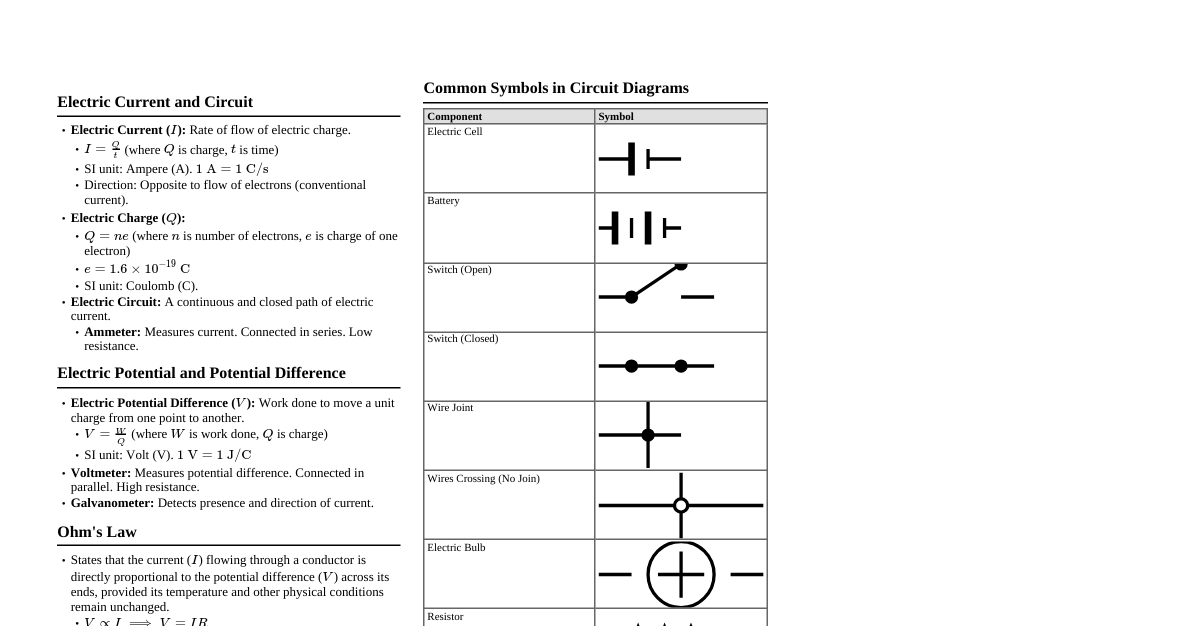
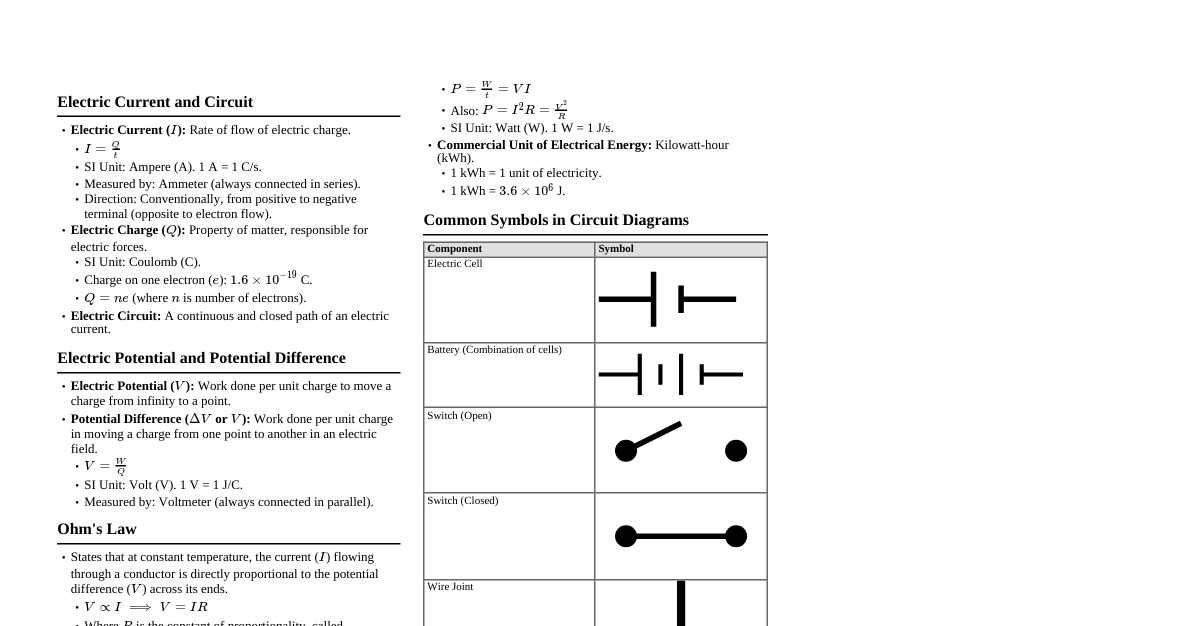
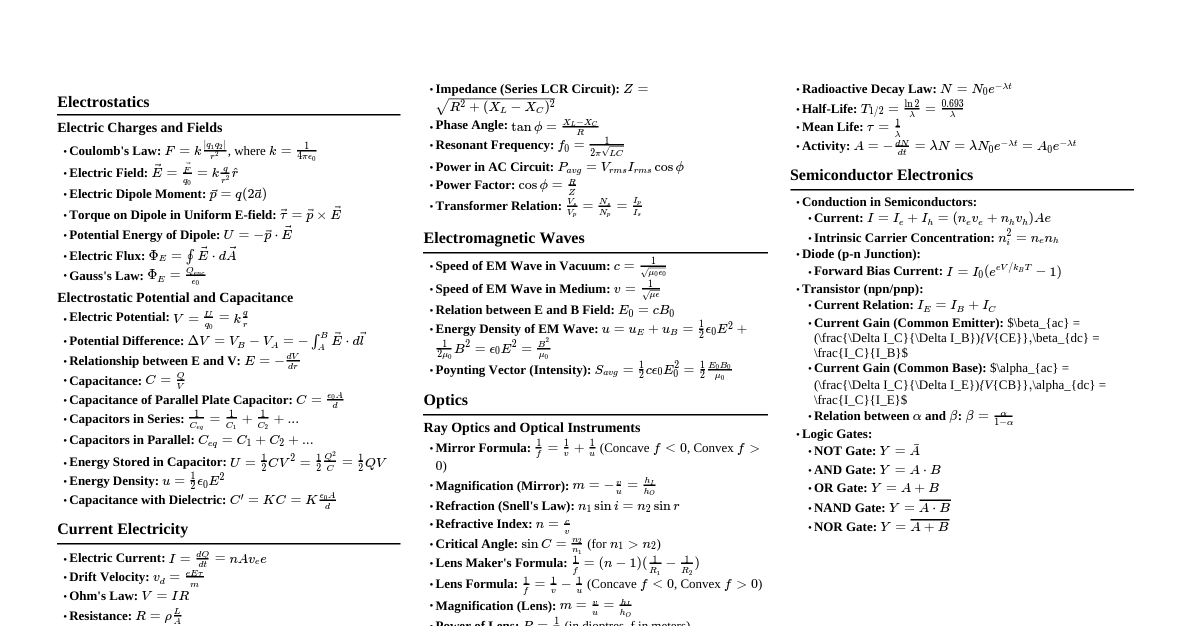
Electric Current and Circuit Electric Current (I): Rate of flow of electric charge. $I = \frac{Q}{t}$ SI Unit: Ampere (A). $1 \text{ A} = 1 \text{ C/s}$. Measured by: Ammeter (connected in series). Electric Charge (Q): Property of matter responsible for electric phenomena. Unit: Coulomb (C). $1 \text{ C} \approx 6 \times 10^{18}$ electrons. Charge on one electron ($e$): $-1.6 \times 10^{-19} \text{ C}$. Charge on one proton ($p$): $+1.6 \times 10^{-19} \text{ C}$. Direction of Current: Conventionally, from positive to negative terminal (opposite to electron flow). Electric Circuit: A continuous and closed path of an electric current. Circuit Diagram Symbols: Component Symbol Electric Cell Battery Switch (Open) Switch (Closed) Wire Joint Wires Crossing (No Joint) Electric Bulb Resistor Variable Resistor Ammeter A Voltmeter V Electric Potential and Potential Difference Electric Potential (V): Work done per unit charge in bringing a charge from infinity to a point. Potential Difference ($\Delta V$): Work done per unit charge in moving a charge from one point to another. $\Delta V = V_B - V_A = \frac{W}{Q}$ SI Unit: Volt (V). $1 \text{ V} = 1 \text{ J/C}$. Measured by: Voltmeter (connected in parallel). Ohm's Law States that the potential difference (V) across the ends of a metallic conductor is directly proportional to the current (I) flowing through it, provided its temperature remains the same. $V \propto I \implies V = IR$ R: Resistance of the conductor. SI Unit of Resistance: Ohm ($\Omega$). $1 \Omega = 1 \text{ V/A}$. Resistance Definition: The property of a conductor to resist the flow of charges through it. Factors Affecting Resistance: Directly proportional to length (L): $R \propto L$ Inversely proportional to area of cross-section (A): $R \propto \frac{1}{A}$ Nature of the material (resistivity $\rho$). Temperature. Formula: $R = \rho \frac{L}{A}$ Resistivity ($\rho$): SI Unit: Ohm-metre ($\Omega \text{ m}$). Does not change with length or area, but changes with temperature and material. Conductors: Low resistivity ($10^{-8}$ to $10^{-6} \Omega \text{ m}$). Insulators: High resistivity ($10^{12}$ to $10^{17} \Omega \text{ m}$). Alloys: Higher resistivity than their constituent metals, less sensitive to temperature changes. Combination of Resistors Resistors in Series: Same current flows through each resistor. Total potential difference is the sum of individual potential differences. Equivalent Resistance: $R_S = R_1 + R_2 + R_3 + ...$ $R_S$ is greater than the greatest individual resistance. Resistors in Parallel: Same potential difference across each resistor. Total current is the sum of individual currents. Equivalent Resistance: $\frac{1}{R_P} = \frac{1}{R_1} + \frac{1}{R_2} + \frac{1}{R_3} + ...$ $R_P$ is smaller than the smallest individual resistance. Heating Effect of Electric Current (Joule's Law) When current flows through a resistor, electrical energy is converted into heat energy. Heat Produced (H): $H = VIt$ Using Ohm's Law ($V=IR$): $H = I^2Rt$ Using Ohm's Law ($I=V/R$): $H = \frac{V^2}{R}t$ SI Unit: Joule (J). Applications: Electric heater, electric iron, electric bulb (filament heats up and glows), electric fuse. Electric Fuse: Safety device based on heating effect. Made of a wire with low melting point (usually an alloy of lead and tin). Connected in series with the live wire. Melts and breaks the circuit if current exceeds a safe limit. Electric Power Definition: The rate at which electrical energy is consumed or dissipated. $P = \frac{W}{t}$ $P = VI$ Using Ohm's Law: $P = I^2R = \frac{V^2}{R}$ SI Unit: Watt (W). $1 \text{ W} = 1 \text{ J/s}$. $1 \text{ kilowatt (kW)} = 1000 \text{ W}$. Commercial Unit of Electrical Energy: Kilowatt-hour (kWh). $1 \text{ kWh} = 3.6 \times 10^6 \text{ J}$. Known as 'unit' in household electricity bills.