Class 12 Organic Chemistry Rea
Cheatsheet Content
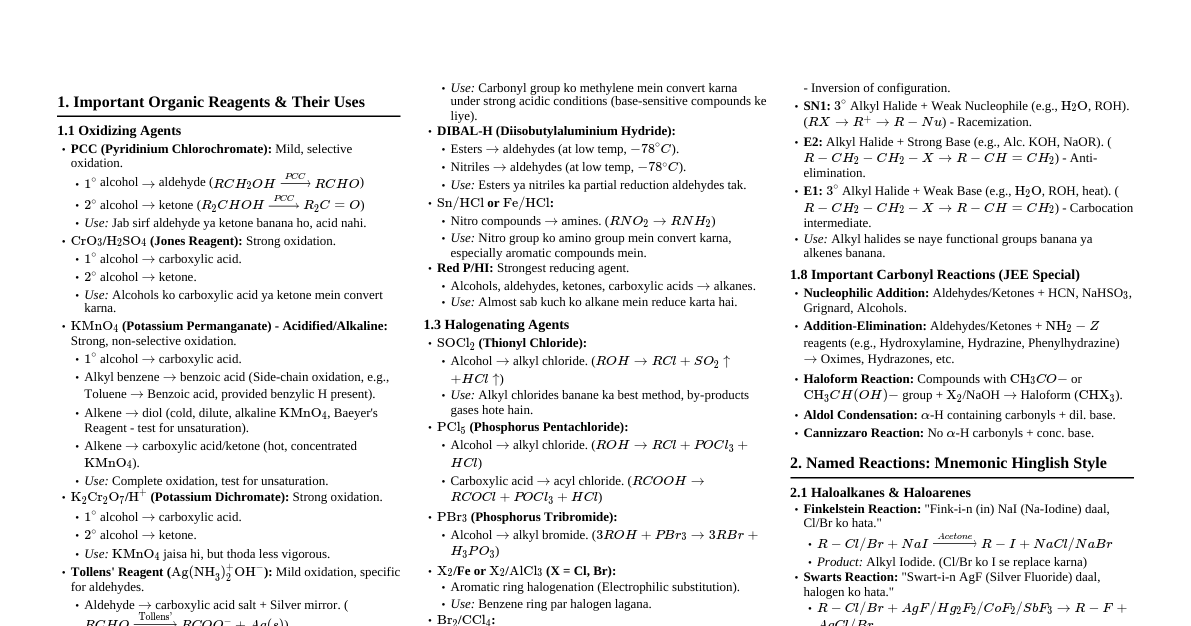
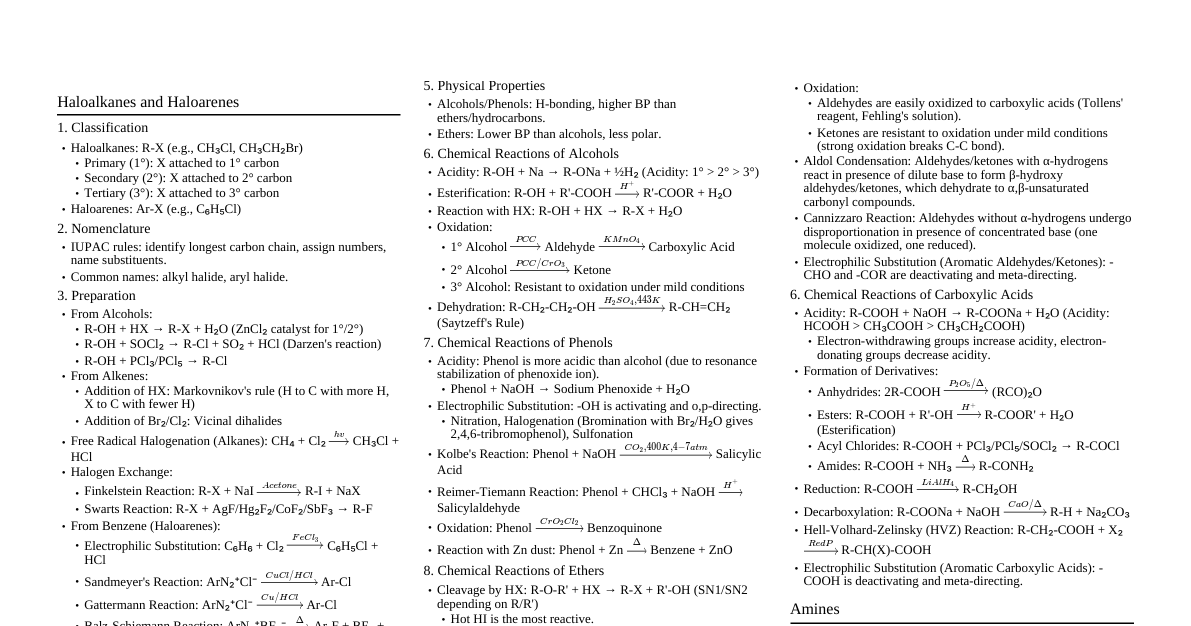
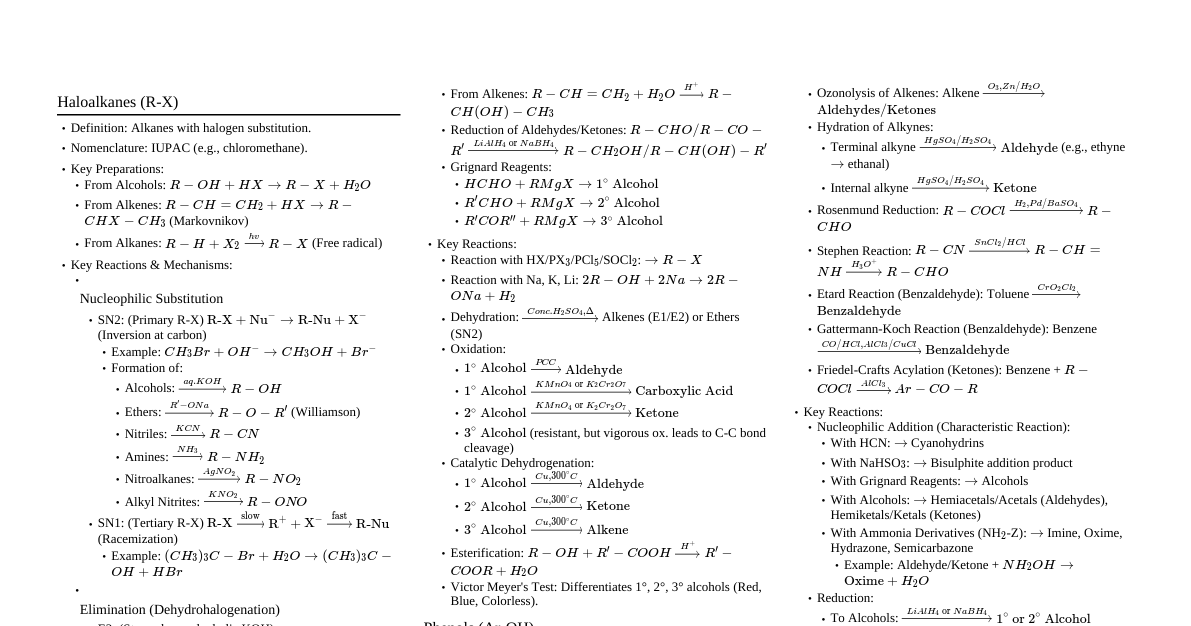
### Haloalkanes and Haloarenes #### Nucleophilic Substitution Reactions (SN1, SN2) - **SN2 Reaction:** (Concerted, primary alkyl halides, strong nucleophile) - $R-X + Nu^- \rightarrow R-Nu + X^-$ - Example: $CH_3Br + OH^- \rightarrow CH_3OH + Br^-$ - **SN1 Reaction:** (Two steps, carbocation intermediate, tertiary alkyl halides, weak nucleophile) - $R_3C-X \rightarrow R_3C^+ + X^-$ (slow) - $R_3C^+ + Nu^- \rightarrow R_3C-Nu$ (fast) - Example: $(CH_3)_3C-Br + H_2O \rightarrow (CH_3)_3C-OH + HBr$ #### Elimination Reactions (E1, E2) - **Dehydrohalogenation:** Alkyl halide + Alc. KOH $\rightarrow$ Alkene - Example: $CH_3CH_2Br + KOH(alc) \rightarrow CH_2=CH_2 + KBr + H_2O$ - *Saytzeff's Rule:* More substituted alkene is major product. #### Reactions with Metals - **Wurtz Reaction:** (Repeating reaction - Board Exam) - $2RX + 2Na \xrightarrow{dry \ ether} R-R + 2NaX$ - Example: $2CH_3Br + 2Na \xrightarrow{dry \ ether} CH_3-CH_3 + 2NaBr$ - **Wurtz-Fittig Reaction:** - $RX + ArX + 2Na \xrightarrow{dry \ ether} R-Ar + 2NaX$ - Example: $CH_3Br + C_6H_5Br + 2Na \xrightarrow{dry \ ether} C_6H_5CH_3 + 2NaBr$ - **Fittig Reaction:** - $2ArX + 2Na \xrightarrow{dry \ ether} Ar-Ar + 2NaX$ - Example: $2C_6H_5Br + 2Na \xrightarrow{dry \ ether} C_6H_5-C_6H_5 + 2NaBr$ - **Grignard Reagent Formation:** $RX + Mg \xrightarrow{dry \ ether} RMgX$ #### Reactions of Haloarenes - **Electrophilic Substitution:** (Halogen is deactivating but o,p-directing) - Halogenation: $C_6H_5Cl + Cl_2 \xrightarrow{FeCl_3} o/p-C_6H_4Cl_2$ - Nitration: $C_6H_5Cl + HNO_3/H_2SO_4 \rightarrow o/p-C_6H_4ClNO_2$ - Sulphonation: $C_6H_5Cl + H_2SO_4 \rightarrow o/p-C_6H_4ClSO_3H$ - Friedel-Crafts Alkylation/Acylation: $C_6H_5Cl + CH_3Cl \xrightarrow{AlCl_3} o/p-C_6H_4ClCH_3$ - **Replacement by Hydroxyl Group (Dow's Process):** - $C_6H_5Cl + NaOH \xrightarrow{623K, 300atm} C_6H_5ONa \xrightarrow{H^+} C_6H_5OH$ ### Alcohols, Phenols and Ethers #### Preparation of Alcohols - **From Alkenes:** - Acid catalysed hydration: $CH_2=CH_2 + H_2O \xrightarrow{H^+} CH_3CH_2OH$ - Hydroboration-oxidation: $R-CH=CH_2 \xrightarrow{(BH_3)_2, H_2O_2/OH^-} R-CH_2CH_2OH$ (Anti-Markovnikov) - **From Carbonyl Compounds (Reduction):** - Aldehydes $\xrightarrow{LiAlH_4 \text{ or } NaBH_4} 1^\circ$ Alcohol - Ketones $\xrightarrow{LiAlH_4 \text{ or } NaBH_4} 2^\circ$ Alcohol - Carboxylic Acids/Esters $\xrightarrow{LiAlH_4} 1^\circ$ Alcohol - **From Grignard Reagents:** - Formaldehyde + RMgX $\rightarrow 1^\circ$ Alcohol - Aldehyde (other) + RMgX $\rightarrow 2^\circ$ Alcohol - Ketone + RMgX $\rightarrow 3^\circ$ Alcohol #### Reactions of Alcohols - **Reaction with HX (Lucas Test):** $ROH + HX \xrightarrow{ZnCl_2} RX + H_2O$ - Reactivity: $3^\circ > 2^\circ > 1^\circ$ - **Dehydration:** (Repeating reaction - Board Exam) - $ROH \xrightarrow{Conc. H_2SO_4, \Delta} Alkene$ - Example: $CH_3CH_2OH \xrightarrow{Conc. H_2SO_4, 443K} CH_2=CH_2$ - **Oxidation:** - $1^\circ ROH \xrightarrow{PCC} Aldehyde$ - $1^\circ ROH \xrightarrow{CrO_3 \text{ or } KMnO_4} Carboxylic \ Acid$ - $2^\circ ROH \xrightarrow{PCC \text{ or } CrO_3} Ketone$ - $3^\circ ROH$ are resistant to oxidation. #### Preparation of Phenols - **From Haloarenes (Dow's Process):** (See Haloalkanes) - **From Benzenediazonium Salt:** $ArN_2^+Cl^- + H_2O \xrightarrow{\Delta} ArOH + N_2 + HCl$ - **From Cumene:** Cumene $\xrightarrow{O_2} \text{Cumene Hydroperoxide} \xrightarrow{H_3O^+} Phenol + Acetone$ #### Reactions of Phenols - **Electrophilic Substitution:** (OH is activating and o,p-directing) - Nitration: Phenol $\xrightarrow{dil. HNO_3} o/p-Nitrophenol$ - Nitration: Phenol $\xrightarrow{Conc. HNO_3} 2,4,6-Trinitrophenol \ (Picric \ Acid)$ - Bromination: Phenol $\xrightarrow{Br_2/CS_2} o/p-Bromophenol$ - Bromination: Phenol $\xrightarrow{Br_2/H_2O} 2,4,6-Tribromophenol$ - Kolbe's Reaction: (Repeating reaction - Board Exam) - Phenol $\xrightarrow{NaOH} Sodium \ Phenoxide \xrightarrow{CO_2, H^+} Salicylic \ Acid$ - Reimer-Tiemann Reaction: (Repeating reaction - Board Exam) - Phenol $\xrightarrow{CHCl_3/NaOH} \text{Intermediate} \xrightarrow{H^+} Salicylaldehyde$ - **Oxidation:** Phenol $\xrightarrow{CrO_3} Benzoquinone$ #### Preparation of Ethers - **Dehydration of Alcohols:** (Symmetric ethers) - $2ROH \xrightarrow{Conc. H_2SO_4, 413K} ROR + H_2O$ - **Williamson Synthesis:** (Repeating reaction - Board Exam) - $R-X + R'-ONa \rightarrow R-O-R' + NaX$ - Prefer $1^\circ$ alkyl halide for best yield. #### Reactions of Ethers - **Cleavage by HI/HBr:** - $R-O-R' + HI \rightarrow RI + R'OH$ (if $R$ or $R'$ is $1^\circ$ or $2^\circ$) - If one group is tertiary, then $3^\circ$ alkyl iodide is formed. - If one group is aryl, then phenol is formed. ### Aldehydes, Ketones and Carboxylic Acids #### Preparation of Aldehydes - **From Alcohols:** $1^\circ ROH \xrightarrow{PCC} Aldehyde$ - **From Acyl Chlorides (Rosenmund Reduction):** (Repeating reaction - Board Exam) - $RCOCl \xrightarrow{H_2/Pd-BaSO_4} RCHO$ - **From Nitriles (Stephen Reaction):** - $R-C \equiv N \xrightarrow{SnCl_2/HCl} R-CH=NH \xrightarrow{H_3O^+} RCHO$ - **From Esters (DIBAL-H):** $RCOOR' \xrightarrow{DIBAL-H} RCHO$ - **Etard Reaction (for Toluene):** (Repeating reaction - Board Exam) - Toluene $\xrightarrow{CrO_2Cl_2} \text{Chromium complex} \xrightarrow{H_3O^+} Benzaldehyde$ - **Gatterman-Koch Reaction (for Benzene):** - Benzene $\xrightarrow{CO/HCl \text{ in } AlCl_3/CuCl} Benzaldehyde$ #### Preparation of Ketones - **From Alcohols:** $2^\circ ROH \xrightarrow{PCC \text{ or } CrO_3} Ketone$ - **From Nitriles + Grignard Reagent:** - $R-C \equiv N + R'MgX \xrightarrow{H_3O^+} RCOR'$ - **From Acyl Chlorides + Dialkylcadmium:** - $2RCOCl + (R')_2Cd \rightarrow 2RCOR' + CdCl_2$ - **Friedel-Crafts Acylation (for Arenes):** - Benzene $\xrightarrow{RCOCl/AlCl_3} RCOR'$ (Aromatic Ketone) #### Reactions of Aldehydes and Ketones - **Nucleophilic Addition Reactions:** - Addition of HCN: Cyanohydrin formation - Addition of NaHSO$_3$: Bisulphite addition product - Addition of Grignard Reagents: Alcohols (see Alcohols section) - Addition of Alcohols (Hemiacetal/Acetal formation) - Addition of Ammonia derivatives (e.g., Hydrazine, Hydroxylamine) - **Reduction:** - To Alcohols: $\xrightarrow{NaBH_4 \text{ or } LiAlH_4}$ (see Alcohols section) - To Hydrocarbons: - Clemmensen Reduction: (Repeating reaction - Board Exam) - Carbonyl $\xrightarrow{Zn-Hg/Conc. HCl} Alkane$ - Wolff-Kishner Reduction: (Repeating reaction - Board Exam) - Carbonyl $\xrightarrow{NH_2NH_2/KOH, \text{ethylene glycol}} Alkane$ - **Oxidation:** - Aldehydes $\xrightarrow{Tollens' \ Reagent \text{ or } Fehlings' \ Solution} Carboxylic \ Acid$ - Ketones are generally resistant, but with strong oxidizing agents (KMnO$_4$/H$_2$SO$_4$) give carboxylic acids with fewer carbons. - **Aldol Condensation:** (Repeating reaction - Board Exam) - Aldehydes/Ketones with $\alpha$-hydrogen + dil. NaOH $\rightarrow \beta$-hydroxy aldehyde/ketone $\xrightarrow{\Delta} \alpha,\beta$-unsaturated aldehyde/ketone - **Cannizzaro Reaction:** (Repeating reaction - Board Exam) - Aldehydes *without* $\alpha$-hydrogen + Conc. NaOH $\rightarrow$ Alcohol + Carboxylic acid salt - **Cross Aldol Condensation:** Between two different aldehydes/ketones. - **Electrophilic Substitution (for Aromatic Aldehydes/Ketones):** - Carbonyl group is deactivating and meta-directing. - Example: Benzaldehyde $\xrightarrow{HNO_3/H_2SO_4} m-Nitrobenzaldehyde$ #### Preparation of Carboxylic Acids - **From Primary Alcohols:** $RCH_2OH \xrightarrow{KMnO_4} RCOOH$ - **From Aldehydes:** $RCHO \xrightarrow{Tollens' \ Reagent \text{ or } Fehlings' \ Solution} RCOOH$ - **From Alkylbenzenes:** $Ar-R \xrightarrow{KMnO_4} Ar-COOH$ - **From Nitriles and Amides:** $R-C \equiv N \text{ or } RCONH_2 \xrightarrow{H_3O^+ \text{ or } OH^-} RCOOH$ - **From Grignard Reagents:** $RMgX + CO_2 \xrightarrow{H_3O^+} RCOOH$ - **From Acyl Halides/Anhydrides/Esters:** Hydrolysis yields carboxylic acids. #### Reactions of Carboxylic Acids - **Acidity:** Reacts with bases, metals, carbonates. - **Formation of Anhydrides:** $2RCOOH \xrightarrow{P_2O_5/\Delta} (RCO)_2O$ - **Esterification:** $RCOOH + R'OH \xrightarrow{H_2SO_4} RCOOR' + H_2O$ - **Reduction:** $RCOOH \xrightarrow{LiAlH_4} RCH_2OH$ - **Decarboxylation:** $RCOOH \xrightarrow{NaOH/CaO, \Delta} R-H + Na_2CO_3$ - **Hell-Volhard-Zelinsky (HVZ) Reaction:** (Repeating reaction - Board Exam) - $R-CH_2-COOH \xrightarrow{X_2/Red P} R-CH(X)-COOH$ - **Electrophilic Substitution (for Benzoic Acid):** - Carboxyl group is deactivating and meta-directing. - Example: Benzoic acid $\xrightarrow{HNO_3/H_2SO_4} m-Nitrobenzoic \ Acid$ ### Amines #### Preparation of Amines - **Reduction of Nitro Compounds:** - $RNO_2 \xrightarrow{Sn/HCl \text{ or } Fe/HCl \text{ or } H_2/Pd} RNH_2$ - **Ammonolysis of Alkyl Halides:** - $RX + NH_3 \rightarrow RNH_2 \rightarrow R_2NH \rightarrow R_3N \rightarrow R_4N^+X^-$ (mixture) - **Reduction of Nitriles:** $R-C \equiv N \xrightarrow{LiAlH_4 \text{ or } H_2/Ni} RCH_2NH_2$ - **Reduction of Amides:** $RCONH_2 \xrightarrow{LiAlH_4} RCH_2NH_2$ - **Gabriel Phthalimide Synthesis:** (For $1^\circ$ amines only) - Phthalimide $\xrightarrow{KOH} \text{Potassium Phthalimide} \xrightarrow{RX} N-Alkylphthalimide \xrightarrow{NaOH/\Delta} RNH_2$ - **Hoffmann Bromamide Degradation Reaction:** (Repeating reaction - Board Exam) - $RCONH_2 \xrightarrow{Br_2/NaOH} RNH_2 + Na_2CO_3 + NaBr + H_2O$ (one carbon less) #### Reactions of Amines - **Basicity:** Amines are basic due to lone pair on N. - Order of basicity: $2^\circ > 1^\circ > 3^\circ$ (aqueous solution) - Aromatic amines are less basic than aliphatic amines. - **Alkylation:** $RNH_2 + R'X \rightarrow RNHR'$ (mixture of $1^\circ, 2^\circ, 3^\circ$) - **Acylation:** $RNH_2 + R'COCl \rightarrow RNHCOR' + HCl$ (Amide formation) - **Carbylamine Reaction (Isocyanide Test):** (Repeating reaction - Board Exam) - $RNH_2 (1^\circ) + CHCl_3 + KOH(alc) \xrightarrow{\Delta} RNC + 3KCl + 3H_2O$ (Foul smell) - **Reaction with Nitrous Acid ($HNO_2$):** - $1^\circ$ Aliphatic Amine: $RNH_2 \xrightarrow{NaNO_2/HCl} R-N_2^+Cl^- \rightarrow ROH + N_2 + HCl$ - $1^\circ$ Aromatic Amine (Diazotisation): (Repeating reaction - Board Exam) - $ArNH_2 \xrightarrow{NaNO_2/HCl, 273-278K} ArN_2^+Cl^-$ (Benzenediazonium Chloride) - **Hinsberg's Test:** (Distinguishes $1^\circ, 2^\circ, 3^\circ$ amines) - Reaction with Benzenesulphonyl chloride ($C_6H_5SO_2Cl$) - $1^\circ$ amine: forms sulphonamide soluble in KOH. - $2^\circ$ amine: forms sulphonamide insoluble in KOH. - $3^\circ$ amine: does not react. #### Reactions of Diazonium Salts - **Replacement Reactions:** - **Sandmeyer Reaction:** (Repeating reaction - Board Exam) - $ArN_2^+Cl^- \xrightarrow{CuCl/HCl \text{ or } CuBr/HBr \text{ or } CuCN/KCN} ArCl/ArBr/ArCN + N_2$ - **Gatterman Reaction:** - $ArN_2^+Cl^- \xrightarrow{Cu/HCl \text{ or } Cu/HBr} ArCl/ArBr + N_2$ - Replacement by I: $ArN_2^+Cl^- \xrightarrow{KI} ArI + N_2 + KCl$ - Replacement by F (Balz-Schiemann Reaction): $ArN_2^+Cl^- \xrightarrow{HBF_4} ArN_2^+BF_4^- \xrightarrow{\Delta} ArF + BF_3 + N_2$ - Replacement by H: $ArN_2^+Cl^- \xrightarrow{H_3PO_2/H_2O \text{ or } C_2H_5OH} ArH + N_2 + HCl$ - Replacement by OH: $ArN_2^+Cl^- \xrightarrow{H_2O/\Delta} ArOH + N_2 + HCl$ - Replacement by NO$_2$: $ArN_2^+Cl^- \xrightarrow{HBF_4, NaNO_2/Cu} ArNO_2 + N_2 + NaBF_4$ - **Coupling Reactions:** (Repeating reaction - Board Exam) - $ArN_2^+Cl^- + Phenol \xrightarrow{NaOH} p-Hydroxyazobenzene$ (Orange dye) - $ArN_2^+Cl^- + Aniline \xrightarrow{HCl} p-Aminoazobenzene$ (Yellow dye) ### Biomolecules #### Glucose Reactions - **Reaction with HI:** Glucose $\xrightarrow{HI/\Delta} n-Hexane$ (confirms straight chain) - **Reaction with Hydroxylamine:** Glucose $\xrightarrow{NH_2OH} Oxime$ - **Reaction with HCN:** Glucose $\xrightarrow{HCN} Cyanohydrin$ - **Oxidation with Bromine Water:** Glucose $\xrightarrow{Br_2/H_2O} Gluconic \ Acid$ (mild oxidising agent) - **Oxidation with Nitric Acid:** Glucose $\xrightarrow{HNO_3} Saccharic \ Acid$ (strong oxidising agent) - **Reduction with NaBH$_4$ or H$_2$/Ni:** Glucose $\xrightarrow{NaBH_4} Sorbitol$ - **Acetylation:** Glucose $\xrightarrow{(CH_3CO)_2O/Pyridine} \text{Glucose Pentaacetate}$ (confirms 5 -OH groups) #### Sucrose Hydrolysis - Sucrose $\xrightarrow{H_2O/H^+} Glucose + Fructose$ #### Peptide Bond Formation - Amino acid 1 + Amino acid 2 $\xrightarrow{\text{dehydration}} \text{Peptide bond} + H_2O$ #### Denaturation of Proteins - Protein $\xrightarrow{Heat/Acid/Base} \text{Denatured Protein}$ (loss of biological activity, coagulation)