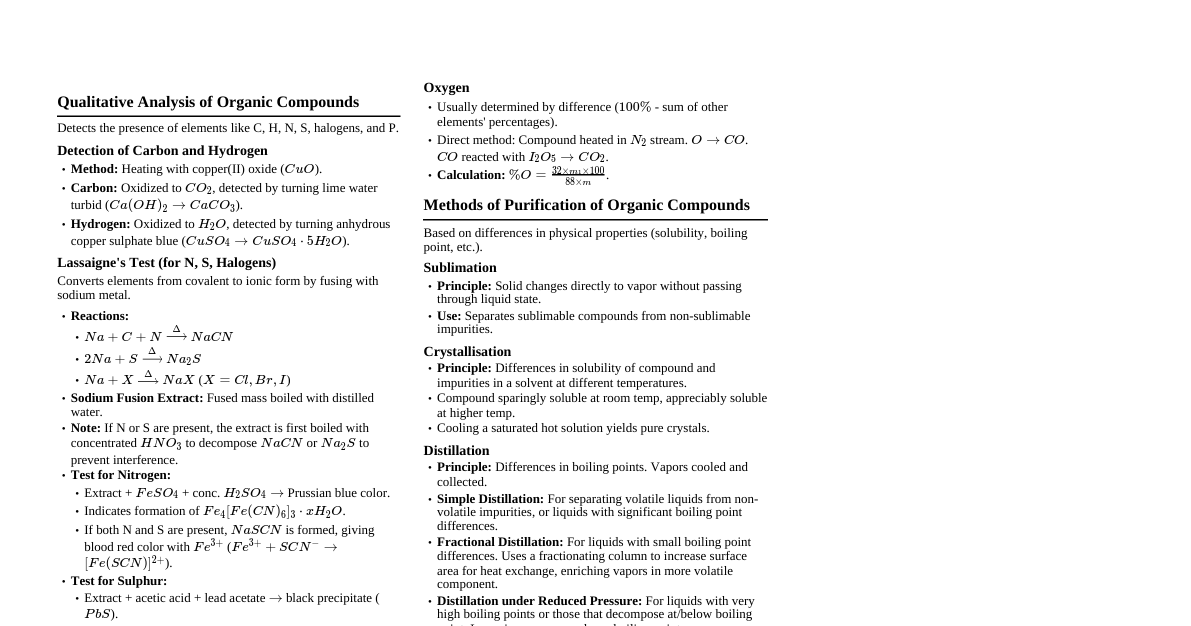
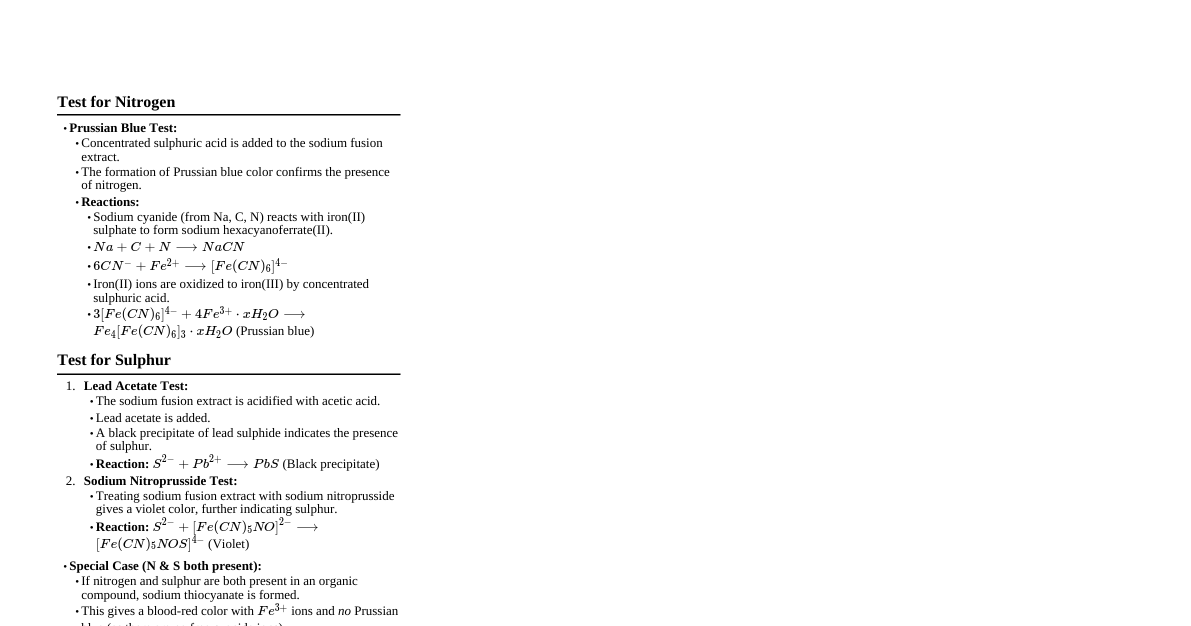
### Qualitative Analysis of Organic Compounds The elements commonly present in organic compounds are carbon and hydrogen. Additionally, they may also contain oxygen, nitrogen, sulfur, halogens, and phosphorus. ### Detection of Carbon and Hydrogen Carbon and hydrogen are detected by heating the organic compound with copper(II) oxide. - **Carbon:** Oxidized to carbon dioxide ($CO_2$), which turns lime-water ($Ca(OH)_2$) turbid. - $C + 2CuO \xrightarrow{\Delta} 2Cu + CO_2$ - $CO_2 + Ca(OH)_2 \rightarrow CaCO_3 \downarrow + H_2O$ (Turbidity) - **Hydrogen:** Oxidized to water ($H_2O$), which turns anhydrous copper sulfate ($CuSO_4$) blue. - $2H + CuO \xrightarrow{\Delta} Cu + H_2O$ - $5H_2O + CuSO_4 \rightarrow CuSO_4 \cdot 5H_2O$ (Blue color) ### Detection of Other Elements (Lassaigne's Test) Nitrogen, sulfur, halogens, and phosphorus in organic compounds are detected using Lassaigne's test. The elements are converted from covalent to ionic form by fusing the organic compound with sodium metal. #### Reactions During Fusion: - **Nitrogen:** $Na + C + N \xrightarrow{\Delta} NaCN$ (Sodium Cyanide) - **Sulfur:** $2Na + S \xrightarrow{\Delta} Na_2S$ (Sodium Sulfide) - **Halogens (X = Cl, Br, or I):** $Na + X \xrightarrow{\Delta} NaX$ (Sodium Halide) The C, N, S, and X originate from the organic compound. The formed sodium cyanide, sulfide, and halide are extracted by boiling the fused mass with distilled water. This aqueous extract is known as the **sodium fusion extract**. #### (A) Test for Nitrogen The sodium fusion extract is boiled with iron(II) sulfate and then acidified. - If the sodium fusion is carried out with excess sodium, the thiocyanate formed ($NaSCN$) decomposes to yield cyanide ($CN^-$) and sulfide ($S^{2-}$).