Organic Chemistry Analysis
Cheatsheet Content
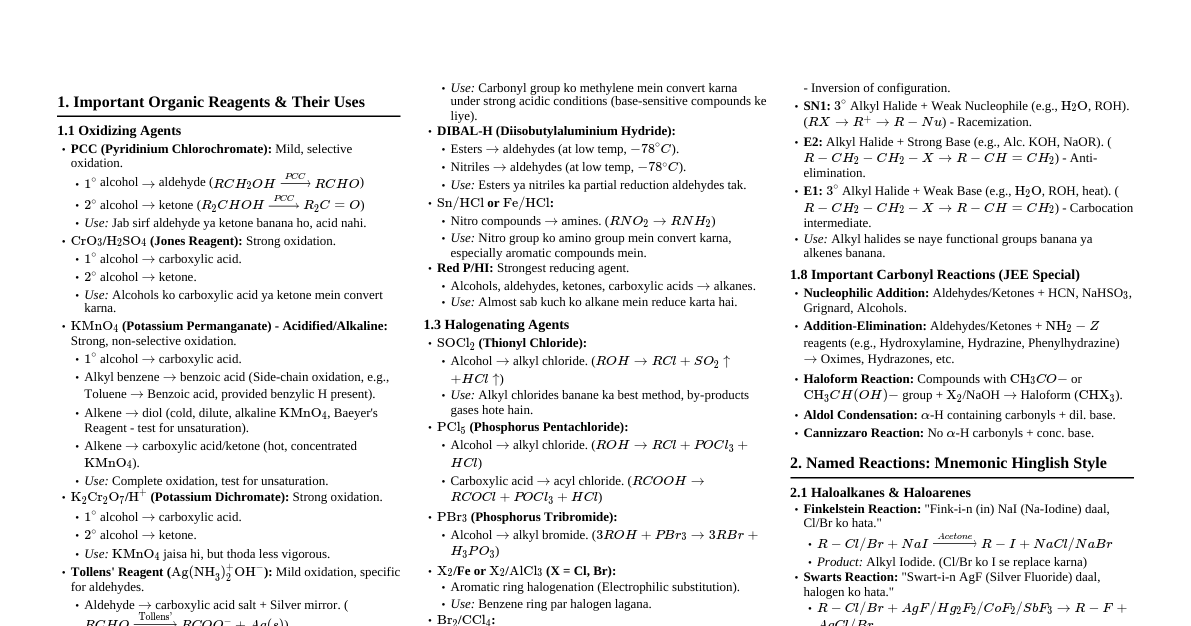
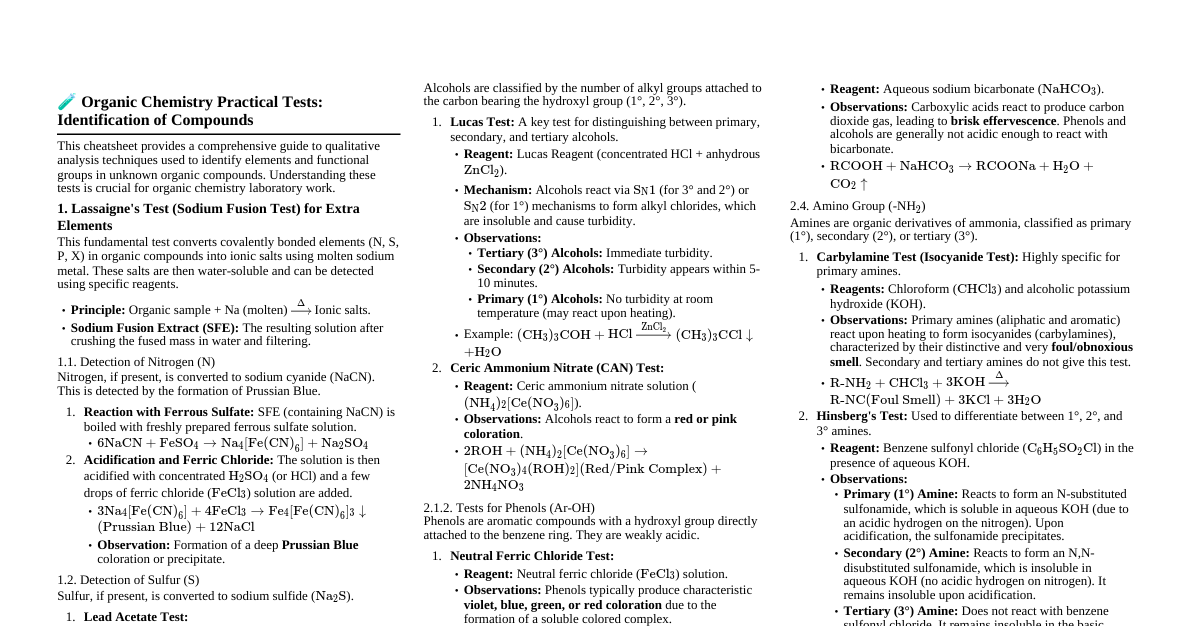
### Test for Nitrogen - **Prussian Blue Test:** - Concentrated sulphuric acid is added to the sodium fusion extract. - The formation of Prussian blue color confirms the presence of nitrogen. - **Reactions:** - Sodium cyanide (from Na, C, N) reacts with iron(II) sulphate to form sodium hexacyanoferrate(II). - $Na + C + N \longrightarrow NaCN$ - $6CN^- + Fe^{2+} \longrightarrow [Fe(CN)_6]^{4-}$ - Iron(II) ions are oxidized to iron(III) by concentrated sulphuric acid. - $3[Fe(CN)_6]^{4-} + 4Fe^{3+} \cdot xH_2O \longrightarrow Fe_4[Fe(CN)_6]_3 \cdot xH_2O$ (Prussian blue) ### Test for Sulphur 1. **Lead Acetate Test:** - The sodium fusion extract is acidified with acetic acid. - Lead acetate is added. - A black precipitate of lead sulphide indicates the presence of sulphur. - **Reaction:** $S^{2-} + Pb^{2+} \longrightarrow PbS$ (Black precipitate) 2. **Sodium Nitroprusside Test:** - Treating sodium fusion extract with sodium nitroprusside gives a violet color, further indicating sulphur. - **Reaction:** $S^{2-} + [Fe(CN)_5NO]^{2-} \longrightarrow [Fe(CN)_5NOS]^{4-}$ (Violet) - **Special Case (N & S both present):** - If nitrogen and sulphur are both present in an organic compound, sodium thiocyanate is formed. - This gives a blood-red color with $Fe^{3+}$ ions and *no* Prussian blue (as there are no free cyanide ions). - **Reactions:** - $Na + C + N + S \longrightarrow NaSCN$ - $Fe^{3+} + SCN^- \longrightarrow [Fe(SCN)]^{2+}$ (Blood red) - If sodium fusion is carried out with excess sodium, thiocyanate decomposes to yield cyanide and sulphide, which then give their usual tests. - **Reaction:** $NaSCN + 2Na \longrightarrow NaCN + Na_2S$ ### Test for Halogens - The sodium fusion extract is acidified with nitric acid and then treated with silver nitrate. - **Observations:** - A white precipitate, soluble in ammonium hydroxide, shows the presence of chlorine ($AgCl$). - A yellowish precipitate, sparingly soluble in ammonium hydroxide, shows the presence of bromine ($AgBr$). - A yellow precipitate, insoluble in ammonium hydroxide, shows the presence of iodine ($AgI$). - **General Reaction:** $X^- + Ag^+ \longrightarrow AgX$ (where X = Cl, Br, or I) - **Interference Note:** If nitrogen or sulphur is also present, the sodium fusion extract is first boiled with concentrated nitric acid to decompose cyanide or sulphide ions, which would otherwise interfere with the silver nitrate test for halogens. ### Test for Phosphorus - The compound is heated with an oxidizing agent (e.g., sodium peroxide) to oxidize phosphorus to phosphate. - The solution is boiled with nitric acid and then treated with ammonium molybdate. - A yellow coloration or precipitate indicates the presence of phosphorus. - **Reactions:** - $Na_3PO_4 + 3HNO_3 \longrightarrow H_3PO_4 + 3NaNO_3$ - $H_3PO_4 + 12(NH_4)_2MoO_4 + 21HNO_3 \longrightarrow (NH_4)_3PO_4 \cdot 12MoO_3 + 21NH_4NO_3 + 12H_2O$ (Ammonium phosphomolybdate, yellow precipitate) ### Quantitative Analysis - Quantitative analysis helps determine the mass percentage of elements in a compound, crucial for empirical and molecular formula determination. #### Carbon and Hydrogen (Liebig's Method) - Both carbon and hydrogen are estimated in one experiment. - A known mass of an organic compound is burnt in the presence of excess oxygen and copper(II) oxide. - Carbon and hydrogen in the compound are oxidized to carbon dioxide and water, respectively. - **Combustion Reaction:** $C_xH_y + (x + y/4)O_2 \longrightarrow xCO_2 + (y/2)H_2O$