Calculus Formulas for Physics
Cheatsheet Content
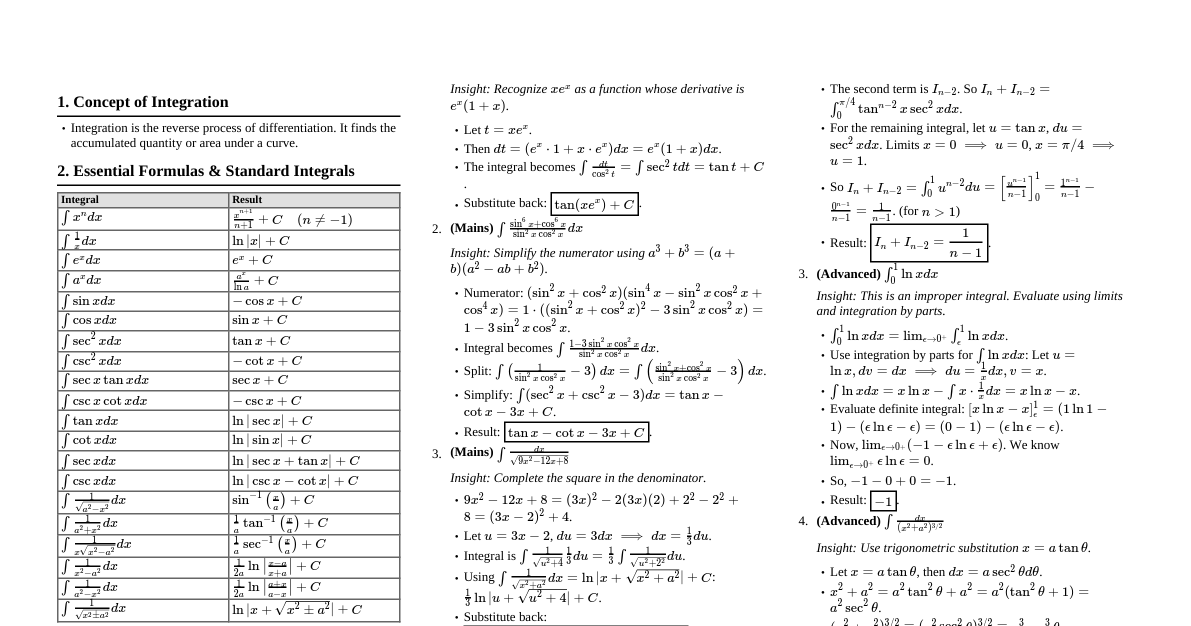
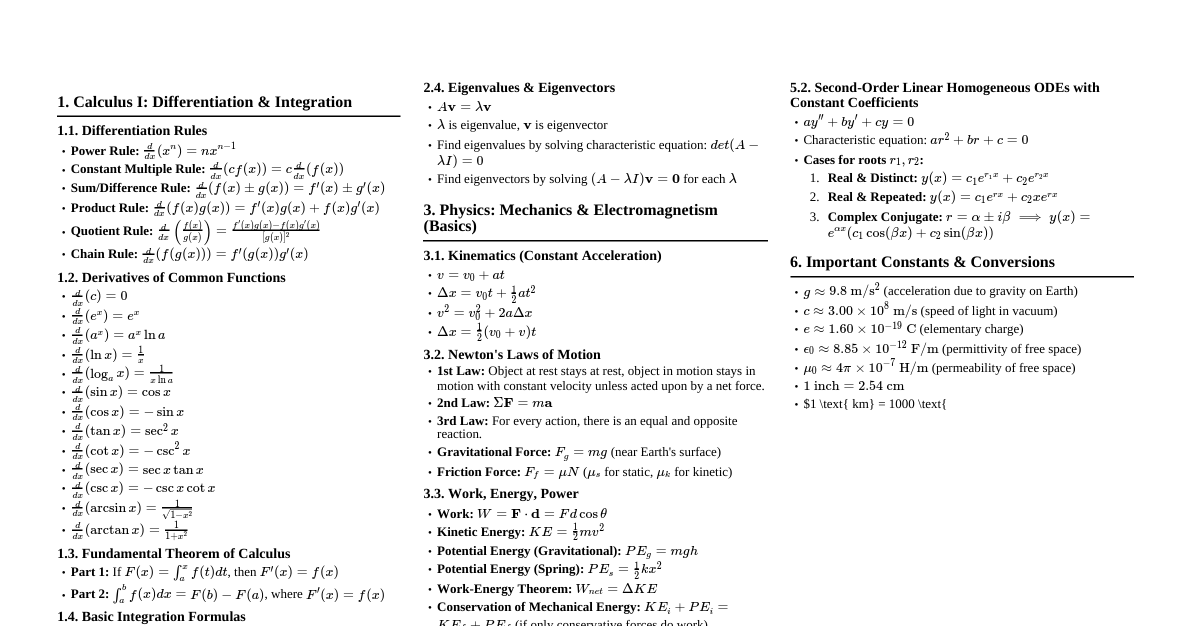
Differentiation Rules Constant Rule: $\frac{d}{dx}(c) = 0$ Power Rule: $\frac{d}{dx}(x^n) = nx^{n-1}$ Constant Multiple Rule: $\frac{d}{dx}(cf(x)) = c\frac{d}{dx}(f(x))$ Sum/Difference Rule: $\frac{d}{dx}(f(x) \pm g(x)) = \frac{d}{dx}(f(x)) \pm \frac{d}{dx}(g(x))$ Product Rule: $\frac{d}{dx}(f(x)g(x)) = f'(x)g(x) + f(x)g'(x)$ Quotient Rule: $\frac{d}{dx}\left(\frac{f(x)}{g(x)}\right) = \frac{f'(x)g(x) - f(x)g'(x)}{[g(x)]^2}$ Chain Rule: $\frac{d}{dx}(f(g(x))) = f'(g(x))g'(x)$ Derivatives of Common Functions $\frac{d}{dx}(e^x) = e^x$ $\frac{d}{dx}(a^x) = a^x \ln(a)$ $\frac{d}{dx}(\ln|x|) = \frac{1}{x}$ $\frac{d}{dx}(\log_a|x|) = \frac{1}{x \ln(a)}$ $\frac{d}{dx}(\sin x) = \cos x$ $\frac{d}{dx}(\cos x) = -\sin x$ $\frac{d}{dx}(\tan x) = \sec^2 x$ $\frac{d}{dx}(\csc x) = -\csc x \cot x$ $\frac{d}{dx}(\sec x) = \sec x \tan x$ $\frac{d}{dx}(\cot x) = -\csc^2 x$ $\frac{d}{dx}(\arcsin x) = \frac{1}{\sqrt{1-x^2}}$ $\frac{d}{dx}(\arctan x) = \frac{1}{1+x^2}$ Basic Integrals (Antiderivatives) $\int c \, dx = cx + C$ $\int x^n \, dx = \frac{x^{n+1}}{n+1} + C \quad (n \ne -1)$ $\int \frac{1}{x} \, dx = \ln|x| + C$ $\int e^x \, dx = e^x + C$ $\int a^x \, dx = \frac{a^x}{\ln(a)} + C$ $\int \sin x \, dx = -\cos x + C$ $\int \cos x \, dx = \sin x + C$ $\int \sec^2 x \, dx = \tan x + C$ $\int \csc^2 x \, dx = -\cot x + C$ $\int \sec x \tan x \, dx = \sec x + C$ $\int \csc x \cot x \, dx = -\csc x + C$ $\int \tan x \, dx = \ln|\sec x| + C = -\ln|\cos x| + C$ $\int \cot x \, dx = \ln|\sin x| + C$ $\int \sec x \, dx = \ln|\sec x + \tan x| + C$ $\int \csc x \, dx = \ln|\csc x - \cot x| + C$ $\int \frac{1}{\sqrt{a^2 - x^2}} \, dx = \arcsin\left(\frac{x}{a}\right) + C$ $\int \frac{1}{a^2 + x^2} \, dx = \frac{1}{a}\arctan\left(\frac{x}{a}\right) + C$ $\int \frac{1}{x\sqrt{x^2 - a^2}} \, dx = \frac{1}{a}\operatorname{arcsec}\left|\frac{x}{a}\right| + C$ Integrals Involving Exponentials $\int e^{ax} \, dx = \frac{1}{a}e^{ax} + C$ $\int x e^{ax} \, dx = \frac{e^{ax}}{a^2}(ax - 1) + C$ $\int x^n e^{ax} \, dx = \frac{1}{a}x^n e^{ax} - \frac{n}{a}\int x^{n-1} e^{ax} \, dx$ (Reduction Formula) $\int e^{ax} \sin(bx) \, dx = \frac{e^{ax}}{a^2+b^2}(a \sin(bx) - b \cos(bx)) + C$ $\int e^{ax} \cos(bx) \, dx = \frac{e^{ax}}{a^2+b^2}(a \cos(bx) + b \sin(bx)) + C$ $\int \frac{e^x}{x} \, dx = \operatorname{Ei}(x) + C$ (Exponential Integral, not elementary) Definite Integrals (Common Forms in Physics) Gaussian Integral: $\int_{-\infty}^{\infty} e^{-ax^2} \, dx = \sqrt{\frac{\pi}{a}}$ for $a > 0$ General Gaussian Integral: $\int_{-\infty}^{\infty} e^{-ax^2 + bx} \, dx = \sqrt{\frac{\pi}{a}} e^{b^2/(4a)}$ for $a > 0$ Integrals of $x^n e^{-ax^2}$: $\int_0^{\infty} e^{-ax^2} \, dx = \frac{1}{2}\sqrt{\frac{\pi}{a}}$ $\int_0^{\infty} x e^{-ax^2} \, dx = \frac{1}{2a}$ $\int_0^{\infty} x^2 e^{-ax^2} \, dx = \frac{1}{4}\sqrt{\frac{\pi}{a^3}}$ $\int_0^{\infty} x^3 e^{-ax^2} \, dx = \frac{1}{2a^2}$ $\int_0^{\infty} x^{2n} e^{-ax^2} \, dx = \frac{(2n)!}{n! 2^{2n+1}} \sqrt{\frac{\pi}{a^{2n+1}}}$ $\int_0^{\infty} x^{2n+1} e^{-ax^2} \, dx = \frac{n!}{2a^{n+1}}$ Integrals of $x^n e^{-ax}$: $\int_0^{\infty} e^{-ax} \, dx = \frac{1}{a}$ for $a > 0$ $\int_0^{\infty} x e^{-ax} \, dx = \frac{1}{a^2}$ for $a > 0$ $\int_0^{\infty} x^n e^{-ax} \, dx = \frac{n!}{a^{n+1}}$ for $a > 0$ (Gamma Function related: $\Gamma(n+1)/a^{n+1}$) Fourier Integral: $\int_{-\infty}^{\infty} e^{ikx} \, dx = 2\pi \delta(k)$ Fundamental Theorem of Calculus Part 1: If $F(x) = \int_a^x f(t) \, dt$, then $F'(x) = f(x)$ Part 2: $\int_a^b f(x) \, dx = F(b) - F(a)$, where $F'(x) = f(x)$ Definite Integral Properties $\int_a^b c f(x) \, dx = c \int_a^b f(x) \, dx$ $\int_a^b (f(x) \pm g(x)) \, dx = \int_a^b f(x) \, dx \pm \int_a^b g(x) \, dx$ $\int_a^a f(x) \, dx = 0$ $\int_a^b f(x) \, dx = -\int_b^a f(x) \, dx$ $\int_a^c f(x) \, dx = \int_a^b f(x) \, dx + \int_b^c f(x) \, dx$ Integration Techniques Substitution (U-Substitution): $\int f(g(x))g'(x) \, dx = \int f(u) \, du$ where $u = g(x)$ Integration by Parts: $\int u \, dv = uv - \int v \, du$ Series Summation Formulas Arithmetic Series: $S_n = \sum_{i=1}^{n} (a + (i-1)d) = \frac{n}{2}(2a + (n-1)d) = \frac{n}{2}(a + a_n)$ Geometric Series: Finite: $S_n = \sum_{i=0}^{n-1} ar^i = a \frac{1-r^n}{1-r}$ Infinite: $S = \sum_{i=0}^{\infty} ar^i = \frac{a}{1-r}$ for $|r| Power Series Expansion (Taylor/Maclaurin): $f(x) = \sum_{n=0}^{\infty} \frac{f^{(n)}(a)}{n!}(x-a)^n$ Maclaurin Series (a=0): $f(x) = \sum_{n=0}^{\infty} \frac{f^{(n)}(0)}{n!}x^n$ $e^x = \sum_{n=0}^{\infty} \frac{x^n}{n!} = 1 + x + \frac{x^2}{2!} + \frac{x^3}{3!} + \dots$ $\sin x = \sum_{n=0}^{\infty} \frac{(-1)^n x^{2n+1}}{(2n+1)!} = x - \frac{x^3}{3!} + \frac{x^5}{5!} - \dots$ $\cos x = \sum_{n=0}^{\infty} \frac{(-1)^n x^{2n}}{(2n)!} = 1 - \frac{x^2}{2!} + \frac{x^4}{4!} - \dots$ $\frac{1}{1-x} = \sum_{n=0}^{\infty} x^n = 1 + x + x^2 + x^3 + \dots$ for $|x| $\ln(1+x) = \sum_{n=1}^{\infty} \frac{(-1)^{n-1} x^n}{n} = x - \frac{x^2}{2} + \frac{x^3}{3} - \dots$ for $|x| Binomial Series: $(1+x)^\alpha = \sum_{n=0}^{\infty} \binom{\alpha}{n} x^n = 1 + \alpha x + \frac{\alpha(\alpha-1)}{2!}x^2 + \dots$ for $|x| Sum of First N Integers: $\sum_{i=1}^{n} i = \frac{n(n+1)}{2}$ Sum of First N Squares: $\sum_{i=1}^{n} i^2 = \frac{n(n+1)(2n+1)}{6}$ Sum of First N Cubes: $\sum_{i=1}^{n} i^3 = \left(\frac{n(n+1)}{2}\right)^2$ Dirac Delta Function Definition: $\delta(x)$ is a generalized function such that: $\delta(x) = 0$ for $x \ne 0$ $\int_{-\infty}^{\infty} \delta(x) \, dx = 1$ Often thought of as having infinite value at $x=0$. Sifting Property: $\int_{-\infty}^{\infty} f(x)\delta(x-a) \, dx = f(a)$ Derivative: $\int_{-\infty}^{\infty} f(x)\delta'(x-a) \, dx = -f'(a)$ Scaling Property: $\delta(ax) = \frac{1}{|a|} \delta(x)$ Relation to Heaviside Step Function: $\frac{d}{dx}H(x) = \delta(x)$ Physics Applications of Derivatives Position ($s$), Velocity ($v$), Acceleration ($a$): $v(t) = \frac{ds}{dt}$ $a(t) = \frac{dv}{dt} = \frac{d^2s}{dt^2}$ Force ($F$) from Potential Energy ($U$): $F_x = -\frac{dU}{dx}$ Rate of Change: Derivatives represent instantaneous rates of change. Linear Density ($\lambda$): $\lambda = \frac{dm}{dL}$ Current ($I$): $I = \frac{dQ}{dt}$ Physics Applications of Integrals Displacement from Velocity: $\Delta s = \int_{t_1}^{t_2} v(t) \, dt$ Velocity from Acceleration: $\Delta v = \int_{t_1}^{t_2} a(t) \, dt$ Work ($W$): $W = \int_{x_1}^{x_2} F(x) \, dx$ (for variable force) Impulse ($J$): $J = \int_{t_1}^{t_2} F(t) \, dt$ Center of Mass: $X_{CM} = \frac{\int x \, dm}{\int dm}$ Moment of Inertia: $I = \int r^2 \, dm$ Charge ($Q$) from Current: $Q = \int_{t_1}^{t_2} I(t) \, dt$ Electric Potential ($V$) from Electric Field ($E$): $V = -\int \vec{E} \cdot d\vec{l}$ Magnetic Flux ($\Phi_B$): $\Phi_B = \int \vec{B} \cdot d\vec{A}$ Point Charge Density: $\rho(\vec{r}) = q \delta(\vec{r} - \vec{r}_0)$ Vector Calculus (Brief Overview) Gradient Scalar field $\phi(x,y,z)$: $\nabla \phi = \frac{\partial \phi}{\partial x}\hat{i} + \frac{\partial \phi}{\partial y}\hat{j} + \frac{\partial \phi}{\partial z}\hat{k}$ Points in direction of maximum increase, magnitude is max rate of increase. Divergence Vector field $\vec{F}(x,y,z)$: $\nabla \cdot \vec{F} = \frac{\partial F_x}{\partial x} + \frac{\partial F_y}{\partial y} + \frac{\partial F_z}{\partial z}$ Measures net outward flux per unit volume (source/sink). Curl Vector field $\vec{F}(x,y,z)$: $\nabla \times \vec{F} = \left(\frac{\partial F_z}{\partial y} - \frac{\partial F_y}{\partial z}\right)\hat{i} + \left(\frac{\partial F_x}{\partial z} - \frac{\partial F_z}{\partial x}\right)\hat{j} + \left(\frac{\partial F_y}{\partial x} - \frac{\partial F_x}{\partial y}\right)\hat{k}$ Measures the "rotation" or "circulation" of the vector field. Line Integrals $\int_C \vec{F} \cdot d\vec{r}$: Work done by force $\vec{F}$ along path $C$. Surface Integrals $\iint_S \vec{F} \cdot d\vec{A}$: Flux of vector field $\vec{F}$ through surface $S$. Volume Integrals $\iiint_V f(x,y,z) \, dV$: Sum of scalar field over a volume. Key Theorems in Vector Calculus Divergence Theorem (Gauss's Theorem): $\iiint_V (\nabla \cdot \vec{F}) \, dV = \iint_S \vec{F} \cdot d\vec{A}$ Stokes' Theorem: $\iint_S (\nabla \times \vec{F}) \cdot d\vec{A} = \oint_C \vec{F} \cdot d\vec{r}$