Continuity & Differentiability
Cheatsheet Content
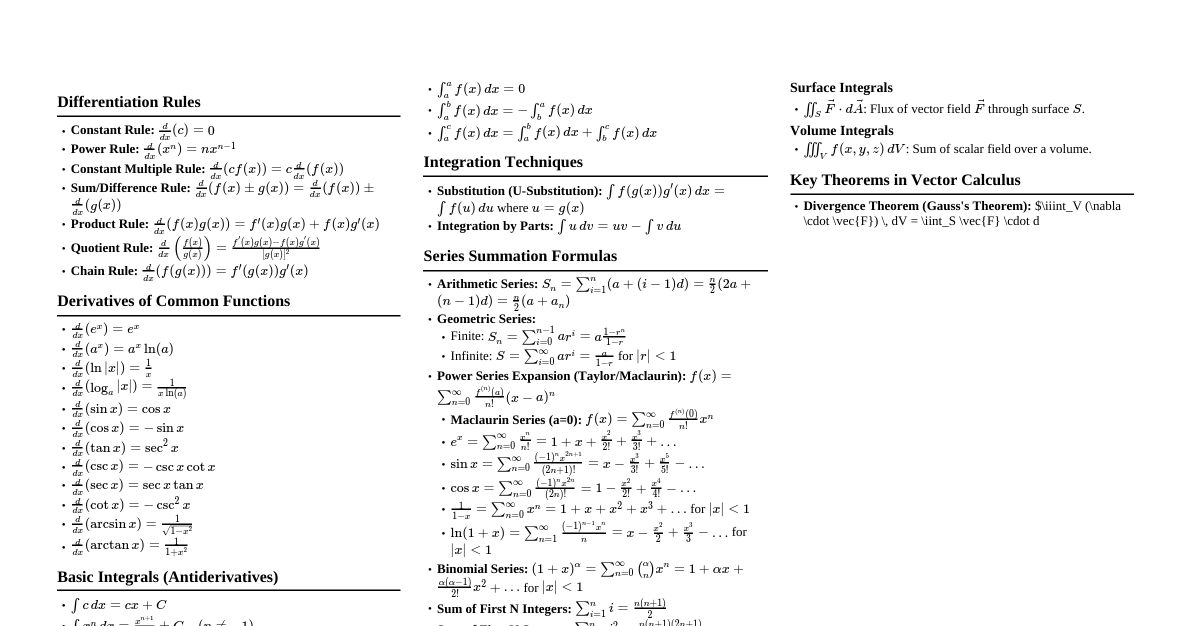
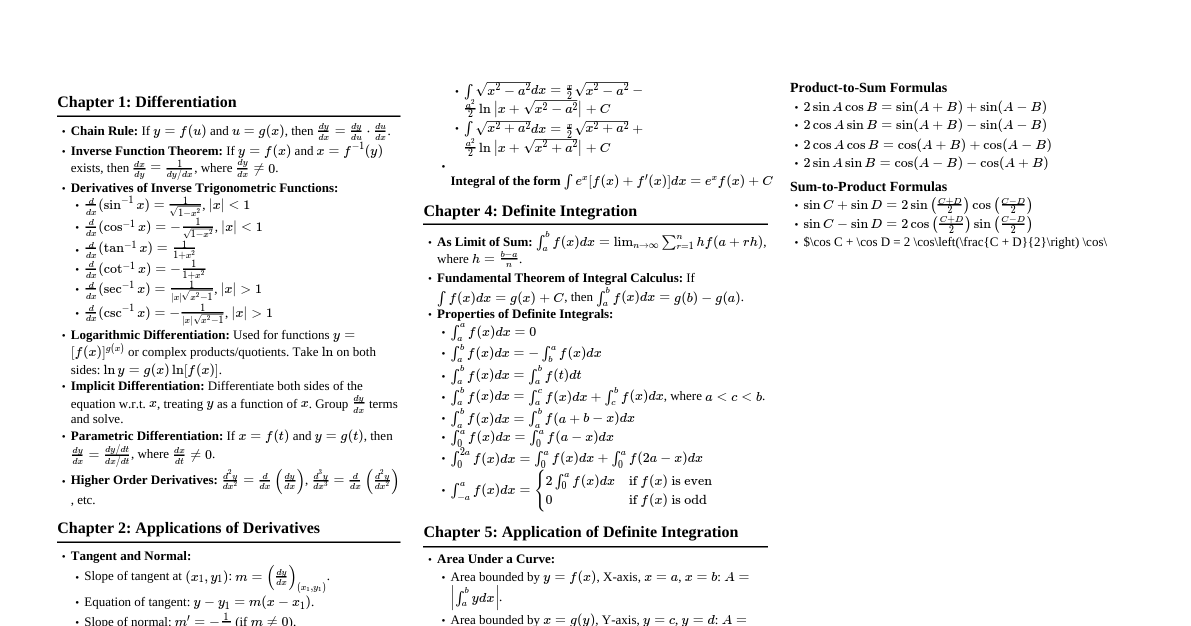
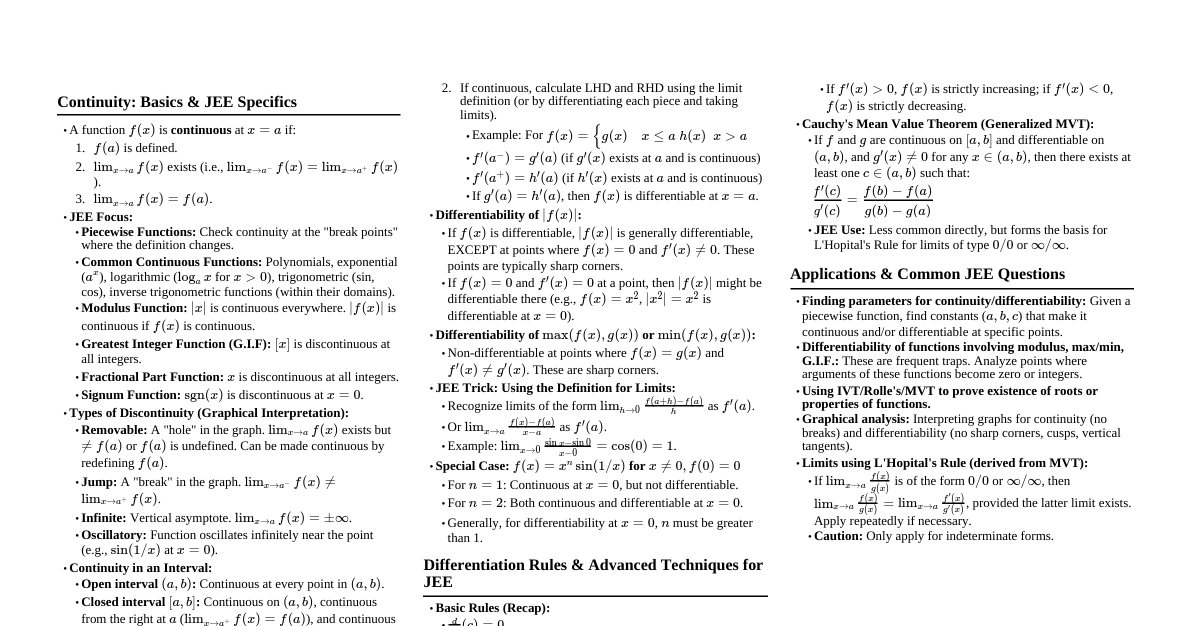
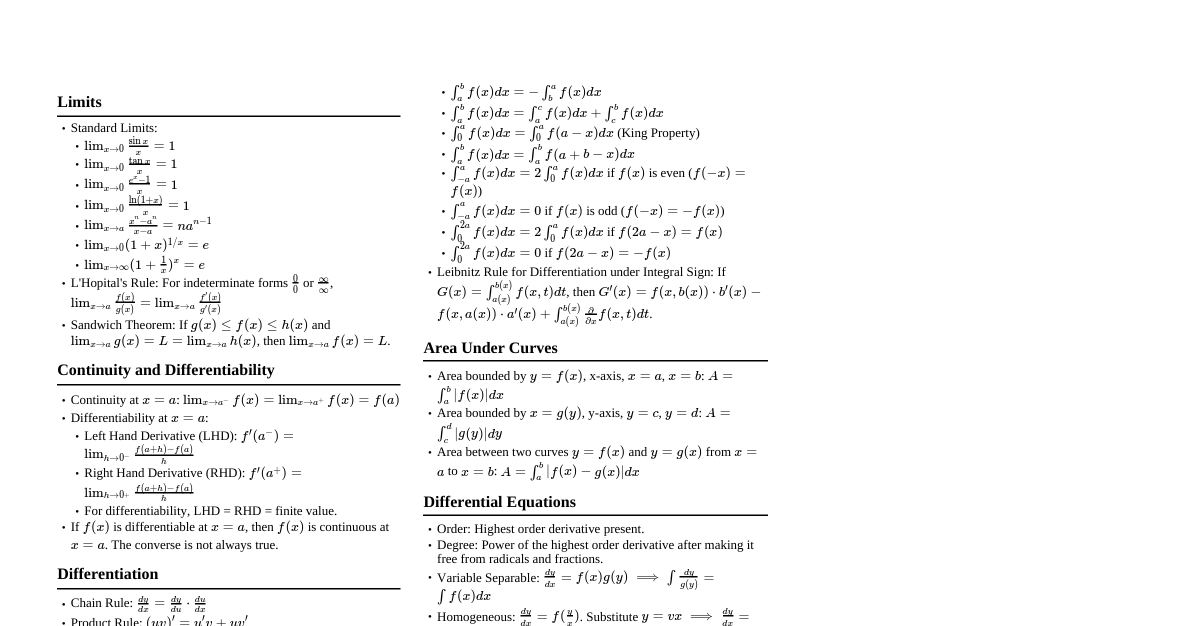
1. Continuity Definition at a point 'a': A function $f(x)$ is continuous at $x=a$ if $\lim_{x \to a^-} f(x) = \lim_{x \to a^+} f(x) = f(a)$. Continuity in an interval: Open interval $(a,b)$: $f(x)$ is continuous at every point in $(a,b)$. Closed interval $[a,b]$: $f(x)$ is continuous in $(a,b)$, and $\lim_{x \to a^+} f(x) = f(a)$ and $\lim_{x \to b^-} f(x) = f(b)$. Types of Discontinuity: Removable: $\lim_{x \to a} f(x)$ exists but is not equal to $f(a)$, or $f(a)$ is undefined. Can be made continuous by redefining $f(a)$. Jump: $\lim_{x \to a^-} f(x) \neq \lim_{x \to a^+} f(x)$. Infinite: One or both limits are $\pm \infty$. Oscillatory: The function oscillates infinitely near the point. Algebra of Continuous Functions: If $f$ and $g$ are continuous at $x=a$, then: $f \pm g$ is continuous at $x=a$. $f \cdot g$ is continuous at $x=a$. $f/g$ is continuous at $x=a$, provided $g(a) \neq 0$. $k \cdot f$ is continuous at $x=a$, for any constant $k$. Composition of Continuous Functions: If $g$ is continuous at $a$ and $f$ is continuous at $g(a)$, then $f \circ g$ is continuous at $a$. 2. Differentiability Definition at a point 'a': A function $f(x)$ is differentiable at $x=a$ if its derivative $f'(a)$ exists. $f'(a) = \lim_{h \to 0} \frac{f(a+h) - f(a)}{h}$ Left Hand Derivative (LHD): $L f'(a) = \lim_{h \to 0^-} \frac{f(a+h) - f(a)}{h}$ Right Hand Derivative (RHD): $R f'(a) = \lim_{h \to 0^+} \frac{f(a+h) - f(a)}{h}$ For $f(x)$ to be differentiable at $x=a$, $L f'(a) = R f'(a)$ must exist and be finite. Relation between Continuity and Differentiability: If $f(x)$ is differentiable at $x=a$, then it is continuous at $x=a$. The converse is NOT necessarily true (e.g., $f(x)=|x|$ at $x=0$). Algebra of Differentiable Functions: If $f$ and $g$ are differentiable at $x=a$, then: $f \pm g$ is differentiable at $x=a$. $f \cdot g$ is differentiable at $x=a$. $f/g$ is differentiable at $x=a$, provided $g(a) \neq 0$. 3. Derivatives of Standard Functions Function Derivative $c$ (constant) $0$ $x^n$ $nx^{n-1}$ $e^x$ $e^x$ $a^x$ $a^x \log_e a$ $\log_e x$ $1/x$ $\log_a x$ $1/(x \log_e a)$ $\sin x$ $\cos x$ $\cos x$ $-\sin x$ $\tan x$ $\sec^2 x$ $\cot x$ $-\csc^2 x$ $\sec x$ $\sec x \tan x$ $\csc x$ $-\csc x \cot x$ $\sin^{-1} x$ $1/\sqrt{1-x^2}$ $\cos^{-1} x$ $-1/\sqrt{1-x^2}$ $\tan^{-1} x$ $1/(1+x^2)$ $\cot^{-1} x$ $-1/(1+x^2)$ $\sec^{-1} x$ $1/(|x|\sqrt{x^2-1})$ $\csc^{-1} x$ $-1/(|x|\sqrt{x^2-1})$ 4. Rules of Differentiation Constant Rule: $\frac{d}{dx}(c) = 0$ Constant Multiple Rule: $\frac{d}{dx}(c \cdot f(x)) = c \cdot \frac{d}{dx}(f(x))$ Sum/Difference Rule: $\frac{d}{dx}(f(x) \pm g(x)) = \frac{d}{dx}(f(x)) \pm \frac{d}{dx}(g(x))$ Product Rule: $\frac{d}{dx}(u \cdot v) = u \frac{dv}{dx} + v \frac{du}{dx}$ Quotient Rule: $\frac{d}{dx}\left(\frac{u}{v}\right) = \frac{v \frac{du}{dx} - u \frac{dv}{dx}}{v^2}$ Chain Rule: $\frac{dy}{dx} = \frac{dy}{du} \cdot \frac{du}{dx}$ (If $y=f(u)$ and $u=g(x)$) Implicit Differentiation: Differentiate both sides of the equation with respect to $x$, treating $y$ as a function of $x$ and using the chain rule for terms involving $y$. Logarithmic Differentiation: Used for functions of the form $f(x)^{g(x)}$ or complex products/quotients. Take $\log$ on both sides and then differentiate. If $y = [f(x)]^{g(x)}$, then $\log y = g(x) \log f(x)$. $\frac{1}{y} \frac{dy}{dx} = g'(x) \log f(x) + g(x) \frac{f'(x)}{f(x)}$. 5. Higher Order Derivatives Second Order Derivative: $\frac{d^2y}{dx^2} = \frac{d}{dx}\left(\frac{dy}{dx}\right)$ (also denoted as $y''$ or $f''(x)$) Nth Order Derivative: $\frac{d^ny}{dx^n}$ 6. Mean Value Theorems Rolle's Theorem: If $f(x)$ is continuous on $[a,b]$ and differentiable on $(a,b)$, and $f(a) = f(b)$, then there exists at least one $c \in (a,b)$ such that $f'(c) = 0$. Lagrange's Mean Value Theorem (LMVT): If $f(x)$ is continuous on $[a,b]$ and differentiable on $(a,b)$, then there exists at least one $c \in (a,b)$ such that $f'(c) = \frac{f(b) - f(a)}{b - a}$. Cauchy's Mean Value Theorem (CMVT): If $f(x)$ and $g(x)$ are continuous on $[a,b]$ and differentiable on $(a,b)$, and $g'(x) \neq 0$ for any $x \in (a,b)$, then there exists at least one $c \in (a,b)$ such that $\frac{f'(c)}{g'(c)} = \frac{f(b) - f(a)}{g(b) - g(a)}$.