JEE Calculus: Top 100 PYQs
Cheatsheet Content
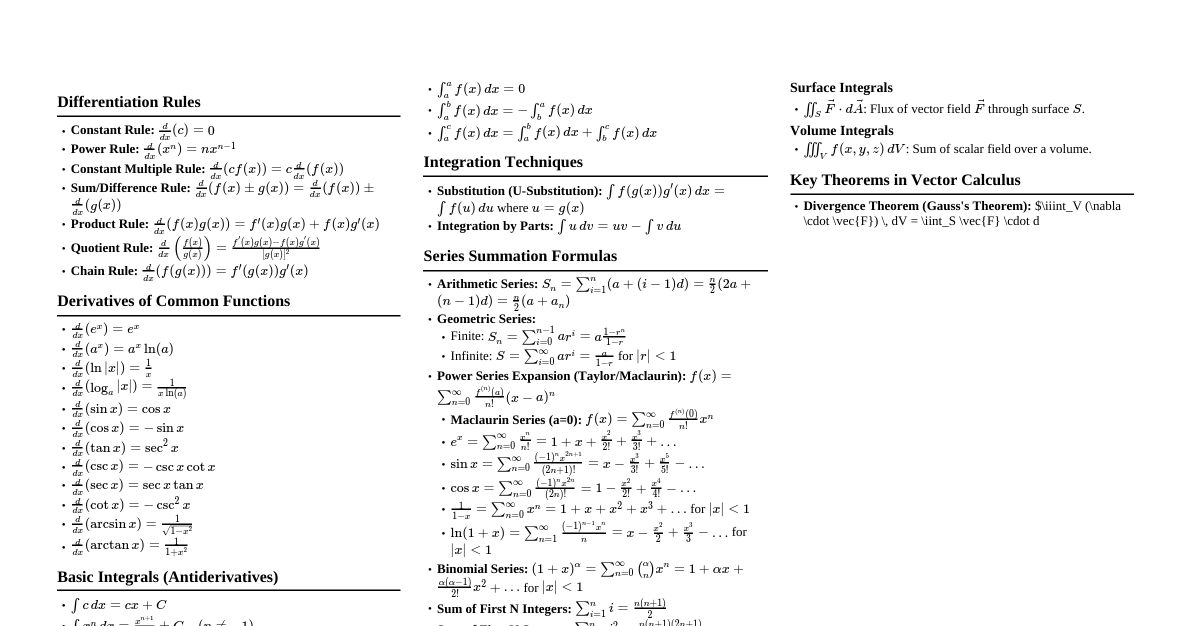
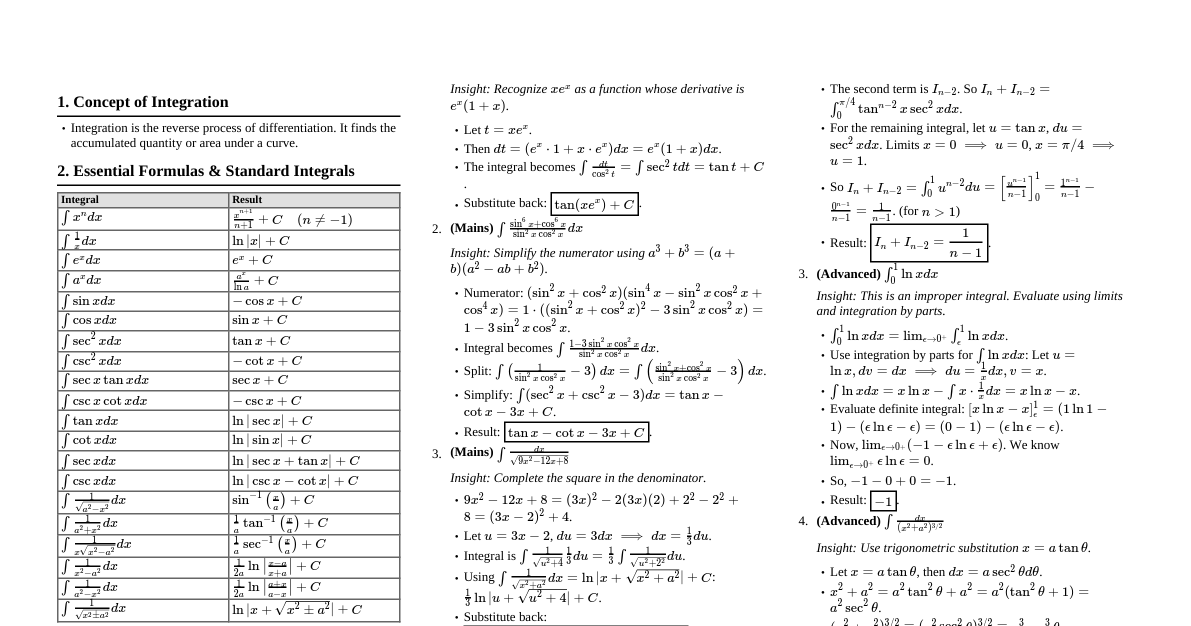
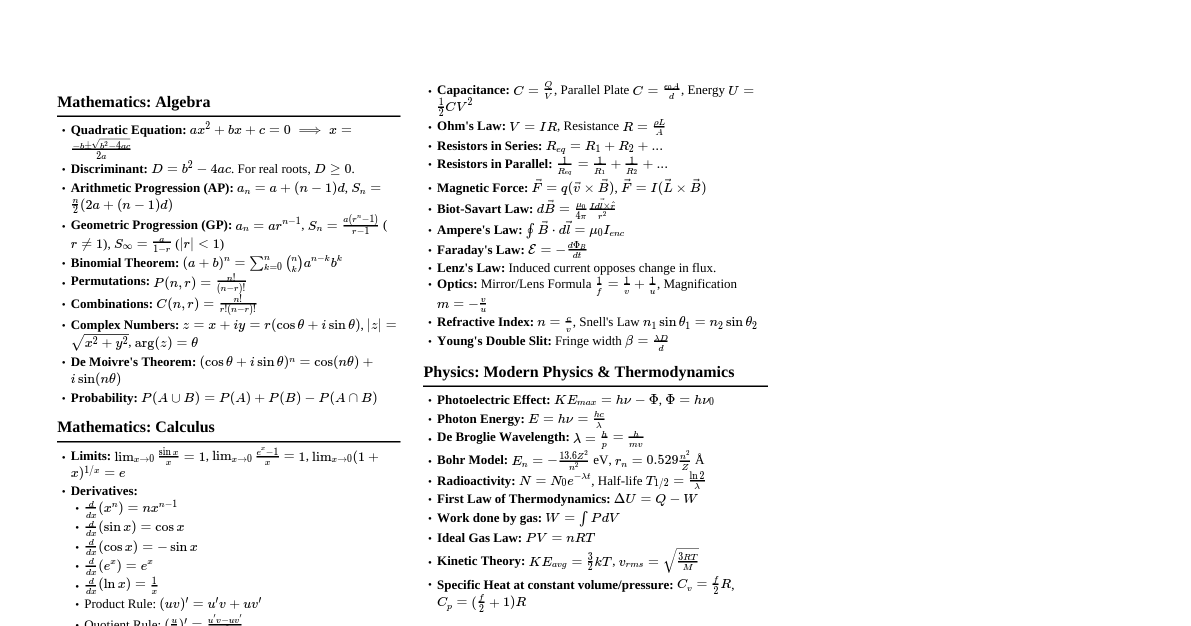
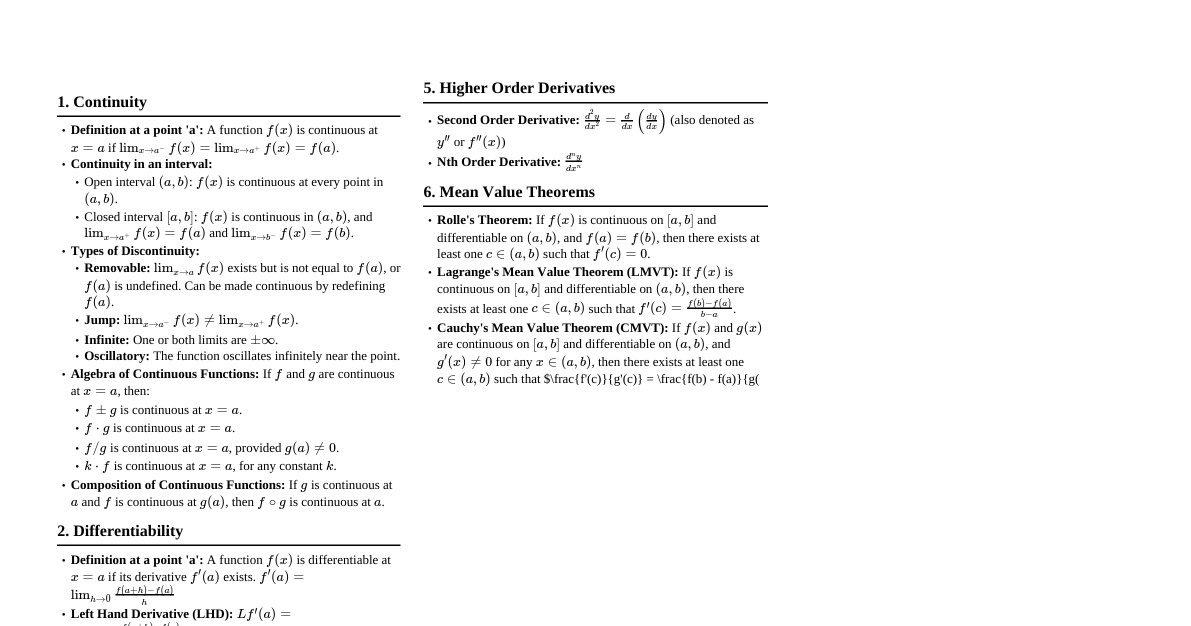
Limits Standard Limits: $\lim_{x \to 0} \frac{\sin x}{x} = 1$ $\lim_{x \to 0} \frac{\tan x}{x} = 1$ $\lim_{x \to 0} \frac{e^x - 1}{x} = 1$ $\lim_{x \to 0} \frac{\ln(1+x)}{x} = 1$ $\lim_{x \to a} \frac{x^n - a^n}{x - a} = na^{n-1}$ $\lim_{x \to 0} (1+x)^{1/x} = e$ $\lim_{x \to \infty} (1+\frac{1}{x})^x = e$ L'Hopital's Rule: For indeterminate forms $\frac{0}{0}$ or $\frac{\infty}{\infty}$, $\lim_{x \to a} \frac{f(x)}{g(x)} = \lim_{x \to a} \frac{f'(x)}{g'(x)}$ Sandwich Theorem: If $g(x) \le f(x) \le h(x)$ and $\lim_{x \to a} g(x) = L = \lim_{x \to a} h(x)$, then $\lim_{x \to a} f(x) = L$. Continuity and Differentiability Continuity at $x=a$: $\lim_{x \to a^-} f(x) = \lim_{x \to a^+} f(x) = f(a)$ Differentiability at $x=a$: Left Hand Derivative (LHD): $f'(a^-) = \lim_{h \to 0^-} \frac{f(a+h) - f(a)}{h}$ Right Hand Derivative (RHD): $f'(a^+) = \lim_{h \to 0^+} \frac{f(a+h) - f(a)}{h}$ For differentiability, LHD = RHD = finite value. If $f(x)$ is differentiable at $x=a$, then $f(x)$ is continuous at $x=a$. The converse is not always true. Differentiation Chain Rule: $\frac{dy}{dx} = \frac{dy}{du} \cdot \frac{du}{dx}$ Product Rule: $(uv)' = u'v + uv'$ Quotient Rule: $(\frac{u}{v})' = \frac{u'v - uv'}{v^2}$ Implicit Differentiation: Differentiate both sides with respect to $x$, treating $y$ as a function of $x$. Parametric Differentiation: If $x=f(t), y=g(t)$, then $\frac{dy}{dx} = \frac{dy/dt}{dx/dt}$. Applications of Derivatives Tangents and Normals: Slope of tangent at $(x_0, y_0)$: $m = (\frac{dy}{dx})_{(x_0, y_0)}$ Equation of tangent: $y - y_0 = m(x - x_0)$ Slope of normal: $-\frac{1}{m}$ Equation of normal: $y - y_0 = -\frac{1}{m}(x - x_0)$ Monotonicity: $f'(x) > 0 \implies f(x)$ is strictly increasing $f'(x) Maxima and Minima (First Derivative Test): If $f'(x)$ changes from +ve to -ve at $x=a$, then local maximum. If $f'(x)$ changes from -ve to +ve at $x=a$, then local minimum. Maxima and Minima (Second Derivative Test): If $f'(a)=0$ and $f''(a) If $f'(a)=0$ and $f''(a) > 0$, then local minimum. If $f'(a)=0$ and $f''(a) = 0$, test fails (use first derivative test). Rolle's Theorem: If $f(x)$ is continuous on $[a,b]$, differentiable on $(a,b)$, and $f(a)=f(b)$, then there exists $c \in (a,b)$ such that $f'(c)=0$. Mean Value Theorem (Lagrange): If $f(x)$ is continuous on $[a,b]$ and differentiable on $(a,b)$, then there exists $c \in (a,b)$ such that $f'(c) = \frac{f(b)-f(a)}{b-a}$. Indefinite Integration Standard Formulas (examples): $\int x^n dx = \frac{x^{n+1}}{n+1} + C, (n \ne -1)$ $\int \frac{1}{x} dx = \ln|x| + C$ $\int e^x dx = e^x + C$ $\int \sin x dx = -\cos x + C$ $\int \cos x dx = \sin x + C$ $\int \frac{1}{\sqrt{a^2-x^2}} dx = \sin^{-1}(\frac{x}{a}) + C$ $\int \frac{1}{a^2+x^2} dx = \frac{1}{a}\tan^{-1}(\frac{x}{a}) + C$ Integration by Parts: $\int u dv = uv - \int v du$ (use ILATE rule for choosing $u$) Partial Fractions: For rational functions, decompose into simpler fractions. Special Integrals: $\int e^x (f(x) + f'(x)) dx = e^x f(x) + C$ $\int \sqrt{a^2-x^2} dx = \frac{x}{2}\sqrt{a^2-x^2} + \frac{a^2}{2}\sin^{-1}(\frac{x}{a}) + C$ $\int \sqrt{x^2 \pm a^2} dx = \frac{x}{2}\sqrt{x^2 \pm a^2} \pm \frac{a^2}{2}\ln|x+\sqrt{x^2 \pm a^2}| + C$ Definite Integration Fundamental Theorem of Calculus: $\int_a^b f(x) dx = F(b) - F(a)$, where $F'(x)=f(x)$. Properties: $\int_a^b f(x) dx = -\int_b^a f(x) dx$ $\int_a^b f(x) dx = \int_a^c f(x) dx + \int_c^b f(x) dx$ $\int_0^a f(x) dx = \int_0^a f(a-x) dx$ (King Property) $\int_a^b f(x) dx = \int_a^b f(a+b-x) dx$ $\int_{-a}^a f(x) dx = 2\int_0^a f(x) dx$ if $f(x)$ is even ($f(-x)=f(x)$) $\int_{-a}^a f(x) dx = 0$ if $f(x)$ is odd ($f(-x)=-f(x)$) $\int_0^{2a} f(x) dx = 2\int_0^a f(x) dx$ if $f(2a-x)=f(x)$ $\int_0^{2a} f(x) dx = 0$ if $f(2a-x)=-f(x)$ Leibnitz Rule for Differentiation under Integral Sign: If $G(x) = \int_{a(x)}^{b(x)} f(x,t) dt$, then $G'(x) = f(x, b(x)) \cdot b'(x) - f(x, a(x)) \cdot a'(x) + \int_{a(x)}^{b(x)} \frac{\partial}{\partial x} f(x,t) dt$. Area Under Curves Area bounded by $y=f(x)$, x-axis, $x=a$, $x=b$: $A = \int_a^b |f(x)| dx$ Area bounded by $x=g(y)$, y-axis, $y=c$, $y=d$: $A = \int_c^d |g(y)| dy$ Area between two curves $y=f(x)$ and $y=g(x)$ from $x=a$ to $x=b$: $A = \int_a^b |f(x) - g(x)| dx$ Differential Equations Order: Highest order derivative present. Degree: Power of the highest order derivative after making it free from radicals and fractions. Variable Separable: $\frac{dy}{dx} = f(x)g(y) \implies \int \frac{dy}{g(y)} = \int f(x) dx$ Homogeneous: $\frac{dy}{dx} = f(\frac{y}{x})$. Substitute $y=vx \implies \frac{dy}{dx} = v + x\frac{dv}{dx}$. Linear Differential Equation: $\frac{dy}{dx} + P(x)y = Q(x)$ Integrating Factor (IF): $e^{\int P(x) dx}$ Solution: $y \cdot (\text{IF}) = \int Q(x) \cdot (\text{IF}) dx + C$ Bernoulli's Equation (reducible to linear): $\frac{dy}{dx} + P(x)y = Q(x)y^n$. Divide by $y^n$ and substitute $z = y^{1-n}$. Key Concepts for JEE Advanced/Mains Mastering all standard integration formulas and techniques. Understanding the geometric interpretation of derivatives and integrals. Solving problems involving properties of definite integrals. Analyzing graphs for continuity, differentiability, and extrema. Applying L'Hopital's rule effectively for limits. Solving differential equations, especially linear and variable separable types. Understanding the concept of area as a definite integral. Problems combining multiple concepts (e.g., limits leading to derivatives, integrals in functions). Careful handling of absolute values and piecewise functions.