Last-Minute STEM Exam Cheatsheet
Cheatsheet Content
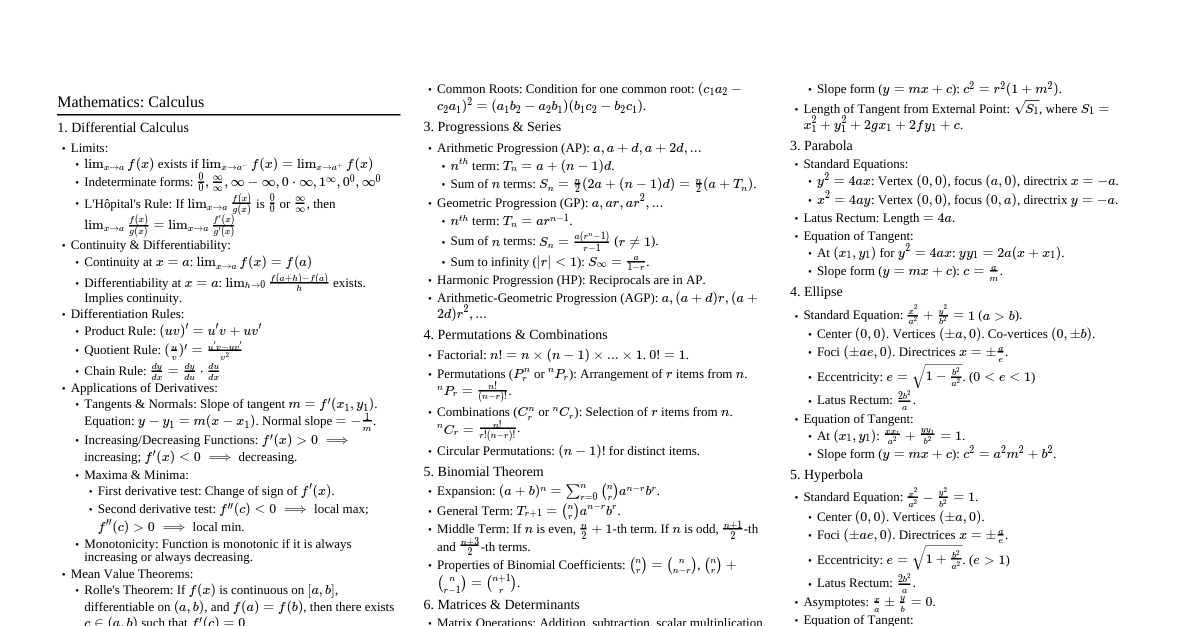
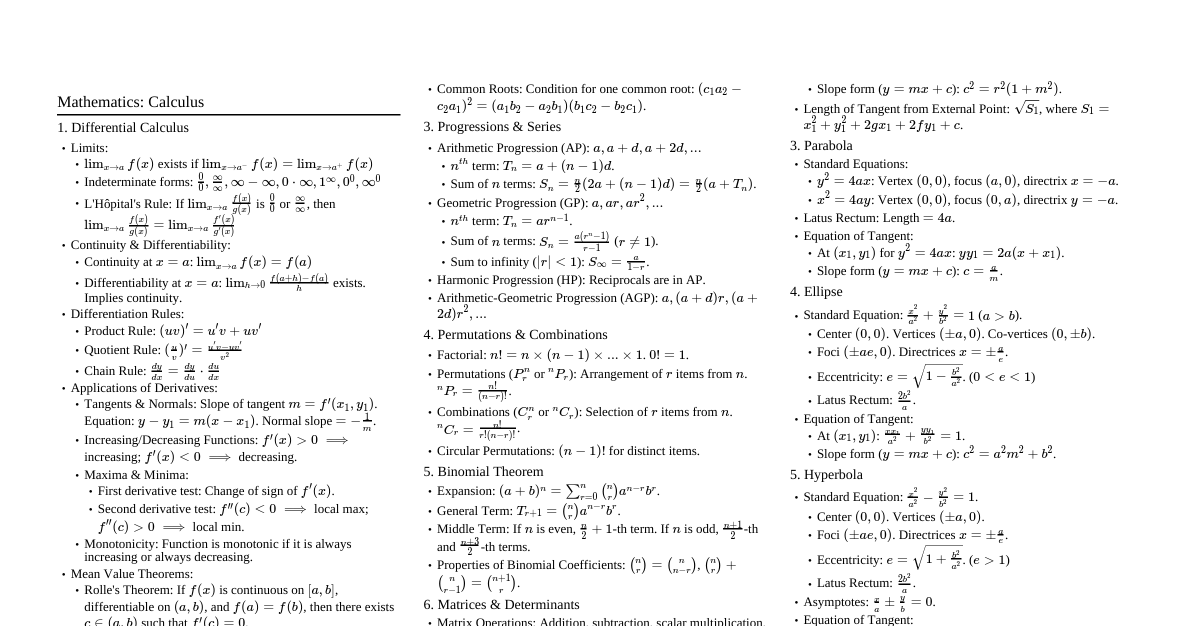
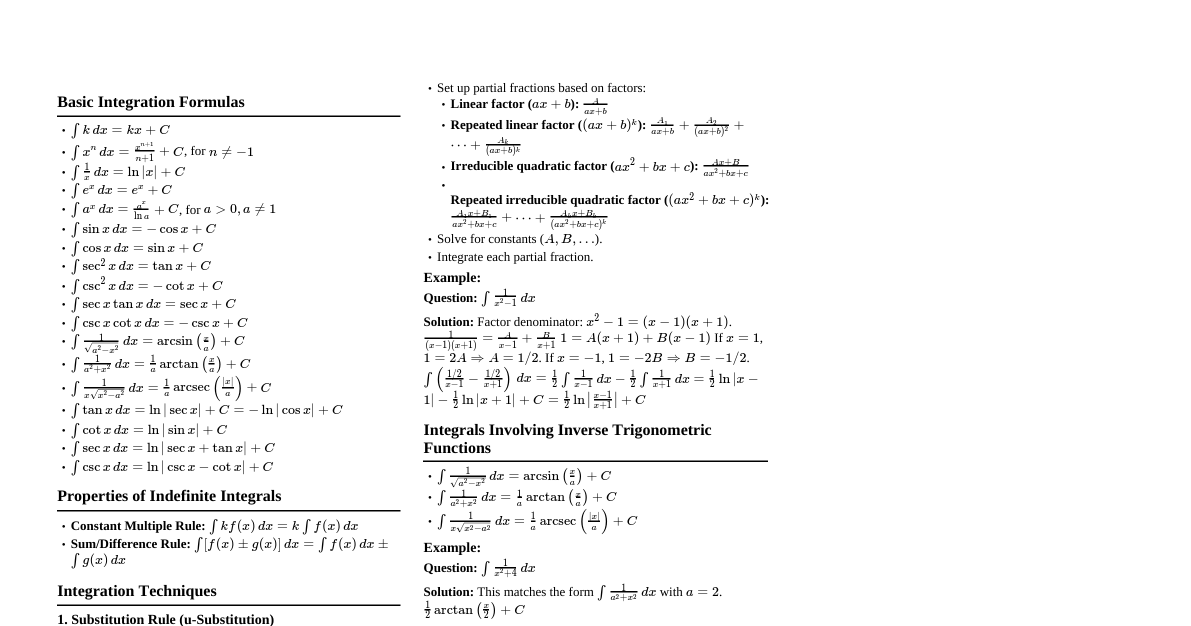
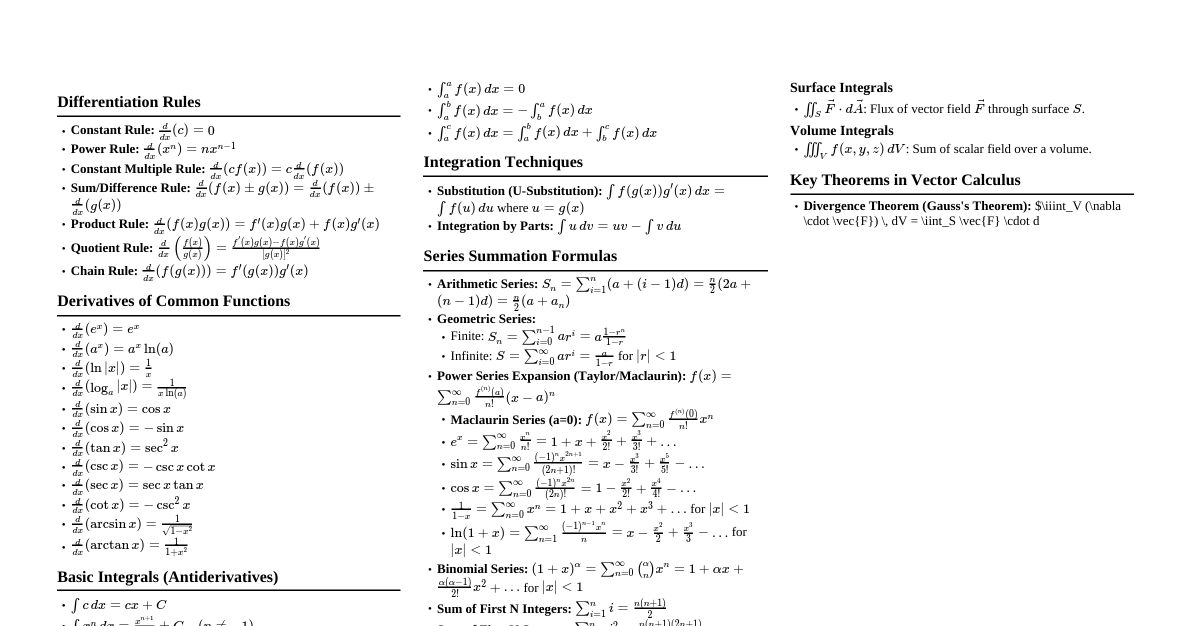
1. Calculus I: Differentiation & Integration 1.1. Differentiation Rules Power Rule: $\frac{d}{dx}(x^n) = nx^{n-1}$ Constant Multiple Rule: $\frac{d}{dx}(cf(x)) = c\frac{d}{dx}(f(x))$ Sum/Difference Rule: $\frac{d}{dx}(f(x) \pm g(x)) = f'(x) \pm g'(x)$ Product Rule: $\frac{d}{dx}(f(x)g(x)) = f'(x)g(x) + f(x)g'(x)$ Quotient Rule: $\frac{d}{dx}\left(\frac{f(x)}{g(x)}\right) = \frac{f'(x)g(x) - f(x)g'(x)}{[g(x)]^2}$ Chain Rule: $\frac{d}{dx}(f(g(x))) = f'(g(x))g'(x)$ 1.2. Derivatives of Common Functions $\frac{d}{dx}(c) = 0$ $\frac{d}{dx}(e^x) = e^x$ $\frac{d}{dx}(a^x) = a^x \ln a$ $\frac{d}{dx}(\ln x) = \frac{1}{x}$ $\frac{d}{dx}(\log_a x) = \frac{1}{x \ln a}$ $\frac{d}{dx}(\sin x) = \cos x$ $\frac{d}{dx}(\cos x) = -\sin x$ $\frac{d}{dx}(\tan x) = \sec^2 x$ $\frac{d}{dx}(\cot x) = -\csc^2 x$ $\frac{d}{dx}(\sec x) = \sec x \tan x$ $\frac{d}{dx}(\csc x) = -\csc x \cot x$ $\frac{d}{dx}(\arcsin x) = \frac{1}{\sqrt{1-x^2}}$ $\frac{d}{dx}(\arctan x) = \frac{1}{1+x^2}$ 1.3. Fundamental Theorem of Calculus Part 1: If $F(x) = \int_a^x f(t) dt$, then $F'(x) = f(x)$ Part 2: $\int_a^b f(x) dx = F(b) - F(a)$, where $F'(x) = f(x)$ 1.4. Basic Integration Formulas $\int x^n dx = \frac{x^{n+1}}{n+1} + C \quad (n \neq -1)$ $\int \frac{1}{x} dx = \ln|x| + C$ $\int e^x dx = e^x + C$ $\int a^x dx = \frac{a^x}{\ln a} + C$ $\int \sin x dx = -\cos x + C$ $\int \cos x dx = \sin x + C$ $\int \sec^2 x dx = \tan x + C$ $\int \frac{1}{\sqrt{1-x^2}} dx = \arcsin x + C$ $\int \frac{1}{1+x^2} dx = \arctan x + C$ 1.5. Integration Techniques Substitution (u-sub): $\int f(g(x))g'(x) dx = \int f(u) du$ (let $u=g(x)$) Integration by Parts: $\int u dv = uv - \int v du$ 2. Linear Algebra: Vectors & Matrices 2.1. Vectors Vector Addition: $\mathbf{u} + \mathbf{v} = (u_1+v_1, ..., u_n+v_n)$ Scalar Multiplication: $c\mathbf{u} = (cu_1, ..., cu_n)$ Dot Product: $\mathbf{u} \cdot \mathbf{v} = u_1v_1 + ... + u_nv_n = ||\mathbf{u}|| \cdot ||\mathbf{v}|| \cos\theta$ Cross Product (in $\mathbb{R}^3$): $\mathbf{u} \times \mathbf{v} = (u_2v_3-u_3v_2, u_3v_1-u_1v_3, u_1v_2-u_2v_1)$ $||\mathbf{u} \times \mathbf{v}|| = ||\mathbf{u}|| \cdot ||\mathbf{v}|| \sin\theta$ $\mathbf{u} \times \mathbf{v}$ is orthogonal to both $\mathbf{u}$ and $\mathbf{v}$ Magnitude: $||\mathbf{u}|| = \sqrt{u_1^2 + ... + u_n^2}$ Unit Vector: $\hat{\mathbf{u}} = \frac{\mathbf{u}}{||\mathbf{u}||}$ 2.2. Matrices Matrix Addition/Subtraction: Element-wise Scalar Multiplication: $c A = (c a_{ij})$ Matrix Multiplication: $(AB)_{ij} = \sum_k A_{ik} B_{kj}$ (Rows of A by Columns of B) Not commutative: $AB \neq BA$ Identity Matrix ($I$): $I = \begin{pmatrix} 1 & 0 & \dots \\ 0 & 1 & \dots \\ \vdots & \vdots & \ddots \end{pmatrix}$, $AI = IA = A$ Transpose ($A^T$): $(A^T)_{ij} = A_{ji}$ Determinant ($det(A)$ or $|A|$): $2 \times 2$: $\begin{vmatrix} a & b \\ c & d \end{vmatrix} = ad - bc$ $3 \times 3$: Use cofactor expansion (Sarrus' rule for $3 \times 3$) $det(A^T) = det(A)$ $det(AB) = det(A)det(B)$ $det(A^{-1}) = \frac{1}{det(A)}$ If $det(A) = 0$, $A$ is singular (no inverse) Inverse Matrix ($A^{-1}$): $A A^{-1} = A^{-1} A = I$ For $2 \times 2$: $\begin{pmatrix} a & b \\ c & d \end{pmatrix}^{-1} = \frac{1}{ad-bc} \begin{pmatrix} d & -b \\ -c & a \end{pmatrix}$ Exists iff $det(A) \neq 0$ 2.3. Systems of Linear Equations Represent as $A\mathbf{x} = \mathbf{b}$ Methods: Gaussian Elimination, Cramer's Rule (using determinants), $A^{-1}\mathbf{b}$ (if $A^{-1}$ exists) Possible Solutions: Unique solution, No solution, Infinitely many solutions 2.4. Eigenvalues & Eigenvectors $A\mathbf{v} = \lambda\mathbf{v}$ $\lambda$ is eigenvalue, $\mathbf{v}$ is eigenvector Find eigenvalues by solving characteristic equation: $det(A - \lambda I) = 0$ Find eigenvectors by solving $(A - \lambda I)\mathbf{v} = \mathbf{0}$ for each $\lambda$ 3. Physics: Mechanics & Electromagnetism (Basics) 3.1. Kinematics (Constant Acceleration) $v = v_0 + at$ $\Delta x = v_0 t + \frac{1}{2}at^2$ $v^2 = v_0^2 + 2a\Delta x$ $\Delta x = \frac{1}{2}(v_0+v)t$ 3.2. Newton's Laws of Motion 1st Law: Object at rest stays at rest, object in motion stays in motion with constant velocity unless acted upon by a net force. 2nd Law: $\Sigma \mathbf{F} = m\mathbf{a}$ 3rd Law: For every action, there is an equal and opposite reaction. Gravitational Force: $F_g = mg$ (near Earth's surface) Friction Force: $F_f = \mu N$ ($\mu_s$ for static, $\mu_k$ for kinetic) 3.3. Work, Energy, Power Work: $W = \mathbf{F} \cdot \mathbf{d} = Fd\cos\theta$ Kinetic Energy: $KE = \frac{1}{2}mv^2$ Potential Energy (Gravitational): $PE_g = mgh$ Potential Energy (Spring): $PE_s = \frac{1}{2}kx^2$ Work-Energy Theorem: $W_{net} = \Delta KE$ Conservation of Mechanical Energy: $KE_i + PE_i = KE_f + PE_f$ (if only conservative forces do work) Power: $P = \frac{W}{t} = Fv\cos\theta$ 3.4. Electromagnetism Basics Coulomb's Law: $F = k \frac{|q_1 q_2|}{r^2}$, where $k = \frac{1}{4\pi\epsilon_0} \approx 9 \times 10^9 \text{ Nm}^2/\text{C}^2$ Electric Field: $\mathbf{E} = \frac{\mathbf{F}}{q_0}$ (Force per unit charge) Electric Field of Point Charge: $E = k \frac{|q|}{r^2}$ Electric Potential (Voltage): $V = \frac{PE}{q_0}$ Potential Difference: $\Delta V = -\int \mathbf{E} \cdot d\mathbf{l}$ Ohm's Law: $V = IR$ Resistors in Series: $R_{eq} = R_1 + R_2 + ...$ Resistors in Parallel: $\frac{1}{R_{eq}} = \frac{1}{R_1} + \frac{1}{R_2} + ...$ Capacitance: $C = \frac{Q}{V}$ Capacitors in Series: $\frac{1}{C_{eq}} = \frac{1}{C_1} + \frac{1}{C_2} + ...$ Capacitors in Parallel: $C_{eq} = C_1 + C_2 + ...$ Magnetic Force on a Charge: $\mathbf{F}_B = q(\mathbf{v} \times \mathbf{B})$ (Right-hand rule) Magnetic Force on a Current: $\mathbf{F}_B = I(\mathbf{L} \times \mathbf{B})$ 4. Probability & Statistics (Basics) 4.1. Basic Probability Probability of Event A: $P(A) = \frac{\text{Number of favorable outcomes}}{\text{Total number of outcomes}}$ Complement Rule: $P(A') = 1 - P(A)$ Addition Rule: $P(A \cup B) = P(A) + P(B) - P(A \cap B)$ Mutually Exclusive Events: $P(A \cap B) = 0 \implies P(A \cup B) = P(A) + P(B)$ Conditional Probability: $P(A|B) = \frac{P(A \cap B)}{P(B)}$ Multiplication Rule: $P(A \cap B) = P(A|B)P(B) = P(B|A)P(A)$ Independent Events: $P(A \cap B) = P(A)P(B) \implies P(A|B) = P(A)$ 4.2. Descriptive Statistics Mean: $\bar{x} = \frac{\sum x_i}{n}$ Median: Middle value when data is ordered Mode: Most frequent value Range: Max - Min Variance: $s^2 = \frac{\sum (x_i - \bar{x})^2}{n-1}$ (sample) or $\sigma^2 = \frac{\sum (x_i - \mu)^2}{N}$ (population) Standard Deviation: $s = \sqrt{s^2}$ or $\sigma = \sqrt{\sigma^2}$ 4.3. Common Distributions Binomial: $P(X=k) = \binom{n}{k} p^k (1-p)^{n-k}$ Mean: $np$, Variance: $np(1-p)$ Normal (Gaussian): Bell curve, symmetric about mean $\mu$. Standard Normal: $Z = \frac{X - \mu}{\sigma}$ 5. Differential Equations (Basics) 5.1. First-Order ODEs Separable: $\frac{dy}{dx} = f(x)g(y) \implies \int \frac{dy}{g(y)} = \int f(x) dx$ Linear: $\frac{dy}{dx} + P(x)y = Q(x)$ Integrating factor: $I(x) = e^{\int P(x) dx}$ Solution: $y = \frac{1}{I(x)} \int I(x)Q(x) dx$ Exact: $M(x,y)dx + N(x,y)dy = 0$ if $\frac{\partial M}{\partial y} = \frac{\partial N}{\partial x}$ 5.2. Second-Order Linear Homogeneous ODEs with Constant Coefficients $ay'' + by' + cy = 0$ Characteristic equation: $ar^2 + br + c = 0$ Cases for roots $r_1, r_2$: Real & Distinct: $y(x) = c_1 e^{r_1 x} + c_2 e^{r_2 x}$ Real & Repeated: $y(x) = c_1 e^{rx} + c_2 x e^{rx}$ Complex Conjugate: $r = \alpha \pm i\beta \implies y(x) = e^{\alpha x}(c_1 \cos(\beta x) + c_2 \sin(\beta x))$ 6. Important Constants & Conversions $g \approx 9.8 \text{ m/s}^2$ (acceleration due to gravity on Earth) $c \approx 3.00 \times 10^8 \text{ m/s}$ (speed of light in vacuum) $e \approx 1.60 \times 10^{-19} \text{ C}$ (elementary charge) $\epsilon_0 \approx 8.85 \times 10^{-12} \text{ F/m}$ (permittivity of free space) $\mu_0 \approx 4\pi \times 10^{-7} \text{ H/m}$ (permeability of free space) $1 \text{ inch} = 2.54 \text{ cm}$ $1 \text{ km} = 1000 \text{ m}$ $1 \text{ hour} = 3600 \text{ seconds}$ $1 \text{ N} = 1 \text{ kg} \cdot \text{m/s}^2$ $1 \text{ J} = 1 \text{ N} \cdot \text{m}$ $1 \text{ W} = 1 \text{ J/s}$