Calculus Cheatsheet
Cheatsheet Content
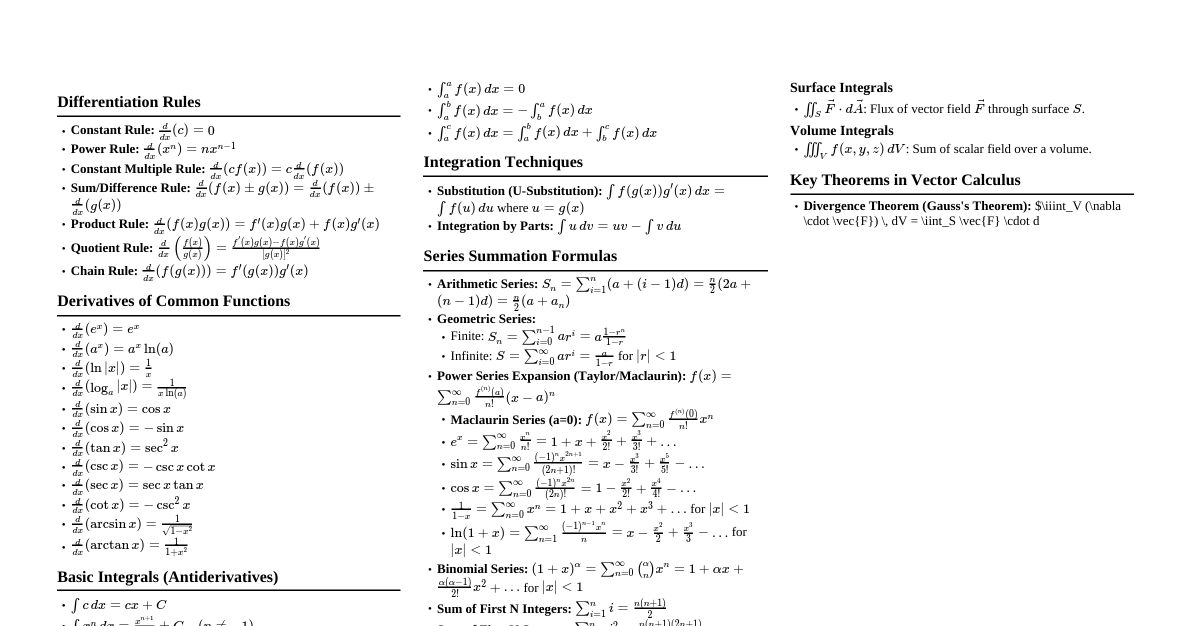
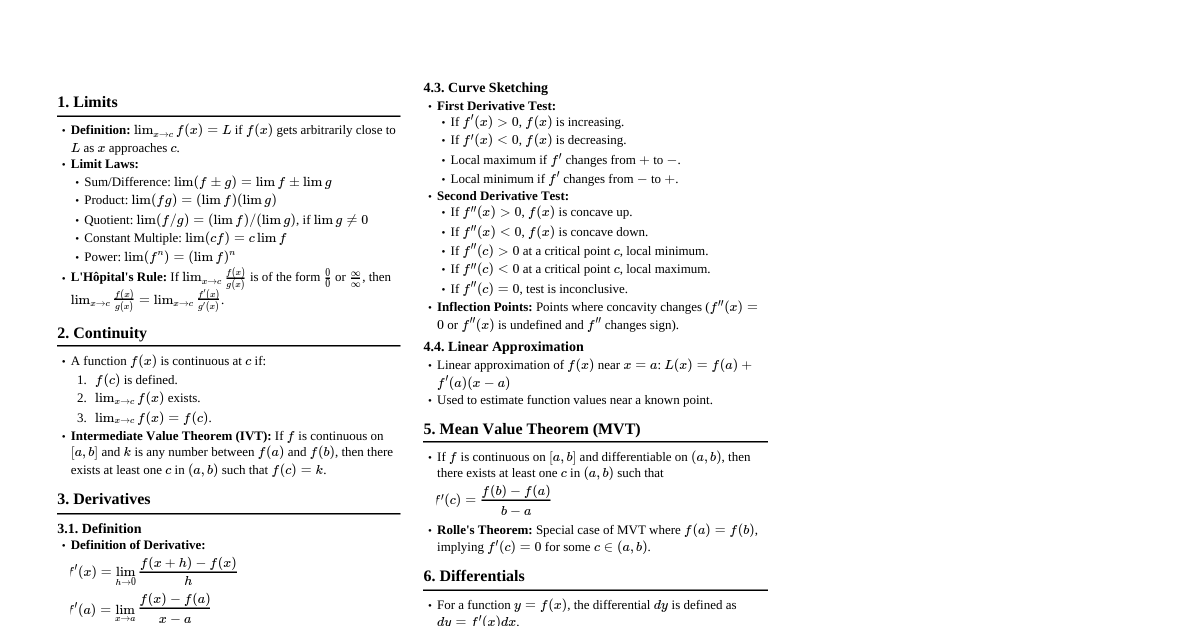
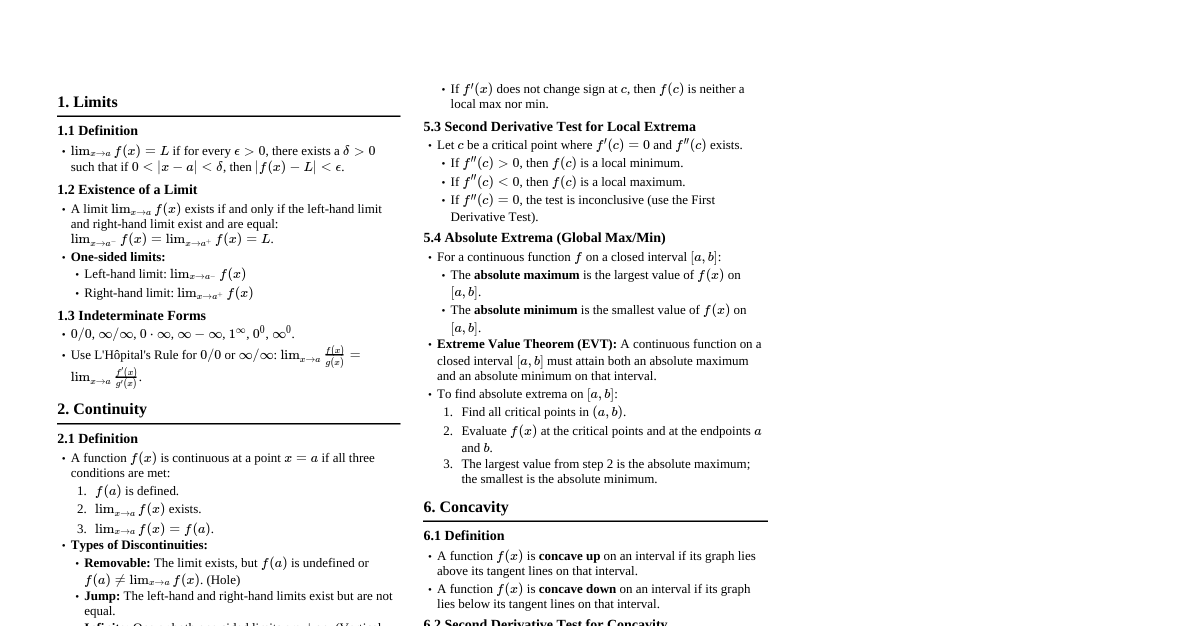
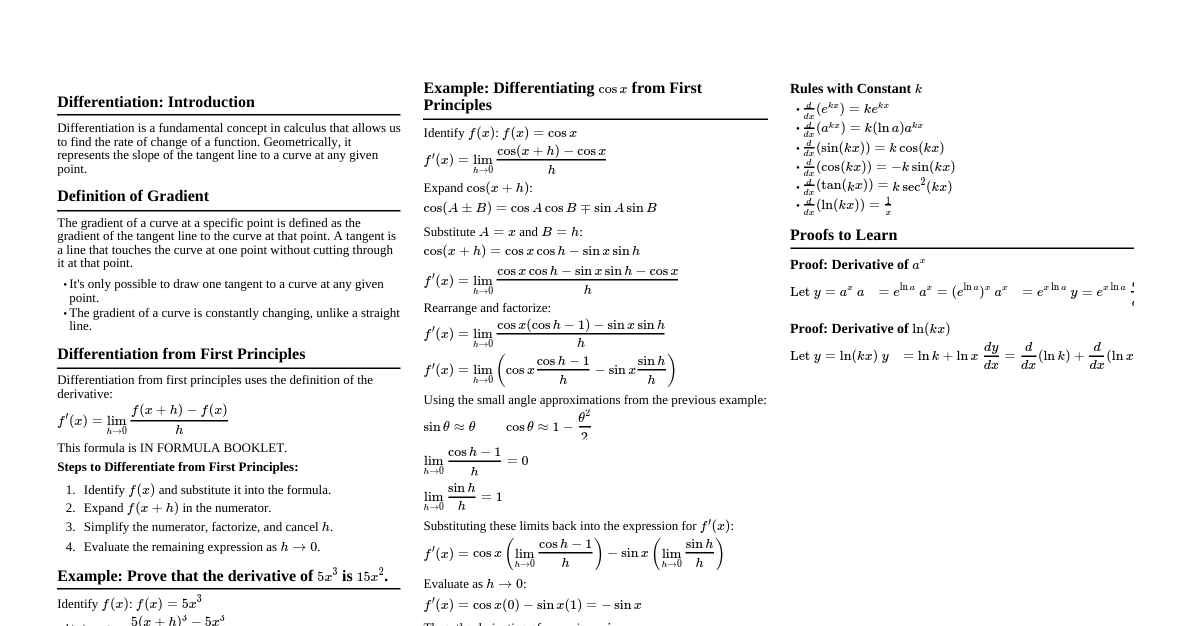
1. Limits Definition: $\lim_{x \to a} f(x) = L$ if $f(x)$ approaches $L$ as $x$ approaches $a$. One-Sided Limits: Left-hand: $\lim_{x \to a^-} f(x)$ Right-hand: $\lim_{x \to a^+} f(x)$ $\lim_{x \to a} f(x)$ exists iff $\lim_{x \to a^-} f(x) = \lim_{x \to a^+} f(x)$ Limit Properties: $\lim_{x \to a} [f(x) \pm g(x)] = \lim_{x \to a} f(x) \pm \lim_{x \to a} g(x)$ $\lim_{x \to a} [c \cdot f(x)] = c \cdot \lim_{x \to a} f(x)$ $\lim_{x \to a} [f(x) \cdot g(x)] = \lim_{x \to a} f(x) \cdot \lim_{x \to a} g(x)$ $\lim_{x \to a} \frac{f(x)}{g(x)} = \frac{\lim_{x \to a} f(x)}{\lim_{x \to a} g(x)}$, if $\lim_{x \to a} g(x) \neq 0$ Standard Limits: $\lim_{x \to 0} \frac{\sin x}{x} = 1$ $\lim_{x \to 0} \frac{1 - \cos x}{x} = 0$ $\lim_{x \to 0} (1 + x)^{1/x} = e$ $\lim_{x \to \infty} (1 + \frac{1}{x})^x = e$ L’Hôpital’s Rule: If $\lim_{x \to a} \frac{f(x)}{g(x)}$ is of the form $\frac{0}{0}$ or $\frac{\infty}{\infty}$, then $\lim_{x \to a} \frac{f(x)}{g(x)} = \lim_{x \to a} \frac{f'(x)}{g'(x)}$. 2. Continuity Conditions for Continuity at $x=a$: $f(a)$ is defined. $\lim_{x \to a} f(x)$ exists. $\lim_{x \to a} f(x) = f(a)$. Types of Discontinuity: Removable: A hole in the graph (e.g., $\frac{(x-a)(x-b)}{x-a}$). Can be "filled" by redefining $f(a)$. Jump: Left and right limits exist but are not equal (e.g., piecewise functions). Infinite: $f(x)$ approaches $\pm \infty$ as $x \to a$ (vertical asymptote). 3. Derivatives Definition: $f'(x) = \lim_{h \to 0} \frac{f(x+h) - f(x)}{h}$ (slope of tangent line). Basic Rules: Constant Rule: $\frac{d}{dx}(c) = 0$ Power Rule: $\frac{d}{dx}(x^n) = nx^{n-1}$ Constant Multiple Rule: $\frac{d}{dx}(cf(x)) = c f'(x)$ Sum/Difference Rule: $\frac{d}{dx}(f(x) \pm g(x)) = f'(x) \pm g'(x)$ Product Rule: $\frac{d}{dx}(f(x)g(x)) = f'(x)g(x) + f(x)g'(x)$ Quotient Rule: $\frac{d}{dx}\left(\frac{f(x)}{g(x)}\right) = \frac{f'(x)g(x) - f(x)g'(x)}{(g(x))^2}$ Chain Rule: $\frac{d}{dx}(f(g(x))) = f'(g(x))g'(x)$ 4. Derivative Formulas Function Derivative $x^n$ $nx^{n-1}$ $\sin x$ $\cos x$ $\cos x$ $-\sin x$ $\tan x$ $\sec^2 x$ $\cot x$ $-\csc^2 x$ $\sec x$ $\sec x \tan x$ $\csc x$ $-\csc x \cot x$ $e^x$ $e^x$ $a^x$ $a^x \ln a$ $\ln x$ $\frac{1}{x}$ $\log_a x$ $\frac{1}{x \ln a}$ $\arcsin x$ $\frac{1}{\sqrt{1-x^2}}$ $\arccos x$ $-\frac{1}{\sqrt{1-x^2}}$ $\arctan x$ $\frac{1}{1+x^2}$ 5. Higher-Order Derivatives First derivative: $f'(x) = \frac{dy}{dx}$ Second derivative: $f''(x) = \frac{d^2y}{dx^2} = \frac{d}{dx}\left(\frac{dy}{dx}\right)$ $n$-th derivative: $f^{(n)}(x) = \frac{d^ny}{dx^n}$ 6. Maxima & Minima Conditions Critical Points: $f'(c) = 0$ or $f'(c)$ is undefined. First Derivative Test: If $f'(x)$ changes from $+$ to $-$ at $c$, then $f(c)$ is a local maximum. If $f'(x)$ changes from $-$ to $+$ at $c$, then $f(c)$ is a local minimum. Second Derivative Test: If $f'(c) = 0$: If $f''(c) > 0$, then $f(c)$ is a local minimum. If $f''(c) If $f''(c) = 0$, test is inconclusive (use First Derivative Test). Absolute Extrema: Compare local extrema and values at endpoints on a closed interval. 7. Applications of Derivatives Rate of Change: $f'(x)$ is the instantaneous rate of change of $f(x)$ with respect to $x$. Motion Problems: Position: $s(t)$ Velocity: $v(t) = s'(t)$ Acceleration: $a(t) = v'(t) = s''(t)$ Related Rates: Use implicit differentiation to find the rate of change of one variable with respect to time, given the rates of change of other related variables. 8. Integrals Antiderivative: $F(x)$ is an antiderivative of $f(x)$ if $F'(x) = f(x)$. Indefinite Integral: $\int f(x) dx = F(x) + C$ (where $C$ is the constant of integration). Basic Rules: $\int k \cdot f(x) dx = k \int f(x) dx$ $\int [f(x) \pm g(x)] dx = \int f(x) dx \pm \int g(x) dx$ Power Rule: $\int x^n dx = \frac{x^{n+1}}{n+1} + C$, for $n \neq -1$ $\int \frac{1}{x} dx = \ln|x| + C$ Standard Integrals: $\int \cos x dx = \sin x + C$ $\int \sin x dx = -\cos x + C$ $\int \sec^2 x dx = \tan x + C$ $\int e^x dx = e^x + C$ $\int a^x dx = \frac{a^x}{\ln a} + C$ $\int \frac{1}{\sqrt{1-x^2}} dx = \arcsin x + C$ $\int \frac{1}{1+x^2} dx = \arctan x + C$ 9. Techniques of Integration Substitution (u-substitution): Let $u = g(x)$, then $du = g'(x) dx$. Transform integral in terms of $u$ and $du$. Integration by Parts: $\int u \, dv = uv - \int v \, du$ Partial Fractions: For rational functions $\frac{P(x)}{Q(x)}$, decompose into simpler fractions. Case 1: Distinct linear factors (e.g., $\frac{A}{ax+b} + \frac{B}{cx+d}$) Case 2: Repeated linear factors (e.g., $\frac{A}{ax+b} + \frac{B}{(ax+b)^2}$) Case 3: Irreducible quadratic factors (e.g., $\frac{Ax+B}{ax^2+bx+c}$) Trigonometric Integrals: Involving powers of $\sin x$, $\cos x$, $\tan x$, $\sec x$. Use identities like $\sin^2 x + \cos^2 x = 1$, $\sec^2 x = 1 + \tan^2 x$. Power reduction formulas: $\sin^2 x = \frac{1-\cos(2x)}{2}$, $\cos^2 x = \frac{1+\cos(2x)}{2}$. Trigonometric Substitution: $\sqrt{a^2-x^2} \Rightarrow x = a \sin \theta$ $\sqrt{a^2+x^2} \Rightarrow x = a \tan \theta$ $\sqrt{x^2-a^2} \Rightarrow x = a \sec \theta$ 10. Definite Integrals Definition: $\int_a^b f(x) dx = \lim_{n \to \infty} \sum_{i=1}^n f(x_i^*) \Delta x$ (Area under curve). Fundamental Theorem of Calculus (Part 1): If $F(x) = \int_a^x f(t) dt$, then $F'(x) = f(x)$. Fundamental Theorem of Calculus (Part 2): $\int_a^b f(x) dx = F(b) - F(a)$, where $F'(x) = f(x)$. Properties: $\int_a^b f(x) dx = -\int_b^a f(x) dx$ $\int_a^a f(x) dx = 0$ $\int_a^b f(x) dx + \int_b^c f(x) dx = \int_a^c f(x) dx$ $\int_a^b c \cdot f(x) dx = c \int_a^b f(x) dx$ Evaluation Shortcuts: Average Value: $\frac{1}{b-a}\int_a^b f(x) dx$ Mean Value Theorem for Integrals: There exists $c \in [a,b]$ such that $f(c) = \frac{1}{b-a}\int_a^b f(x) dx$. 11. Area Under Curves Area between $f(x)$ and $x$-axis from $a$ to $b$: $A = \int_a^b |f(x)| dx$. Area between two curves $f(x)$ and $g(x)$ from $a$ to $b$: $A = \int_a^b |f(x) - g(x)| dx$. For $f(x) \ge g(x)$ on $[a,b]$, $A = \int_a^b (f(x) - g(x)) dx$. 12. Differential Equations Definition: An equation involving an unknown function and its derivatives. Order: Highest derivative in the equation. Degree: Power of the highest derivative (if polynomial). Standard Forms & Solutions: Separable Equations: $\frac{dy}{dx} = g(x)h(y) \Rightarrow \int \frac{1}{h(y)} dy = \int g(x) dx$. First-Order Linear Equations: $\frac{dy}{dx} + P(x)y = Q(x)$ Integrating factor: $I(x) = e^{\int P(x) dx}$ Solution: $y \cdot I(x) = \int Q(x) I(x) dx$ Homogeneous Equations: $\frac{dy}{dx} = F(\frac{y}{x})$ Substitution: $y = vx \Rightarrow \frac{dy}{dx} = v + x \frac{dv}{dx}$