Life Processes (Class 10)
Cheatsheet Content
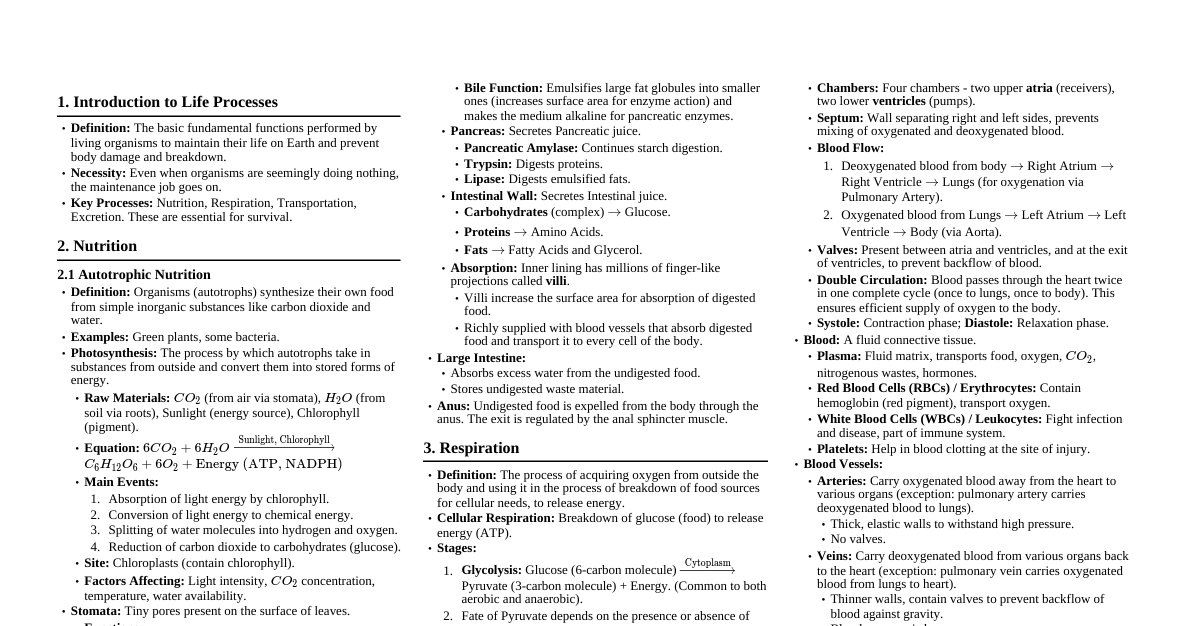
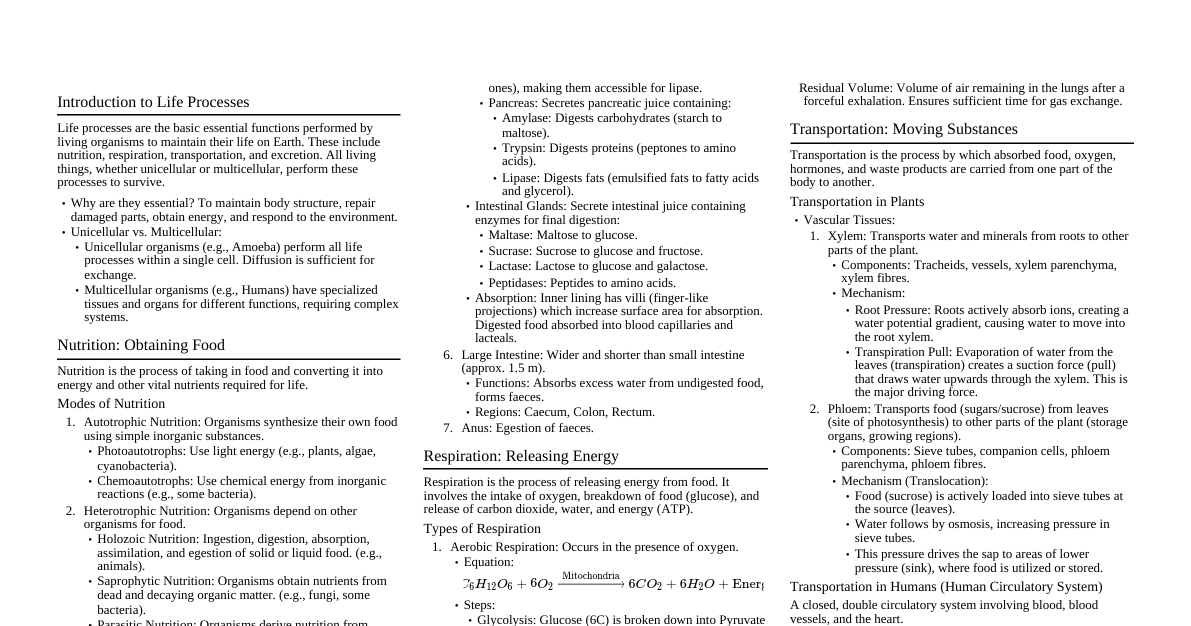
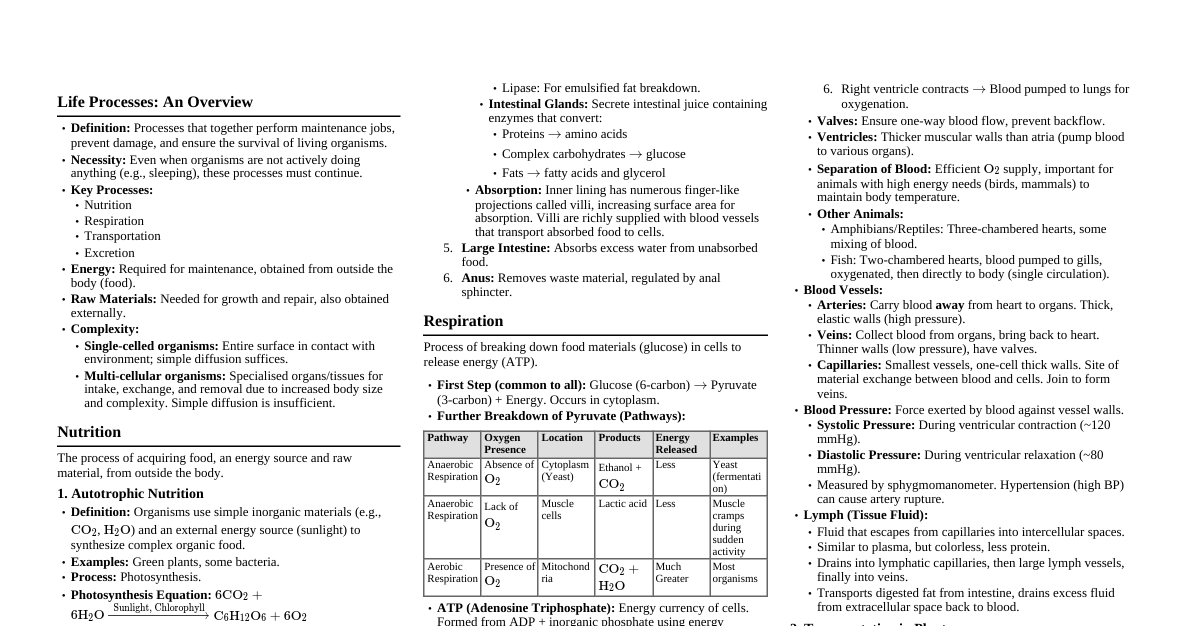
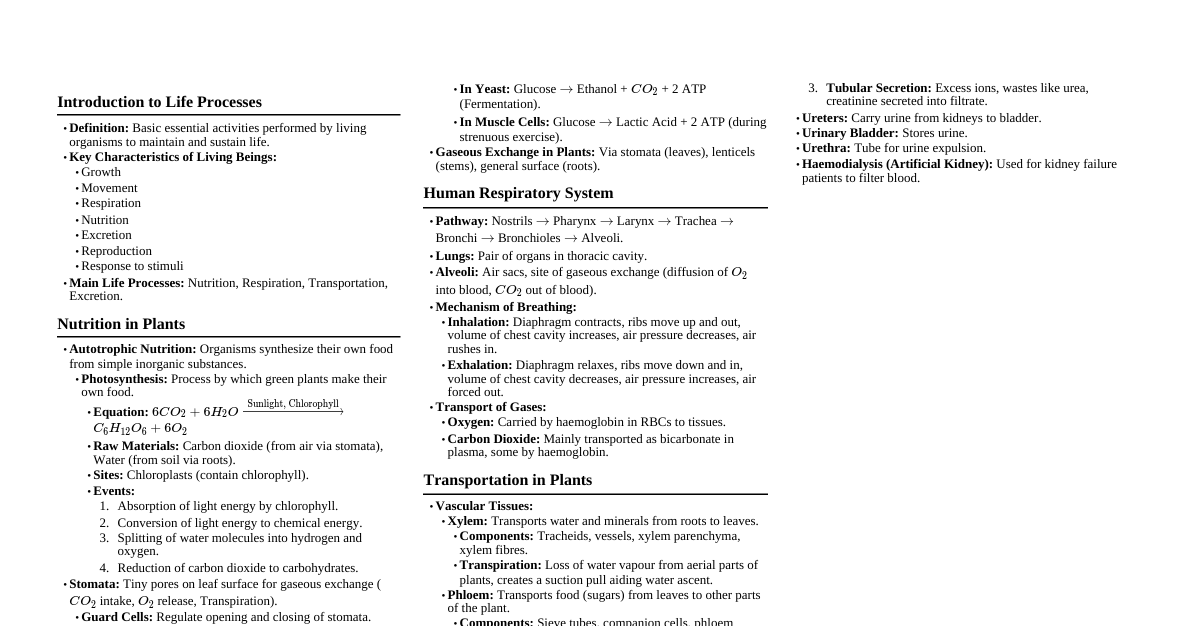
### Introduction to Life Processes - **Definition:** The fundamental processes essential for an organism's survival, maintenance, and continuity of life. These processes work in coordination to keep an organism alive. - **Key Life Processes:** 1. **Nutrition:** Acquiring food for energy and raw materials. 2. **Respiration:** Releasing energy from food. 3. **Transportation/Circulation:** Moving substances within the body. 4. **Excretion:** Removing waste products. 5. **Control & Coordination:** Responding to stimuli (not covered in this chapter, but an important life process). 6. **Growth:** Increase in size and development. 7. **Reproduction:** Producing offspring (not covered in this chapter, but an important life process). - **Need for Energy:** All living organisms require a continuous supply of energy to perform various life processes. This energy is derived from the food they consume. - **Maintenance Functions:** Even when an organism is seemingly at rest, its body performs maintenance functions (e.g., cell repair, growth) that require energy. ### Nutrition (PYQ: Modes, Photosynthesis, Human Digestion) - **Definition:** The process of taking in food and its utilization by the body to obtain energy for growth, repair, and other metabolic activities. - **Modes of Nutrition:** - **1. Autotrophic Nutrition (Self-feeding):** - Organisms synthesize their own organic food from simple inorganic substances (e.g., $CO_2$, water) using an external energy source. - **Examples:** Green plants, cyanobacteria, some protists. - **Photosynthesis:** The primary process of autotrophic nutrition in green plants. - **Definition:** The process by which green plants (and some other organisms) use sunlight, water, and carbon dioxide to create food (glucose) and release oxygen. - **Raw Materials:** Carbon dioxide (from atmosphere via stomata), Water (from soil via roots). - **Site:** Chloroplasts (contain chlorophyll pigment). - **Equation:** $6CO_2 + 6H_2O \xrightarrow{\text{Sunlight, Chlorophyll}} C_6H_{12}O_6 + 6O_2$ - **Key Events/Steps:** 1. **Light-Dependent Reactions:** Absorption of light energy by chlorophyll. Conversion of light energy into chemical energy (ATP and NADPH). Splitting of water molecules (photolysis) to release oxygen, protons ($H^+$), and electrons. 2. **Light-Independent Reactions (Calvin Cycle):** Reduction of carbon dioxide to carbohydrates (glucose) using the chemical energy (ATP, NADPH) produced in the light reactions. - **Role of Stomata:** - Tiny pores on the surface of leaves (mostly on the underside). - **Functions:** - Facilitate gaseous exchange ($CO_2$ intake for photosynthesis, $O_2$ release). - Allow transpiration (loss of excess water vapor). - **Regulation:** Guard cells (kidney-shaped cells) surround each stoma and regulate its opening and closing. They swell when water enters them, causing the stomatal pore to open, and shrink when water leaves, closing the pore. - **2. Heterotrophic Nutrition (Other-feeding):** - Organisms depend on other organisms for their food supply as they cannot synthesize their own. - **Types:** - **Holozoic Nutrition:** Involves the ingestion of complex organic food material, its digestion, absorption, assimilation, and egestion of undigested waste. - **Examples:** Humans, animals, Amoeba. - **Saprophytic Nutrition:** Organisms obtain nutrients from dead and decaying organic matter. They secrete digestive enzymes outside their body to break down complex food into simpler forms, which are then absorbed. - **Examples:** Fungi (mushrooms, bread mould), some bacteria. - **Parasitic Nutrition:** Organisms (parasites) obtain food from another living organism (host) without killing it, often causing harm to the host. - **Examples:** Cuscuta (plant parasite), ticks, lice, tapeworms. - **Nutrition in Amoeba (Holozoic):** 1. **Ingestion:** Uses temporary finger-like extensions called **pseudopodia** to engulf food particles, forming a **food vacuole**. 2. **Digestion:** Digestive enzymes are secreted into the food vacuole, breaking down complex food into simpler substances. 3. **Absorption:** Digested food diffuses into the cytoplasm. 4. **Assimilation:** Utilized for energy, growth, and repair. 5. **Egestion:** Undigested waste is expelled from the cell. - **Nutrition in Human Beings (Human Digestive System - PYQ: Parts, Functions, Enzymes):** - A complex alimentary canal and associated digestive glands. - **1. Mouth (Buccal Cavity):** - **Ingestion:** Intake of food. - **Mechanical Digestion:** Chewing (mastication) by teeth. - **Chemical Digestion:** Saliva (secreted by salivary glands) contains **salivary amylase (ptyalin)**, which begins the digestion of starch into simpler sugars (maltose). - **2. Pharynx:** Common passage for food and air. - **3. Oesophagus (Food Pipe):** - Muscular tube connecting pharynx to stomach. - Food moves down by **peristaltic movements** (rhythmic contraction and relaxation of muscular walls). - **4. Stomach:** - J-shaped muscular bag. - **Gastric Glands** in its wall secrete **gastric juice**, containing: - **Hydrochloric Acid (HCl):** - Creates an acidic medium (pH 1.5-3.5) necessary for the activation of pepsin. - Kills bacteria and other harmful microorganisms in food. - **Pepsin:** An enzyme that begins the digestion of proteins into peptones. - **Mucus:** Protects the inner lining of the stomach from the corrosive action of HCl. - **5. Small Intestine (PYQ: Villi, Complete Digestion):** - Longest part of the alimentary canal (about 6.5 meters), highly coiled. - **Site of Complete Digestion** of carbohydrates, proteins, and fats. - **Site of Absorption** of digested food. - **Receives secretions from:** - **Liver:** Secretes **Bile juice** (stored in gallbladder). Bile emulsifies fats (breaks large fat globules into smaller ones), making it easier for lipase to act. Bile also provides an alkaline medium. - **Pancreas:** Secretes **Pancreatic juice**, containing: - **Amylase:** Digests starch. - **Trypsin:** Digests proteins. - **Lipase:** Digests emulsified fats. - **Intestinal Glands:** Secrete **Intestinal juice (succus entericus)**, which contains enzymes that complete digestion: - Carbohydrates $\rightarrow$ Glucose (e.g., Maltase, Sucrase, Lactase) - Proteins $\rightarrow$ Amino Acids (e.g., Peptidases) - Fats $\rightarrow$ Fatty Acids and Glycerol - **Absorption:** The inner lining of the small intestine has millions of tiny, finger-like projections called **villi**. - **Function of Villi:** Greatly increase the surface area for efficient absorption of digested food. - Richly supplied with blood vessels that absorb the digested food and transport it to all body cells. - **6. Large Intestine:** - Wider and shorter than the small intestine. - **Function:** Absorbs excess water from the undigested food material. - Forms faeces (solid waste). - **7. Rectum:** Stores faeces temporarily. - **8. Anus:** Egestion (expulsion) of faeces from the body, regulated by the anal sphincter. ### Respiration (PYQ: Types, Human Respiratory System, Gaseous Exchange) - **Definition:** The biochemical process of releasing energy from the breakdown of organic food substances (like glucose) for various life processes. It involves gaseous exchange and oxidation of food. - **Types of Respiration:** - **1. Aerobic Respiration:** - Occurs in the **presence of oxygen**. - **Site:** Primarily in the **mitochondria** (with glycolysis occurring in the cytoplasm). - **Energy Yield:** High (releases a large amount of energy, typically 38 ATP molecules per glucose molecule). - **End Products:** Carbon dioxide, water, and energy. - **Equation:** $C_6H_{12}O_6 + 6O_2 \xrightarrow{\text{Enzymes}} 6CO_2 + 6H_2O + \text{Energy (38 ATP)}$ - **Steps (Overview):** 1. **Glycolysis:** Glucose (6-carbon molecule) is broken down into two molecules of pyruvate (3-carbon molecule) in the cytoplasm (releases 2 ATP). 2. **Krebs Cycle (Citric Acid Cycle):** Pyruvate is converted and enters the Krebs cycle in the mitochondrial matrix, producing ATP, NADH, and FADH2. 3. **Electron Transport Chain:** NADH and FADH2 release electrons, leading to the production of a large amount of ATP (oxidative phosphorylation) in the inner mitochondrial membrane. - **2. Anaerobic Respiration:** - Occurs in the **absence of oxygen**. - **Site:** Cytoplasm. - **Energy Yield:** Low (releases a small amount of energy, typically 2 ATP molecules per glucose molecule). - **Types of Anaerobic Respiration:** - **a) Alcoholic Fermentation (in Yeast, some bacteria):** - **End Products:** Ethanol, carbon dioxide, and energy. - **Equation:** $C_6H_{12}O_6 \xrightarrow{\text{Enzymes}} 2C_2H_5OH (\text{Ethanol}) + 2CO_2 + \text{Energy (2 ATP)}$ - **Application:** Used in brewing and baking industries. - **b) Lactic Acid Fermentation (in muscle cells during strenuous exercise):** - **End Products:** Lactic acid and energy. - **Equation:** $C_6H_{12}O_6 \xrightarrow{\text{Enzymes}} 2CH_3CH(OH)COOH (\text{Lactic Acid}) + \text{Energy (2 ATP)}$ - **Effect:** Accumulation of lactic acid in muscle cells causes muscle cramps and fatigue. Oxygen debt is incurred. - **Respiration in Human Beings (Human Respiratory System - PYQ: Alveoli, Gaseous Exchange):** - **Pathway of Air:** 1. **Nostrils:** Air enters, filtered by fine hairs and mucus. 2. **Pharynx:** Common passage. 3. **Larynx (Voice Box):** Contains vocal cords. 4. **Trachea (Windpipe):** Supported by C-shaped cartilaginous rings (prevent collapse). Divides into primary bronchi. 5. **Bronchi:** Enter lungs, further divide into smaller **bronchioles**. 6. **Bronchioles:** End in tiny air sacs called **alveoli**. - **Lungs:** Pair of spongy, elastic organs in the chest cavity. - **Alveoli (PYQ: Structure, Function):** - **Structure:** Extremely thin-walled, balloon-like structures. - **Blood Supply:** Rich network of blood capillaries surrounding them. - **Function:** The primary site of gaseous exchange. - Oxygen from the inhaled air in the alveoli diffuses into the blood capillaries (due to higher $O_2$ concentration in alveoli). - Carbon dioxide from the blood capillaries diffuses into the alveoli (due to higher $CO_2$ concentration in blood) to be exhaled. - The extensive surface area of millions of alveoli ensures efficient gaseous exchange. - **Mechanism of Breathing:** - **Inhalation:** Diaphragm contracts and flattens, rib cage moves upwards and outwards (due to intercostal muscles). This increases the volume of the chest cavity, reducing air pressure, so air rushes into the lungs. - **Exhalation:** Diaphragm relaxes and domes upwards, rib cage moves downwards and inwards. This decreases the volume of the chest cavity, increasing air pressure, forcing air out of the lungs. - **Respiratory Pigment:** - **Haemoglobin:** Present in Red Blood Cells (RBCs). Has a high affinity for oxygen and transports it from the lungs to all body tissues. - Carbon dioxide is mostly transported in dissolved form in plasma and as bicarbonate ions. - **Respiration in Plants (PYQ: Stomata):** - Plants respire through different parts: - **Leaves:** Gaseous exchange occurs through **stomata**. - **Stems:** Gaseous exchange occurs through **lenticels** (small pores) in woody stems or stomata in herbaceous stems. - **Roots:** Cells in the roots absorb oxygen from the air spaces between soil particles. - **Rate:** Respiration rate in plants is much slower than in animals. - **Day vs. Night:** During the day, photosynthesis produces oxygen, some of which is used for respiration. At night, only respiration occurs, consuming oxygen and releasing carbon dioxide. ### Transportation (PYQ: Human Circulatory System, Plant Transport) - **Definition:** The process of moving substances (like food, water, oxygen, hormones, metabolic wastes) from one part of the body to another. - **Transportation in Human Beings (Human Circulatory System - PYQ: Heart, Blood, Blood Vessels, Double Circulation):** - A closed system involving blood, blood vessels, and the heart. - **1. Blood:** A fluid connective tissue. - **Components:** - **Plasma:** Liquid matrix (about 55% of blood volume). Transports water, proteins, hormones, digested food, salts, carbon dioxide, and nitrogenous wastes. - **Red Blood Cells (RBCs/Erythrocytes):** Contain **haemoglobin**, a red iron-containing pigment that binds with oxygen and transports it to tissues. Lack nucleus. - **White Blood Cells (WBCs/Leukocytes):** Part of the immune system, fight infections. - **Platelets (Thrombocytes):** Cell fragments involved in blood clotting to prevent excessive blood loss. - **2. Blood Vessels:** Network of tubes that carry blood. - **Arteries:** - Carry **oxygenated blood** (except pulmonary artery) **away from the heart** to various body parts. - Have thick, elastic, muscular walls to withstand high pressure. - Do not have valves (except at their origin from the heart). - **Veins:** - Carry **deoxygenated blood** (except pulmonary vein) **towards the heart** from various body parts. - Have thinner, less elastic walls. - Contain **valves** to prevent the backflow of blood, as blood pressure is lower. - **Capillaries:** - Microscopic, extremely thin-walled (single cell thick) vessels connecting arteries and veins. - **Site of exchange** of gases, nutrients, hormones, and waste products between blood and body cells. - Their thin walls facilitate rapid diffusion. - **3. Heart (PYQ: Structure, Blood Flow):** - A muscular, four-chambered pumping organ located in the chest cavity. - **Chambers:** - **Upper Chambers:** Left Atrium, Right Atrium (receive blood). - **Lower Chambers:** Left Ventricle, Right Ventricle (pump blood). - **Septum:** Muscular wall separating the left and right sides of the heart, preventing the mixing of oxygenated and deoxygenated blood. - **Valves:** Ensure unidirectional flow of blood and prevent backflow. - **Blood Flow (Double Circulation):** 1. **Right Atrium:** Receives deoxygenated blood from the body (via vena cava). 2. **Right Ventricle:** Pumps deoxygenated blood to the lungs (via pulmonary artery). 3. **Lungs:** Blood gets oxygenated. 4. **Left Atrium:** Receives oxygenated blood from the lungs (via pulmonary vein). 5. **Left Ventricle:** Pumps oxygenated blood to the rest of the body (via aorta). - The left ventricle has thicker walls than the right ventricle as it has to pump blood to the entire body. - **Double Circulation (PYQ: Significance):** - Blood passes through the heart **twice** in one complete cycle: - **Pulmonary Circulation:** Blood from heart to lungs and back to heart (for oxygenation). - **Systemic Circulation:** Blood from heart to the rest of the body and back to heart (to deliver oxygen and nutrients). - **Significance:** Ensures complete separation of oxygenated and deoxygenated blood, leading to a highly efficient supply of oxygen to the body. This is crucial for warm-blooded animals (mammals, birds) that require a lot of energy to maintain their body temperature. - **Lymphatic System:** - **Lymph:** A yellowish fluid (tissue fluid) that leaks out of blood capillaries into intercellular spaces. - **Components:** Lymph, lymph vessels, lymph nodes. - **Functions:** - Carries digested and absorbed fat from the intestine. - Drains excess fluid from extracellular spaces back into the blood. - Plays a role in the immune system (lymph nodes filter pathogens). - **Transportation in Plants (PYQ: Xylem, Phloem, Transpiration, Translocation):** - Plants have specialized vascular tissues for transport. - **1. Xylem:** - **Function:** Transports **water and dissolved minerals** from the roots to all aerial parts of the plant (leaves, stem). - **Direction:** Unidirectional (upwards only). - **Components:** Tracheids, vessels, xylem parenchyma, xylem fibres. - **Mechanism (Ascent of Sap):** - **Root Pressure:** Pushes water up from the roots, especially at night when transpiration is low. - **Transpiration Pull (Cohesion-Tension Theory):** **Most significant force.** - **Transpiration:** The loss of water vapor from the aerial parts of plants (primarily leaves through stomata). - As water evaporates from the leaves, it creates a "suction pull" or tension in the xylem vessels. - This pull, combined with the cohesive (water molecules sticking to each other) and adhesive (water molecules sticking to xylem walls) properties of water, draws a continuous column of water upwards from the roots to the leaves. - **2. Phloem:** - **Function:** Transports **food (sugars, mainly sucrose)** synthesized during photosynthesis in the leaves to other parts of the plant (roots, storage organs, growing regions). - **Direction:** Bidirectional (upwards and downwards). - **Components:** Sieve tubes, companion cells, phloem parenchyma, phloem fibres. - **Mechanism (Translocation):** - Food is loaded into sieve tubes at the source (e.g., leaves) using ATP energy. - This increases the osmotic pressure in the sieve tubes, causing water to move into them from adjacent xylem. - The increased pressure drives the sap (food solution) through the phloem to areas of lower pressure (sinks, e.g., roots, fruits) where food is utilized or stored. ### Excretion (PYQ: Human Excretory System, Nephron) - **Definition:** The biological process of removing harmful metabolic waste products (e.g., urea, uric acid, excess salts, water) from the body. - **Excretion in Human Beings (Human Excretory System - Urinary System - PYQ: Kidney, Nephron, Urine Formation):** - **Components:** 1. **A pair of Kidneys:** Bean-shaped organs located on either side of the backbone, in the abdomen. 2. **A pair of Ureters:** Tubes carrying urine from kidneys to the bladder. 3. **A Urinary Bladder:** Muscular sac that stores urine temporarily. 4. **A Urethra:** Tube that carries urine from the bladder out of the body. - **Kidneys (PYQ: Function):** - **Primary Function:** Filter blood to remove nitrogenous waste products (urea, uric acid, creatinine) and regulate water and salt balance. - Produce urine. - **Nephron (PYQ: Structure, Urine Formation):** - The **structural and functional unit of the kidney**. Each kidney contains millions of nephrons. - **Structure of a Nephron:** - **Bowman's Capsule:** Cup-shaped structure containing a cluster of capillaries called the **glomerulus**. - **Glomerulus:** A knot of capillaries where blood is filtered. - **Renal Tubule:** A long, convoluted tube extending from Bowman's capsule, leading to a collecting duct. - **Urine Formation (Three main steps):** 1. **Glomerular Filtration:** - Blood (containing waste products, useful substances) enters the glomerulus under high pressure. - Water, salts, glucose, amino acids, urea, etc., are filtered out of the blood into the Bowman's capsule. Large molecules like proteins and blood cells do not pass through. The fluid collected is called **glomerular filtrate**. 2. **Tubular Reabsorption:** - As the filtrate flows through the renal tubule, essential substances like **glucose, amino acids, most salts, and a major portion of water** are selectively reabsorbed back into the blood capillaries surrounding the tubule. This process is highly regulated. 3. **Tubular Secretion:** - Some additional waste products (e.g., excess ions like $K^+$, some drugs) are actively secreted from the blood into the filtrate within the renal tubule. - The fluid remaining in the tubule after reabsorption and secretion is urine. - **Ureters:** Muscular tubes that transport urine from the renal pelvis of each kidney to the urinary bladder by peristaltic movements. - **Urinary Bladder:** A muscular bag that stores urine until it is excreted. The urge to urinate arises when the bladder is full. - **Urethra:** A tube that carries urine from the urinary bladder to the outside of the body. - **Dialysis (Artificial Kidney - PYQ: Principle, Use):** - A medical procedure used for patients with kidney failure. - **Principle:** Works on the principle of diffusion and ultrafiltration. - **Process:** The patient's blood is passed through an artificial kidney containing a semi-permeable membrane. The membrane allows waste products to diffuse from the blood into a dialyzing fluid, while useful substances and blood cells remain in the blood. The purified blood is then returned to the patient. - **Significance:** Saves lives by removing toxic wastes when kidneys fail, but it's a temporary solution as it cannot perform other kidney functions like hormone production. - **Excretion in Plants (PYQ: Methods):** - Plants have simpler excretory mechanisms than animals, as they do not have a specialized excretory system. - **Methods:** 1. **Gaseous Wastes:** Oxygen (product of photosynthesis) and carbon dioxide (product of respiration) are excreted through **stomata** in leaves and **lenticels** in stems. 2. **Excess Water:** Removed through **transpiration** (loss of water vapor from aerial parts, primarily stomata). 3. **Solid/Liquid Wastes:** - Stored in cellular vacuoles. - Stored in dead leaves that eventually fall off. - Stored in barks that peel off. - Excreted as gums, resins (especially in old xylem), and latex. - Some waste substances are released into the surrounding soil through the roots.