Alkenes & Alkynes Chemistry
Cheatsheet Content
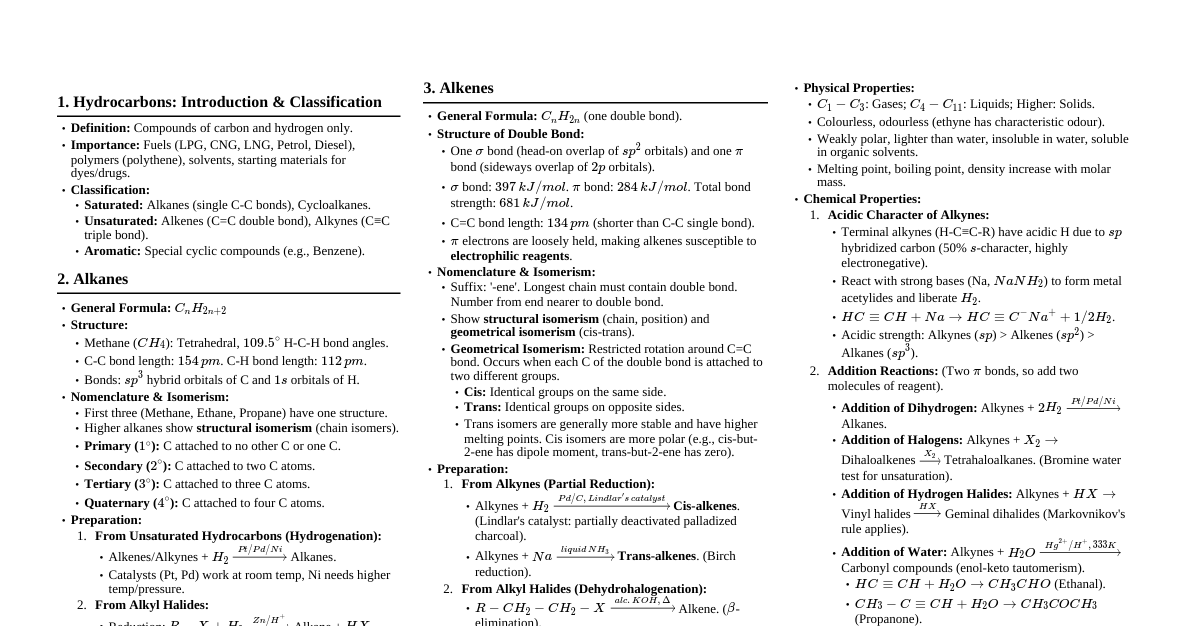
### Alkenes: Introduction & Structure - **Nomenclature:** Suffix "-ene", longest carbon chain containing the double bond. - e.g., Ethene ($C_2H_4$), Propene ($C_3H_6$), But-1-ene ($C_4H_8$). - **Structure of Double Bond (Ethene):** - $sp^2$ hybridized carbon atoms. - One sigma ($\sigma$) bond and one pi ($\pi$) bond. - Bond angles ~120°. Planar geometry. - Restricted rotation around the double bond. - **Isomerism:** - **Structural Isomerism:** Chain, position, functional group. - **Geometric (cis-trans) Isomerism:** Due to restricted rotation around the C=C bond when each carbon of the double bond has two different groups attached. - `cis`: Identical groups on the same side. - `trans`: Identical groups on opposite sides. ### Alkenes: Methods of Preparation 1. **Dehydration of Alcohols:** - Alcohol heated with conc. $H_2SO_4$ or $Al_2O_3$ at high temperatures. - Example: $CH_3CH_2OH \xrightarrow{Conc. H_2SO_4, 170^\circ C} CH_2=CH_2 + H_2O$ - Follows **Saytzeff's Rule:** In dehydrohalogenation or dehydration, the preferred alkene formed is the one that is more substituted (more stable). 2. **Dehydrohalogenation of Alkyl Halides:** - Alkyl halide heated with alcoholic KOH. - Example: $CH_3CH_2Br \xrightarrow{Alc. KOH, \Delta} CH_2=CH_2 + KBr + H_2O$ - From vicinal dihalides (e.g., 1,2-dibromoethane) with Zn dust: $BrCH_2-CH_2Br + Zn \xrightarrow{\Delta} CH_2=CH_2 + ZnBr_2$ 3. **Kolbe's Electrolytic Method:** - Electrolysis of an aqueous solution of potassium or sodium salt of a dicarboxylic acid. - Example (for ethene): $2CH_2(COOK)-CH_2(COOK) \xrightarrow{Electrolysis} CH_2=CH_2 + 2CO_2 + 2KOH + H_2$ 4. **From Alkynes (Partial Hydrogenation):** - Alkynes hydrogenated with $H_2$ in presence of Lindlar's catalyst ($Pd/CaCO_3$ poisoned with lead acetate and quinoline) or Nickel boride. - Lindlar's catalyst gives `cis`-alkenes. - Example: $RC \equiv CR' + H_2 \xrightarrow{Lindlar's Cat.} \text{cis}-RCH=CHR'$ ### Alkenes: Physical Properties - **State:** $C_2-C_4$ are gases, $C_5-C_{17}$ are liquids, higher are solids at room temperature. - **Freezing point, Melting point, Boiling point:** Generally increase with molecular mass due to increasing Van der Waals forces. `trans` isomers usually have higher melting points than `cis` due to better packing. - **Dipole moment:** `cis` isomers often have a net dipole moment (e.g., cis-but-2-ene), while `trans` isomers may have zero or a very small dipole moment (e.g., trans-but-2-ene). - **Density:** Less dense than water. Density increases with molecular weight. - **Solubility:** Non-polar, insoluble in water but soluble in non-polar solvents. ### Alkenes: Chemical Properties (Addition Reactions) - Characteristic reaction is **Electrophilic Addition** due to the presence of the $\pi$-electron cloud. - **Mechanism of Electrophilic Addition:** 1. Electrophile ($E^+$) attacks the $\pi$-bond, forming a carbocation intermediate. 2. Nucleophile ($Nu^-$) attacks the carbocation, forming the product. #### Addition of Hydrogen (Hydrogenation) - $CH_2=CH_2 + H_2 \xrightarrow{Ni/Pt/Pd} CH_3-CH_3$ (Alkane formation) #### Addition of Halogens ($X_2$, e.g., $Br_2$, $Cl_2$) - $CH_2=CH_2 + Br_2 \xrightarrow{CCl_4} BrCH_2-CH_2Br$ (Vicinal dihalide, decolorizes bromine water - test for unsaturation). - Mechanism: Halogen acts as an electrophile, forming a cyclic halonium ion intermediate. #### Addition of Water (Hydration) - $CH_2=CH_2 + H_2O \xrightarrow{H_2SO_4} CH_3CH_2OH$ (Alcohol formation) - Follows Markownikoff's Rule for unsymmetrical alkenes. #### Addition of Hydrogen Halides ($HX$, e.g., $HCl$, $HBr$, $HI$) - $CH_2=CH_2 + HBr \rightarrow CH_3CH_2Br$ - **Markownikoff's Rule:** In the addition of an unsymmetrical reagent to an unsymmetrical alkene, the positive part of the reagent adds to the carbon atom of the double bond that has more hydrogen atoms. - Example: $CH_3-CH=CH_2 + HBr \rightarrow CH_3-CH(Br)-CH_3$ (2-Bromopropane, major) - Mechanism: Proceeds via the more stable carbocation intermediate. - **Anti-Markownikoff's Rule (Peroxide Effect):** Only for HBr in the presence of peroxides. - $CH_3-CH=CH_2 + HBr \xrightarrow{Peroxide} CH_3-CH_2-CH_2Br$ (1-Bromopropane, major) - Mechanism: Free radical addition, where the Br radical adds to form the more stable carbon radical intermediate. #### Oxidation Reactions 1. **Complete Combustion:** Alkenes burn in excess oxygen to produce $CO_2$ and $H_2O$. - $C_nH_{2n} + \frac{3n}{2}O_2 \rightarrow nCO_2 + nH_2O$ 2. **Baeyer's Reagent (Cold, Dilute, Alkaline $KMnO_4$):** - Alkenes react with cold, dilute, alkaline $KMnO_4$ to form vicinal diols. - $CH_2=CH_2 \xrightarrow{Cold, dil. KMnO_4} HOCH_2-CH_2OH$ (Ethane-1,2-diol) - Decolorizes the purple $KMnO_4$ solution (test for unsaturation). 3. **Hot, Acidified/Alkaline $KMnO_4$:** - Stronger oxidation, leads to cleavage of the double bond, forming carboxylic acids, ketones, or $CO_2$ depending on substitution. 4. **Ozonolysis:** - Reaction with ozone ($O_3$) followed by hydrolysis ($Zn/H_2O$ or $H_2O_2$). - Cleaves the double bond, forming aldehydes and/or ketones. - Example: $R_2C=CR_2 \xrightarrow{1. O_3; 2. Zn/H_2O} 2R_2C=O$ - Useful for determining the position of the double bond. #### Polymerisation - Alkenes undergo addition polymerization to form long chain polymers. - Example: $nCH_2=CH_2 \xrightarrow{High\ T, P, catalyst} -(CH_2-CH_2)_n-$ (Polyethylene) #### Uses of Alkenes - Manufacture of polymers (polyethylene, polypropylene, PVC). - Starting materials for synthesis of alcohols, aldehydes, ketones, and other organic compounds. - Ethene is used as a ripening agent for fruits and as an anesthetic. ### Alkynes: Introduction & Structure - **Nomenclature:** Suffix "-yne", longest carbon chain containing the triple bond. - e.g., Ethyne ($C_2H_2$), Propyne ($C_3H_4$), But-1-yne ($C_4H_6$). - **Structure of Triple Bond (Ethyne):** - $sp$ hybridized carbon atoms. - One sigma ($\sigma$) bond and two pi ($\pi$) bonds. - Linear geometry, bond angle 180°. - **Isomerism:** Chain, position, functional group. No geometric isomerism possible. ### Alkynes: Methods of Preparation 1. **From Calcium Carbide ($CaC_2$):** (Manufacture of Ethyne) - $CaC_2 + 2H_2O \rightarrow CH \equiv CH + Ca(OH)_2$ 2. **From Natural Gas (Methane):** (Manufacture of Ethyne) - $2CH_4 \xrightarrow{1500^\circ C} CH \equiv CH + 3H_2$ 3. **Dehydrohalogenation of Vicinal or Geminal Dihalides:** - Two steps, usually with strong base like $NaNH_2$. - Example (from vicinal dibromide): $BrCH_2-CH_2Br + 2NaNH_2 \rightarrow CH \equiv CH + 2NaBr + 2NH_3$ 4. **Kolbe's Electrolytic Method:** - Electrolysis of an aqueous solution of potassium or sodium salt of fumaric or maleic acid. - Example: $2KOOC-CH=CH-COOK \xrightarrow{Electrolysis} CH \equiv CH + 2CO_2 + 2KOH + H_2$ ### Alkynes: Physical Properties - **State:** $C_2-C_3$ are gases, $C_4-C_{17}$ are liquids, higher are solids. - **Freezing point, Melting point, Boiling point:** Increase with molecular mass. Generally higher than corresponding alkenes and alkanes due to linear structure allowing better packing. - **Density:** Less dense than water, density increases with molecular weight. - **Solubility:** Non-polar, insoluble in water, soluble in organic solvents. ### Alkynes: Chemical Properties - Undergo **Electrophilic Addition** reactions, similar to alkenes, but can add two molecules of reagent across the triple bond. - **Acidic Character of Alkynes:** Terminal alkynes ($RC \equiv CH$) are weakly acidic due to the $sp$-hybridized carbon's high electronegativity, which pulls electron density from the C-H bond, making the hydrogen slightly acidic. - React with strong bases (e.g., $NaNH_2$) or active metals (Na) to form acetylides. - $RC \equiv CH + NaNH_2 \rightarrow RC \equiv C^-Na^+ + NH_3$ #### Addition Reactions 1. **Addition of Hydrogen (Hydrogenation):** - Complete: $RC \equiv CR' + 2H_2 \xrightarrow{Ni/Pt/Pd} RCH_2-CH_2R'$ (Alkane) - Partial: $RC \equiv CR' + H_2 \xrightarrow{Lindlar's Cat.} \text{cis}-RCH=CHR'$ (cis-Alkene) - Partial: $RC \equiv CR' + H_2 \xrightarrow{Na/Li\text{ in liquid } NH_3} \text{trans}-RCH=CHR'$ (trans-Alkene, Birch reduction) 2. **Addition of Halogens ($X_2$):** - $CH \equiv CH + Br_2 \xrightarrow{CCl_4} BrCH=CHBr$ (Dibromoalkene) - $BrCH=CHBr + Br_2 \xrightarrow{CCl_4} Br_2CH-CHBr_2$ (Tetrabromoalkane) 3. **Addition of Hydrogen Halides ($HX$):** - Follows Markownikoff's Rule for each addition. - $CH \equiv CH + HCl \rightarrow CH_2=CHCl$ (Vinyl chloride) - $CH_2=CHCl + HCl \rightarrow CH_3-CHCl_2$ (1,1-Dichloroethane) - Peroxide effect (Anti-Markownikoff) is observed for HBr. 4. **Addition of Water (Hydration):** - $CH \equiv CH + H_2O \xrightarrow{HgSO_4/H_2SO_4} [CH_2=CH-OH] \rightarrow CH_3-CHO$ - Forms an enol intermediate which tautomerizes to an aldehyde or ketone. - Ethyne gives ethanal, other alkynes give ketones (e.g., propyne gives propanone). #### Oxidation Reactions 1. **Complete Combustion:** Alkynes burn in excess oxygen to produce $CO_2$ and $H_2O$. - $C_nH_{2n-2} + \frac{3n-1}{2}O_2 \rightarrow nCO_2 + (n-1)H_2O$ 2. **Baeyer's Reagent (Cold, Dilute, Alkaline $KMnO_4$):** - React to form diketones or carboxylic acids upon further oxidation. - Decolorizes $KMnO_4$. 3. **Hot, Acidified/Alkaline $KMnO_4$:** - Cleaves the triple bond, forming carboxylic acids. For terminal alkynes, $CO_2$ is also formed. 4. **Ozonolysis:** - Cleaves the triple bond, forming carboxylic acids. For terminal alkynes, one product is formic acid, which gets further oxidized to $CO_2$. #### Polymerisation - Ethyne can undergo linear polymerization to form polyacetylene. - Cyclic polymerization (e.g., three molecules of ethyne polymerize to form benzene at red hot iron tube). #### Uses of Alkynes - Ethyne (acetylene) is used in oxy-acetylene welding. - Manufacture of polymers (PVC, synthetic rubber). - Starting material for synthesis of acetaldehyde, acetic acid, etc. ### Distinguishing Tests: Alkane, Alkene, Alkyne | Test | Alkane | Alkene | Alkyne (Terminal) | Alkyne (Internal) | | :------------------------------------ | :------------------------------------ | :---------------------------------------- | :---------------------------------------- | :---------------------------------------- | | **Bromine Water Test** ($Br_2/CCl_4$) | No reaction, no color change (orange) | Decolorizes bromine water (addition) | Decolorizes bromine water (addition) | Decolorizes bromine water (addition) | | **Baeyer's Reagent** (cold, dil. $KMnO_4$) | No reaction, no color change (purple) | Decolorizes $KMnO_4$ (forms diol) | Decolorizes $KMnO_4$ (forms diketone/acid) | Decolorizes $KMnO_4$ (forms diketone/acid) | | **Tollen's Reagent** ($[Ag(NH_3)_2]OH$) | No reaction | No reaction | Forms white precipitate of silver acetylide | No reaction | | **Fehling's Solution** (or Benedict's) | No reaction | No reaction | No reaction | No reaction | | **Ammoniacal CuCl** | No reaction | No reaction | Forms red precipitate of copper acetylide | No reaction |