Organic Reagents & Functions (JEE)
Cheatsheet Content
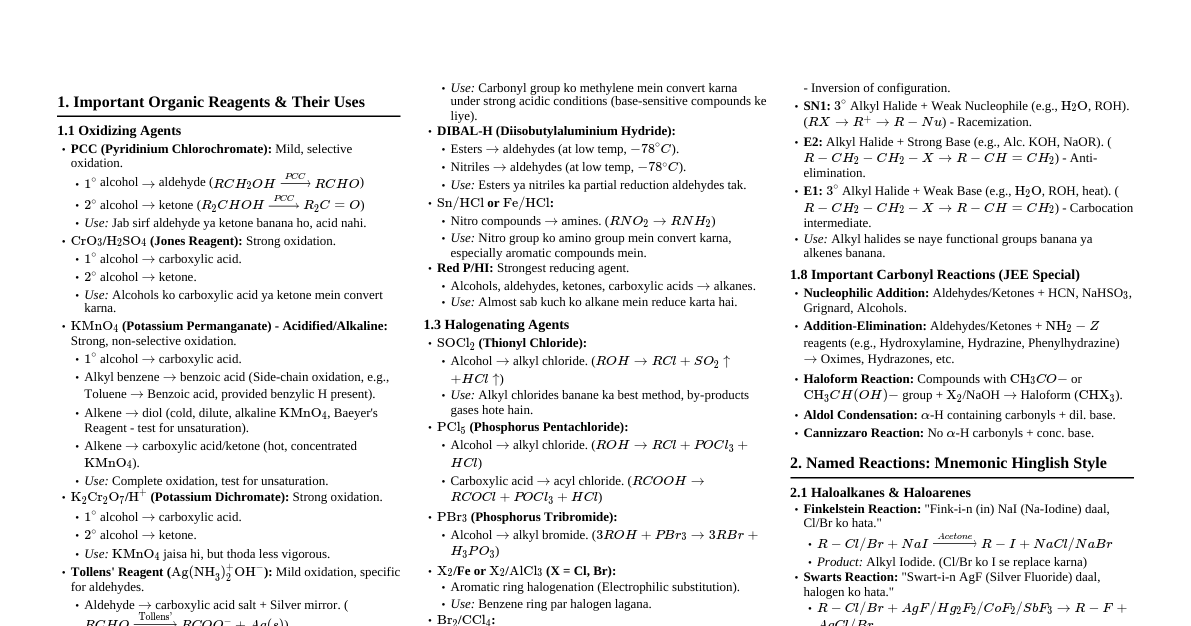
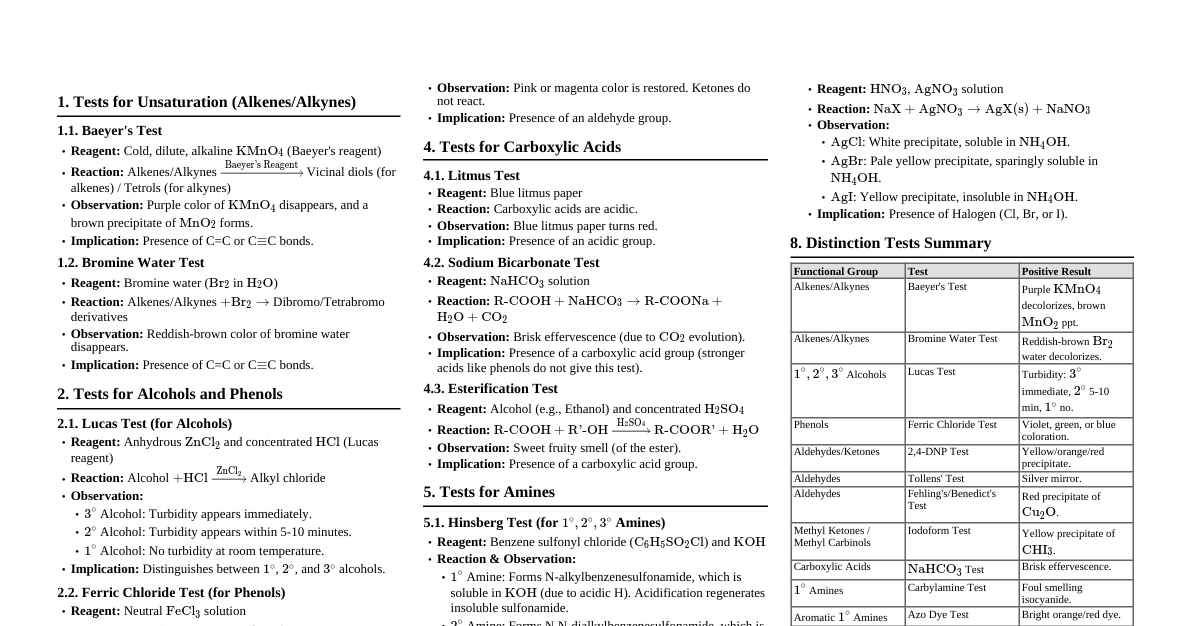
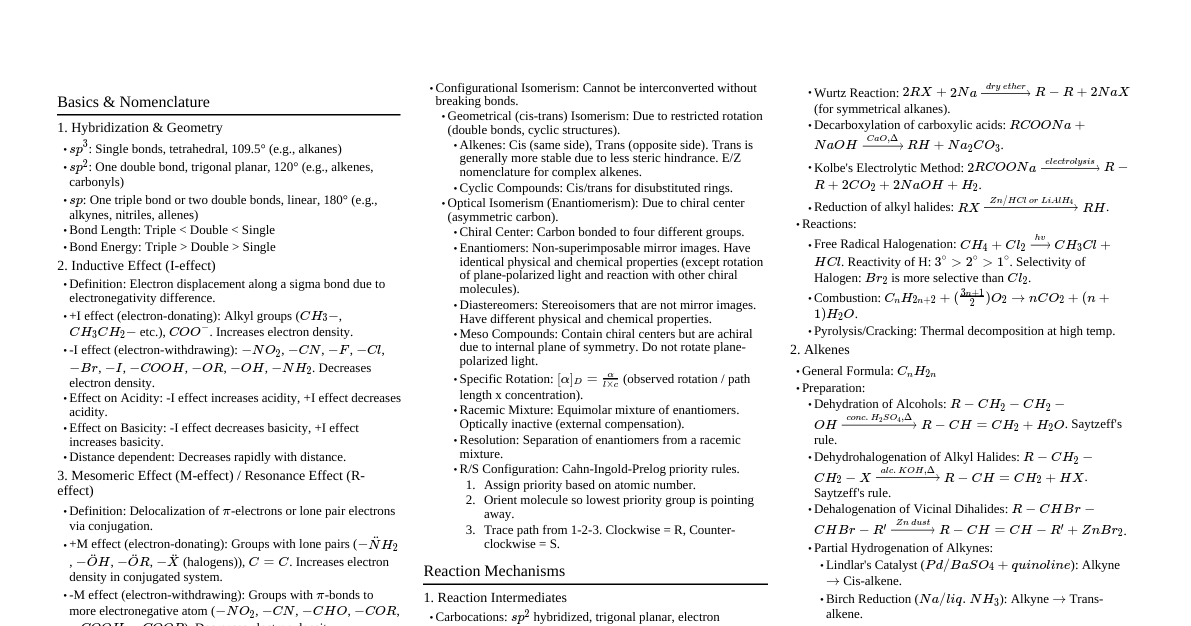
1. Grignard Reagent ($R-MgX$) Preparation: $R-X + Mg \xrightarrow{dry \ ether} R-MgX$ Properties: Strong nucleophile and strong base. Reacts with compounds having acidic H. Functions: Reaction with Carbonyl Compounds: Forms alcohols. Formaldehyde: $HCHO + R-MgX \to RCH_2OH$ (Primary Alcohol) Aldehydes (other): $R'CHO + R-MgX \to R'RCHOH$ (Secondary Alcohol) Ketones: $R'COR'' + R-MgX \to R'R''RCOH$ (Tertiary Alcohol) Reaction with Esters: Forms tertiary alcohols (excess Grignard) or ketones (1 equivalent). $R'COOR'' + R-MgX \to R'COR$ (ketone if 1 eq) $\xrightarrow{R-MgX} R'R_2COH$ Reaction with CO$_2$: Forms carboxylic acids. $R-MgX + CO_2 \xrightarrow{H_3O^+} RCOOH$ Reaction with Epoxides: Forms primary alcohols. $\text{Ethylene oxide} + R-MgX \to RCH_2CH_2OH$ Reaction with compounds having acidic H: Forms alkanes. $R-MgX + H_2O \to R-H + Mg(OH)X$ $R-MgX + R'OH \to R-H + R'OMgX$ $R-MgX + R'COOH \to R-H + R'COOMgX$ 2. Lithium Aluminum Hydride ($LiAlH_4$) Properties: Strong reducing agent. Reduces polar multiple bonds. Does not reduce non-polar C=C or C$\equiv$C bonds. Functions: Reduction of Carbonyl Compounds: Aldehydes: $RCHO \xrightarrow{LiAlH_4} RCH_2OH$ (Primary alcohol) Ketones: $RCOR' \xrightarrow{LiAlH_4} RCH(OH)R'$ (Secondary alcohol) Reduction of Carboxylic Acids & Esters: $RCOOH \xrightarrow{LiAlH_4} RCH_2OH$ (Primary alcohol) $RCOOR' \xrightarrow{LiAlH_4} RCH_2OH + R'OH$ Reduction of Amides: $RCONH_2 \xrightarrow{LiAlH_4} RCH_2NH_2$ (Primary amine) Reduction of Nitriles: $RCN \xrightarrow{LiAlH_4} RCH_2NH_2$ (Primary amine) Reduction of Alkyl Halides: $R-X \xrightarrow{LiAlH_4} R-H$ (Alkane) 3. Sodium Borohydride ($NaBH_4$) Properties: Milder reducing agent than $LiAlH_4$. Selective reduction. Functions: Reduction of Aldehydes & Ketones: Aldehydes: $RCHO \xrightarrow{NaBH_4} RCH_2OH$ (Primary alcohol) Ketones: $RCOR' \xrightarrow{NaBH_4} RCH(OH)R'$ (Secondary alcohol) Does NOT reduce: Carboxylic acids, esters, amides, nitriles, C=C, C$\equiv$C. 4. Hydrogenation ($H_2$ with Catalyst) Catalysts: $Pd, Pt, Ni$ (Raney Ni), $Rh$. Properties: Reduces unsaturated bonds. Functions: Reduction of Alkenes & Alkynes: $RCH=CH_2 \xrightarrow{H_2/Ni} RCH_2CH_3$ $RC \equiv CH \xrightarrow{H_2/Ni} RCH_2CH_3$ Reduction of Carbonyl Compounds: $RCHO \xrightarrow{H_2/Ni} RCH_2OH$ $RCOR' \xrightarrow{H_2/Ni} RCH(OH)R'$ Reduction of Nitriles to Primary Amines: $RCN \xrightarrow{H_2/Ni} RCH_2NH_2$ Reduction of Nitro Compounds to Amines: $RNO_2 \xrightarrow{H_2/Ni} RNH_2$ 5. Oxidizing Agents Potassium Permanganate ($KMnO_4$) Cold, dilute, alkaline ($Baeyer's Reagent$): Oxidizes alkenes to vicinal diols (syn addition). $RCH=CH_2 \xrightarrow{cold, dil. KMnO_4} RCH(OH)CH_2OH$ Hot, concentrated, acidic/alkaline: Cleaves C=C bonds, oxidizes alkanes at benzylic/allylic positions. $RCH=CHR' \xrightarrow{hot, conc. KMnO_4} RCOOH + R'COOH$ (if H present on C) $R_2C=CHR' \xrightarrow{hot, conc. KMnO_4} R_2C=O + R'COOH$ $R_2C=CR'_2 \xrightarrow{hot, conc. KMnO_4} R_2C=O + R'_2C=O$ Toluene $\xrightarrow{hot, conc. KMnO_4} Benzoic \ Acid$ Oxidation of Alcohols: $RCH_2OH \xrightarrow{KMnO_4} RCOOH$ (Primary alcohol to carboxylic acid) $R_2CHOH \xrightarrow{KMnO_4} R_2C=O$ (Secondary alcohol to ketone) Potassium Dichromate ($K_2Cr_2O_7/H^+$) Oxidation of Alcohols: Milder than $KMnO_4$. $RCH_2OH \xrightarrow{K_2Cr_2O_7/H^+} RCOOH$ (Primary alcohol to carboxylic acid) $R_2CHOH \xrightarrow{K_2Cr_2O_7/H^+} R_2C=O$ (Secondary alcohol to ketone) Chromium Trioxide ($CrO_3$) Jones Reagent ($CrO_3/H_2SO_4/Acetone$): Oxidizes primary alcohols to carboxylic acids, secondary alcohols to ketones. $RCH_2OH \xrightarrow{Jones \ Reagent} RCOOH$ $R_2CHOH \xrightarrow{Jones \ Reagent} R_2C=O$ PCC (Pyridinium Chlorochromate) ($CrO_3 \cdot pyridine \cdot HCl$): Selective oxidation of primary alcohols to aldehydes. $RCH_2OH \xrightarrow{PCC} RCHO$ $R_2CHOH \xrightarrow{PCC} R_2C=O$ (Secondary alcohol to ketone) Ozone ($O_3$) - Ozonolysis Reductive Ozonolysis ($O_3, Zn/H_2O$ or $DMS$): Cleaves C=C bonds, forms aldehydes/ketones. $RCH=CHR' \xrightarrow{O_3, Zn/H_2O} RCHO + R'CHO$ $R_2C=CHR' \xrightarrow{O_3, Zn/H_2O} R_2C=O + R'CHO$ $R_2C=CR'_2 \xrightarrow{O_3, Zn/H_2O} R_2C=O + R'_2C=O$ Oxidative Ozonolysis ($O_3, H_2O_2$): Cleaves C=C bonds, forms carboxylic acids/ketones. $RCH=CHR' \xrightarrow{O_3, H_2O_2} RCOOH + R'COOH$ $R_2C=CHR' \xrightarrow{O_3, H_2O_2} R_2C=O + R'COOH$ 6. Halogenating Agents Chlorine ($Cl_2$), Bromine ($Br_2$), Iodine ($I_2$) Alkanes (Free Radical Substitution): Requires UV light or heat. $CH_4 + Cl_2 \xrightarrow{h\nu} CH_3Cl + HCl$ Alkenes & Alkynes (Electrophilic Addition): Anti addition. $RCH=CH_2 + Br_2 \xrightarrow{CCl_4} RCH(Br)CH_2Br$ Benzene (Electrophilic Substitution): Requires Lewis acid catalyst ($FeCl_3, FeBr_3$). $C_6H_6 + Cl_2 \xrightarrow{FeCl_3} C_6H_5Cl + HCl$ Hydrogen Halides ($HCl, HBr, HI$) Alkenes & Alkynes (Electrophilic Addition): Markovnikov's rule. $RCH=CH_2 + HBr \to RCH(Br)CH_3$ Alcohols: Forms alkyl halides. $ROH + HCl \xrightarrow{ZnCl_2} RCl + H_2O$ (Lucas reagent) Thionyl Chloride ($SOCl_2$) Alcohols: Converts alcohols to alkyl chlorides (best method due to gaseous byproducts). $ROH + SOCl_2 \to RCl + SO_2 \uparrow + HCl \uparrow$ Phosphorus Trihalides ($PX_3$, e.g., $PCl_3, PBr_3$) Alcohols: Converts alcohols to alkyl halides. $3ROH + PCl_3 \to 3RCl + H_3PO_3$ 7. Nitrating Agents Nitrating Mixture ($Conc. HNO_3 + Conc. H_2SO_4$) Aromatic Compounds (Electrophilic Substitution): Benzene $\xrightarrow{Conc. HNO_3, Conc. H_2SO_4} Nitrobenzene$ 8. Sulfonating Agents Fuming Sulfuric Acid ($Conc. H_2SO_4 + SO_3$) or $Conc. H_2SO_4$ Aromatic Compounds (Electrophilic Substitution): Benzene $\xrightarrow{Conc. H_2SO_4} Benzenesulfonic \ Acid$ 9. Friedel-Crafts Reagents Alkyl Halides ($R-X$) + Lewis Acid ($AlCl_3$) Alkylation: Adds an alkyl group to an aromatic ring. Benzene + $CH_3Cl \xrightarrow{AlCl_3} Toluene$ Acyl Halides ($RCO-X$) or Acid Anhydrides ($(RCO)_2O$) + Lewis Acid ($AlCl_3$) Acylation: Adds an acyl group to an aromatic ring. Benzene + $CH_3COCl \xrightarrow{AlCl_3} Acetophenone$ 10. Dehydrating Agents Concentrated Sulfuric Acid ($Conc. H_2SO_4$) Alcohols: Forms alkenes (at high temp) or ethers (at lower temp, primary alcohols). $CH_3CH_2OH \xrightarrow{Conc. H_2SO_4, 170^\circ C} CH_2=CH_2 + H_2O$ $2CH_3CH_2OH \xrightarrow{Conc. H_2SO_4, 140^\circ C} CH_3CH_2OCH_2CH_3 + H_2O$ Carboxylic Acids with Alcohols (Esterification): $RCOOH + R'OH \xrightarrow{H_2SO_4} RCOOR' + H_2O$ Alumina ($Al_2O_3$) Alcohols: Forms alkenes. $CH_3CH_2OH \xrightarrow{Al_2O_3, 350^\circ C} CH_2=CH_2 + H_2O$ Phosphorus Pentoxide ($P_2O_5$) Amides to Nitriles: $RCONH_2 \xrightarrow{P_2O_5} RCN + H_2O$ 11. Hydroboration-Oxidation ($BH_3 \cdot THF, H_2O_2/OH^-$) Alkenes: Anti-Markovnikov addition of water, syn addition. $RCH=CH_2 \xrightarrow{1. BH_3 \cdot THF \\ 2. H_2O_2/OH^-} RCH_2CH_2OH$ (Primary alcohol) 12. Mercuric Acetate/Sodium Borohydride (Oxymercuration-Demercuration) Alkenes: Markovnikov addition of water, anti addition (overall). $RCH=CH_2 \xrightarrow{1. Hg(OAc)_2, H_2O \\ 2. NaBH_4, OH^-} RCH(OH)CH_3$ (Secondary alcohol) 13. Tollen's Reagent ($[Ag(NH_3)_2]OH$) Properties: Mild oxidizing agent, used to detect aldehydes. Functions: Oxidation of Aldehydes: Forms carboxylic acid, deposits silver mirror. $RCHO + 2[Ag(NH_3)_2]OH \to RCOONH_4 + 2Ag \downarrow + 3NH_3 + H_2O$ 14. Fehling's Solution (Cupric ions in alkaline medium) Properties: Mild oxidizing agent, used to detect aldehydes. Functions: Oxidation of Aldehydes: Forms carboxylic acid, precipitates red $Cu_2O$. $RCHO + 2Cu^{2+} + 5OH^- \to RCOO^- + Cu_2O \downarrow + 3H_2O$ 15. Lucas Reagent ($Conc. HCl + Anhydrous ZnCl_2$) Properties: Used to distinguish between primary, secondary, and tertiary alcohols. Functions: Tertiary Alcohols: Reacts immediately (turbidity). $R_3COH + HCl \xrightarrow{ZnCl_2} R_3CCl + H_2O$ Secondary Alcohols: Reacts in 5-10 minutes. Primary Alcohols: No reaction at room temperature. 16. Wurtz Reaction ($Na$ in dry ether) Alkyl Halides: Forms higher alkanes by coupling alkyl groups. $2R-X + 2Na \xrightarrow{dry \ ether} R-R + 2NaX$ 17. Clemmensen Reduction ($Zn-Hg/Conc. HCl$) Carbonyl Compounds: Reduces ketone/aldehyde carbonyl group to methylene group. $R_2C=O \xrightarrow{Zn-Hg/Conc. HCl} R_2CH_2$ 18. Wolff-Kishner Reduction ($NH_2NH_2/KOH, Ethylene \ Glycol, \Delta$) Carbonyl Compounds: Reduces ketone/aldehyde carbonyl group to methylene group. $R_2C=O \xrightarrow{NH_2NH_2, KOH, \Delta} R_2CH_2$