Organic Reactions & Mechanisms
Cheatsheet Content
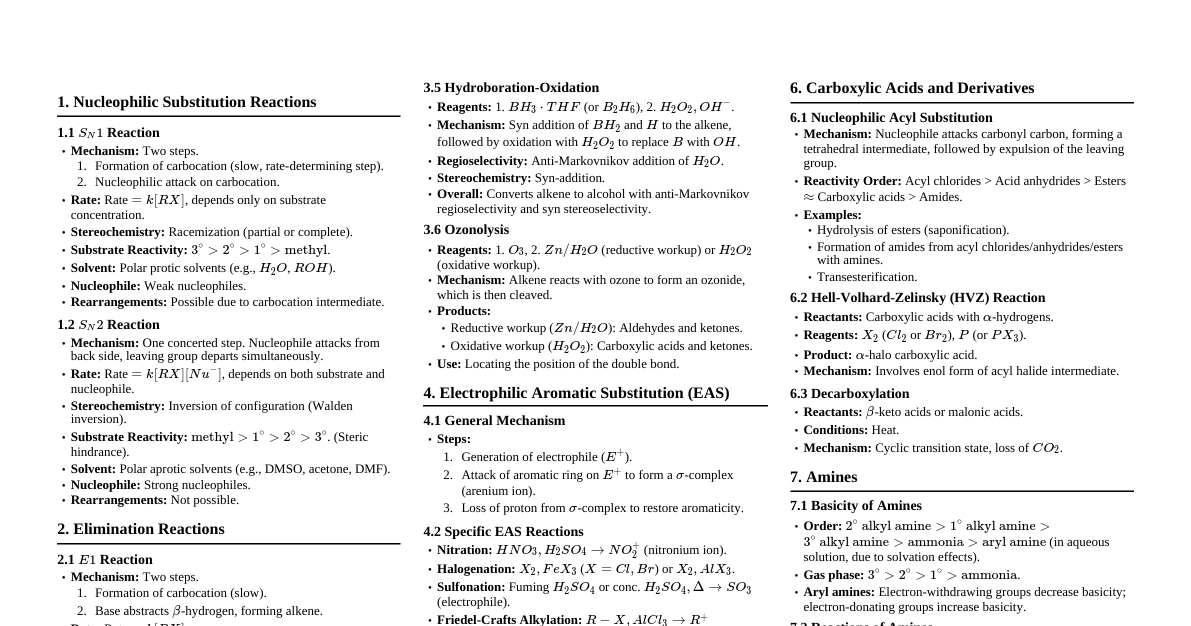
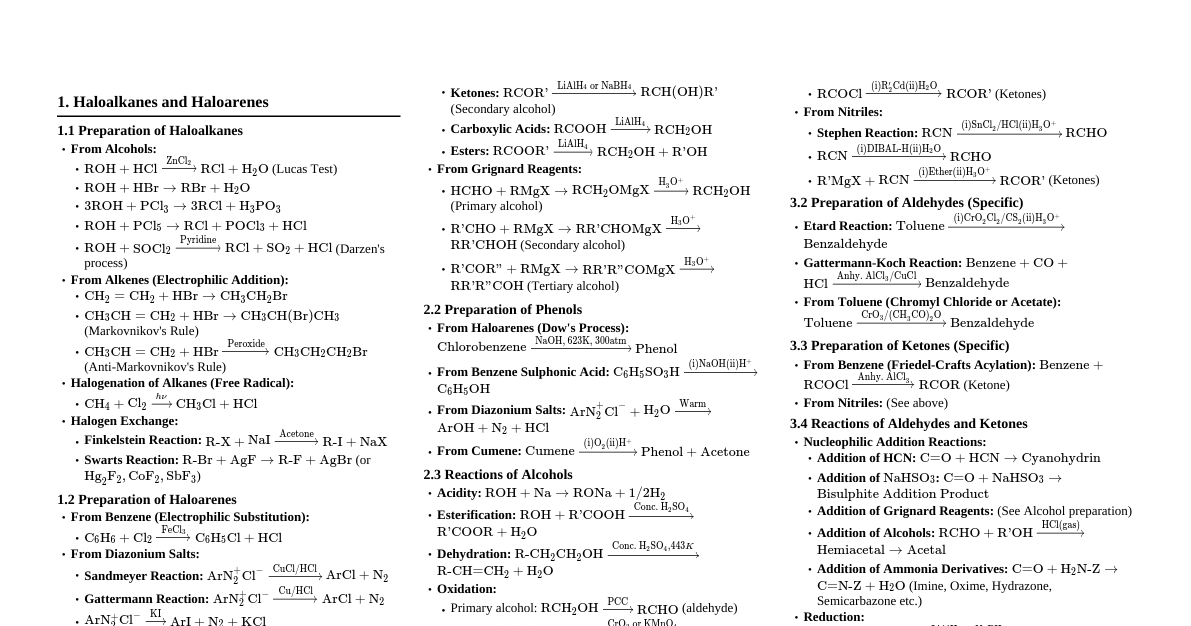
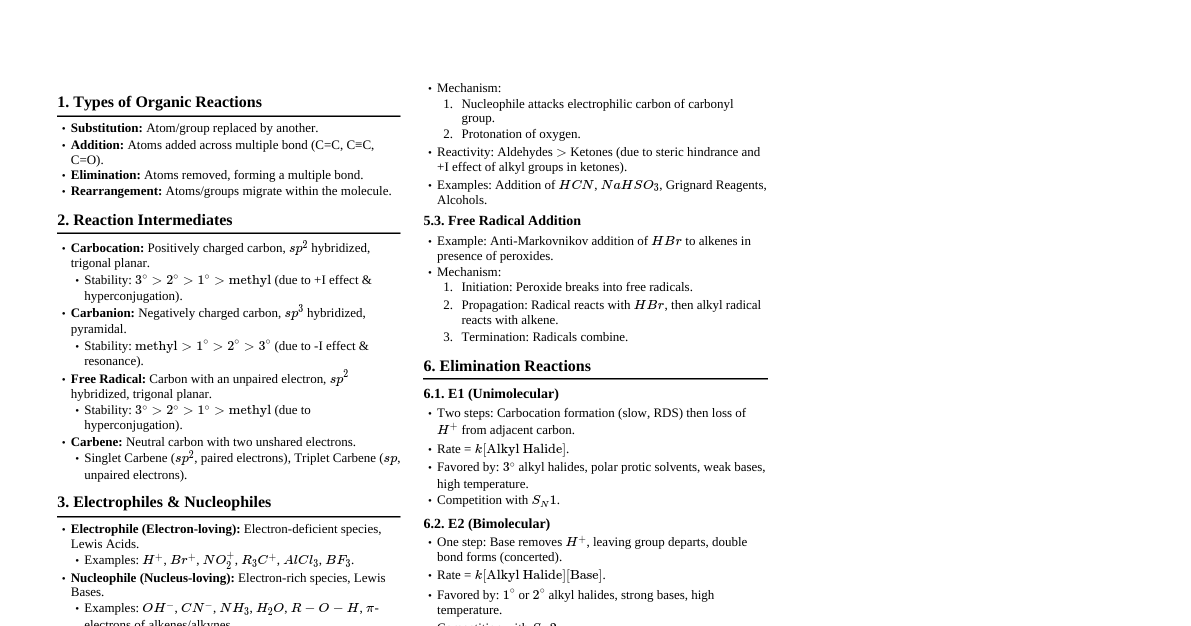
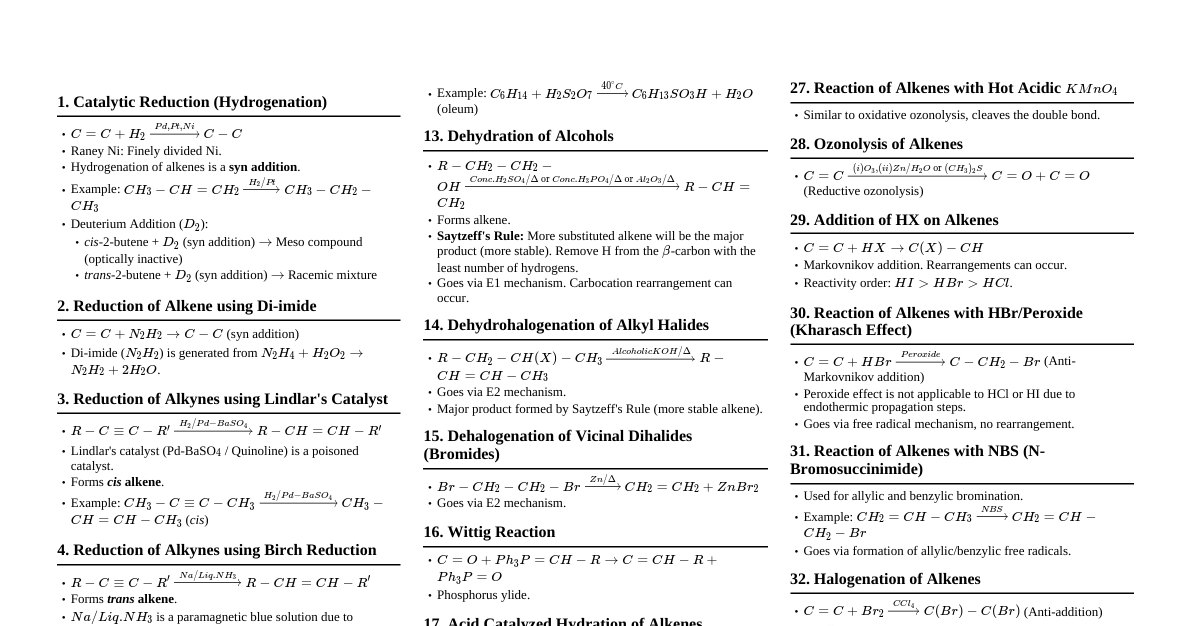
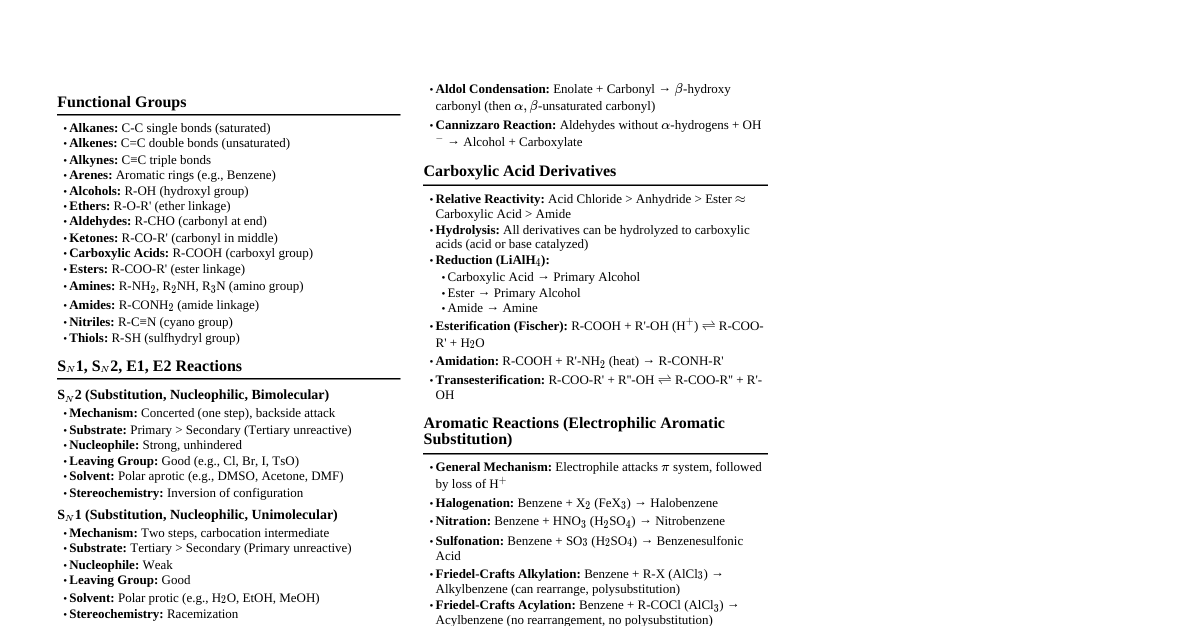
### Haloalkanes and Haloarenes #### 1. Nucleophilic Substitution Reactions (SN1 & SN2) - **SN1 (Unimolecular Nucleophilic Substitution):** - **Mechanism:** Two steps. Carbocation intermediate. - **Order of Reactivity:** $3^\circ > 2^\circ > 1^\circ$ alkyl halides. - **Stereochemistry:** Racemization (loss of optical activity). - **Example:** Hydrolysis of tert-butyl bromide. - **SN2 (Bimolecular Nucleophilic Substitution):** - **Mechanism:** One step. Transition state. - **Order of Reactivity:** $1^\circ > 2^\circ > 3^\circ$ alkyl halides. - **Stereochemistry:** Inversion of configuration (Walden inversion). - **Example:** Reaction of methyl bromide with hydroxide. #### 2. Elimination Reactions (E1 & E2) - **E1 (Unimolecular Elimination):** - **Mechanism:** Two steps. Carbocation intermediate. - **Order of Reactivity:** $3^\circ > 2^\circ > 1^\circ$ alkyl halides. - **Product:** Follows Saytzeff's rule (more substituted alkene is major product). - **E2 (Bimolecular Elimination):** - **Mechanism:** One step. Concerted process. - **Order of Reactivity:** $3^\circ > 2^\circ > 1^\circ$ alkyl halides. - **Product:** Follows Saytzeff's rule. Anti-elimination. #### 3. Wurtz Reaction - **Reactants:** Two molecules of alkyl halide (RX) - **Reagent:** Na in dry ether - **Product:** Alkane ($R-R$) - **Mechanism:** Free radical or carbanionic. - **Wurtz-Fittig Reaction:** Alkyl halide + Aryl halide + Na $\rightarrow$ Alkylbenzene. - **Fittig Reaction:** Two Aryl halides + Na $\rightarrow$ Biphenyl. ### Alcohols, Phenols, and Ethers #### 1. Reactions of Alcohols - **Dehydration:** Alcohols $\xrightarrow{\text{Conc. H}_2\text{SO}_4, \Delta}$ Alkenes. Follows Saytzeff's rule. - **Oxidation:** - $1^\circ$ Alcohol $\xrightarrow{\text{PCC}}$ Aldehyde - $1^\circ$ Alcohol $\xrightarrow{\text{Strong oxidizing agent}}$ Carboxylic Acid - $2^\circ$ Alcohol $\xrightarrow{\text{CrO}_3 \text{ or PCC}}$ Ketone - $3^\circ$ Alcohol: No oxidation under mild conditions. #### 2. Reactions of Phenols - **Electrophilic Aromatic Substitution:** Phenol is ortho-para directing. - **Nitration:** Phenol $\xrightarrow{\text{Dil. HNO}_3}$ o-nitrophenol + p-nitrophenol - **Bromination:** Phenol $\xrightarrow{\text{Br}_2/\text{CS}_2}$ Monobrominated product - Phenol $\xrightarrow{\text{Br}_2/\text{H}_2\text{O}}$ 2,4,6-Tribromophenol (white precipitate) - **Kolbe's Reaction (Kolbe-Schmidt Reaction):** - **Reactants:** Phenol, NaOH, $\text{CO}_2$, $\text{H}^+$ - **Product:** Salicylic acid (o-hydroxybenzoic acid). - **Mechanism:** Electrophilic substitution on phenoxide ion. - **Reimer-Tiemann Reaction:** - **Reactants:** Phenol, $\text{CHCl}_3$, NaOH, $\text{H}^+$ - **Product:** Salicylaldehyde (o-hydroxybenzaldehyde). - **Mechanism:** Electrophilic substitution by dichlorocarbene ($:CCl_2$). #### 3. Reactions of Ethers - **Cleavage by HI/HBr:** - $R-O-R' \xrightarrow{\text{HI/HBr}}$ $R-I + R'-OH$ (if one R is $1^\circ$ or $2^\circ$) - If one alkyl group is $3^\circ$, then $3^\circ$ alkyl halide is formed. - **Williamson Synthesis:** - **Reactants:** Alkyl halide ($1^\circ$) + Sodium alkoxide ($R'-O^-Na^+$) - **Product:** Ether ($R-O-R'$). - **Mechanism:** SN2 reaction. ### Aldehydes, Ketones, and Carboxylic Acids #### 1. Nucleophilic Addition Reactions (Aldehydes & Ketones) - **Addition of HCN:** Cyanohydrin formation. - **Addition of Grignard Reagent:** Alcohol formation. - Formaldehyde $\rightarrow 1^\circ$ alcohol - Aldehyde $\rightarrow 2^\circ$ alcohol - Ketone $\rightarrow 3^\circ$ alcohol - **Addition of Alcohols:** Hemiacetal/Acetal formation. - **Addition of Ammonia Derivatives:** Imine, oxime, hydrazone, semicarbazone formation. #### 2. Reduction Reactions - **Clemmensen Reduction:** $\text{C=O} \xrightarrow{\text{Zn-Hg/Conc. HCl}}$ $\text{CH}_2$ (Converts carbonyl to methylene). - **Wolff-Kishner Reduction:** $\text{C=O} \xrightarrow{\text{N}_2\text{H}_4, \text{KOH/Ethylene glycol}, \Delta}$ $\text{CH}_2$. #### 3. Oxidation Reactions - **Tollens' Test:** Aldehyde $\xrightarrow{\text{Ag(NH}_3)_2^+ \text{OH}^-}$ Silver mirror (Aldehydes only). - **Fehling's Test:** Aldehyde $\xrightarrow{\text{Cu}^{2+} \text{ (alkaline solution)}}$ Red precipitate of $\text{Cu}_2\text{O}$ (Aldehydes only). - **Haloform Reaction (Iodoform Test):** - **Reactants:** Methyl ketones ($\text{CH}_3\text{CO-R}$) or alcohols with $\text{CH}_3\text{CH(OH)-}$ group. - **Reagents:** $\text{I}_2/\text{NaOH}$ - **Product:** Yellow precipitate of iodoform ($\text{CHI}_3$). #### 4. Aldol Condensation - **Reactants:** Aldehydes/Ketones with $\alpha$-hydrogen. - **Reagent:** Dilute base (NaOH, $\text{Ba(OH)}_2$). - **Product:** $\beta$-hydroxy aldehyde/ketone (aldol) $\xrightarrow{\Delta}$ $\alpha,\beta$-unsaturated aldehyde/ketone. - **Cross-Aldol Condensation:** Between two different aldehydes/ketones. #### 5. Cannizzaro Reaction - **Reactants:** Aldehydes *without* $\alpha$-hydrogen (e.g., HCHO, $\text{C}_6\text{H}_5\text{CHO}$). - **Reagent:** Concentrated base (NaOH, KOH). - **Product:** Alcohol + Carboxylic acid salt (Disproportionation reaction). #### 6. Carboxylic Acid Reactions - **Esterification:** Carboxylic acid + Alcohol $\xrightarrow{\text{Conc. H}_2\text{SO}_4}$ Ester. - **Hell-Volhard-Zelinsky (HVZ) Reaction:** - **Reactants:** Carboxylic acid with $\alpha$-hydrogen. - **Reagents:** $\text{X}_2$ (Cl or Br), Red P, $\text{H}_2\text{O}$. - **Product:** $\alpha$-halo carboxylic acid. ### Amines #### 1. Basicity of Amines - **Order:** Aliphatic amines > Ammonia > Aromatic amines. - **In aqueous phase:** $2^\circ > 1^\circ > 3^\circ$ (due to solvation effects). - **In gaseous phase:** $3^\circ > 2^\circ > 1^\circ$ (due to inductive effect). #### 2. Carbylamine Reaction (Isocyanide Test) - **Reactants:** $1^\circ$ Amine (aliphatic or aromatic), $\text{CHCl}_3$, KOH (alcoholic). - **Product:** Alkyl/Aryl isocyanide (foul-smelling). - **Use:** Test for $1^\circ$ amines. #### 3. Hinsberg's Test - **Reagent:** Benzenesulphonyl chloride ($\text{C}_6\text{H}_5\text{SO}_2\text{Cl}$). - **$1^\circ$ Amine:** Forms N-alkylbenzenesulphonamide, soluble in KOH. - **$2^\circ$ Amine:** Forms N,N-dialkylbenzenesulphonamide, insoluble in KOH. - **$3^\circ$ Amine:** No reaction. #### 4. Diazotisation - **Reactants:** $1^\circ$ Aromatic amine (e.g., Aniline), $\text{NaNO}_2$, HCl, $0-5^\circ$C. - **Product:** Arenediazonium salt ($\text{ArN}_2^+X^-$). - **Reactions of Diazonium Salts:** - **Sandmeyer Reaction:** $\text{ArN}_2^+X^- \xrightarrow{\text{Cu}_2X_2/\text{HX}}$ ArX (X=Cl, Br, CN). - **Gattermann Reaction:** $\text{ArN}_2^+X^- \xrightarrow{\text{Cu powder/HX}}$ ArX (X=Cl, Br). - **Balz-Schiemann Reaction:** $\text{ArN}_2^+X^- \xrightarrow{\text{HBF}_4, \Delta}$ $\text{ArF} + \text{N}_2 + \text{BF}_3$. - **Coupling Reactions:** With phenol/aniline to form azo dyes. #### 5. Hoffmann Bromamide Degradation Reaction - **Reactants:** Amide ($\text{RCONH}_2$). - **Reagent:** $\text{Br}_2$, NaOH/KOH. - **Product:** $1^\circ$ Amine ($\text{RNH}_2$) with one carbon less than the amide. - **Mechanism:** Involves isocyanate intermediate. ### Biomolecules (Brief Overview) #### 1. Carbohydrates - **Monosaccharides:** Glucose, Fructose. - **Disaccharides:** Sucrose, Lactose, Maltose. - **Polysaccharides:** Starch, Cellulose, Glycogen. - **Reducing Sugars:** Possess free aldehyde/ketone group (e.g., Glucose, Fructose, Maltose, Lactose). Reduce Tollens' and Fehling's reagents. Sucrose is a non-reducing sugar. #### 2. Proteins - **Amino Acids:** Building blocks of proteins. Contain both amino ($\text{-NH}_2$) and carboxyl ($\text{-COOH}$) groups. - **Peptide Bond:** Formed by condensation reaction between $\text{-COOH}$ of one amino acid and $\text{-NH}_2$ of another. - **Denaturation:** Loss of biological activity due to change in secondary, tertiary, or quaternary structure (e.g., by heat, pH change). #### 3. Nucleic Acids - **DNA (Deoxyribonucleic Acid) & RNA (Ribonucleic Acid):** Genetic material. - **Components:** Pentose sugar (deoxyribose in DNA, ribose in RNA), Phosphate group, Nitrogenous bases (A, T, C, G in DNA; A, U, C, G in RNA). - **Double Helix Structure:** DNA is a double helix.