Advanced Calculus & Complex An
Cheatsheet Content
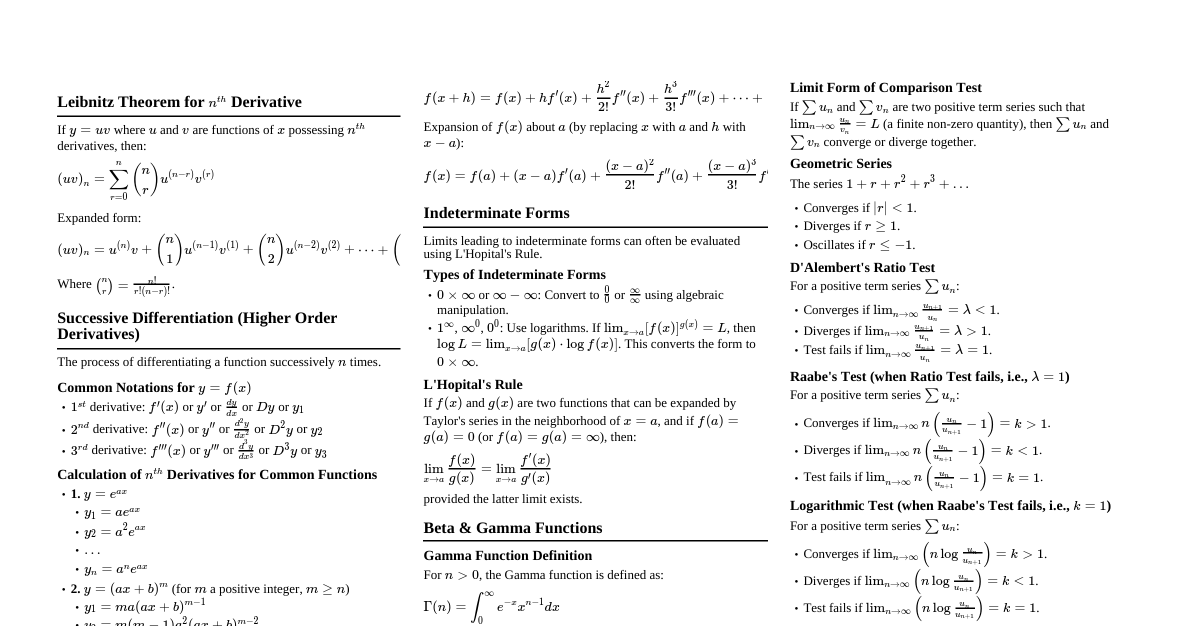
### Beta and Gamma Functions #### Beta Function - **Definition:** $B(m, n) = \int_0^1 x^{m-1} (1-x)^{n-1} \, dx$ for $m, n > 0$. - **Symmetry Property:** $B(m, n) = B(n, m)$ #### Gamma Function - **Definition:** $\Gamma(n) = \int_0^\infty x^{n-1} e^{-x} \, dx$ for $n > 0$. - **Fundamental Property:** $\Gamma(n+1) = n\Gamma(n)$. For integer $n$, $\Gamma(n+1) = n!$. - **Special Value:** $\Gamma\left(\frac{1}{2}\right) = \sqrt{\pi}$ #### Relation between Beta and Gamma Functions - $B(m, n) = \frac{\Gamma(m)\Gamma(n)}{\Gamma(m+n)}$ #### Problems & Solutions 1. **Evaluate $\int_0^1 \frac{x^2}{\sqrt{1-x^5}} \, dx$ in terms of Beta function.** - Let $x^5 = z \Rightarrow 5x^4 dx = dz \Rightarrow dx = \frac{1}{5} z^{-4/5} dz$. - $x^2 = z^{2/5}$. - Integral becomes $\int_0^1 z^{2/5} (1-z)^{-1/2} \frac{1}{5} z^{-4/5} dz = \frac{1}{5} \int_0^1 z^{-2/5} (1-z)^{-1/2} dz$. - Comparing with $B(m,n)$ definition, $m-1 = -2/5 \Rightarrow m = 3/5$, and $n-1 = -1/2 \Rightarrow n = 1/2$. - Result: $\frac{1}{5} B\left(\frac{3}{5}, \frac{1}{2}\right)$. 2. **Evaluate $\int_0^{\pi/2} \sqrt{\tan \theta} \, d\theta$.** - Let $\tan \theta = t^2 \Rightarrow \theta = \arctan(t^2) \Rightarrow d\theta = \frac{2t}{1+t^4} dt$. - Or, simpler substitution: $\int_0^{\pi/2} (\sin \theta)^{1/2} (\cos \theta)^{-1/2} d\theta$. - Using the Beta function form $B(m,n) = 2 \int_0^{\pi/2} (\sin \theta)^{2m-1} (\cos \theta)^{2n-1} d\theta$. - $2m-1 = 1/2 \Rightarrow 2m = 3/2 \Rightarrow m = 3/4$. - $2n-1 = -1/2 \Rightarrow 2n = 1/2 \Rightarrow n = 1/4$. - So, the integral is $\frac{1}{2} B\left(\frac{3}{4}, \frac{1}{4}\right) = \frac{1}{2} \frac{\Gamma(3/4)\Gamma(1/4)}{\Gamma(1)}$. - Using $\Gamma(z)\Gamma(1-z) = \frac{\pi}{\sin(\pi z)}$, for $z=1/4$, $\Gamma(1/4)\Gamma(3/4) = \frac{\pi}{\sin(\pi/4)} = \frac{\pi}{1/\sqrt{2}} = \pi\sqrt{2}$. - Result: $\frac{1}{2} \pi\sqrt{2} = \frac{\pi}{\sqrt{2}}$. 3. **Evaluate $\int_0^1 x^3 (1-x)^3 \, dx$.** - This is directly in $B(m,n)$ form. - $m-1 = 3 \Rightarrow m=4$. - $n-1 = 3 \Rightarrow n=4$. - Result: $B(4,4) = \frac{\Gamma(4)\Gamma(4)}{\Gamma(8)} = \frac{3!3!}{7!} = \frac{6 \times 6}{5040} = \frac{36}{5040} = \frac{1}{140}$. ### Fourier Series #### Definition A Fourier series is an expansion of a periodic function $f(x)$ with period $2L$ (or $2\pi$) into a sum of sines and cosines. For a function $f(x)$ defined on $[-L, L]$: $f(x) = a_0 + \sum_{n=1}^\infty \left( a_n \cos\left(\frac{n\pi x}{L}\right) + b_n \sin\left(\frac{n\pi x}{L}\right) \right)$ #### Fourier Coefficients - $a_0 = \frac{1}{2L} \int_{-L}^L f(x) \, dx$ - $a_n = \frac{1}{L} \int_{-L}^L f(x) \cos\left(\frac{n\pi x}{L}\right) \, dx$ - $b_n = \frac{1}{L} \int_{-L}^L f(x) \sin\left(\frac{n\pi x}{L}\right) \, dx$ #### Dirichlet Conditions for Fourier Series A function $f(x)$ will have a Fourier series expansion that converges to $f(x)$ at points of continuity if it satisfies: 1. $f(x)$ is single-valued and bounded in the interval. 2. $f(x)$ has a finite number of maxima and minima in any given interval. 3. $f(x)$ has a finite number of discontinuities in any given interval. 4. If $f(x)$ is discontinuous at $x_0$, the series converges to $\frac{f(x_0^+) + f(x_0^-)}{2}$. #### Condition of Existence of a Fourier Series A common condition for the existence (and convergence) of a Fourier series is that the function $f(x)$ must be piecewise smooth on the interval. This implies that $f(x)$ and $f'(x)$ are piecewise continuous. #### Parseval's Identity For a function $f(x)$ with period $2L$: $\frac{1}{L} \int_{-L}^L [f(x)]^2 dx = 2a_0^2 + \sum_{n=1}^\infty (a_n^2 + b_n^2)$ #### Problems & Solutions 1. **Find the Fourier coefficient $b_n$ for $f(x) = |x|$ in $[-\pi, \pi]$.** - The function $f(x) = |x|$ is an even function. For even functions, $b_n = 0$. - $b_n = \frac{1}{\pi} \int_{-\pi}^\pi |x| \sin(nx) \, dx$. Since $|x|$ is even and $\sin(nx)$ is odd, their product is odd. - Integral of an odd function over a symmetric interval $[-\pi, \pi]$ is $0$. - Result: $b_n = 0$. 2. **Find the Fourier expansion of $f(x) = x$ in $[-\pi, \pi]$.** - $f(x)=x$ is an odd function. So $a_0 = 0$ and $a_n = 0$. - $b_n = \frac{1}{\pi} \int_{-\pi}^\pi x \sin(nx) dx = \frac{2}{\pi} \int_0^\pi x \sin(nx) dx$. - Using integration by parts: $\int x \sin(nx) dx = -\frac{x \cos(nx)}{n} + \int \frac{\cos(nx)}{n} dx = -\frac{x \cos(nx)}{n} + \frac{\sin(nx)}{n^2}$. - $b_n = \frac{2}{\pi} \left[ -\frac{x \cos(nx)}{n} + \frac{\sin(nx)}{n^2} \right]_0^\pi = \frac{2}{\pi} \left( -\frac{\pi \cos(n\pi)}{n} + 0 - 0 + 0 \right)$. - Since $\cos(n\pi) = (-1)^n$, $b_n = -\frac{2}{n} (-1)^n = \frac{2}{n} (-1)^{n+1}$. - Fourier Series: $f(x) = \sum_{n=1}^\infty \frac{2}{n} (-1)^{n+1} \sin(nx) = 2\left(\sin x - \frac{\sin 2x}{2} + \frac{\sin 3x}{3} - \dots \right)$. ### Complex Analysis #### Analytic Functions - **Definition:** A function $f(z)$ is analytic (or holomorphic) at a point $z_0$ if it is differentiable not only at $z_0$ but also at every point in some neighborhood of $z_0$. - **Cauchy-Riemann (C-R) Equations:** For $f(z) = u(x,y) + iv(x,y)$ to be analytic, its partial derivatives must satisfy: - $\frac{\partial u}{\partial x} = \frac{\partial v}{\partial y}$ - $\frac{\partial u}{\partial y} = -\frac{\partial v}{\partial x}$ - **Polar Form C-R Equations:** For $f(z) = u(r,\theta) + iv(r,\theta)$: - $\frac{\partial u}{\partial r} = \frac{1}{r} \frac{\partial v}{\partial \theta}$ - $\frac{\partial v}{\partial r} = -\frac{1}{r} \frac{\partial u}{\partial \theta}$ #### Harmonic Functions - **Definition:** A real-valued function $\phi(x,y)$ is harmonic if it satisfies Laplace's equation: $\frac{\partial^2 \phi}{\partial x^2} + \frac{\partial^2 \phi}{\partial y^2} = 0$. - **Conjugate Harmonic Function:** If $f(z) = u+iv$ is analytic, then $u$ and $v$ are harmonic conjugates of each other. #### Mobius Transformation (Bilinear Transformation) - **Definition:** A transformation of the form $w = f(z) = \frac{az+b}{cz+d}$, where $a, b, c, d$ are complex constants and $ad-bc \neq 0$. - **Properties:** It maps generalized circles (circles or lines) to generalized circles. It is conformal everywhere except at its critical points. #### Critical Points - **Definition (General):** For a transformation $w = f(z)$, a critical point is a point where $f'(z) = 0$ or $f'(z)$ is undefined. - **Definition (Mobius):** For $w=\frac{az+b}{cz+d}$, the critical point is where $cz+d=0$, i.e., $z = -d/c$ (if $c \neq 0$). This point is mapped to infinity. There's also the point at infinity mapped to $a/c$. The derivative $f'(z) = \frac{ad-bc}{(cz+d)^2}$ is never zero if $ad-bc \neq 0$, so no finite $z$ gives $f'(z)=0$. #### Conformal Mapping - **Definition:** A transformation $w = f(z)$ is conformal at a point $z_0$ if it preserves both the magnitude of angles and their sense (orientation) between intersecting curves. If $f'(z_0) \neq 0$, then $f(z)$ is conformal at $z_0$. #### Coefficient of Magnification and Angle of Rotation - For a conformal mapping $w = f(z)$ at a point $z_0$: - **Coefficient of Magnification:** $|f'(z_0)|$ - **Angle of Rotation:** $\arg(f'(z_0))$ #### Inverse Points with Respect to a Circle - Two points $P$ and $Q$ are inverse points with respect to a circle $C$ if: 1. They lie on the same ray from the center of the circle. 2. The product of their distances from the center equals the square of the radius. - If the circle is $|z-z_0|=R$, then $z^*$ is the inverse of $z$ if $(z^*-z_0)(\bar{z}-\bar{z_0}) = R^2$. Thus, $z^* = z_0 + \frac{R^2}{\bar{z}-\bar{z_0}}$. #### Stereographic Projection - **Finding the image of $2+3i$ on the sphere of radius $\frac{1}{2}$ and center $(0,0,\frac{1}{2})$.** - The sphere is $x^2 + y^2 + (z - 1/2)^2 = (1/2)^2 \Rightarrow x^2 + y^2 + z^2 - z = 0$. - The formula for stereographic projection from the North Pole $(0,0,1)$ to the complex plane $z = x+iy$ is $X = \frac{x}{1-z'}, Y = \frac{y}{1-z'}, Z = \frac{z'}{1-z'}$. (Here, $z'$ is the coordinate on the sphere). - For a sphere with radius $R$ and center $(0,0,R)$, map from North Pole $N=(0,0,2R)$ to the $xy$-plane $(Z=0)$. - Given sphere: radius $R=1/2$, center $(0,0,1/2)$. North Pole is $(0,0,1)$. - Complex number $z = x+iy = 2+3i$, so $x=2, y=3$. - The formulas for the point $(X,Y,Z)$ on the sphere are: - $X = \frac{Re(z)}{|z|^2+1}$ - $Y = \frac{Im(z)}{|z|^2+1}$ - $Z = \frac{|z|^2}{|z|^2+1}$ - These formulas are for a unit sphere centered at origin projected from $(0,0,1)$. - For our given sphere $x^2 + y^2 + z^2 - z = 0$: - $X_s = \frac{x}{1+|z|^2}$, $Y_s = \frac{y}{1+|z|^2}$, $Z_s = \frac{|z|^2}{1+|z|^2}$. These are for the unit sphere $X_s^2+Y_s^2+(Z_s-1)^2=1$. - The image point on the sphere $S$ will be $(X,Y,Z)$, where $X = \frac{Re(z)}{|z|^2+1}$, $Y = \frac{Im(z)}{|z|^2+1}$, $Z = \frac{|z|^2}{1+|z|^2}$. - For $z=2+3i$, $|z|^2 = 2^2+3^2 = 4+9=13$. - $X = \frac{2}{13+1} = \frac{2}{14} = \frac{1}{7}$. - $Y = \frac{3}{13+1} = \frac{3}{14}$. - $Z = \frac{13}{13+1} = \frac{13}{14}$. - This point $(1/7, 3/14, 13/14)$ is on the unit sphere centered at the origin, projected from $(0,0,1)$. - This is often the assumed sphere for such problems. If the sphere given is $x^2+y^2+(z-R)^2=R^2$ with projection from $(0,0,2R)$, mapping to the $xy$-plane, the formulas are: - $X = \frac{2R \cdot Re(z)}{|z|^2+R^2}$ - $Y = \frac{2R \cdot Im(z)}{|z|^2+R^2}$ - $Z = \frac{R(|z|^2-R^2)}{|z|^2+R^2} + R$ or related. This is more complex usually. - Given radius $1/2$ and center $(0,0,1/2)$, the complex plane $z$ is identified with the plane $Z=0$. - A point $P(x_1, y_1, 0)$ in the complex plane $z_1 = x_1+iy_1$ maps to a point $P'(X,Y,Z)$ on the sphere. - The North Pole $N$ is $(0,0,1)$. Line connecting $N$ and $P$ is $N + t(P-N) = (0,0,1) + t(x_1,y_1,-1)$. - $X = tx_1$, $Y = ty_1$, $Z = 1-t$. - Substitute into sphere equation $X^2+Y^2+(Z-1/2)^2=(1/2)^2$: - $(tx_1)^2 + (ty_1)^2 + (1-t-1/2)^2 = 1/4$ - $t^2(x_1^2+y_1^2) + (1/2-t)^2 = 1/4$ - $t^2|z_1|^2 + 1/4 - t + t^2 = 1/4$ - $t^2|z_1|^2 - t + t^2 = 0$ - $t(|z_1|^2 t - 1 + t) = 0$. Since $t=0$ gives the North Pole, we take the other solution: - $t(|z_1|^2+1) = 1 \Rightarrow t = \frac{1}{|z_1|^2+1}$. - So, $X = \frac{x_1}{|z_1|^2+1}$, $Y = \frac{y_1}{|z_1|^2+1}$, $Z = 1 - \frac{1}{|z_1|^2+1} = \frac{|z_1|^2}{|z_1|^2+1}$. - For $z_1 = 2+3i$, $|z_1|^2 = 13$. - Image point: $(X,Y,Z) = \left(\frac{2}{14}, \frac{3}{14}, \frac{13}{14}\right) = \left(\frac{1}{7}, \frac{3}{14}, \frac{13}{14}\right)$. #### Problems & Solutions (Analytic Functions) 1. **For what value of $z$, the function $z = \sinh u \cos v + i \cosh u \sin v$ ceases to be analytic.** - This question seems to confuse notation. It's likely asking for the points where $f(z)$ as defined by $f(z) = \sinh u \cos v + i \cosh u \sin v$ is NOT analytic, or where a related function $w = \sinh z$ (where $z=u+iv$) might not be analytic. - Let's assume the question meant a function $f(u,v) = \sinh u \cos v + i \cosh u \sin v$, and asks where it fails to satisfy C-R equations. Or maybe it means $f(z)$ whose real part is $u(x,y)$ and imaginary part is $v(x,y)$. - If it's a function $w = f(z)$ where $z=u+iv$ as the independent variable. - Recall $\sinh(u+iv) = \sinh u \cos v + i \cosh u \sin v$. - So, it is asking where $\sinh(z)$ ceases to be analytic. $\sinh(z)$ is an entire function (analytic everywhere). Therefore, it never ceases to be analytic. - The answer provided "$z = \pm i$" for a similar problem suggests a misunderstanding in the question context. This might refer to a different function or a specific value of $z$ for which a different condition might arise (e.g., $f'(z)=0$, but $\sinh'(z) = \cosh(z)$, which is zero when $\cosh z = 0$ i.e., $e^z+e^{-z}=0 \Rightarrow e^{2z}=-1 \Rightarrow 2z = i(\pi + 2k\pi) \Rightarrow z = i(\frac{\pi}{2} + k\pi)$). - Let's re-interpret the question as "For what values of $z$ would $f(z) = u(x,y) + i v(x,y)$ cease to be analytic if $u = \sinh u_0 \cos v_0$ and $v = \cosh u_0 \sin v_0$?" - this is not well-formed either. - **Revisiting the original wording:** "For what value of $z$, the function $z = \sinh hu \cos v + i \cos hu \sin v$" - This is $z = \sinh u \cos v + i \cosh u \sin v$ (typo corrected). - This equation defines $z$ in terms of $u$ and $v$. If $w$ was defined as $w = \sinh(z_{\text{new}})$ with $z_{\text{new}}=u+iv$, then $w$ is analytic. - Assuming this function $f(u,v) = \sinh u \cos v + i \cosh u \sin v$ is given, and we want to determine if it can be an analytic function of some complex variable $z = x+iy$ where $u, v$ are related to $x, y$. - If we just check C-R equations for $U(u,v) = \sinh u \cos v$ and $V(u,v) = \cosh u \sin v$. - $\frac{\partial U}{\partial u} = \cosh u \cos v$ - $\frac{\partial V}{\partial v} = \cosh u \cos v$ (These match!) - $\frac{\partial U}{\partial v} = -\sinh u \sin v$ - $\frac{\partial V}{\partial u} = \sinh u \sin v$ (These are negative of each other!) - So $f(u+iv) = \sinh(u+iv)$ is analytic. The function $f(z)=z$ itself is analytic everywhere. - The given "Answer: $z = \pm i$" is puzzling. It might refer to points where a derivative is zero for a related mapping, or a singularity point in a specific context not fully provided. Without further context, the function $f(Z)=Z$ is analytic everywhere. 2. **Find $k$ such that $f(z) = r^2 \cos 2\theta + i r^2 \sin k\theta$ is analytic.** - Here $u(r,\theta) = r^2 \cos 2\theta$ and $v(r,\theta) = r^2 \sin k\theta$. - Use polar form C-R equations: - $\frac{\partial u}{\partial r} = 2r \cos 2\theta$ - $\frac{1}{r} \frac{\partial v}{\partial \theta} = \frac{1}{r} (r^2 k \cos k\theta) = r k \cos k\theta$ - For these to be equal: $2r \cos 2\theta = r k \cos k\theta$. This must hold for all $r, \theta$. - This implies $k=2$. - Check second C-R equation with $k=2$: - $\frac{\partial v}{\partial r} = 2r \sin 2\theta$ - $-\frac{1}{r} \frac{\partial u}{\partial \theta} = -\frac{1}{r} (r^2 (-2 \sin 2\theta)) = 2r \sin 2\theta$ - Both conditions are satisfied for $k=2$. - Result: $k=2$. (Note: There was a repeat of this question with $k\theta$ and $2\theta$ swapped in the problem list, solution assumes $r^2 \cos k\theta + i r^2 \sin 2\theta$, let's solve that too). 3. **Find $k$ such that $f(z) = r^2 \cos k\theta + i r^2 \sin 2\theta$ is analytic.** (Alternate version from listed questions) - Here $u(r,\theta) = r^2 \cos k\theta$ and $v(r,\theta) = r^2 \sin 2\theta$. - Use polar form C-R equations: - $\frac{\partial u}{\partial r} = 2r \cos k\theta$ - $\frac{1}{r} \frac{\partial v}{\partial \theta} = \frac{1}{r} (r^2 2 \cos 2\theta) = 2r \cos 2\theta$ - For these to be equal: $2r \cos k\theta = 2r \cos 2\theta$. This implies $k=2$. - Check second C-R equation with $k=2$: - $\frac{\partial v}{\partial r} = 2r \sin 2\theta$ - $-\frac{1}{r} \frac{\partial u}{\partial \theta} = -\frac{1}{r} (r^2 (-k \sin k\theta)) = r k \sin k\theta$. - Substitute $k=2$: $2r \sin 2\theta = 2r \sin 2\theta$. - Both conditions are satisfied for $k=2$. - Result: $k=2$. 4. **Show that $f(z) = z^2$ is uniformly continuous in $|z| 0$, there exists a $\delta > 0$ such that for all $z_1, z_2 \in D$, if $|z_1 - z_2| 0$, choose $\delta = \epsilon/2$. - If $|z_1 - z_2| ### Jacobians #### Definition - For a transformation from $(x,y)$ to $(u,v)$ where $u=u(x,y)$ and $v=v(x,y)$, the Jacobian is given by $J = \frac{\partial(u,v)}{\partial(x,y)} = \begin{vmatrix} \frac{\partial u}{\partial x} & \frac{\partial u}{\partial y} \\ \frac{\partial v}{\partial x} & \frac{\partial v}{\partial y} \end{vmatrix} = \frac{\partial u}{\partial x} \frac{\partial v}{\partial y} - \frac{\partial u}{\partial y} \frac{\partial v}{\partial x}$. - For a transformation from $(x,y,z)$ to $(r,\theta,\phi)$, the Jacobian often relates volume elements. #### Problems & Solutions 1. **If $r = \sqrt{x^2 + y^2}$, $\theta = \tan^{-1} \frac{y}{x}$, show that $\frac{\partial(r, \theta)}{\partial(x, y)} = \frac{1}{\sqrt{x^2 + y^2}}$.** - $r_x = \frac{x}{\sqrt{x^2+y^2}}$, $r_y = \frac{y}{\sqrt{x^2+y^2}}$. - $\theta_x = \frac{1}{1+(y/x)^2} \left(-\frac{y}{x^2}\right) = \frac{x^2}{x^2+y^2} \left(-\frac{y}{x^2}\right) = -\frac{y}{x^2+y^2}$. - $\theta_y = \frac{1}{1+(y/x)^2} \left(\frac{1}{x}\right) = \frac{x^2}{x^2+y^2} \left(\frac{1}{x}\right) = \frac{x}{x^2+y^2}$. - $\frac{\partial(r, \theta)}{\partial(x, y)} = r_x \theta_y - r_y \theta_x = \left(\frac{x}{\sqrt{x^2+y^2}}\right) \left(\frac{x}{x^2+y^2}\right) - \left(\frac{y}{\sqrt{x^2+y^2}}\right) \left(-\frac{y}{x^2+y^2}\right)$. - $= \frac{x^2}{(x^2+y^2)^{3/2}} + \frac{y^2}{(x^2+y^2)^{3/2}} = \frac{x^2+y^2}{(x^2+y^2)^{3/2}} = \frac{1}{\sqrt{x^2+y^2}}$. 2. **If $u = x^2 - 2y$, $v = x + y$, prove that $\frac{\partial(u, v)}{\partial(x, y)} = 2x + 2$.** - $u_x = 2x$, $u_y = -2$. - $v_x = 1$, $v_y = 1$. - $\frac{\partial(u, v)}{\partial(x, y)} = u_x v_y - u_y v_x = (2x)(1) - (-2)(1) = 2x + 2$. 3. **If $x = r \cos \theta$, $y = r \sin \theta$, $z = z$, then evaluate $\frac{\partial(x, y, z)}{\partial(r, \theta, z)}$.** - This is the Jacobian for cylindrical coordinates. - $\frac{\partial(x, y, z)}{\partial(r, \theta, z)} = \begin{vmatrix} \frac{\partial x}{\partial r} & \frac{\partial x}{\partial \theta} & \frac{\partial x}{\partial z} \\ \frac{\partial y}{\partial r} & \frac{\partial y}{\partial \theta} & \frac{\partial y}{\partial z} \\ \frac{\partial z}{\partial r} & \frac{\partial z}{\partial \theta} & \frac{\partial z}{\partial z} \end{vmatrix}$. - $x_r = \cos \theta$, $x_\theta = -r \sin \theta$, $x_z = 0$. - $y_r = \sin \theta$, $y_\theta = r \cos \theta$, $y_z = 0$. - $z_r = 0$, $z_\theta = 0$, $z_z = 1$. - Jacobian $= \begin{vmatrix} \cos \theta & -r \sin \theta & 0 \\ \sin \theta & r \cos \theta & 0 \\ 0 & 0 & 1 \end{vmatrix}$. - Expand along the third row: $1 \cdot (\cos \theta (r \cos \theta) - (-r \sin \theta)(\sin \theta))$. - $= r \cos^2 \theta + r \sin^2 \theta = r(\cos^2 \theta + \sin^2 \theta) = r$. ### Miscellaneous Integrals #### Problems & Solutions 1. **Evaluate $\int_0^1 \frac{x^2}{\sqrt{1-x^2}} \, dx$ in terms of beta function.** - Let $x=\sin\theta$, $dx=\cos\theta d\theta$. Limits $0 \to \pi/2$. - $\int_0^{\pi/2} \frac{\sin^2\theta}{\sqrt{1-\sin^2\theta}} \cos\theta d\theta = \int_0^{\pi/2} \frac{\sin^2\theta}{\cos\theta} \cos\theta d\theta = \int_0^{\pi/2} \sin^2\theta d\theta$. - This integral can be written as $\int_0^{\pi/2} (\sin\theta)^{2(3/2)-1} (\cos\theta)^{2(1/2)-1} d\theta$. - $B(m,n) = 2 \int_0^{\pi/2} (\sin\theta)^{2m-1} (\cos\theta)^{2n-1} d\theta$. - So, $\int_0^{\pi/2} \sin^2\theta (\cos\theta)^0 d\theta = \frac{1}{2} B\left(\frac{3}{2}, \frac{1}{2}\right)$. - $\frac{1}{2} \frac{\Gamma(3/2)\Gamma(1/2)}{\Gamma(2)} = \frac{1}{2} \frac{(1/2)\Gamma(1/2)\Gamma(1/2)}{1!} = \frac{1}{2} \frac{(1/2)\sqrt{\pi}\sqrt{\pi}}{1} = \frac{1}{4}\pi$. 2. **Evaluate $\int_0^1 (8 - x^2)^{1/2} \, dx$.** (This problem seems miswritten, perhaps it implies $\int_0^1 \sqrt{1-x^2/8} dx$ or refers to a different context. Let's assume it's a simplification test case.) - This is $\int_0^1 \sqrt{8-x^2} \, dx$. Use $x = \sqrt{8}\sin\theta$. $dx = \sqrt{8}\cos\theta d\theta$. - When $x=0, \theta=0$. When $x=1, \sin\theta=1/\sqrt{8}$. - Integral $=\int_0^{\arcsin(1/\sqrt{8})} \sqrt{8-8\sin^2\theta} (\sqrt{8}\cos\theta d\theta) = \int_0^{\arcsin(1/\sqrt{8})} 8\cos^2\theta d\theta$. - $= 8 \int_0^{\arcsin(1/\sqrt{8})} \frac{1+\cos(2\theta)}{2} d\theta = 4 \left[ \theta + \frac{\sin(2\theta)}{2} \right]_0^{\arcsin(1/\sqrt{8})}$. - $= 4 \left[ \theta + \sin\theta\cos\theta \right]_0^{\arcsin(1/\sqrt{8})}$. - Let $\alpha = \arcsin(1/\sqrt{8})$. $\sin\alpha = 1/\sqrt{8}$, $\cos\alpha = \sqrt{1-1/8} = \sqrt{7/8}$. - $= 4 \left( \arcsin(1/\sqrt{8}) + \frac{1}{\sqrt{8}}\sqrt{\frac{7}{8}} \right) = 4 \left( \arcsin\left(\frac{1}{2\sqrt{2}}\right) + \frac{\sqrt{7}}{8} \right)$. - This is the direct evaluation. It doesn't seem to be reducible to a beta function easily without further manipulation.