Advanced Calculus & Algebra Cheatsheet
Cheatsheet Content
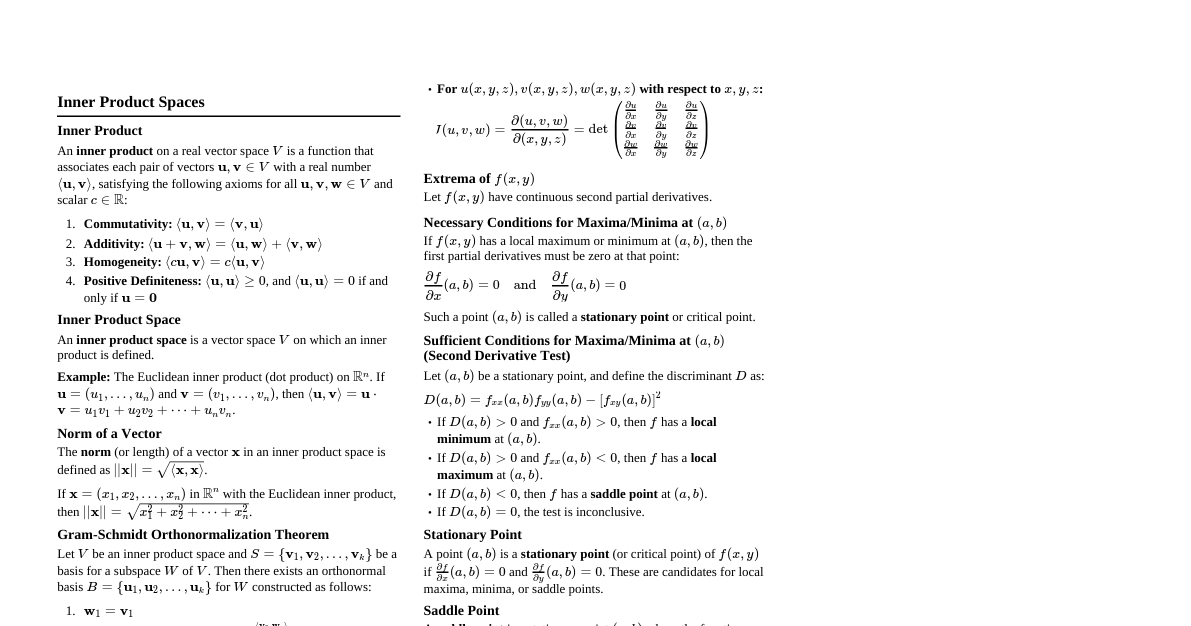
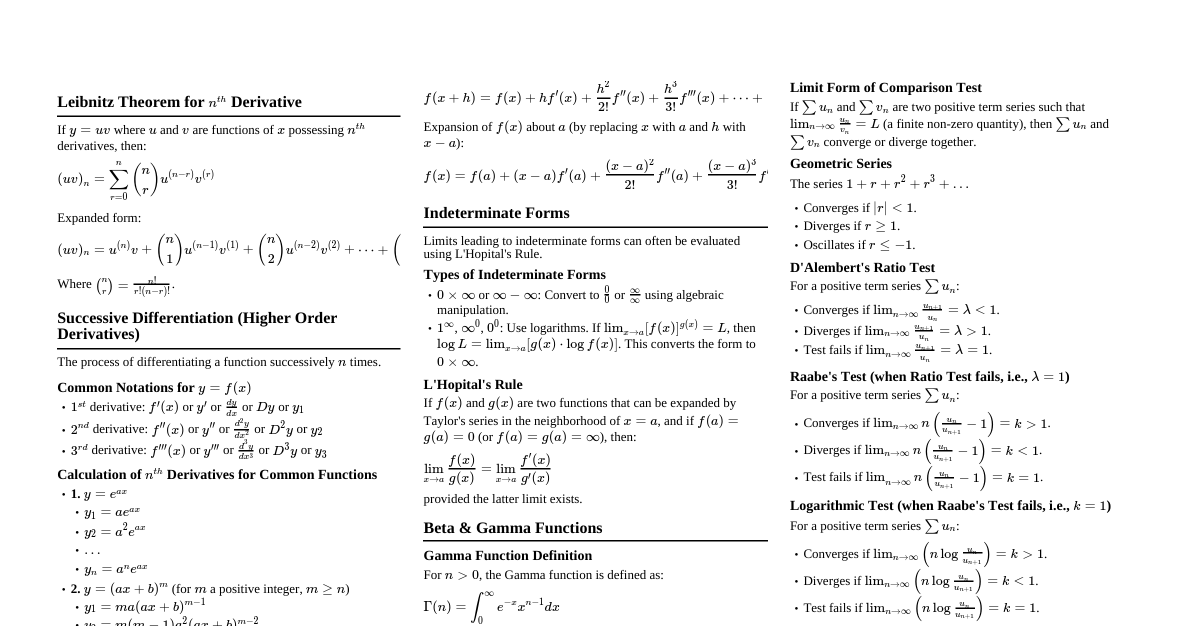
Unit I: Group Theory Subgroups Definition: A subset $H$ of a group $G$ is a subgroup if $H$ is itself a group under the binary operation of $G$. Necessary & Sufficient Condition: A non-empty subset $H$ of a group $G$ is a subgroup if and only if for all $a, b \in H$, $ab^{-1} \in H$. Finite Subgroup Condition: A non-empty finite subset $H$ of a group $G$ is a subgroup if and only if for all $a, b \in H$, $ab \in H$. Cosets Left Coset: For a subgroup $H$ of $G$ and $a \in G$, the left coset of $H$ with respect to $a$ is $aH = \{ah \mid h \in H\}$. Right Coset: For a subgroup $H$ of $G$ and $a \in G$, the right coset of $H$ with respect to $a$ is $Ha = \{ha \mid h \in H\}$. Properties: $a \in aH$. $aH = H$ iff $a \in H$. Either $aH = bH$ or $aH \cap bH = \emptyset$. $|aH| = |H|$. Lagrange's Theorem Statement: If $G$ is a finite group and $H$ is a subgroup of $G$, then the order of $H$ divides the order of $G$. That is, $|H|$ divides $|G|$. Corollaries: The order of any element $a \in G$ divides $|G|$. If $|G|=n$, then $a^n = e$ for all $a \in G$. A group of prime order is cyclic. Fundamental Theorem of Homomorphism Statement: Let $\phi: G \to G'$ be a group homomorphism. Then $G/\text{Ker}(\phi) \cong \text{Im}(\phi)$. Key Concepts: Homomorphism: $\phi(ab) = \phi(a)\phi(b)$ for all $a, b \in G$. Kernel: $\text{Ker}(\phi) = \{g \in G \mid \phi(g) = e' \}$, where $e'$ is the identity in $G'$. $\text{Ker}(\phi)$ is a normal subgroup of $G$. Image: $\text{Im}(\phi) = \{\phi(g) \mid g \in G \}$, which is a subgroup of $G'$. Isomorphism: A bijective homomorphism. Unit II: Compulsory Questions (Calculus) Lagrange's Mean Value Theorem (LMVT) Statement: If a function $f:[a, b] \to \mathbb{R}$ is continuous on $[a, b]$ and differentiable on $(a, b)$, then there exists at least one $c \in (a, b)$ such that $f'(c) = \frac{f(b) - f(a)}{b - a}$. Proof Sketch: Consider an auxiliary function $F(x) = f(x) - Kx$. Choose $K$ such that $F(a) = F(b)$, i.e., $f(a) - Ka = f(b) - Kb$. So, $K = \frac{f(b) - f(a)}{b - a}$. By Rolle's Theorem, there exists $c \in (a, b)$ such that $F'(c) = 0$. $F'(x) = f'(x) - K$, so $f'(c) - K = 0 \implies f'(c) = K = \frac{f(b) - f(a)}{b - a}$. Problem Example: For $f(x) = x^3$ on $[1, 2]$, find $c$. $f(1) = 1, f(2) = 8$. $f'(x) = 3x^2$. $3c^2 = \frac{f(2) - f(1)}{2 - 1} = \frac{8 - 1}{1} = 7$. $c^2 = 7/3 \implies c = \sqrt{7/3} \approx 1.527 \in (1, 2)$. Taylor's and Maclaurin Series Taylor Series: $f(x) = \sum_{n=0}^{\infty} \frac{f^{(n)}(a)}{n!}(x-a)^n = f(a) + f'(a)(x-a) + \frac{f''(a)}{2!}(x-a)^2 + \dots$ Maclaurin Series (Taylor series with $a=0$): $f(x) = \sum_{n=0}^{\infty} \frac{f^{(n)}(0)}{n!}x^n = f(0) + f'(0)x + \frac{f''(0)}{2!}x^2 + \dots$ Problem Example (Maclaurin for $e^x$): $f(x) = e^x$, so $f^{(n)}(x) = e^x$ for all $n$. $f^{(n)}(0) = e^0 = 1$. $e^x = \sum_{n=0}^{\infty} \frac{1}{n!}x^n = 1 + x + \frac{x^2}{2!} + \frac{x^3}{3!} + \dots$ Lagrange Multipliers (for constrained optimization) Method: To find the extrema of $f(x, y, z)$ subject to the constraint $g(x, y, z) = 0$, solve the system of equations: $\nabla f = \lambda \nabla g$ $g(x, y, z) = 0$ where $\nabla f = \left( \frac{\partial f}{\partial x}, \frac{\partial f}{\partial y}, \frac{\partial f}{\partial z} \right)$ and $\lambda$ is the Lagrange multiplier. Problem Example: Find the maximum product of two positive numbers $x, y$ such that $x+y=10$. Maximize $f(x, y) = xy$. Constraint $g(x, y) = x+y-10 = 0$. $\frac{\partial f}{\partial x} = y, \frac{\partial f}{\partial y} = x$. $\frac{\partial g}{\partial x} = 1, \frac{\partial g}{\partial y} = 1$. Equations: $y = \lambda (1) \implies y = \lambda$ $x = \lambda (1) \implies x = \lambda$ $x+y=10$ Substitute $x=\lambda, y=\lambda$ into $x+y=10 \implies \lambda + \lambda = 10 \implies 2\lambda = 10 \implies \lambda = 5$. So, $x=5, y=5$. Max product $f(5,5) = 25$. Maxima and Minima (Unconstrained) Method for $f(x, y)$: Find critical points by solving $\frac{\partial f}{\partial x} = 0$ and $\frac{\partial f}{\partial y} = 0$. Calculate second partial derivatives: $A = \frac{\partial^2 f}{\partial x^2}$, $B = \frac{\partial^2 f}{\partial x \partial y}$, $C = \frac{\partial^2 f}{\partial y^2}$. Compute $D = AC - B^2$ at each critical point. If $D > 0$ and $A > 0$, it's a local minimum. If $D > 0$ and $A If $D If $D = 0$, the test is inconclusive. Problem Example: Find extrema of $f(x, y) = x^2 + xy + y^2 + 3x - 3y + 4$. $\frac{\partial f}{\partial x} = 2x + y + 3 = 0$ (1) $\frac{\partial f}{\partial y} = x + 2y - 3 = 0$ (2) From (1), $y = -2x - 3$. Substitute into (2): $x + 2(-2x - 3) - 3 = 0 \implies x - 4x - 6 - 3 = 0 \implies -3x - 9 = 0 \implies x = -3$. Then $y = -2(-3) - 3 = 6 - 3 = 3$. Critical point: $(-3, 3)$. $A = \frac{\partial^2 f}{\partial x^2} = 2$. $B = \frac{\partial^2 f}{\partial x \partial y} = 1$. $C = \frac{\partial^2 f}{\partial y^2} = 2$. $D = AC - B^2 = (2)(2) - (1)^2 = 4 - 1 = 3$. Since $D = 3 > 0$ and $A = 2 > 0$, $f(-3, 3)$ is a local minimum. $f(-3, 3) = (-3)^2 + (-3)(3) + (3)^2 + 3(-3) - 3(3) + 4 = 9 - 9 + 9 - 9 - 9 + 4 = -5$. Unit III: Sequences and Series Monotonic Convergence Theorem Statement 1: Every monotonically increasing sequence which is bounded above converges to its least upper bound (l.u.b.). Proof Sketch (Increasing & Bounded Above): Let $\{a_n\}$ be an increasing sequence bounded above. By the Completeness Axiom, the set $\{a_n \mid n \in \mathbb{N}\}$ has a least upper bound, say $L = \text{sup}\{a_n\}$. Since $L$ is the l.u.b., for any $\epsilon > 0$, there exists an $N$ such that $L - \epsilon Since $\{a_n\}$ is increasing, for all $n > N$, $a_N \le a_n$. Thus, for $n > N$, $L - \epsilon This means $|a_n - L| N$, so $\lim_{n \to \infty} a_n = L$. Statement 2: Every monotonically decreasing sequence which is bounded below converges to its greatest lower bound (g.l.b.). Problem on Sequence Example: Show that the sequence $a_n = \frac{2n-1}{3n+2}$ converges. Monotonicity: Consider $f(x) = \frac{2x-1}{3x+2}$. $f'(x) = \frac{2(3x+2) - 3(2x-1)}{(3x+2)^2} = \frac{6x+4-6x+3}{(3x+2)^2} = \frac{7}{(3x+2)^2} > 0$. Since $f'(x) > 0$, $f(x)$ is increasing, so $a_n$ is an increasing sequence. Boundedness: $a_n = \frac{2n-1}{3n+2} > \frac{0}{3n+2} = 0$ for $n \ge 1$. So, bounded below by 0. $a_n = \frac{2n-1}{3n+2} = \frac{n(2 - 1/n)}{n(3 + 2/n)} = \frac{2 - 1/n}{3 + 2/n} Since $a_n$ is increasing and bounded above, by the Monotonic Convergence Theorem, it converges. The limit is $\lim_{n \to \infty} \frac{2n-1}{3n+2} = \lim_{n \to \infty} \frac{2 - 1/n}{3 + 2/n} = \frac{2}{3}$. Cauchy's General Principle of Convergence (for sequences) Statement: A sequence $\{a_n\}$ converges if and only if it is a Cauchy sequence. A sequence $\{a_n\}$ is Cauchy if for every $\epsilon > 0$, there exists a positive integer $N$ such that for all $m, n > N$, $|a_m - a_n| Significance: It provides a criterion for convergence that does not require knowing the limit itself. Cauchy's First Theorem on Limits Statement: If $\lim_{n \to \infty} a_n = L$, then $\lim_{n \to \infty} \frac{a_1 + a_2 + \dots + a_n}{n} = L$. Proof Sketch: Let $b_n = a_n - L$. Then $\lim_{n \to \infty} b_n = 0$. We need to show $\lim_{n \to \infty} \frac{(b_1+L) + (b_2+L) + \dots + (b_n+L)}{n} = L$. This simplifies to $\lim_{n \to \infty} \left( \frac{b_1 + \dots + b_n}{n} + \frac{nL}{n} \right) = \lim_{n \to \infty} \frac{b_1 + \dots + b_n}{n} + L$. So we need to show $\lim_{n \to \infty} \frac{b_1 + \dots + b_n}{n} = 0$. Since $b_n \to 0$, for any $\epsilon > 0$, there exists $N_1$ such that $|b_n| N_1$. For $n > N_1$, $\left| \frac{b_1 + \dots + b_n}{n} \right| \le \frac{|b_1| + \dots + |b_{N_1}|}{n} + \frac{|b_{N_1+1}| + \dots + |b_n|}{n}$. The first term $\frac{|b_1| + \dots + |b_{N_1}|}{n} \to 0$ as $n \to \infty$. Choose $N_2$ such that this term is less than $\epsilon/2$ for $n > N_2$. The second term $\frac{|b_{N_1+1}| + \dots + |b_n|}{n} Thus, for $n > \max(N_1, N_2)$, $\left| \frac{b_1 + \dots + b_n}{n} \right| Unit IV: Differential Equations Exact Differential Equations Definition: A first-order differential equation of the form $M(x, y)dx + N(x, y)dy = 0$ is exact if there exists a function $\phi(x, y)$ such that $d\phi = Mdx + Ndy$. This implies $\frac{\partial M}{\partial y} = \frac{\partial N}{\partial x}$. Proof of Condition: If $Mdx + Ndy = 0$ is exact, then there exists $\phi$ such that $\frac{\partial \phi}{\partial x} = M$ and $\frac{\partial \phi}{\partial y} = N$. Differentiating $M$ with respect to $y$: $\frac{\partial M}{\partial y} = \frac{\partial^2 \phi}{\partial y \partial x}$. Differentiating $N$ with respect to $x$: $\frac{\partial N}{\partial x} = \frac{\partial^2 \phi}{\partial x \partial y}$. Since $\frac{\partial^2 \phi}{\partial y \partial x} = \frac{\partial^2 \phi}{\partial x \partial y}$ (assuming continuity of second partials), we have $\frac{\partial M}{\partial y} = \frac{\partial N}{\partial x}$. Solution Method: Verify $\frac{\partial M}{\partial y} = \frac{\partial N}{\partial x}$. Integrate $M$ with respect to $x$ (treating $y$ as constant): $\phi(x, y) = \int M(x, y)dx + g(y)$. Differentiate $\phi(x, y)$ with respect to $y$ and set it equal to $N(x, y)$: $\frac{\partial \phi}{\partial y} = \frac{\partial}{\partial y} \left( \int M(x, y)dx \right) + g'(y) = N(x, y)$. Solve for $g'(y)$ and integrate to find $g(y)$. The general solution is $\phi(x, y) = C$. Problem Example: Solve $(y^2 - 2xy)dx + (2xy - x^2)dy = 0$. $M = y^2 - 2xy \implies \frac{\partial M}{\partial y} = 2y - 2x$. $N = 2xy - x^2 \implies \frac{\partial N}{\partial x} = 2y - 2x$. Since $\frac{\partial M}{\partial y} = \frac{\partial N}{\partial x}$, the equation is exact. $\phi(x, y) = \int (y^2 - 2xy)dx + g(y) = xy^2 - x^2y + g(y)$. $\frac{\partial \phi}{\partial y} = 2xy - x^2 + g'(y)$. Equating to $N$: $2xy - x^2 + g'(y) = 2xy - x^2 \implies g'(y) = 0$. Integrating $g'(y) = 0 \implies g(y) = C_1$. General solution: $xy^2 - x^2y = C$. Differential Equations Solvable for $p, x, y$ and Clairaut's Form Solvable for $p$: If the equation is $F(x, y, p) = 0$ (where $p = dy/dx$) and can be factored into $(p - f_1(x, y))(p - f_2(x, y))\dots = 0$. Solve each $p = f_i(x, y)$ as a first-order equation. Example: $p^2 - 5p + 6 = 0 \implies (p-2)(p-3) = 0$. $p=2 \implies dy/dx = 2 \implies y = 2x + C_1$. $p=3 \implies dy/dx = 3 \implies y = 3x + C_2$. Solvable for $y$: If the equation can be written as $y = f(x, p)$. Differentiate with respect to $x$: $p = \frac{\partial f}{\partial x} + \frac{\partial f}{\partial p}\frac{dp}{dx}$. This gives a first-order equation in $x$ and $p$. Solve for $p$ in terms of $x$, then substitute back into $y = f(x, p)$. Also check for singular solutions by setting $\frac{\partial f}{\partial p} = 0$. Solvable for $x$: If the equation can be written as $x = f(y, p)$. Differentiate with respect to $y$: $\frac{1}{p} = \frac{\partial f}{\partial y} + \frac{\partial f}{\partial p}\frac{dp}{dy}$. This gives a first-order equation in $y$ and $p$. Solve for $p$ in terms of $y$, then substitute back into $x = f(y, p)$. Clairaut's Equation: A special case of solvable for $y$, of the form $y = xp + f(p)$. Differentiate with respect to $x$: $p = p + x\frac{dp}{dx} + f'(p)\frac{dp}{dx}$. This simplifies to $(x + f'(p))\frac{dp}{dx} = 0$. Two cases: $\frac{dp}{dx} = 0 \implies p = C$. Substituting back into $y = xp + f(p)$ gives the general solution: $y = Cx + f(C)$ (a family of straight lines). $x + f'(p) = 0$. Eliminating $p$ between this and $y = xp + f(p)$ gives the singular solution (envelope of the general solution). Problem Example (Clairaut's): Solve $y = xp + p^2$. This is in Clairaut's form with $f(p) = p^2$. General solution: Replace $p$ with $C$: $y = Cx + C^2$. Singular solution: $x + f'(p) = 0 \implies x + 2p = 0 \implies p = -x/2$. Substitute $p = -x/2$ into $y = xp + p^2$: $y = x(-x/2) + (-x/2)^2 = -x^2/2 + x^2/4 = -x^2/4$. The singular solution is $y = -x^2/4$.