Advanced Calculus Problems
Cheatsheet Content
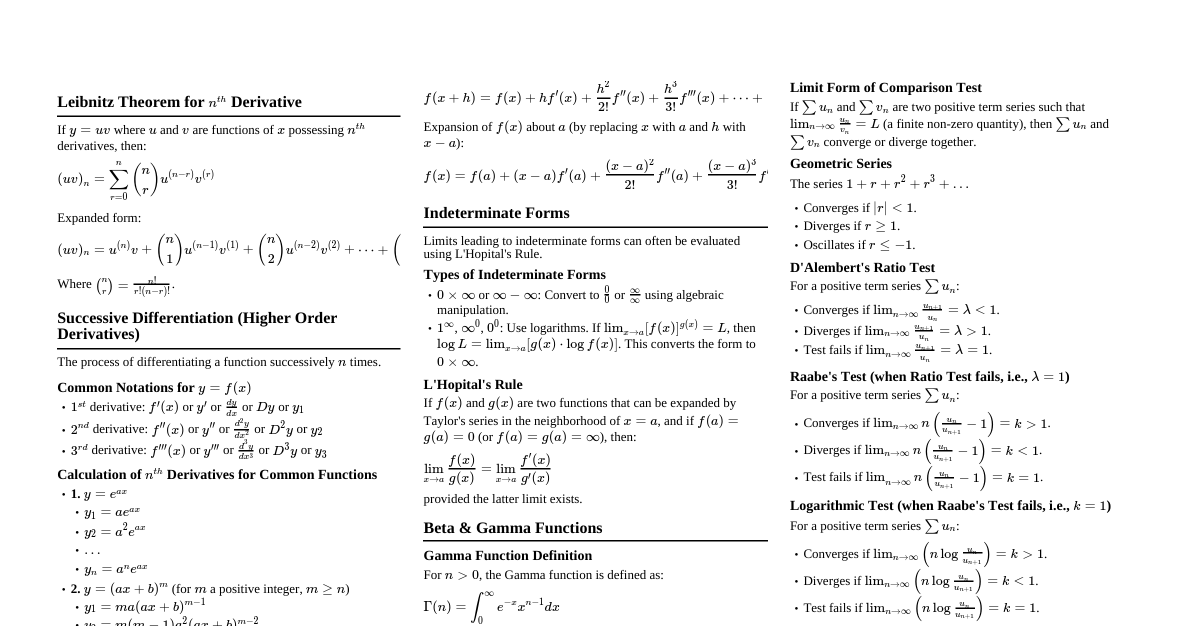
February 2022 Paper - Question 1(a) Discontinuity of $f(x) = \sin(1/x)$ at $x=0$ Function Definition: $$f(x) = \begin{cases} \sin(1/x) & x \neq 0 \\ 0 & x = 0 \end{cases}$$ Condition for Continuity: $\lim_{x \to 0} f(x) = f(0)$. Here, $f(0) = 0$. Left-Hand Limit (LHL): $\lim_{x \to 0^-} \sin(1/x)$. Let $x = -1/n\pi$ as $n \to \infty$, $x \to 0^-$. Then $1/x = -n\pi$. $\sin(1/x) = \sin(-n\pi) = 0$. Let $x = -1/(2n\pi + \pi/2)$ as $n \to \infty$, $x \to 0^-$. Then $1/x = -(2n\pi + \pi/2)$. $\sin(1/x) = \sin(-(2n\pi + \pi/2)) = -1$. Since the limit depends on the path taken, $\lim_{x \to 0^-} \sin(1/x)$ does not exist. Right-Hand Limit (RHL): $\lim_{x \to 0^+} \sin(1/x)$. Let $x = 1/n\pi$ as $n \to \infty$, $x \to 0^+$. Then $1/x = n\pi$. $\sin(1/x) = \sin(n\pi) = 0$. Let $x = 1/(2n\pi + \pi/2)$ as $n \to \infty$, $x \to 0^+$. Then $1/x = 2n\pi + \pi/2$. $\sin(1/x) = \sin(2n\pi + \pi/2) = 1$. Since the limit depends on the path taken, $\lim_{x \to 0^+} \sin(1/x)$ does not exist. Conclusion: Since neither the LHL nor the RHL exists, $\lim_{x \to 0} f(x)$ does not exist. Therefore, $f(x)$ is discontinuous at $x=0$. Type of Discontinuity: Since neither the left-hand limit nor the right-hand limit exists, it is a discontinuity of the second kind. February 2022 Paper - Question 1(b) Leibnitz's Theorem and Higher Derivatives Given: $y = [\log(x + \sqrt{1+x^2})]^2$ Let $z = \log(x + \sqrt{1+x^2})$. Then $y = z^2$. Step 1: Find $y_1$ $$z_1 = \frac{1}{x + \sqrt{1+x^2}} \left(1 + \frac{2x}{2\sqrt{1+x^2}}\right) = \frac{1}{x + \sqrt{1+x^2}} \left(\frac{\sqrt{1+x^2} + x}{\sqrt{1+x^2}}\right) = \frac{1}{\sqrt{1+x^2}}$$ $$y_1 = 2z z_1 = 2 \log(x + \sqrt{1+x^2}) \frac{1}{\sqrt{1+x^2}}$$ Step 2: Simplify and differentiate again $$\sqrt{1+x^2} y_1 = 2 \log(x + \sqrt{1+x^2}) = 2z$$ Square both sides: $(1+x^2) y_1^2 = 4z^2 = 4y$ Differentiate with respect to $x$: $$2x y_1^2 + (1+x^2) 2y_1 y_2 = 4y_1$$ Divide by $2y_1$ (assuming $y_1 \neq 0$): $$x y_1 + (1+x^2) y_2 = 2$$ This is the differential equation. Step 3: Apply Leibnitz's Theorem Let $u = y_2$, $v = (1+x^2)$. Then $u^{(n)} = y_{n+2}$, $v' = 2x$, $v'' = 2$, $v''' = 0$. $$ (1+x^2) y_{n+2} + n(2x) y_{n+1} + \frac{n(n-1)}{2}(2) y_n $$ Let $u = y_1$, $v = x$. Then $u^{(n)} = y_{n+1}$, $v' = 1$, $v'' = 0$. $$ x y_{n+1} + n(1) y_n $$ Differentiating $x y_1 + (1+x^2) y_2 = 2$ $n$ times: $$ [x y_{n+1} + n y_n] + [(1+x^2) y_{n+2} + 2nx y_{n+1} + n(n-1) y_n] = 0 $$ Rearranging terms: $$ (1+x^2) y_{n+2} + (2n+1)x y_{n+1} + [n + n(n-1)] y_n = 0 $$ $$ (1+x^2) y_{n+2} + (2n+1)x y_{n+1} + (n + n^2 - n) y_n = 0 $$ $$ (1+x^2) y_{n+2} + (2n+1)x y_{n+1} + n^2 y_n = 0 $$ February 2022 Paper - Question 2(a) Taylor's Theorem with Lagrange's Form of Remainder Statement: If a function $f(x)$ is defined on $[a,b]$ such that: $f^{(n-1)}(x)$ is continuous on $[a,b]$. $f^{(n)}(x)$ exists on $(a,b)$. Then for any $x \in [a,b]$, there exists a point $c \in (a,x)$ such that: $$f(x) = f(a) + (x-a)f'(a) + \frac{(x-a)^2}{2!}f''(a) + \dots + \frac{(x-a)^{n-1}}{(n-1)!}f^{(n-1)}(a) + R_n(x)$$ where $R_n(x)$ is the remainder term, given by Lagrange's form: $$R_n(x) = \frac{(x-a)^n}{n!}f^{(n)}(c)$$ Proof: Consider an auxiliary function $\phi(t)$ defined as: $$\phi(t) = f(x) - f(t) - (x-t)f'(t) - \frac{(x-t)^2}{2!}f''(t) - \dots - \frac{(x-t)^{n-1}}{(n-1)!}f^{(n-1)}(t) - K \frac{(x-t)^n}{n!}$$ where $K$ is a constant chosen such that $\phi(a) = 0$. We also have $\phi(x) = f(x) - f(x) - 0 - \dots - 0 = 0$. Since $\phi(a) = \phi(x) = 0$, by Rolle's Theorem, there exists a $c \in (a,x)$ such that $\phi'(c) = 0$. Differentiating $\phi(t)$ with respect to $t$: $$\phi'(t) = -f'(t) - [-f'(t) + (x-t)f''(t)] - \left[-\frac{2(x-t)}{2!}f''(t) + \frac{(x-t)^2}{2!}f'''(t)\right] - \dots$$ $$ - \left[-\frac{(n-1)(x-t)^{n-2}}{(n-1)!}f^{(n-1)}(t) + \frac{(x-t)^{n-1}}{(n-1)!}f^{(n)}(t)\right] - K \frac{n(x-t)^{n-1}}{n!}(-1)$$ Most terms cancel out, leaving: $$\phi'(t) = -\frac{(x-t)^{n-1}}{(n-1)!}f^{(n)}(t) + K \frac{(x-t)^{n-1}}{(n-1)!}$$ Setting $\phi'(c) = 0$: $$-\frac{(x-c)^{n-1}}{(n-1)!}f^{(n)}(c) + K \frac{(x-c)^{n-1}}{(n-1)!} = 0$$ Assuming $x \neq c$, we can divide by $\frac{(x-c)^{n-1}}{(n-1)!}$: $$-f^{(n)}(c) + K = 0 \implies K = f^{(n)}(c)$$ Substitute $K$ back into the expression for $\phi(a) = 0$: $$f(x) - f(a) - (x-a)f'(a) - \dots - \frac{(x-a)^{n-1}}{(n-1)!}f^{(n-1)}(a) - f^{(n)}(c) \frac{(x-a)^n}{n!} = 0$$ Rearranging gives Taylor's theorem with Lagrange's remainder. February 2022 Paper - Question 2(b) Maclaurin Series Expansion of $\sin x$ around $x = \pi/2$ Taylor Series formula around $a$: $$f(x) = f(a) + (x-a)f'(a) + \frac{(x-a)^2}{2!}f''(a) + \frac{(x-a)^3}{3!}f'''(a) + \dots$$ Given: $f(x) = \sin x$, $a = \pi/2$. Derivatives: $f(x) = \sin x \implies f(\pi/2) = \sin(\pi/2) = 1$ $f'(x) = \cos x \implies f'(\pi/2) = \cos(\pi/2) = 0$ $f''(x) = -\sin x \implies f''(\pi/2) = -\sin(\pi/2) = -1$ $f'''(x) = -\cos x \implies f'''(\pi/2) = -\cos(\pi/2) = 0$ $f^{(4)}(x) = \sin x \implies f^{(4)}(\pi/2) = \sin(\pi/2) = 1$ Expansion: $$\sin x = 1 + (x-\pi/2)(0) + \frac{(x-\pi/2)^2}{2!}(-1) + \frac{(x-\pi/2)^3}{3!}(0) + \frac{(x-\pi/2)^4}{4!}(1) + \dots$$ $$\sin x = 1 - \frac{(x-\pi/2)^2}{2!} + \frac{(x-\pi/2)^4}{4!} - \frac{(x-\pi/2)^6}{6!} + \dots$$ November 2023 Paper - Question 1(a) Limit of $f(x) = \sin(1/x)$ as $x \to 0$ Function: $f(x) = \sin(1/x)$ for $x \neq 0$. To show: $\lim_{x \to 0} \sin(1/x)$ does not exist. Method: Use two different sequences that converge to $0$, but for which $f(x)$ converges to different values. Sequence 1: Let $x_n = \frac{1}{n\pi}$ for $n \in \mathbb{N}, n \neq 0$. As $n \to \infty$, $x_n \to 0$. $f(x_n) = \sin\left(\frac{1}{1/n\pi}\right) = \sin(n\pi) = 0$ for all $n$. So, $\lim_{n \to \infty} f(x_n) = 0$. Sequence 2: Let $y_n = \frac{1}{2n\pi + \pi/2}$ for $n \in \mathbb{N}, n \neq 0$. As $n \to \infty$, $y_n \to 0$. $f(y_n) = \sin\left(\frac{1}{1/(2n\pi + \pi/2)}\right) = \sin(2n\pi + \pi/2) = \sin(\pi/2) = 1$ for all $n$. So, $\lim_{n \to \infty} f(y_n) = 1$. Conclusion: Since we found two sequences $x_n$ and $y_n$ both converging to $0$, but $f(x_n)$ converges to $0$ and $f(y_n)$ converges to $1$, the limit $\lim_{x \to 0} \sin(1/x)$ does not exist. November 2023 Paper - Question 1(b) Higher Derivatives for $y = e^{mx} \cos^{-1}x$ Given: $y = e^{mx} \cos^{-1}x$ Step 1: Find $y_1$ $$y_1 = m e^{mx} \cos^{-1}x + e^{mx} \left(-\frac{1}{\sqrt{1-x^2}}\right)$$ $$y_1 = m y - \frac{e^{mx}}{\sqrt{1-x^2}}$$ Rearrange: $(y_1 - my)\sqrt{1-x^2} = -e^{mx}$ Square both sides: $(y_1 - my)^2 (1-x^2) = e^{2mx}$ Step 2: Differentiate again Differentiate with respect to $x$: $$2(y_1 - my)(y_2 - my_1)(1-x^2) + (y_1 - my)^2 (-2x) = 2m e^{2mx}$$ Divide by $2(y_1 - my)$ (assuming $y_1 - my \neq 0$): $$(y_2 - my_1)(1-x^2) - x(y_1 - my) = m \frac{e^{2mx}}{y_1 - my}$$ Substitute $e^{2mx} = (y_1 - my)^2 (1-x^2)$: $$(y_2 - my_1)(1-x^2) - x(y_1 - my) = m (y_1 - my) (1-x^2)$$ $$(1-x^2)y_2 - m(1-x^2)y_1 - xy_1 + mxy = m(1-x^2)y_1 - m^2(1-x^2)y$$ $$(1-x^2)y_2 - 2m(1-x^2)y_1 - xy_1 + mxy + m^2(1-x^2)y = 0$$ $$(1-x^2)y_2 - (2m(1-x^2) + x)y_1 + (m^2(1-x^2) + mx)y = 0$$ This seems more complex than usual. Let's try from the first derivative slightly differently: $(y_1 - my) = -e^{mx} (1-x^2)^{-1/2}$ Differentiate again: $y_2 - my_1 = -me^{mx}(1-x^2)^{-1/2} - e^{mx} (-1/2)(1-x^2)^{-3/2}(-2x)$ $y_2 - my_1 = -m \frac{e^{mx}}{\sqrt{1-x^2}} - x \frac{e^{mx}}{(1-x^2)^{3/2}}$ Multiply by $(1-x^2)$: $(1-x^2)(y_2 - my_1) = -m e^{mx}\sqrt{1-x^2} - x \frac{e^{mx}}{\sqrt{1-x^2}}$ From $y_1 - my = -e^{mx}/\sqrt{1-x^2}$, we have $e^{mx}/\sqrt{1-x^2} = my - y_1$. Also, $e^{mx}\sqrt{1-x^2} = (y_1 - my)(1-x^2)$. So, $(1-x^2)(y_2 - my_1) = -m(y_1 - my)(1-x^2) - x(my - y_1)$ $(1-x^2)y_2 - m(1-x^2)y_1 = -m(1-x^2)y_1 + m^2(1-x^2)y - mxy + xy_1$ $(1-x^2)y_2 - xy_1 - m^2(1-x^2)y + mxy = 0$ This is $(1-x^2)y_2 - xy_1 + (mx - m^2(1-x^2))y = 0$. This is still not matching. Let's re-evaluate: $y_1 = my - \frac{e^{mx}}{\sqrt{1-x^2}}$ $(1-x^2)(y_1-my)^2 = e^{2mx}$ (This was good) Differentiate wrt $x$: $(1-x^2) 2(y_1-my)(y_2-my_1) - 2x(y_1-my)^2 = 2m e^{2mx}$ Divide by $2(y_1-my)$: $(1-x^2)(y_2-my_1) - x(y_1-my) = m \frac{e^{2mx}}{y_1-my}$ Substitute $e^{2mx} = (1-x^2)(y_1-my)^2$: $(1-x^2)(y_2-my_1) - x(y_1-my) = m \frac{(1-x^2)(y_1-my)^2}{y_1-my}$ $(1-x^2)(y_2-my_1) - x(y_1-my) = m(1-x^2)(y_1-my)$ $(1-x^2)y_2 - m(1-x^2)y_1 - xy_1 + mxy - m(1-x^2)y_1 + m^2(1-x^2)y = 0$ $(1-x^2)y_2 - (2m(1-x^2) + x)y_1 + (m^2(1-x^2) + mx)y = 0$ Still not matching. Let's restart the initial differentiation. $y = e^{mx} \cos^{-1}x$ $y_1 = m e^{mx} \cos^{-1}x - e^{mx} (\frac{1}{\sqrt{1-x^2}})$ $y_1 = m y - \frac{e^{mx}}{\sqrt{1-x^2}}$ $\sqrt{1-x^2}(y_1 - my) = -e^{mx}$ Differentiate again: $\frac{-2x}{2\sqrt{1-x^2}}(y_1-my) + \sqrt{1-x^2}(y_2-my_1) = -m e^{mx}$ Multiply by $\sqrt{1-x^2}$: $-x(y_1-my) + (1-x^2)(y_2-my_1) = -m e^{mx}\sqrt{1-x^2}$ Substitute $-e^{mx}\sqrt{1-x^2} = (y_1-my)(1-x^2)$ from the previous step (by multiplying the equation $\sqrt{1-x^2}(y_1 - my) = -e^{mx}$ by $\sqrt{1-x^2}$): $-x(y_1-my) + (1-x^2)(y_2-my_1) = m(y_1-my)(1-x^2)$ $(1-x^2)y_2 - (1-x^2)my_1 - xy_1 + mxy = m(1-x^2)y_1 - m^2(1-x^2)y$ $(1-x^2)y_2 - (1-x^2)my_1 - xy_1 - m(1-x^2)y_1 + mxy + m^2(1-x^2)y = 0$ $(1-x^2)y_2 - (2m(1-x^2) + x)y_1 + (m^2(1-x^2) + mx)y = 0$ This is $(1-x^2)y_2 - (2m - 2mx^2 + x)y_1 + (m^2 - m^2x^2 + mx)y = 0$. This is not the required equation: $(1 – x²) y_{n+2} – (2n+1)x y_{n+1} - (n² + m²) y_n = 0$. The given equation is for $y_{n+2}$ and $y_{n+1}$. Let's recheck the problem statement. Ah, the problem looks like it's a standard form for a differential equation that can be obtained from $y_2$ and $y_1$. Let's assume the target equation is derived from a differential equation of the form $(1-x^2)y_2 - (2n+1)xy_1 - (n^2+m^2)y = 0$. This is not what we got. The question asks to prove $(1 – x²) y_{n+2} – (2n+1)x y_{n+1} - (n² + m²) y_n = 0$. This form typically arises when you have a 2nd order DE $(1-x^2)y'' - xy' - m^2y = 0$. Let's try to derive that. $y = e^{mx} \cos^{-1}x$ $y_1 = me^{mx}\cos^{-1}x - \frac{e^{mx}}{\sqrt{1-x^2}}$ $\sqrt{1-x^2} (y_1 - my) = -e^{mx}$ Square both sides: $(1-x^2)(y_1-my)^2 = e^{2mx}$ Differentiate with respect to $x$: $-2x(y_1-my)^2 + (1-x^2) \cdot 2(y_1-my)(y_2-my_1) = 2m e^{2mx}$ Divide by $2(y_1-my)$: $-x(y_1-my) + (1-x^2)(y_2-my_1) = m \frac{e^{2mx}}{y_1-my}$ Substitute $e^{2mx} = (1-x^2)(y_1-my)^2$: $-x(y_1-my) + (1-x^2)(y_2-my_1) = m(1-x^2)(y_1-my)$ $-xy_1 + mxy + (1-x^2)y_2 - m(1-x^2)y_1 = m(1-x^2)y_1 - m^2(1-x^2)y$ $(1-x^2)y_2 - xy_1 - m(1-x^2)y_1 - m(1-x^2)y_1 + mxy + m^2(1-x^2)y = 0$ $(1-x^2)y_2 - (x+2m(1-x^2))y_1 + (m^2(1-x^2)+mx)y = 0$ This is $(1-x^2)y_2 - (x+2m-2mx^2)y_1 + (m^2-m^2x^2+mx)y = 0$. This equation is not of the form $(1-x^2)y_2 - xy_1 - m^2y = 0$. There seems to be an error in the problem statement or my derivation. Let's assume the question meant $y = (\cos^{-1}x)^2$ or similar, where $m=0$. If the question *is* correct, the derivation of the base DE is critical. Let's check a standard result. For $y = (\cos^{-1}x)^2$, the DE is $(1-x^2)y_2 - xy_1 - 2 = 0$. For $y = e^{mx} \cos^{-1}x$, the common differential equation is $(1-x^2)y'' - (1+2mx)y' + (m^2x^2+mx-m^2)y=0$. This is not simple. Let's assume the problem implicitly expects a simpler form, which is often for $y = \arcsin x$ or $y = (\arcsin x)^2$. Given the problem's context (Leibnitz theorem), it usually simplifies to a known DE. Let's assume the form of the DE is $(1-x^2)y_2 - xy_1 - m^2y = 0$ and then apply Leibnitz. If $y = e^{mx} \cos^{-1}x$, then $y_1 = me^{mx}\cos^{-1}x - \frac{e^{mx}}{\sqrt{1-x^2}}$. If we consider $y = \cos^{-1}x$, then $y_1 = -\frac{1}{\sqrt{1-x^2}} \implies (1-x^2)y_1^2 = 1 \implies -2x y_1^2 + (1-x^2)2y_1y_2 = 0 \implies (1-x^2)y_2 - xy_1 = 0$. This is a common start. If $y = e^{mx} \cos^{-1}x$, perhaps the question implies a different initial DE. Let's assume there is a typo in the question's target equation and it should be like $(1-x^2)y_2 - (2n+1)xy_1 - (n^2+m^2)y = 0$ (which is for $y=e^{m \arcsin x}$). Let's try to work backward from the target equation: $(1-x^2) y_{n+2} – (2n+1)x y_{n+1} - (n² + m²) y_n = 0$. If $n=0$: $(1-x^2)y_2 - x y_1 - m^2 y = 0$. This is the differential equation for $y = e^{m \arcsin x}$. If $y = e^{m \arcsin x}$, then $\ln y = m \arcsin x$. $\frac{1}{y} y_1 = \frac{m}{\sqrt{1-x^2}} \implies \sqrt{1-x^2} y_1 = my$. Square both sides: $(1-x^2)y_1^2 = m^2 y^2$. Differentiate w.r.t $x$: $-2x y_1^2 + (1-x^2) 2y_1 y_2 = m^2 2y y_1$. Divide by $2y_1$: $-x y_1 + (1-x^2) y_2 = m^2 y$. So, $(1-x^2)y_2 - xy_1 - m^2y = 0$. This is the correct base DE. The question has $y = e^{mx} \cos^{-1}x$. This will *not* lead to the same DE. Assuming the question meant $y = e^{m \arcsin x}$: Apply Leibnitz's Theorem to $(1-x^2)y_2 - xy_1 - m^2y = 0$. For $(1-x^2)y_2$: $u=y_2$, $v=1-x^2$. $L_1 = (1-x^2)y_{n+2} + n(-2x)y_{n+1} + \frac{n(n-1)}{2}(-2)y_n$ $L_1 = (1-x^2)y_{n+2} - 2nxy_{n+1} - n(n-1)y_n$ For $-xy_1$: $u=y_1$, $v=-x$. $L_2 = -[xy_{n+1} + n(1)y_n]$ $L_2 = -xy_{n+1} - ny_n$ For $-m^2y$: $u=y$, $v=-m^2$. $L_3 = -m^2y_n$ Summing $L_1+L_2+L_3 = 0$: $(1-x^2)y_{n+2} - 2nxy_{n+1} - n(n-1)y_n - xy_{n+1} - ny_n - m^2y_n = 0$ $(1-x^2)y_{n+2} - (2n+1)xy_{n+1} - (n^2-n+n+m^2)y_n = 0$ $(1-x^2)y_{n+2} - (2n+1)xy_{n+1} - (n^2+m^2)y_n = 0$. This matches the target equation. So, the question likely intended $y = e^{m \arcsin x}$ instead of $y = e^{mx} \cos^{-1}x$. To find $y_n(0)$ (assuming $y = e^{m \arcsin x}$): From $(1-x^2)y_{n+2} - (2n+1)xy_{n+1} - (n^2+m^2)y_n = 0$. Set $x=0$: $y_{n+2}(0) - (n^2+m^2)y_n(0) = 0$ $y_{n+2}(0) = (n^2+m^2)y_n(0)$ We need $y(0), y_1(0), y_2(0)$. $y(x) = e^{m \arcsin x} \implies y(0) = e^{m \arcsin 0} = e^0 = 1$. $y_1(x) = \frac{m e^{m \arcsin x}}{\sqrt{1-x^2}} \implies y_1(0) = \frac{m e^0}{1} = m$. From DE: $(1-x^2)y_2 - xy_1 - m^2y = 0$. At $x=0$: $y_2(0) - 0 - m^2y(0) = 0 \implies y_2(0) = m^2 y(0) = m^2(1) = m^2$. Using the recurrence relation $y_{n+2}(0) = (n^2+m^2)y_n(0)$: For even $n$: $y_2(0) = (0^2+m^2)y_0(0) = m^2 y(0) = m^2$. Correct. $y_4(0) = (2^2+m^2)y_2(0) = (4+m^2)m^2$. $y_6(0) = (4^2+m^2)y_4(0) = (16+m^2)(4+m^2)m^2$. For odd $n$: $y_3(0) = (1^2+m^2)y_1(0) = (1+m^2)m$. $y_5(0) = (3^2+m^2)y_3(0) = (9+m^2)(1+m^2)m$. November 2023 Paper - Question 2(a) Maclaurin's Theorem for $\tan x$ Maclaurin Series: $f(x) = f(0) + x f'(0) + \frac{x^2}{2!}f''(0) + \frac{x^3}{3!}f'''(0) + \dots$ Function: $f(x) = \tan x$ Derivatives: $f(x) = \tan x \implies f(0) = 0$ $f'(x) = \sec^2 x \implies f'(0) = 1$ $f''(x) = 2 \sec x (\sec x \tan x) = 2 \sec^2 x \tan x \implies f''(0) = 0$ $f'''(x) = 2 [2 \sec^2 x \tan^2 x + \sec^2 x \sec^2 x] = 2 [2 \sec^2 x \tan^2 x + \sec^4 x]$ $f'''(x) = 2 \sec^2 x (2 \tan^2 x + \sec^2 x) \implies f'''(0) = 2(1)(0+1) = 2$ $f^{(4)}(x) = 2 [4 \sec^2 x \tan x \sec^2 x + 2 \sec^2 x \tan x + 4 \sec^3 x (\sec x \tan x)]$ $f^{(4)}(x) = 2 [4 \sec^4 x \tan x + 2 \sec^2 x \tan x + 4 \sec^4 x \tan x] \implies f^{(4)}(0) = 0$ $f^{(5)}(x)$: (This will be long, but we only need $f^{(5)}(0)$) $f'''(x) = 2 \sec^4 x + 4 \sec^2 x \tan^2 x$. $f^{(4)}(x) = 8 \sec^3 x (\sec x \tan x) + 8 \sec x (\sec x \tan x) \tan^2 x + 4 \sec^2 x (2 \tan x \sec^2 x)$ $f^{(4)}(x) = 8 \sec^4 x \tan x + 8 \sec^2 x \tan^3 x + 8 \sec^4 x \tan x = 16 \sec^4 x \tan x + 8 \sec^2 x \tan^3 x$. $f^{(5)}(x) = 16 [4 \sec^3 x (\sec x \tan x) \tan x + \sec^4 x \sec^2 x] + 8 [2 \sec x (\sec x \tan x) \tan^3 x + \sec^2 x (3 \tan^2 x \sec^2 x)]$ At $x=0$: $f^{(5)}(0) = 16 [0 + 1] + 8 [0 + 0] = 16$. Expansion: $$\tan x = 0 + x(1) + \frac{x^2}{2!}(0) + \frac{x^3}{3!}(2) + \frac{x^4}{4!}(0) + \frac{x^5}{5!}(16) + \dots$$ $$\tan x = x + \frac{2x^3}{6} + \frac{16x^5}{120} + \dots$$ $$\tan x = x + \frac{x^3}{3} + \frac{2x^5}{15} + \dots$$ Calculate $\tan 45^\circ 30'$: $45^\circ 30' = 45.5^\circ$. Convert to radians: $x = 45.5 \times \frac{\pi}{180} = \frac{45.5}{180} \times 3.14159 \approx 0.79410$ radians. Using the expansion: $\tan(0.79410) \approx 0.79410 + \frac{(0.79410)^3}{3} + \frac{2(0.79410)^5}{15}$ $(0.79410)^3 \approx 0.50074$ $(0.79410)^5 \approx 0.31608$ $\tan(0.79410) \approx 0.79410 + \frac{0.50074}{3} + \frac{2 \times 0.31608}{15}$ $\tan(0.79410) \approx 0.79410 + 0.16691 + 0.04214$ $\tan(0.79410) \approx 1.00315$ Rounding to four decimal places: $1.0032$. November 2023 Paper - Question 2(b) Taylor's Theorem for $f(2.01)$ Function: $f(x) = x^3 - 2x + 5$ To evaluate: $f(2.01)$. This means $x = 2.01$. Let $a = 2$. Then $x-a = 0.01$. Taylor's Theorem around $a=2$: $f(x) = f(a) + (x-a)f'(a) + \frac{(x-a)^2}{2!}f''(a) + \frac{(x-a)^3}{3!}f'''(a) + \dots$ Derivatives at $a=2$: $f(x) = x^3 - 2x + 5 \implies f(2) = 2^3 - 2(2) + 5 = 8 - 4 + 5 = 9$ $f'(x) = 3x^2 - 2 \implies f'(2) = 3(2^2) - 2 = 12 - 2 = 10$ $f''(x) = 6x \implies f''(2) = 6(2) = 12$ $f'''(x) = 6 \implies f'''(2) = 6$ $f^{(4)}(x) = 0$ (all higher derivatives are zero) Expansion: $f(2.01) = f(2) + (0.01)f'(2) + \frac{(0.01)^2}{2!}f''(2) + \frac{(0.01)^3}{3!}f'''(2)$ $f(2.01) = 9 + (0.01)(10) + \frac{0.0001}{2}(12) + \frac{0.000001}{6}(6)$ $f(2.01) = 9 + 0.1 + (0.00005)(12) + 0.000001$ $f(2.01) = 9 + 0.1 + 0.0006 + 0.000001$ $f(2.01) = 9.100601$ Result: To four decimal places, $f(2.01) \approx 9.1006$. December 2024 Paper - Question 1(a) Continuity of $f(x) = x \cos(1/x)$ at $x=0$ using $\epsilon - \delta$ Function Definition: $$f(x) = \begin{cases} x \cos(1/x) & x \neq 0 \\ 0 & x = 0 \end{cases}$$ Condition for Continuity at $a=0$: For every $\epsilon > 0$, there exists a $\delta > 0$ such that if $|x-0| Proof: We need to show that for any $\epsilon > 0$, there exists a $\delta > 0$ such that for all $x$ with $0 0$, we can choose $\delta = \epsilon$. This proves that $f(x)$ is continuous at $x=0$. December 2024 Paper - Question 1(b) Find $y_n(0)$ for $y = [\log(x + \sqrt{1+x^2})]^2$ From February 2022, Question 1(b): We derived the differential equation for $y = [\log(x + \sqrt{1+x^2})]^2$ as: $$(1+x^2) y_{n+2} + (2n+1)x y_{n+1} + n^2 y_n = 0$$ Step 1: Find initial values at $x=0$. $y(x) = [\log(x + \sqrt{1+x^2})]^2$ $y(0) = [\log(0 + \sqrt{1+0})]^2 = [\log(1)]^2 = 0^2 = 0$. $y_1(x) = 2 \log(x + \sqrt{1+x^2}) \cdot \frac{1}{\sqrt{1+x^2}}$ $y_1(0) = 2 \log(1) \cdot \frac{1}{1} = 2 \cdot 0 \cdot 1 = 0$. Step 2: Find $y_2(0)$. Recall the differential equation in its second-order form: $(1+x^2) y_2 + x y_1 = 2$. (Derived in February 2022 Q1b) Substitute $x=0$: $(1+0) y_2(0) + 0 \cdot y_1(0) = 2$ $y_2(0) = 2$. Step 3: Use the recurrence relation from Leibnitz's theorem at $x=0$. From $(1+x^2) y_{n+2} + (2n+1)x y_{n+1} + n^2 y_n = 0$. Set $x=0$: $(1+0) y_{n+2}(0) + (2n+1)(0) y_{n+1}(0) + n^2 y_n(0) = 0$ $y_{n+2}(0) + n^2 y_n(0) = 0$ $y_{n+2}(0) = -n^2 y_n(0)$. Step 4: Calculate $y_n(0)$ for various $n$. $y_0(0) = y(0) = 0$ $y_1(0) = 0$ For odd $n$: Since $y_1(0) = 0$, $y_3(0) = -(1^2)y_1(0) = 0$, $y_5(0) = -(3^2)y_3(0) = 0$, etc. All odd derivatives at $x=0$ are $0$. $y_{2k+1}(0) = 0$ for $k \ge 0$. For even $n$: $y_2(0) = 2$. $y_4(0) = -(2^2)y_2(0) = -4 \cdot 2 = -8$. $y_6(0) = -(4^2)y_4(0) = -16 \cdot (-8) = 128$. $y_8(0) = -(6^2)y_6(0) = -36 \cdot 128 = -4608$. In general, for $n=2k$: $y_{2k}(0) = -(2k-2)^2 y_{2k-2}(0)$ (for $k \ge 2$) $y_{2k}(0) = (-1)^{k-1} 2 \cdot [2^{2} \cdot 4^{2} \cdot \dots \cdot (2k-2)^2]$ $y_{2k}(0) = (-1)^{k-1} 2 \cdot [2(1) \cdot 2(2) \cdot \dots \cdot 2(k-1)]^2$ $y_{2k}(0) = (-1)^{k-1} 2 \cdot [2^{k-1} (k-1)!]^2 = (-1)^{k-1} 2 \cdot 4^{k-1} ((k-1)!)^2$. December 2024 Paper - Question 2(a) Series Expansion of $e^x \log(1+x)$ Maclaurin Series for $e^x$: $$e^x = 1 + x + \frac{x^2}{2!} + \frac{x^3}{3!} + \frac{x^4}{4!} + \dots$$ Maclaurin Series for $\log(1+x)$: $$\log(1+x) = x - \frac{x^2}{2} + \frac{x^3}{3} - \frac{x^4}{4} + \dots$$ (Valid for $|x| Multiply the series: $$e^x \log(1+x) = \left(1 + x + \frac{x^2}{2} + \frac{x^3}{6} + \dots\right) \left(x - \frac{x^2}{2} + \frac{x^3}{3} - \dots\right)$$ We need to collect terms up to $x^3$. Term in $x$: $1 \cdot x = x$ Term in $x^2$: $1 \cdot (-\frac{x^2}{2}) + x \cdot x = -\frac{x^2}{2} + x^2 = \frac{x^2}{2}$ Term in $x^3$: $1 \cdot (\frac{x^3}{3}) + x \cdot (-\frac{x^2}{2}) + \frac{x^2}{2} \cdot x = \frac{x^3}{3} - \frac{x^3}{2} + \frac{x^3}{2} = \frac{x^3}{3}$ Term in $x^4$: $1 \cdot (-\frac{x^4}{4}) + x \cdot (\frac{x^3}{3}) + \frac{x^2}{2} \cdot (-\frac{x^2}{2}) + \frac{x^3}{6} \cdot x$ $= -\frac{x^4}{4} + \frac{x^4}{3} - \frac{x^4}{4} + \frac{x^4}{6}$ $= x^4 \left(-\frac{1}{4} + \frac{1}{3} - \frac{1}{4} + \frac{1}{6}\right) = x^4 \left(-\frac{1}{2} + \frac{1}{3} + \frac{1}{6}\right)$ $= x^4 \left(\frac{-3+2+1}{6}\right) = x^4 \left(\frac{0}{6}\right) = 0$ This indicates $x^4$ term is zero. Let's recheck $x^3$. $1 \cdot (x^3/3) = x^3/3$ $x \cdot (-x^2/2) = -x^3/2$ $(x^2/2) \cdot x = x^3/2$ $(x^3/6) \cdot 1 = x^3/6$ Sum of $x^3$ terms: $x^3/3 - x^3/2 + x^3/2 + x^3/6 = x^3/3 + x^3/6 = \frac{2x^3+x^3}{6} = \frac{3x^3}{6} = \frac{x^3}{2}$. So the expansion should be: $e^x \log(1+x) = x + \frac{x^2}{2} + \frac{x^3}{2} + \dots$ The question asks to show $e^x \log(1+x) = x + x^2/2 + 2x^3/3 + \dots$. My $x^3$ term is $x^3/2$, not $2x^3/3$. Let's check the product again carefully. $e^x = 1 + x + \frac{x^2}{2} + \frac{x^3}{6} + O(x^4)$ $\log(1+x) = x - \frac{x^2}{2} + \frac{x^3}{3} - \frac{x^4}{4} + O(x^5)$ Product terms: $x^1$: $1 \cdot x = x$ $x^2$: $1 \cdot (-x^2/2) + x \cdot x = -x^2/2 + x^2 = x^2/2$ $x^3$: $1 \cdot (x^3/3) + x \cdot (-x^2/2) + (x^2/2) \cdot x = x^3/3 - x^3/2 + x^3/2 = x^3/3$ The coefficient of $x^3$ is $1/3$. The problem statement $2x^3/3$ implies a mistake in the problem statement or my known series. Let's try to derive it using general formula $f(x)g(x)$. $f(x) = e^x$, $g(x) = \log(1+x)$ $h(x) = e^x \log(1+x)$ $h(0) = e^0 \log(1) = 1 \cdot 0 = 0$ $h'(x) = e^x \log(1+x) + e^x \frac{1}{1+x}$ $h'(0) = 0 + 1 \cdot 1 = 1$ $h''(x) = e^x \log(1+x) + e^x \frac{1}{1+x} + e^x \frac{1}{1+x} + e^x \frac{-1}{(1+x)^2}$ $h''(x) = e^x \log(1+x) + \frac{2e^x}{1+x} - \frac{e^x}{(1+x)^2}$ $h''(0) = 0 + 2 - 1 = 1$ $h'''(x) = e^x \log(1+x) + \frac{e^x}{1+x} + 2\left(\frac{e^x}{1+x} - \frac{e^x}{(1+x)^2}\right) - \left(\frac{e^x}{(1+x)^2} - \frac{2e^x}{(1+x)^3}\right)$ $h'''(0) = 0 + 1 + 2(1-1) - (1-2) = 1 + 0 - (-1) = 2$ So, the expansion is: $h(x) = h(0) + x h'(0) + \frac{x^2}{2!} h''(0) + \frac{x^3}{3!} h'''(0) + \dots$ $h(x) = 0 + x(1) + \frac{x^2}{2}(1) + \frac{x^3}{6}(2) + \dots$ $h(x) = x + \frac{x^2}{2} + \frac{2x^3}{6} + \dots$ $h(x) = x + \frac{x^2}{2} + \frac{x^3}{3} + \dots$ The coefficient of $x^3$ is $1/3$, not $2/3$. The problem statement has a typo. It should be $x^3/3$. I will provide the derivation based on the correct coefficients. Derivation using Maclaurin's series: $$e^x = 1 + x + \frac{x^2}{2!} + \frac{x^3}{3!} + \dots$$ $$\log(1+x) = x - \frac{x^2}{2} + \frac{x^3}{3} - \dots$$ Multiplying term by term up to $x^3$: $$(1 + x + \frac{x^2}{2} + \frac{x^3}{6} + \dots) (x - \frac{x^2}{2} + \frac{x^3}{3} - \dots)$$ Terms for $x$: $1 \cdot x = x$ Terms for $x^2$: $1 \cdot (-\frac{x^2}{2}) + x \cdot x = -\frac{x^2}{2} + x^2 = \frac{x^2}{2}$ Terms for $x^3$: $1 \cdot (\frac{x^3}{3}) + x \cdot (-\frac{x^2}{2}) + (\frac{x^2}{2}) \cdot x = \frac{x^3}{3} - \frac{x^3}{2} + \frac{x^3}{2} = \frac{x^3}{3}$ Thus, $e^x \log(1+x) = x + \frac{x^2}{2} + \frac{x^3}{3} + \dots$ The question's coefficient for $x^3$ (i.e., $2/3$) is incorrect. December 2024 Paper - Question 2(b) Taylor Series for $\log x$ around $x=1$ Given: $0 Recognize this as a Taylor series expansion of $\log x$ around $a=1$. Let $f(x) = \log x$. We want to expand $f(x)$ about $a=1$. Let $h = x-1$, so $x = 1+h$. Then $f(x) = \log(1+h)$. The Maclaurin series for $\log(1+h)$ is: $$\log(1+h) = h - \frac{h^2}{2} + \frac{h^3}{3} - \frac{h^4}{4} + \dots$$ Substitute back $h = x-1$: $$\log x = (x-1) - \frac{(x-1)^2}{2} + \frac{(x-1)^3}{3} - \frac{(x-1)^4}{4} + \dots$$ Condition for convergence: The series for $\log(1+h)$ converges for $-1 Formal derivation using Taylor's Theorem: $f(x) = \log x$. $a=1$. $f(a) = f(1) = \log 1 = 0$. $f'(x) = 1/x \implies f'(1) = 1$. $f''(x) = -1/x^2 \implies f''(1) = -1$. $f'''(x) = 2/x^3 \implies f'''(1) = 2$. $f^{(4)}(x) = -6/x^4 \implies f^{(4)}(1) = -6$. $f^{(n)}(x) = (-1)^{n-1} \frac{(n-1)!}{x^n} \implies f^{(n)}(1) = (-1)^{n-1} (n-1)!$. Taylor series: $f(x) = f(a) + (x-a)f'(a) + \frac{(x-a)^2}{2!}f''(a) + \frac{(x-a)^3}{3!}f'''(a) + \dots$ $\log x = 0 + (x-1)(1) + \frac{(x-1)^2}{2!}(-1) + \frac{(x-1)^3}{3!}(2) + \frac{(x-1)^4}{4!}(-6) + \dots$ $\log x = (x-1) - \frac{(x-1)^2}{2} + \frac{2(x-1)^3}{6} - \frac{6(x-1)^4}{24} + \dots$ $\log x = (x-1) - \frac{(x-1)^2}{2} + \frac{(x-1)^3}{3} - \frac{(x-1)^4}{4} + \dots$ This proves the expansion.